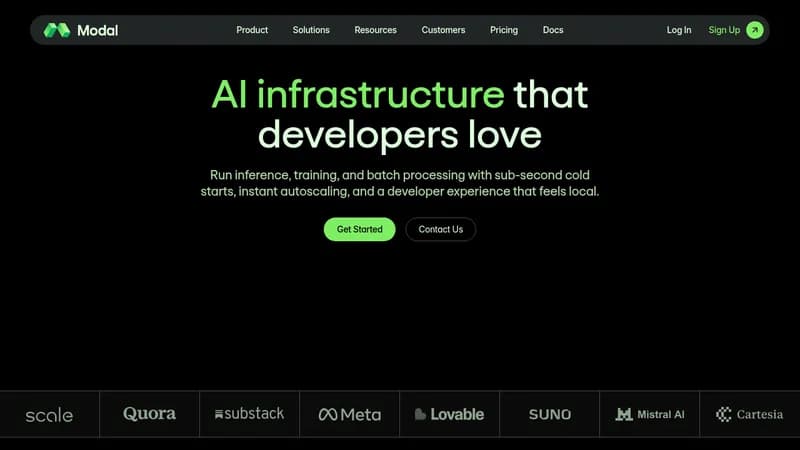
Modal is a serverless cloud platform designed for AI workloads, enabling developers to run inference, training, and batch processing with minimal latency and maximum scalability. It abstracts away infrastructure management by allowing teams to define compute requirements in code, providing sub-second cold starts and elastic access to thousands of GPUs across multiple cloud providers.
Key Features
- Programmable Infrastructure: Define environment, dependencies, and hardware in pure Python—no YAML, config files, or manual scaling rules.
- Sub-Second Cold Starts: Containers launch in under a second, keeping feedback loops tight and latency low for real-time serving and iterative development.
- Elastic GPU Scaling: Instantly scale from zero to thousands of GPUs, with no quotas or reservations, and automatically scale back to zero when idle.
- Unified Observability: Integrated logging, metrics, and traces give full visibility into every function, container, and workload running on the platform.
- Built-in Storage Layer: A high-throughput, low-latency distributed file system optimized for model weights, training datasets, and batch outputs.
Use Cases
- Serving LLMs, image/video generation, and audio models at scale.
- Fine-tuning open-source models on single or multi-node GPU clusters.
- Running secure, ephemeral sandboxes for executing untrusted or user-submitted code.
- Processing large-scale batch jobs like audio transcription, data transformation, or video encoding.
- Collaborative data science with shareable, real-time notebooks.
Modal integrates with existing cloud storage and MLOps tools, and provides SOC2 and HIPAA compliance, making it suitable for production deployments across industries. The developer experience is designed to feel like working locally, with fast iteration and minimal configuration overhead.
Key Benefits
- Define infrastructure in code, no YAML or config files
- Sub-second cold starts and instant autoscaling
- Access to thousands of GPUs across clouds with elastic scaling
- Integrated logging and full workload visibility