
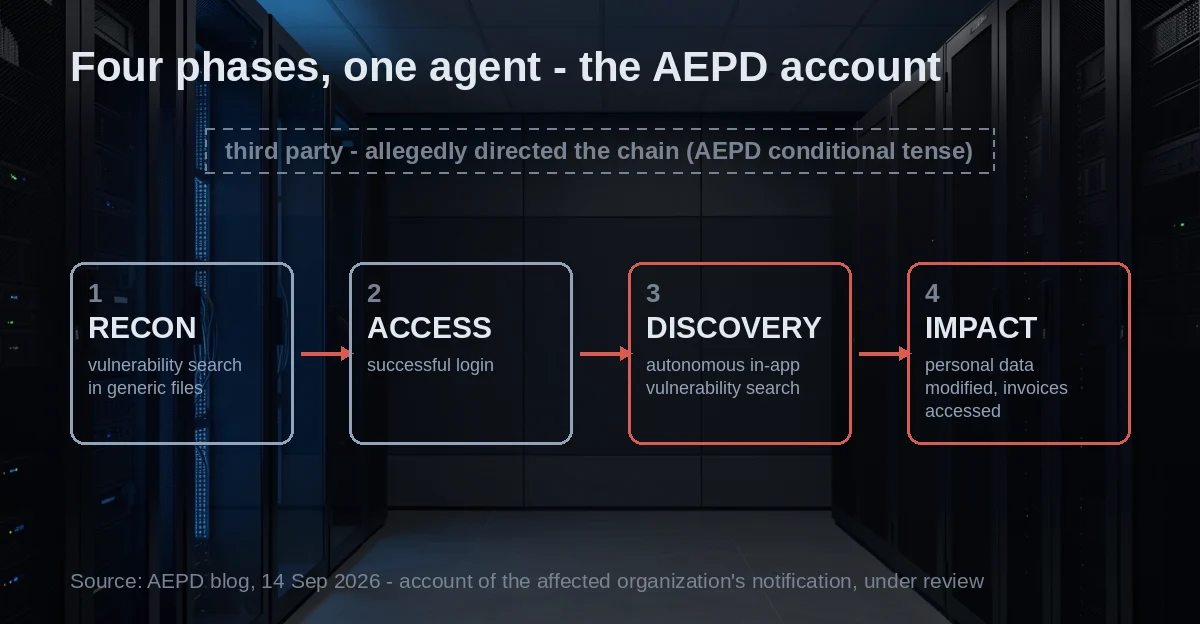
Spain's data protection authority, the AEPD, has received and publicized the first breach notification in which an AI agent was allegedly used as an instrument to chain together multiple phases of a data breach: vulnerability search, login, autonomous in-app discovery, modification of personal data, and access to invoices. The account comes from an AEPD blog post published on September 14, 2026, bylined by Francisco Pérez Bes, Deputy Director and deputy to the agency's president. The AEPD says it "has received the first notification" of this kind in Spain, and the same hedging runs through the whole post: the agency writes in conditional tense, the incident is still under analysis, and neither the affected organization nor the model is named.
Two terms used throughout this piece: an AI agent is an LLM-powered system that can plan, call tools, and take actions on its own toward a goal, not a chatbot that only answers prompts, and deployments built on that capacity for autonomous action are what agentic AI refers to. Incident response (IR) is the process of detecting, containing, and recovering from a security incident, and it is the discipline this notification hits hardest.
The takeaway in one line: this is not a new threat category. It is known attack techniques executed at machine speed with an agent as the instrument, and it quietly breaks the timing assumptions inside every incident-response playbook written for human-paced attackers.
In short
- The AEPD says an attacking agent searched "generic files" for vulnerabilities, logged in successfully, then autonomously hunted for vulnerabilities inside the application, modified personal data, and accessed invoices.
- The AEPD hedges in conditional tense: a third party allegedly used the AI agent as an instrument to chain the attack phases. The incident is still under analysis.
- The affected organization, the specific LLM, the breach date, and any affected-record counts are all undisclosed.
- The AEPD explicitly states that the model and its provider's infrastructure were not compromised, and that the tool was not built for malicious purposes.
- GDPR's 72-hour clock under Article 33 is unchanged. What changes is the awareness gap: how fast you detect versus how fast an over-permissioned credential lets an agent move.
- The AEPD's own agentic-AI guide, published February 2026, already contains a ready design gate for this: the "Rule of 2", which forbids combining uncontrolled input, sensitive-data access, and autonomous action at the same time.
What actually happened, according to the AEPD?
The primary source is a single AEPD blog post dated September 14, 2026, written in Spanish by Deputy Director Francisco Pérez Bes. Reuters picked it up on September 15, BleepingComputer on September 16. One notification, not a trend, and the AEPD says so itself: the post stresses that this first notification does not allow asserting a statistical trend, though it is a significant signal that AI-supported attacks have stopped being a theoretical risk.
Here is the attack chain in the AEPD's own words, translated from the Spanish original: "The attacking agent began a search for vulnerabilities in generic files, and performed a successful login. Once it accessed the system, it began, autonomously, searching for vulnerabilities in the application, which, once achieved, allowed it to modify personal data and access invoices."
Four stages, each with attribution worth preserving:
| Stage | AEPD's wording (ES) | English translation | Why it matters for IR |
|---|---|---|---|
| Recon | "búsqueda de vulnerabilidades en archivos genéricos" | vulnerability search in "generic files" | Pre-auth recon against exposed files; note AEPD said generic, not "publicly accessible" (press paraphrase) |
| Access | "realizó un login correcto" | performed a successful login | One valid credential was enough to enter; no model exploit required |
| Autonomous discovery | "comenzó a buscar, de forma autónoma, vulnerabilidades en la aplicación" | began autonomously searching for application vulnerabilities | The autonomy marker is AEPD's own wording, not press gloss |
| Impact | "modificar datos personales y acceder a facturas" | modify personal data and access invoices | Confirmed personal-data impact is what triggers breach-notification duties |
The framing sentence matters as much as the chain. The AEPD writes that "a third party would have used an AI agent as an instrument to successfully chain together different phases of the attack". That conditional tense, habría utilizado, is deliberate: the agency is publicizing an account, not concluding an investigation.
Confirmed vs. alleged: what the AEPD does and doesn't say
The reason the hedging matters is provenance. Everything the AEPD describes comes from the affected organization's own breach notification, and the agency says this information "must be subject to the corresponding analysis" before any conclusion. The AEPD is publicizing, not ruling. Reuters reported that the agency declined to identify the large language model or the targeted organization, and did not say when its review would finish.
That leaves a set of open items nobody should assert: the date the AEPD actually received the notification, the organization's identity, which LLM was involved (the AEPD says only "a well-known language model"), the breach date and duration, affected data-subject and record counts, and whether the attack ran fully autonomously end-to-end. Reuters characterized it as carried out "with limited human intervention"; the full human role is one of the open questions in the review.
| Claim | Status | Basis |
|---|---|---|
| AEPD received its first notification of a breach executed via an AI agent | CONFIRMED by AEPD | AEPD blog post, Sep 14, 2026 ("ha recibido la primera notificación") |
| Attack chain: generic-file recon, login, autonomous discovery, data modification, invoice access | ALLEGED (AEPD account of the notification) | AEPD blog post, conditional tense, "subject to the corresponding analysis" |
| Model and provider infrastructure not compromised; tool not built for malicious purposes | CONFIRMED (AEPD's explicit caveat) | AEPD blog post |
| Attack carried out "with limited human intervention" | REPORTED by press | Reuters, Sep 15, 2026 |
| Organization identity, LLM identity, breach date, record counts, end-to-end autonomy | OPEN / unknown | Never disclosed; Reuters confirms agency declined to identify them |
Two more things the AEPD explicitly rules out, because they will otherwise dominate the comments: the use of a specific AI model does not imply the model or its provider's infrastructure were compromised, and the tool was not designed to carry out malicious activities. The vulnerability the AEPD points at lives in the deployment and its credentials, not in the model.
One attribution note for the record: some press coverage calls Francisco Pérez Bes the AEPD's "president". That is shorthand and it is wrong. He is the agency's deputy, appointed under Royal Decree 143/2025; the president is Lorenzo Cotino Hueso.
Why machine-speed autonomy breaks incident-response assumptions
The AEPD's core framing is that AI "does not create new threats", but increases the speed, scale, and adaptability of already-known techniques, "reducing the time available to detect and contain them". BleepingComputer's coverage renders the agency's four risk-management points in English; they are worth reading as a set.
First, risk analyses must name AI-assisted and AI-executed attacks explicitly. A generic "malware, phishing, unauthorized access" line no longer suffices, because automation can substantially modify the probability, speed, and scope of an incident.
Second, response times need review. Playbooks designed for manually executed attacks assume human-paced lateral movement: one asset at a time, one access path at a time. An agent analyzes multiple assets and tests multiple access paths in parallel, and adapts its behavior as it goes.
Third, identities and credentials become the multiplier. An agent holding an account, API key, or token with excessive permissions "can operate at machine speed" and reach different services before anomalous behavior is detected. This is the same uncontrolled-input surface that makes prompt injection such a quiet risk in agentic deployments: once input and credentials meet autonomy, the blast radius is set by permissions, not by the attacker's typing speed.
Fourth, manual intervention alone is no longer sufficient. Human oversight remains indispensable, the AEPD says, but it must be backed by detection, containment, and response mechanisms fast enough to match. The agency also cites CCN-CERT's BP/36 guidance (as reported via the AEPD's citation), which treats offensive AI as an operational capability now integrated into real campaigns, with recommendations to reinforce essential controls, accelerate vulnerability management, and protect identities.
What GDPR's 72-hour clock does, and doesn't, cover
Article 33(1) GDPR requires notifying the supervisory authority without undue delay and, where feasible, no later than 72 hours after the controller becomes aware of the breach, with reasons required if notification is late. Article 33(2) puts processors under a duty to notify the controller without undue delay, and Article 33(5) requires documenting every breach so the authority can verify compliance. Article 34 adds data-subject communication when the breach is likely to result in high risk.
Under the AEPD's own breach-notification guide, the Spanish mechanics are specific: the clock starts when the controller becomes aware that the incident affected personal data, weekends and holidays count, and if the full picture isn't available, the controller files a preliminary notification within the 72 hours and completes it via a modification within 30 days (working days).
The grounded argument is this: the 72-hour clock is a human-institutional deadline that starts at awareness. It is not a containment SLA. Machine-speed attacks don't compress the legal clock; they compress the awareness gap between compromise and detection, because an agent with one over-permissioned credential can finish its work before monitoring sees anything anomalous. When that gap shrinks, the phased mechanism does the load-bearing work: file the preliminary notification early, complete it within 30 days. No published timeline exists for this incident, so any numbers you see attached to it are invented.
The Rule of 2: AEPD's own design gate, and how this incident walks through it
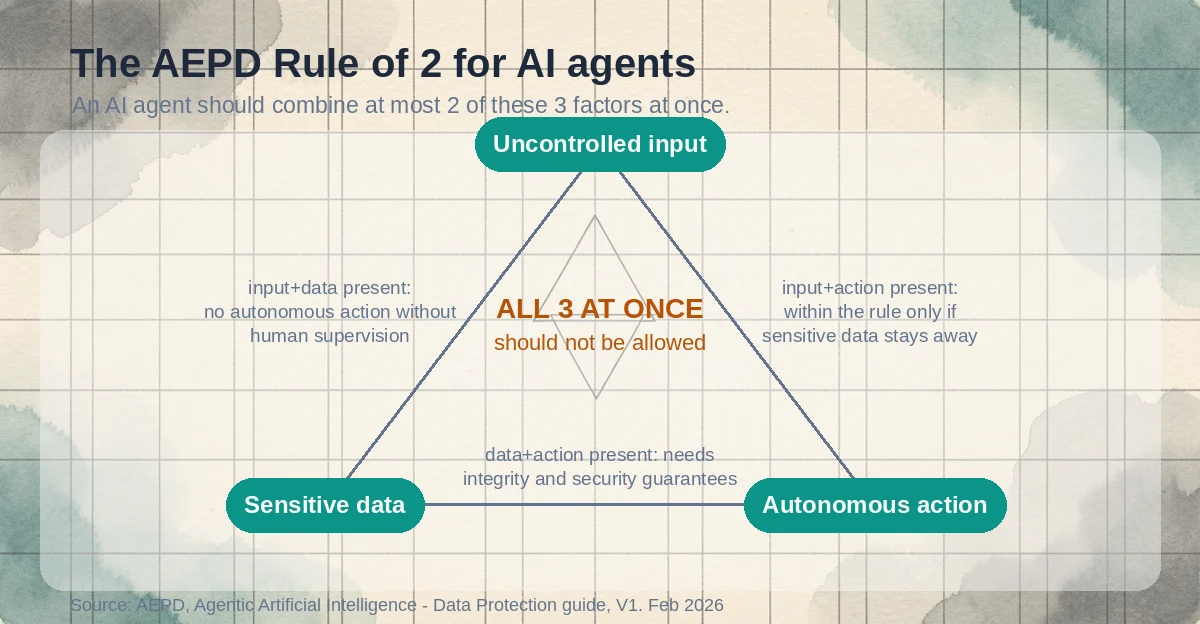
The AEPD saw this coming. Its agentic-AI guidance (Agentic Artificial Intelligence - Data Protection, V1.1, February 2026, pp. 39-40) contains a design gate it calls the Rule of 2, borrowed from browser security (Chromium's rule of 2) and reformulated for AI agents: never combine all three of the following at once.
- Processing uncontrolled input.
- Access to sensitive information.
- Performing autonomous actions.
Two of the three may be manageable under guarantees. All three simultaneously "should not be allowed". The operative cases make it concrete: if uncontrolled input can trigger access to sensitive information, no automatic action may run without human supervision; if an agent can access sensitive information and act automatically, none of its processes may run without integrity and security guarantees. The AEPD's own example is an auto-reply email agent that accepts unvetted inbound mail, reads sensitive stores, and writes replies and memory on its own.
The reported chain is what the three factors in parallel look like from the defender's seat. The attacking agent took uncontrolled-target input (generic files), gained access to personal data and invoices, and acted autonomously at each stage. To be clear, this is analysis, not an AEPD finding: the Rule of 2 is written for the deploying organization, and this incident is what happens when the same control failure is exploited from outside. Credentials with excessive permissions plus no fast containment equals machine-speed chaining, whichever side of the agent you sit on.
A practical incident-response checklist for agent-driven breaches
Pull the AEPD's four points and the Rule of 2 together and you get a working checklist. Each item is grounded in the AEPD's primary post and guidance. For teams that already run agent-based automation, it doubles as an audit script: run it against one live deployment and gaps in identity scoping and containment speed surface quickly.
| # | Control | What it defends against | AEPD anchor |
|---|---|---|---|
| 1 | Behavioral detection tuned for machine-speed operation (parallel asset analysis, rapid path testing) | Agent activity that never trips per-event alert thresholds | "Response times must be reviewed" |
| 2 | Non-human identity governance: credential tiering, per-service scoping, short token TTLs, blast-radius limits per agent identity | One over-permissioned credential becoming the multiplier | "Identities and credentials rise in importance" |
| 3 | Pre-authorized automated containment: token and session revocation that doesn't wait for human approval mid-incident | Response bottlenecked on humans against a parallel attacker | "Manual intervention alone is no longer sufficient" |
| 4 | Rule of 2 as a ship gate: no agent config goes live with all three risk factors enabled | Deploying the exact configuration the attacker wishes you had | AEPD agentic-AI guidance, Feb 2026, pp. 39-40 |
| 5 | Risk-register change: AI-assisted/AI-executed attacks named explicitly in processing-risk analyses and DPIAs | Generic threat models that miss automation's speed and scope | "Risk analyses must name AI attacks explicitly" |
| 6 | Legal earlier: DPO and privacy counsel engaged at detection, not after forensics | Awareness starting the 72-hour clock before you understand the incident | AEPD breach-notification guide: file preliminary, complete in 30 days |
For identity governance in practice, the same discipline that governs CI pipelines and service accounts applies to agents: scope every agent identity to one job, expire tokens aggressively, and treat an agent's permissions as your worst-case blast radius. Teams running agents at scale are increasingly reaching for a governed control plane (see how Akuity frames a governed control plane for AI agents) and for external assurance models like the AIUC-1 standard for AI agent certification, both of which turn "we should limit the agent" into a reviewable gate.
The AEPD closes its post with an exhortation that predates AI and survives it: know your processing, minimize data, limit access, fix vulnerabilities, control your providers, and be ready to respond. Speed increases; the fundamentals stay decisive.
If you want to see how the tools in your stack handle exactly these controls, browse the toolbit.ai directory.
FAQ
Was the LLM provider at fault in the Spain AI-agent breach?
No. The AEPD explicitly states that the use of a specific AI model does not imply the model or its provider's infrastructure were compromised, nor that the tool was designed for malicious purposes. The failure the AEPD points to is in the deployment's credentials and controls, not in the model. Treating this incident as an LLM-vendor story misreads the notification entirely.
Which organization and which AI model were involved in the AEPD's first AI-agent breach notification?
Neither has been disclosed. The AEPD refers only to "a well-known language model", and Reuters confirms the agency declined to identify the LLM or the targeted organization. Any outlet naming a specific vendor or model is speculating. The open questions also include the breach date and any affected-record counts.
Does GDPR's 72-hour breach notification deadline apply to AI-agent attacks?
Yes, unchanged. Article 33's clock still runs "without undue delay and, where feasible, not later than 72 hours after having become aware", regardless of how the breach was executed. What machine-speed attacks change is the awareness gap before the clock starts, which makes detection speed the real compliance variable. In Spain, a preliminary notification can be filed within 72 hours and completed via modification within 30 days.
What is the AEPD Rule of 2 for AI agents?
A design rule from the AEPD's February 2026 agentic-AI guidance stating that a system should never simultaneously combine uncontrolled input, access to sensitive information, and autonomous actions: at most two of the three, under guarantees. It originates in browser-security thinking (Chromium's rule of 2) and serves as the AEPD's minimum safety threshold for agentic deployments.
Was the Spain AI-agent attack fully autonomous, or did a human direct it?
Unknown. The AEPD writes in conditional tense that a third party allegedly used the agent as an instrument, and Reuters characterizes the attack as carried out "with limited human intervention". The AEPD does not claim end-to-end autonomy, and the exact human role is one of the open questions in its review.
Is this the first AI-driven data breach ever reported?
It is the first such notification received by the AEPD in Spain, and that "first" is the agency's own claim, scoped to Spain. The AEPD itself cautions that one notification does not establish a statistical trend, and its wording does not support calling this the first such breach anywhere.