On September 15, 2026, a startup called TypeSafe AI emerged from stealth with $40 million in seed funding led by DCVC and launched Jev, the first of what it calls a "System One Model": a frontier model that never generates text. The founder is Diogo Almeida, who co-invented RLHF and InstructGPT at OpenAI - the research behind ChatGPT (the press release goes further with "co-inventor of RLHF/ChatGPT," a TypeSafe claim). Co-founders Erik Gafni and Sasha Sheng round out a team from OpenAI, Google Brain, Meta FAIR, Stripe, Airbnb, and Docker.
The bet is that chat is the wrong interface for software. When your code needs a decision - is this ticket billing or technical? - you prompt a chat model, get a string, parse it, validate it, retry when it breaks. Jev replaces that loop with three API primitives that return typed values, calibrated probabilities, and confidence scores. Software calls it like a function. Pricing is $0.042/MTok input with free output, latency 70-500ms - both vendor-stated, both worth a closer look below.
In short:
- What launched: Jev, the first "System One Model," from TypeSafe AI - $40M seed led by DCVC, announced September 15, 2026.
- What it returns: typed values, calibrated probabilities, and confidence via Choice, Score, and Noul. No text generation, no parsing.
- What it costs: $0.042/MTok input, output free (vendor pricing, possibly subsidized by the company's own admission).
- How fast (vendor claim): 70-500ms end-to-end; 40x-200x faster on "System One shaped queries" - though TypeSafe's own materials disagree: "up to 100x" in the press release, 193.6x on the homepage.
- Who built it: Diogo Almeida (co-inventor of RLHF/InstructGPT), Erik Gafni, and Sasha Sheng, with alumni of OpenAI, Google Brain, Meta FAIR, Stripe, Airbnb, and Docker.
- Why it matters: a decision-native model class for code paths that today force chat models through prompt-parse-validate loops.
- The honest caveat: all evals are self-published; no third-party benchmarks, waitlist-only access.
What Is a System One Model?
It is a model built to return typed, calibrated decisions that software can use directly - TypeSafe's tagline is "a frontier-intelligence function call: unstructured state in, typed probabilistic decisions out." Chat models are trained for conversation; Jev is trained for the moment your code needs a reliable answer to a narrow question, fast. The launch blog's contrast table:
| Chat LLMs | Jev (System One Model) | |
|---|---|---|
| Training | RLHF / RLVR | RLCD (Reinforcement Learning for Calibrated Decisions) |
| Inputs | Unstructured text, sequential messages | Structured program state |
| Outputs | Strings you must parse and validate | Type-safe values, probabilities, confidence |
| Sampling | Sequential, one token at a time | Parallel, all outputs in one query |
The names tell you how the company thinks. "System One" is Kahneman's fast, intuitive System 1 from Thinking, Fast and Slow (Kahneman also tied System 1 to error-prone shortcuts; the blog acknowledges this and promises to address it later - honest, but not yet an answer). "Jev" honors economist William Stanley Jevons, of the Jevons paradox: when efficiency rises, consumption rises with it - TypeSafe's bet that radically cheaper intelligence per token will explode demand rather than shrink it.
What Jev Actually Returns in an API Call
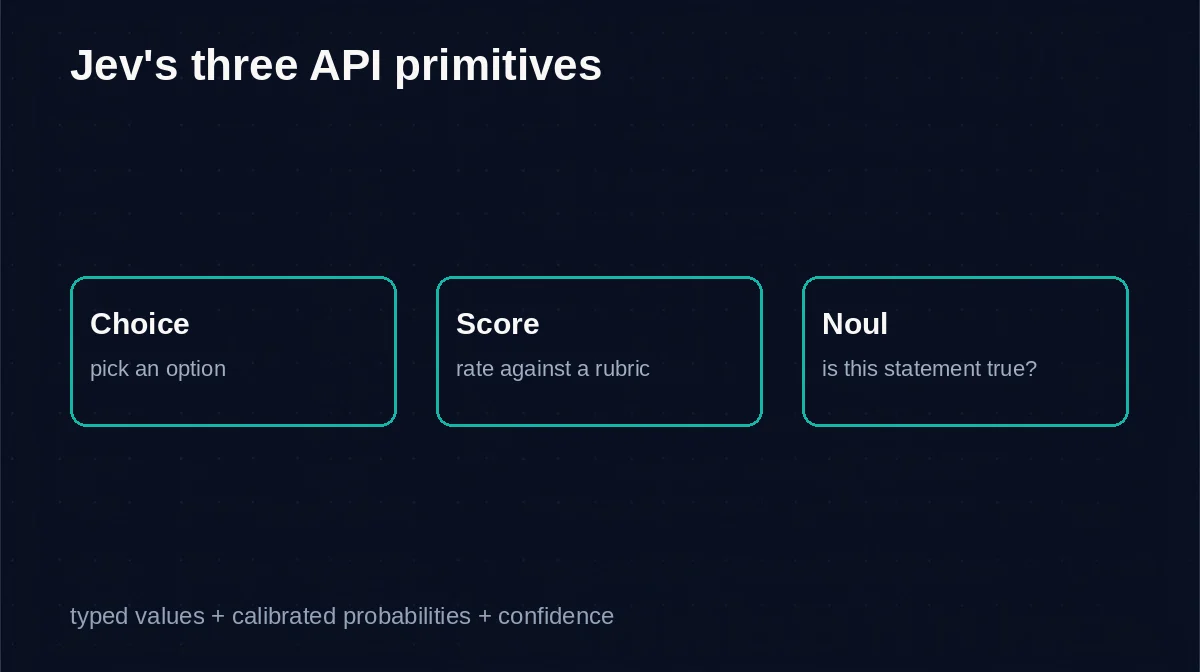
Three question types. That is the whole API surface, per the docs - each returns typed values with probabilities and confidence, and all three mix in a single call.
The three primitives
- Choice - pick an option from a list. Returns the choice, the full probability distribution, and a confidence score.
- Score - rate the state against a rubric. Returns the score, probabilities, and confidence.
- Noul - "is this statement true?" Returns a value from 0 to 1.
The Register's write-up gives the cleanest concrete example. Pass in the state "My card was charged twice." and ask a routing question. Jev returns:
{ "billing": 0.08, "technical": 0.85, "sales": 0.07 }
...with a confidence score of 0.82. Your code branches on technical being the max and moves on - no regex, no hoping the model picked the JSON key names you asked for. You get the judgment plus a calibrated measure of how sure it is, the part chat models make you beg for.
Composing decisions in code
Every question in a call is evaluated in parallel and in isolation against the same state; add more questions and latency barely moves. Choice cardinality goes up to 255, with a two-stage score-then-pick above that. The docs' guidance: keep questions atomic - the kind of judgment a highly knowledgeable person could make in a few seconds - and combine multi-factor decisions with code, not one mega-prompt.
Why TypeSafe Believes Chat Is the Wrong Interface for Machines
The company's thesis, spelled out in its ML primer, is that large-scale AI automation will be roughly 99% machine-to-machine interaction and 1% human - so the interface should look like a typed function call, not a conversation. It calls this "Machine Native Intelligence": structure, reliability, observability, testability, speed, consistency, low cost. Software-engineering values, which is why this model can slot into a pipeline instead of hovering around it as a chatbot.
The load-bearing piece is RLCD's calibration contract: outcomes the model assigns 0.2 probability should occur about 20% of the time, across groups of predictions rather than on any single answer. Probabilities become the product, not prose - you can measure whether a routing layer's confidence scores mean anything, over time, against real outcomes. Try doing that with a chat model's vibes.
The Jevons framing, which The Register flagged skeptically, is the bigger wager: it assumes the market for tokens becomes as broad as the market for energy. Unsettled - but if it holds, a model built around intelligence per dollar is positioned well for it.
Speed and Pricing: What the Numbers Say - and Who Says Them
Input costs $0.042/MTok and output is free; end-to-end latency is 70-500ms. All vendor-stated, straight from the launch blog's pricing table, which puts existing LLMs at $0.20-$10/MTok input with output roughly 5x input. The Register's comparison point: GPT-5.6 Terra costs $2.00/$12 per MTok, and Jev works out to 238x cheaper than Fable 5.1 on those vendor-supplied figures.
Here is the part that should make you squint: TypeSafe's own speedup numbers disagree with each other. The launch blog says 40x-200x faster on "System One shaped queries." The press release says "up to 100 times faster." The homepage's workflow evals say 193.6x faster and 444.6x cheaper - figures the company itself calls "on the higher end of real world gains." The most concrete datapoint is the vendor's own demo, reported by The Register: Jev answered in 0.114s where GPT-5.6 Terra took 8.566s. A 75x gap on one demo is impressive; it is also one demo.
And the pricing has a sustainability asterisk in the company's own words: "We can't prove it isn't subsidized; we'll need the long-term to prove the sustainability of our pricing (which we expect to go down, not up)." One cost note: the cheaper your per-token spend already is, the smaller Jev's price gap - the static-prefix discipline in our prompt caching checklist can cut a chat model's effective input cost dramatically, so benchmark against your real bill, not the list price.
Where Decision-Native Wins Today - and Where Chat Models Still Win
Jev targets the "smart if-statement" layer of software: classify, route, score, extract, guardrail - places where hand-written rules are too brittle and chat models are too slow, expensive, and parse-fragile. Per the vendor's use-case table, the wins are AI workflows, map-reduce over big data, real-time apps where ~100ms matters for UX, and verifying or guardrailing other models' prompts, reasoning traces, and outputs.
Chat models keep three territories, and TypeSafe concedes all three: human-in-the-loop work (chatbots, copilots, coding agents), verifiable problems like math proofs or kernel optimization where correctness can be checked cheaply, and demos and prototypes where the flexibility of strings is a feature. For the decision layer, the real question is whether a typed-decision model beats a chat model wearing a JSON costume.
The proof point TypeSafe chose is delightfully weird: Jev plays Doom, from structured game-state input, at roughly 10 queries per second costing about $7/hour. The company is upfront that it runs on structured state, not images, and that "a non-AI doom bot could play better." The demo is about cost and latency, not skill: 10 decisions per second for the price of lunch. We tracked the industry's pricing slide in DeepSeek v4.1 Flash: a routing checklist earlier this month; Jev is the same trend taken to an architectural extreme.
The Honest Open Questions Before You Bet a Pipeline on It
Every performance number so far is self-published, and the model is waitlist-only - treat Jev as a promising architectural bet, not a proven one, which is literally what the company's own caveats support.
Start with the evals. The benchmarks on evals.typesafe.ai were built by TypeSafe's own model-capabilities team, which admits "some bias could exist." The reference labels are the average of GPT-6 Astra and Claude Fable 5.1 - a methodology the company concedes "biases answers towards OpenAI and Anthropic's models" and likely understates competitors like DeepSeek. And the benchmarks ran from West Coast laptops. None of this makes the evals wrong; it makes them unverified.
Then there is "can't hallucinate." That is a type-safety guarantee, not a correctness guarantee: schema matching is "mathematically impossible" to break because the output space is defined in advance. But The Register's skeptical note is the right one: it "does not preclude the possibility of being incorrect." Jev can hand you a confidently typed, schema-perfect, wrong answer. The calibration scores are meant to tell you when to distrust it - a claim to test, not a law of nature.
Finally, access: early access for select developers, waitlisted at typesafe.ai, no self-serve signup, one vendor, one model. Promising? Genuinely. Proven? Not yet.
FAQ
Is Jev just a smaller LLM with a structured-output wrapper?
No. TypeSafe says Jev is a new architecture with a parallel sampler and a new training method, RLCD, and it never generates strings - nothing to parse, nothing to wrap. Third parties have not yet tested whether the quality holds up.
How is Jev different from JSON mode or function calling on GPT or Claude?
JSON mode constrains the format of text the model was already going to generate - you still pay for output tokens, and the string still needs validation. Jev evaluates questions in parallel and returns typed values, probability distributions, and confidence your code branches on directly, with output at $0 versus roughly 5x input on frontier chat models.
Is the free output pricing subsidized - will it last?
Possibly, and TypeSafe says so itself: "We can't prove it isn't subsidized; we'll need the long-term to prove the sustainability of our pricing (which we expect to go down, not up)." Free output is plausible - a decision call emits a few typed fields, not hundreds of tokens - but plausible is not durable.
How can developers get access to Jev right now?
Early access only, for select developers, waitlisted at typesafe.ai - no self-serve API signup, no public pricing page today.
Does Jev accept images or generate any text at all?
No on both counts. The Doom demo runs on structured game state with text, not images - the company's own caveat - and text generation is architecturally absent. Long, multi-factor questions get decomposed into atomic questions combined with code.
If your pipeline has a stretch of prompt-parse-validate-retry you have learned to tolerate, Jev is the first launch in a while aimed squarely at deleting it - worth a waitlist signup and a skeptical read of the launch blog. To weigh it against the routing decisions you are making today, the model catalog on Toolbit is a good place to start.
Pricing and plan details are as published by the vendor around September 15, 2026 and can change - confirm on the official site.