Short answer: LLMOps is how you run an LLM feature reliably for real users: test it, ship it, watch it, fix it, repeat. It matters because a notebook demo still has to survive real traffic, costs and mistakes.
Azure's docs call GenAIOps "sometimes known as LLMOps", so the two names mean the same practice. If a demo is a lemonade stand, production is the factory: same drink, different job.
How LLMOps works: evaluate, deploy, observe, iterate
LLMOps works as a four-step loop that keeps running after launch. Oracle sums it up as "half of LLMOps is observation, and the other half is action."
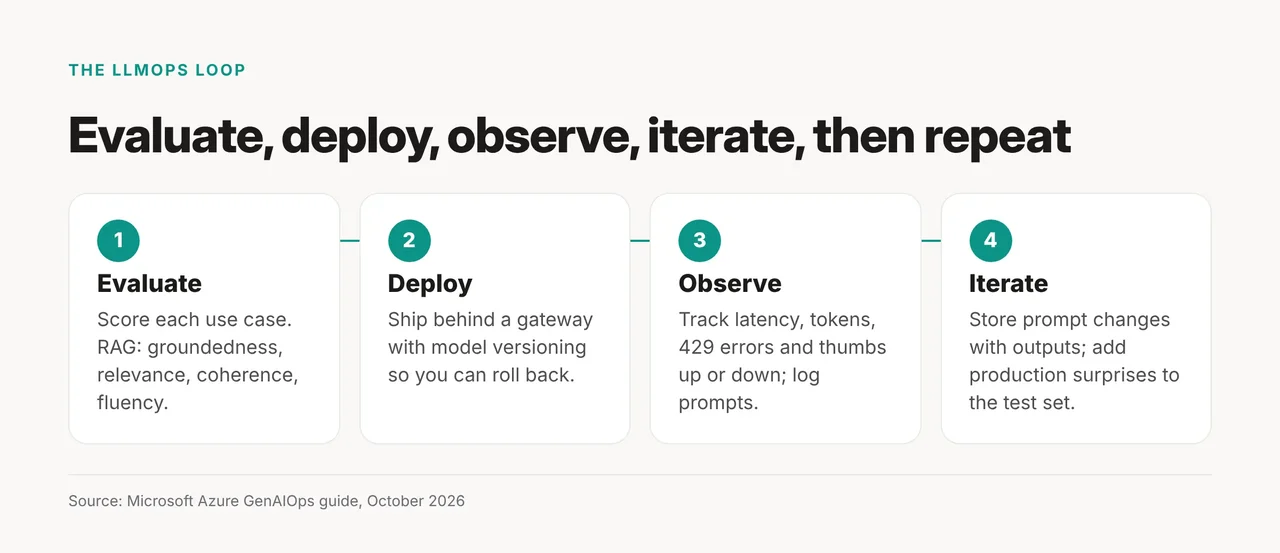
- Evaluate. Score each use case with its own metrics against a fixed set of real inputs (a golden test set). Azure's GenAIOps guide lists BLEU for translation and ROUGE, BERTScore and METEOR for summarization. Classification gets precision, recall, accuracy and cross-entropy; RAG gets groundedness, relevance, coherence and fluency.
- Deploy. Ship changes through a gateway (a proxy in front of the model that logs and routes calls) with model versioning. Azure says this lets you "minimize risk" and "roll back to previous versions when problems occur." A deploy moves the whole system, not just the model: Azure includes the orchestrator, grounding data stores and index changes, so ship them together.
- Observe. Track latency, token usage and 429 errors, and use the gateway to log prompts and outputs. For RAG features, Azure suggests thumbs up or down buttons to capture whether answers were useful.
- Iterate. Store each prompt change with its outputs so experiments are comparable. Then add what users hit in production to your test set. Azure frames this as an inner loop of experiment, evaluate and refine inside an outer loop of deploy, monitor and feed back. See agent observability for how traces feed this step.
See it yourself: run one prompt twice
Send one real question from your demo to your model twice, with an identical prompt. Compare the answers word for word.
Expect different wording, sometimes different facts. That is why Google Cloud says "non-deterministic outputs complicate testing and validation," and why LLMOps scores behavior across a test set instead of checking one exact output.
LLMOps differs from MLOps in four ways
LLMOps extends MLOps rather than replacing it. Azure says "you don't need to start over" and that existing MLOps investments cover several generative AI patterns. Google Cloud calls LLMOps "a specialized subset of MLOps." What changes is where the work sits.
| Difference | Classic MLOps | LLMOps |
|---|---|---|
| The key asset | "The trained and deployed model" | The prompt given to the model, per Azure |
| Prompts | Not a managed artifact | Versioned, evaluated and rolled back like code |
| Testing | One accuracy-style score | Per-use-case scores; Google Cloud notes "non-deterministic outputs complicate testing and validation" |
| Components | Training and serving pipelines | Plus gateways and document-chunking pipelines that split documents for RAG, which "aren't part of DataOps in traditional MLOps" |
| Drift to watch | Prediction drift in the model | Data drift: stale grounding data and indexes, plus cost and latency |
Azure names three patterns to standardize: fine-tuning, prompting and retrieval-augmented generation (RAG). Your existing training pipelines still cover fine-tuning; prompting and RAG are the new work. Google Cloud's GenOps post adds scale, compute, safety and rapid model change as reasons classic MLOps is not enough. In Azure's model, software engineers manage orchestration and set up evaluation metrics, but "it's important to have data scientists review this work."
The gap between pilots and working systems is real. Mayfield's January 2026 survey asked 266 CIOs, CTOs and other tech executives about AI agents. 42% already run agents in production, and 72% are in production or pilots combined. Yet 58% cite data readiness or quality as the top blocker. 60% report early-stage or no formal AI governance. Mayfield is a VC firm and the survey is self-published, so treat it as directional.
Start where your demo hurt first
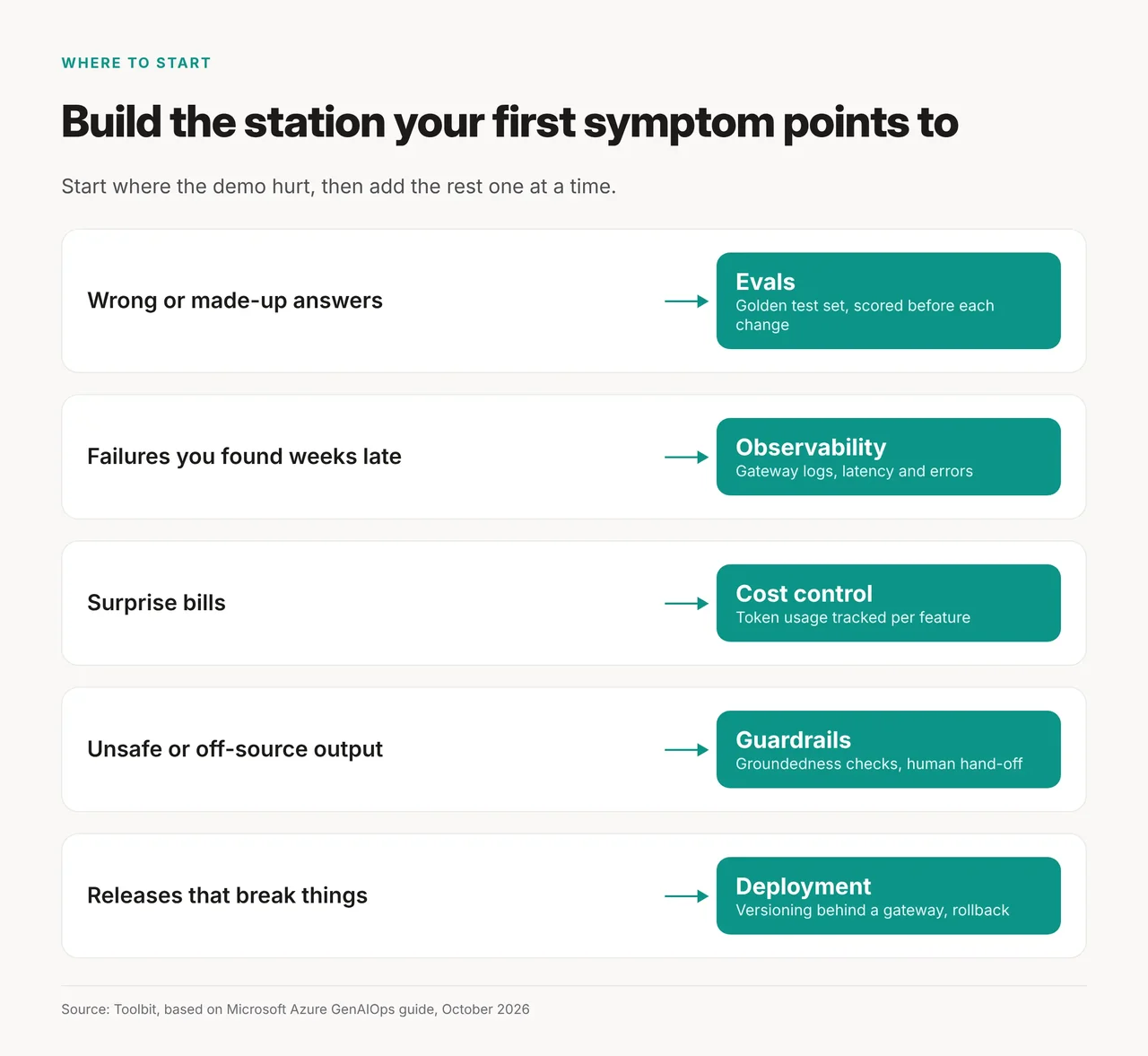
LLMOps work splits into six stations (evals, observability, cost control, memory and context, guardrails, deployment). You don't build all six at once. Pick the station that matches your first symptom, then add the rest.
| First symptom | Station to build first | What it means in practice |
|---|---|---|
| Wrong or made-up answers | 1. Evals | A golden test set scored with per-use-case metrics before every change |
| Failures you found weeks late | 2. Observability | Gateway logs of prompts and outputs, plus latency and error tracking |
| Surprise bills | 3. Cost control | Token usage tracked per feature; see the hidden cost of AI automation |
| Answers that lose track of long chats or documents | 4. Memory and context | Decide what goes into the context window: include, summarize or drop |
| Unsafe or off-source output | 5. Safety and guardrails | Groundedness checks, plus a hand-off path to a human |
| Releases that break other parts | 6. Deployment | Versioned changes behind a gateway with rollback |
If several agents share one feature, read multi-agent workflows and when to build multi-agent systems before scaling deployment.
The smallest responsible loop is six steps
One AI feature can start with a script, a spreadsheet and logging in front of the model. This is our distillation of Azure's guidance, not Microsoft's wording.
- Pin a golden test set of real user inputs, each with the behavior you expect.
- Version the prompt and grounding data so any change can be rolled back.
- Evaluate before every change ships, with automated metrics and a quick human spot-check.
- Deploy behind a gateway that logs prompts and outputs from day one.
- Watch latency, token usage and errors, plus thumbs up or down from users.
- Feed what you learn back into the test set, so tomorrow's tests include today's surprise.
Azure's maturity model has four levels: initial, defined, managed and optimized. Level 2 adds systematic metrics such as groundedness, relevance and similarity. The loop's shape stays the same; only the tooling grows.
LLMOps FAQs
Is LLMOps just MLOps renamed? No. Azure frames GenAIOps as an extension of MLOps. The model becomes a service you call, prompts become versioned artifacts, and per-use-case scores replace one accuracy number.
Do I need LLMOps for one small feature? If real users see the answers, yes. A golden test set, a versioned prompt and a logging gateway are enough to run the loop small.
How do I version prompts? Store each prompt and its grounding config with the outputs it produced. Evaluate every version against the test set, and roll back through the gateway when quality drops.
What tools do I need to start? A spreadsheet for your golden test set, a versioned prompt file and logging middleware in front of the model. That is a real stack for one feature. Add heavier tools such as Promptfoo for evals or Langfuse for tracing station by station.
Is LLMOps a job title? Mostly it is work inside AI engineering roles. LinkedIn's COO wrote in January 2026 that "AI Engineer is one of the fastest‑growing jobs on LinkedIn over the past three years."