Automation Has Changed
The Old Model: One Bot, One Job
- A script that moved a file
- A rule that sorted an inbox
- A macro that filled a form
The 2026 Model: Connected Agents, One Workflow
- Reads a request and understands intent
- Gathers what it needs from multiple systems
- Makes a decision within set limits
- Updates every system involved, without a person stitching the steps together by hand
Definition: Hyperautomation
Combining AI models, robotic process automation (RPA), orchestration, and governance into one coordinated system that runs a process end to end, instead of a pile of disconnected automation scripts.
The numbers behind this shift are large enough that it's no longer a side project for IT teams.
By the Numbers
Key Stats at a Glance
| Metric | Figure |
|---|---|
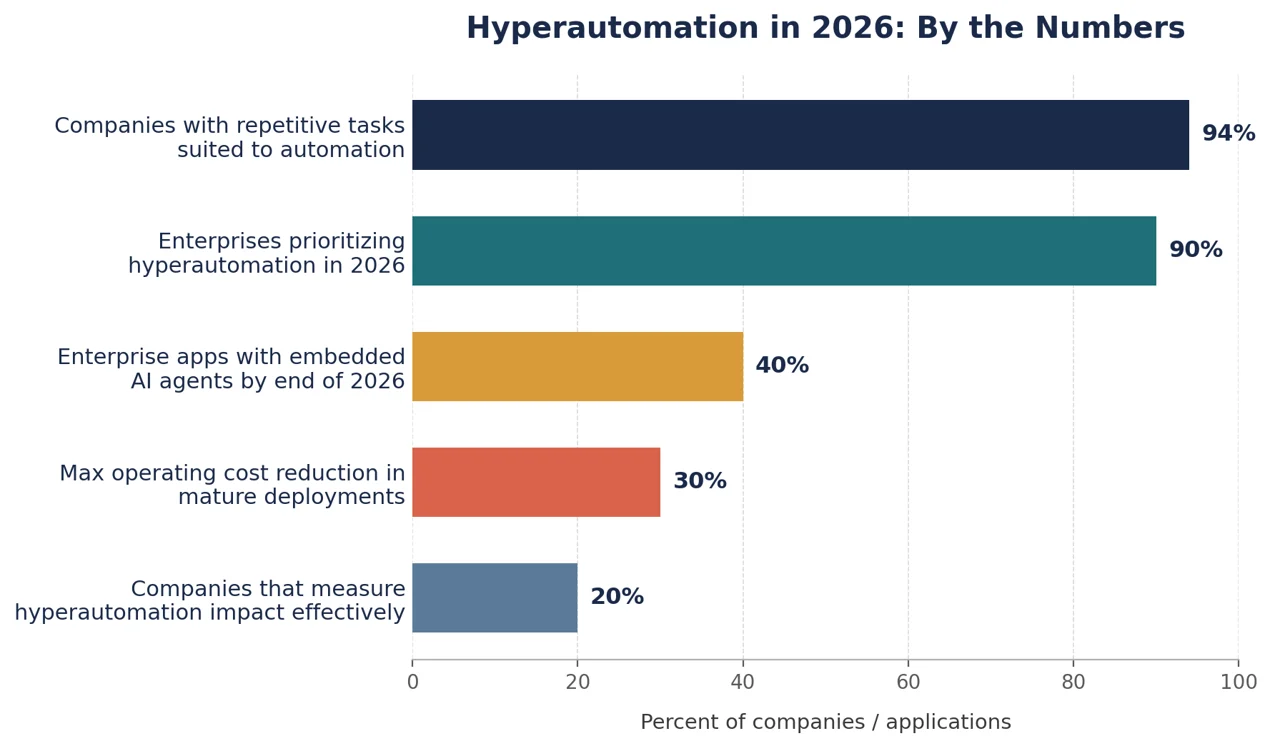
| Companies with repetitive tasks suited to automation | 94% |
| Enterprises prioritizing hyperautomation in 2026 | 90% |
| Enterprise apps expected to carry embedded AI agents by end of 2026 | 40% (up from under 5% in 2025) |
| Operating cost reduction in mature hyperautomation deployments | Up to 30% |
| Companies that measure hyperautomation's impact effectively | Under 20% |
A Note on Market Size
Estimates for the total hyperautomation market in 2026 vary by research firm, ranging from roughly $68 billion to $169 billion depending on what's counted. The exact figure moves depending on the source. The direction doesn't: every estimate points to steady, double-digit growth through the rest of the decade.
From Single Bots to Connected Systems
The Building Blocks
A traditional automation tool, like a basic trigger in a tool such as Zapier, handles one link in a chain: when this happens, do that. Useful, but narrow. It breaks the moment a task needs judgment, or needs information pulled from three different systems at once.
A hyperautomation stack combines several pieces working together:
| Layer | What it does |
|---|---|
| AI models | Read unstructured input, like an email or a support ticket, and understand intent |
| RPA (robotic process automation) | Handles the fixed, rule-based steps reliably |
| Orchestration | Decides which agent handles which part of a task, and in what order |
| Governance and monitoring | Tracks what happened, flags exceptions, and keeps an audit trail |
None of these pieces is new on its own. What changed in 2026 is treating them as one coordinated system rather than separate tools bolted together.

The Four Layers of a Modern Automation Stack
The Layers, in Order
Companies building this well tend to structure it the same way, whether they use this exact language or not:
-
Discovery: mapping what actually happens in a process today, often using process mining tools that quietly observe how work gets done before anything is automated
-
Orchestration: assigning tasks across specialized agents so they work toward one goal instead of colliding with each other
-
Governance: tracking service-level agreements, logging errors, and keeping a record of every automated decision for audit purposes
-
Data: a single, shared source of truth, so agents aren't working off conflicting versions of the same record
Why Skipping a Layer Backfires
Skip the governance and data layers, and companies tend to end up running dozens of separate "automation initiatives" with no consistent way to measure whether any of them actually worked. That pattern lines up directly with the stat above: fewer than one in five companies can currently prove hyperautomation's impact, even though nearly every large enterprise says it's a priority.
Real Example: Customer Service Goes End-to-End
Ushur Agentic Platform
| Detail | Description |
|---|---|
| What launched | Ushur Agentic Platform (UAP), announced July 22, 2026 |
| What it does | Builds and runs AI agents that manage an entire customer journey, not just one reply |
| How it works | The agent understands what a customer needs, gathers required documents, acts directly inside company systems, and guides the customer through to resolution |
| Where it's used | Updating insurance coverage, advancing claims, onboarding banking customers, and guiding patients through care steps |
| Why it's notable | Teams can start building on it without a long-term contract, a sign vendors are competing to lower the barrier into multi-agent systems rather than reserving them for large enterprise budgets |
Why It's Different
This is the practical version of hyperautomation: not a chatbot answering questions, but a system finishing the whole task.
The ROI Numbers Leaders Are Citing
The Numbers
| Result | Context |
|---|---|
| 248% three-year ROI | Forrester Total Economic Impact study, composite enterprise deploying Microsoft Power Automate |
| Up to 42% faster process execution | Organizations with coherent, well-integrated automation stacks |
| Up to 25% productivity gains | Same coherent-stack deployments |
| 20 to 30% operational cost reduction | Basic-to-intelligent automation tiers |
| Up to 30% cost reduction | Mature hyperautomation implementations specifically |
The Catch
The pattern across every study is consistent: the return is real, but it shows up for teams that treat this as a redesign of how work flows, not for teams that simply bought another tool and connected it loosely.
Where Companies Get This Wrong
Common Failure Points
- Automating a process before mapping how it actually works today
- Adding agent after agent with no shared data layer connecting them
- No audit trail, so nobody can explain why an automated decision happened
- Treating governance as a launch-day afterthought instead of a starting requirement
The Pattern Behind the Failures
Teams that skip these controls tend to see automated errors compound silently, rather than get caught early.
What's Next
Two Trends Converging
- The gap between companies running coordinated, governed automation and companies running a pile of disconnected bots is turning into a real competitive gap, not a temporary one
- The tools driving this shift, from orchestration platforms to end-to-end agent systems like Ushur's, are getting cheaper and easier to start with every quarter
The Real Bottleneck
The harder part was never the technology. It's building the discipline underneath it, and that's exactly where most companies are still behind.
Sources & References
- InfoSeeMedia: 2026 State of Hyperautomation, market size estimates and trends: infoseemedia.com
- Orbilon Tech: hyperautomation market data and the four-layer system model: orbilontech.com
- SHNO, citing Gartner, Kissflow, and Salesforce studies: enterprise prioritization and measurement gap: shno.co
- Conversantech: mid-market hyperautomation blueprint and productivity data: conversantech.com
- CFlow Apps: AI workflow automation trends for 2026: cflowapps.com
- AI Agent Store: Ushur Agentic Platform launch coverage, week of July 25, 2026: aiagentstore.ai
Figures and statistics reflect research and reporting current as of July 2026. Market-size estimates vary by methodology and research firm, so treat exact figures as directional rather than fixed. Confirm the latest data directly with the cited sources before republishing.