Bench was supposed to be the future of small business bookkeeping. Then, at the end of 2024, it shut down with almost no warning, leaving thousands of owners scrambling to reconstruct their own financial history. The lesson was not that outsourced bookkeeping is bad. The lesson was that bookkeeping you cannot see, touch, or export is a liability.
That collapse is a big part of why tools like Kick are interesting right now. Kick pitches itself as "self-driving accounting," an agentic ledger that categorizes your transactions in real time, reconciles your accounts, and hands your CPA a clean tax package at the end of the year. No batch monthly cleanup, no spreadsheet archaeology, no waiting for a human bookkeeper in another timezone to ask about a hardware store charge.
The marketing is loud, so this guide digs into what actually happens: what autonomous bookkeeping means in practice, what Kick really does as of September 2026, where it deliberately stops short, and whether it fits your kind of business.
What autonomous bookkeeping actually means
Bookkeeping is mostly a classification problem. Every transaction that hits your bank and card accounts needs a category, a tax treatment, and eventually a home in a ledger that balances. Traditional software like QuickBooks gives you the tools to do this yourself. Outsourced services like Bench did it for you, in batches, with humans. AI-first tools attempt to do it continuously, in the background, with a human reviewing only the edge cases.
The realistic version of "autonomous" looks like a pipeline, not a magic box:
- Connection. You link your bank accounts, cards, and payment processors. Kick connects directly to products like Stripe, Gusto, Ramp, and PayPal, plus your bank feeds, so transactions flow in as they happen.
- Categorization. Each transaction gets classified against your chart of accounts the moment it appears. You correct anything the system gets wrong, and it learns, you can turn a one-off fix into a standing rule.
- Review. This is the part most AI bookkeeping pitches quietly skip. Kick pairs the automation with an expert who reviews for accuracy. The AI drafts, a human confirms. That layer is what separates "agentic ledger" from "spreadsheet with autocomplete."
- Reconciliation. Bank and document data are matched so your ledger reflects what actually happened, not what you remember happening.
- The accountant handoff. At year end, the system produces a Profit and Loss and Balance Sheet your accountant can actually use. Kick's demo shows exactly this: a message to a CPA with a reconciled, categorized tax package attached.
Accuracy is the honest question mark in all of this. No AI categorization engine is perfect, and the failure mode is annoying rather than catastrophic: a meal coded as travel, a subscription miscoded as software. Kick does not publish an accuracy benchmark (competitor Digits does, claiming 93 percent, a number worth treating with appropriate skepticism). What Kick publishes instead is the structure: real-time categorization plus expert review, a reasonable hedge against misclassification.
What Kick does in September 2026
Kick is alive, well funded, and shipping. Here is the current state of the product, verified against first-party pages in late September 2026.
The core loop. Transactions from connected accounts are categorized in real time and reviewed by an expert. Beyond plain categorization, Kick actively hunts for deductions owners typically miss: home office, vehicle, and travel expenses. It also handles the mixed-use mess, if a business expense landed on your personal card, you can flag it, move it to the business, and set a rule so the same vendor is handled automatically next time.
Reporting you might actually read. Custom revenue lines break income down by source each month, say consulting versus courses versus memberships. Monthly vendor breakdowns show what you are paying whom, across all your businesses.
Multi-entity support. This is Kick's quiet differentiator. If you run two or three entities, the general ledger supports multi-entity journal entries, and it automatically accounts for intercompany receivables, payables, and transfers. Most lightweight tools collapse entirely here, and most accountants will tell you intercompany cleanup is where multi-entity books go to die.
The tax handoff. Kick generates tax-ready financials designed to be shared directly with your accountant, which matters because, as we will get to shortly, Kick does not do your taxes.
An agent API. In May 2026, Kick shipped Kick MCP, a Model Context Protocol server that lets AI agents like Claude or ChatGPT read your books and write to them: creating journal entries, running a 13-week cash flow analysis, recording an asset purchase and calculating its depreciation. The framing is "from doer to reviewer": the agent produces the first draft, you approve. It is available on all paid plans and respects your existing permission structure, and it is an unusual move for accounting software, most incumbents expose a thin read-only slice if anything at all.
Momentum. Kick reported in November 2025 that it had raised a total of $20 million from Felicis and Google Ventures, with continued backing from General Catalyst and the OpenAI Startup Fund, and that more than 3,000 businesses had switched over. A small company, but a funded, actively developing one, which matters after the Bench experience.
Pricing, as much as Kick will tell you
Kick's pricing page is unusual in that it publishes no dollar amounts. Here is what is confirmed as of September 2026:
- Free plan: genuinely free up to 250 transactions per year. For a low-volume freelancer, that is a complete product at zero cost.
- Basic plan: 14-day free trial with all paid features and your last four months of transactions categorized, then billed annually.
- Plus plan: same trial terms, billed quarterly.
- Advanced plan: you book a call, this tier is for businesses that need more support.
Third-party reviews list paid plans in the tens of dollars per month, but since Kick itself does not publish figures, treat any specific number you see elsewhere as unverified. The free tier and trial terms are what you can bank on without checking.
Pricing and plan details are as published by the vendor around September 2026 and can change, confirm on the official site.
What Kick does not do
This section matters more than the feature list, especially for anything touching your money and taxes.
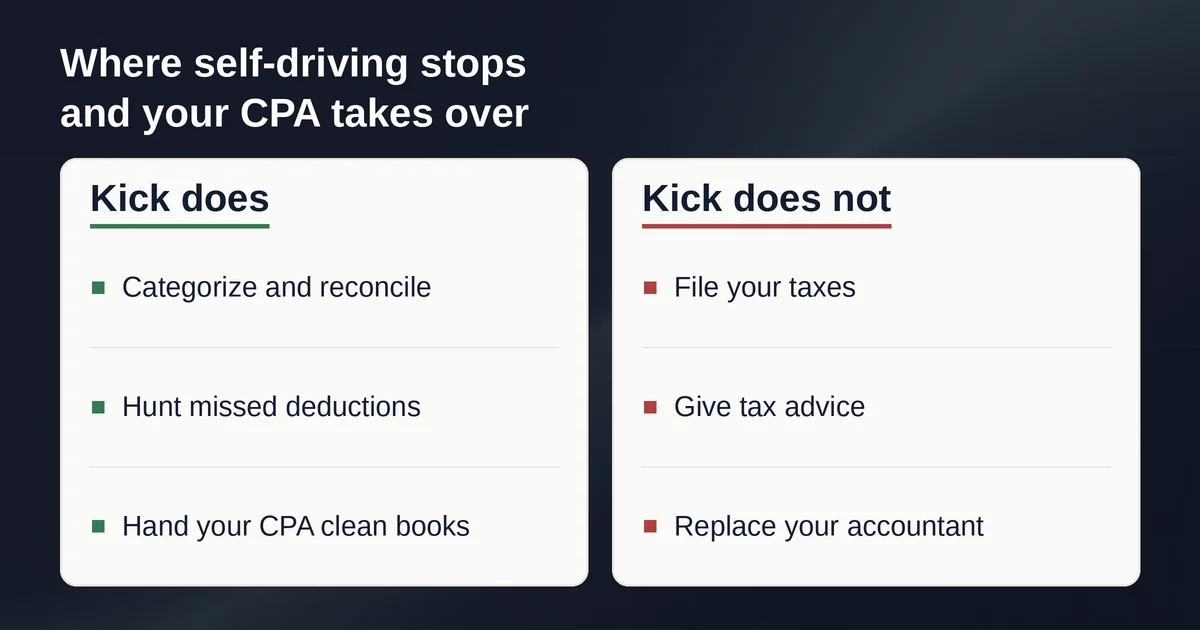
It does not file your taxes, and it does not give tax advice. Kick's own pricing page says it plainly: the company recommends partnering with a local accountant, and it will refer you to tax professionals if you ask. Kick's job ends at producing reconciled, categorized, accountant-ready financials. Your CPA still makes the judgment calls: what you can deduct, how to structure entities, what to file. If a tool promises to "do your taxes" with AI, that is a different product category and a much riskier one.
It does not publish accuracy benchmarks. As covered above, you are trusting the vendor's expert-review process rather than a measurable number.
It may not survive contact with complex accounting. If you need deferred revenue schedules, milestone invoicing, foreign currency complexity, or a full audit-ready general ledger for a board, this is probably not your system. Funded startups with complex revenue models tend to stay on QuickBooks plus a CPA, and that remains the sensible default. Kick's sweet spot is the owner with messy-but-simple finances, not the controller closing books for investors.
Vendor dependency is a real risk. The Bench collapse is the cautionary tale. Whatever bookkeeping tool you choose, make sure you can export your data and history, and keep your accountant relationship independent of your software vendor. Kick's Bench migration offer, 20 percent off the first year plus free migration for Bench refugees, is smart marketing, but the lesson applies to every tool in this category, including Kick itself.
Who should actually use it
- Solopreneurs and freelancers: the strongest fit. Simple transaction mixes, subscription-heavy spending, and a year-end scramble you want to eliminate. The free tier under 250 transactions makes trying it a zero-cost decision.
- Multipreneurs: if you run multiple entities, the multi-entity ledger and automatic intercompany handling solve a problem that otherwise costs real accountant hours.
- Bookkeeping and accounting firm owners: increasingly a first-class user. Kick runs an AI program for firms, and MCP's write access plus multi-client tooling is aimed squarely at firms scaling a review-based model. (If you are newer to what agentic software even is, our piece on AI agents versus automation covers the distinction.)
- Funded startups with complex books: stick with QuickBooks and a CPA for now.
- Anyone who wants AI to file taxes: wrong tool, by design.
Two questions people actually ask
Does Kick replace QuickBooks? For simple owner-operated businesses, quite possibly; a testimonial on Kick's homepage says one user replaced QBO outright. But plenty of owners keep QuickBooks because their accountant's workflow lives there. The practical question is not whether you can replace QBO, it is whether your CPA will work with Kick's output, and since that output is a standard P&L and Balance Sheet, most will.
Is the "expert review" real or marketing? Based on everything Kick publishes, real humans review your categorized transactions. Still, ask during onboarding exactly what the review covers and how quickly, since the answer affects how much you still need to check yourself.
The verdict
Kick is the most credible current answer to a question a lot of owners stopped asking after Bench: can bookkeeping just happen in the background? For solopreneurs, freelancers, and people running a few entities with straightforward finances, the answer in September 2026 is closer to yes than it has ever been. The free tier makes it easy to test honestly.
Treat it as what it is, a categorization and reconciliation engine with a human review layer, not a tax advisor or a CFO. Keep your accountant, keep your data exportable, and the "self-driving" part of self-driving accounting can genuinely be yours.
If you are building out your broader back-office stack first, our guide to an AI small business operations stack covers where financial automation fits alongside invoicing, email, and reporting workflows.