Every sales leader has seen the same spreadsheet: the CRM adoption report where 40 percent of logged calls happened in the last two days of the quarter. Reps skip CRM updates not out of laziness but because they just spent an hour on a discovery call and the last thing they will do is retype what they already know into Salesforce. AI notetakers promised to fix this, and mostly they did fix the note-taking half. The sync half, the part where the call actually lands in the right opportunity record without anyone touching it, is where Fathom and Fireflies diverge in ways that matter at enterprise scale.
Both tools transcribe, summarize, and integrate with Salesforce and HubSpot. That sentence could describe a dozen products in 2026. The differences show up in three places: what gets written into the CRM and how much control you have over it, how well each one surfaces the moments a sales manager actually cares about (the objection, the monologue, the question nobody answered), and how the free tiers tease you before the enterprise tiers take over.
A note on scope: if you want the free-plan comparison, we covered what Fathom, tl;dv, and Fireflies cut off on the free tiers elsewhere, and if your problem is finding a decision buried in months of transcripts, the transcript search comparison is the one to read. This piece is about the CRM sync layer and the sales-team features built on top of it.
What syncs, and what just sits in the tool
Both vendors will tell you they "integrate with your CRM." That word hides the single biggest practical difference between these products.
Fathom distinguishes between two levels, and the pricing page is unusually explicit about it. Basic CRM sync, which pushes Fathom's meeting summaries and notes into a record, exists on lower tiers but is capped at three users per email domain. CRM field sync, which maps AI-extracted call insights into specific Salesforce or HubSpot fields automatically after each meeting, is a Business-tier feature at $34 per user per month, or $25 billed annually. On top of that, Business adds Deal View, a shared page that pulls together every meeting, summary, and key moment attached to a specific deal, plus coaching scorecards and custom call summaries.
Fireflies works differently. Its sync is broader earlier: connect the calendar, and after each call Fireflies logs the meeting to the CRM, attaching transcript, summary, and notes to contact and deal records. The official Salesforce integration page describes automatic logging of meeting notes into Salesforce, and the same pattern applies to HubSpot, Close, Pipedrive, and the rest of its 100-plus app catalog. What Fireflies gates behind its higher tiers is not the sync itself but the analysis: conversation intelligence, the layer that measures talk time, sentiment, monologues, and question detection, lives on the Business plan at $19 per seat annually, with team analytics for admins alongside it.
So the honest framing is this: Fathom gives you deeper, more configurable writes but only at the top paid tier. Fireflies gives you simpler, broader sync earlier, and reserves the coaching analytics for Business and above. Neither approach is objectively better; they fail differently. Fathom's Salesforce integration has documented limits (vendor-reported, from its help center as described in third-party breakdowns): it syncs to open opportunities, contacts, and accounts, but not to Lead objects or closed-won and closed-lost opportunities, and it does not backfill historical calls automatically. If your post-sale team expects renewal calls to land in the CRM, that gap matters. Fireflies' sync is less granular, and its AI extras run on a metered credit system (20 credits on Free, 30 on Business, 50 on Enterprise per month) that requires a bit of arithmetic before you promise a manager unlimited AskFred queries.
The objection-detection question, answered honestly
Search "fathom vs fireflies" and you will find the phrase "objection detection" repeated with confidence. Here is what it actually means in September 2026.
Neither tool ships a literal objection detector that flags "the client balked at the price" mid-call. What you get instead are three mechanisms that get you there with configuration.
Fireflies' Business tier is the stronger off-the-shelf option. Conversation intelligence gives you talk-time ratios per speaker, monologue detection, sentiment scoring, question detection, and topic trackers that alert on specific words and phrases. Set a tracker on "budget" or "competitor" and you get alerted when it comes up. The weakness is that it is all post-meeting: a manager sees that a rep talked 70 percent of a discovery call after the call is dead, not during it. Fireflies' AskFred assistant can then answer questions across the archive, which is where objections surface as patterns: ask "what pricing objections came up in Q3 calls" and it will pull the moments. That is genuinely useful for a manager reviewing five calls before a pipeline meeting, and it is the reason Fireflies reads as a conversation-intelligence platform that also takes notes.
Fathom's approach runs through summary structure. Its advanced and custom call summaries (Business tier and above) can be built on named sales frameworks, and Deal View aggregates what each call contributed to a deal. Fathom's strength is the quality of the summaries themselves; it is the tool reviewers consistently describe as producing the cleanest, most faithful recap. But if you want talk-time dashboards and sentiment scoring, Fathom is not trying to win that fight. Its coaching scorecards on Business are the closest analog, and they are lighter-weight than Fireflies' analytics suite.
If objection detection is your actual buying reason, the practical test is simple: run one week of real calls on each free tier, configure a Fireflies topic tracker, and build one Fathom custom summary template, then see which output a sales manager would actually open.
Free tier versus enterprise tier, the real map
| Fathom | Fireflies | |
|---|---|---|
| Free plan | Unlimited recordings and transcription, AI summaries capped early, basic CRM sync for up to 3 users/domain | Unlimited transcription, limited AI summaries, 400 min storage per team, 20 AI credits, 2-hour recording cap |
| Sales-team tier | Business $34/mo ($25 annual): CRM field sync, Deal View, coaching scorecards | Business $29/mo ($19 annual): conversation intelligence, team analytics, unlimited storage |
| Enterprise tier | Quote-based: Launch Assist onboarding, org-wide security, SSO and SCIM, custom data retention, HIPAA BAA, dedicated CSM | $39/seat annual only: rules engine, SSO and SCIM, audit logs, HIPAA, private storage, dedicated account manager |
| CRM depth | Field-level writes to Salesforce/HubSpot on Business; open-opportunity focus | Broad auto-logging across 100+ apps on lower tiers; analytics gated at Business |
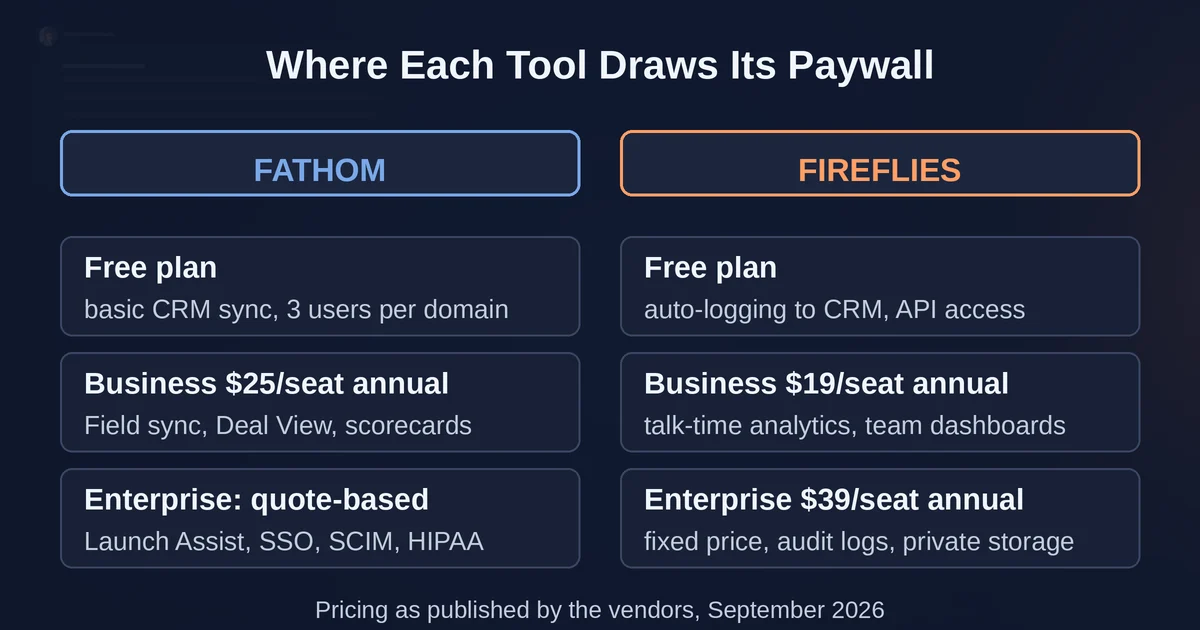
The pattern worth noticing: Fathom's money tier for sales teams is Business at $25 per seat annually, and Fireflies' equivalent is $19. That is the price of the CRM field sync versus the price of the analytics layer, and most teams should pick based on which of those two they will actually use, not on headline prices.
At the true enterprise end, both vendors clear the compliance bar you would expect by late 2026: SSO, SCIM provisioning, HIPAA support, custom retention. Fireflies publishes a fixed enterprise price ($39, annual only) with audit logs and private storage on the spec sheet; Fathom's enterprise tier is a conversation with sales that adds onboarding, a dedicated success manager, and support SLAs. Procurement teams that hate opaque quotes will prefer Fireflies' sticker; teams that expect hand-holding through a Salesforce org with 30 validation rules will prefer Fathom's Launch Assist.
One more enterprise consideration: recording consent and bot etiquette. Fireflies' notetaker joins calls as a visible participant unless you switch to its Chrome extension, which captures browser-based calls without joining the participant list. Fathom now offers bot-free capture (in beta) alongside its bot mode, a tradeoff covered in the bot-free meeting notes comparison. If your legal team has opinions about a named AI participant appearing on client calls, test that scenario before signing anything.
The verdict
Pick Fireflies if the CRM problem is breadth: many reps, many apps, calls that need to land in HubSpot or Salesforce without anyone configuring anything, and managers who want talk-time and sentiment dashboards. The $19 Business seat is one of the cheaper conversation-intelligence packages in 2026, and the fixed $39 enterprise price makes budgeting easy. Accept that the AI extras are credit-metered and the sync is less surgically configurable.
Pick Fathom if the CRM problem is precision: a Salesforce org with a real deal process, admins who want to map AI-extracted insights into specific fields, and a team whose summaries need to be good enough to paste in front of a client. The $25 Business seat buys the field sync and Deal View, and the summaries are the best-in-class part. Accept that the Salesforce integration has documented edges (open opportunities, no Lead object, no auto-backfill) and that analytics beyond scorecards are not the point.
The uncomfortable truth both vendors would rather you not dwell on: either tool costs a tenth of a Gong or a Chorus, and the gap shows. If your enterprise "conversation intelligence" requirement means real-time call guidance and objection coaching mid-call, neither Fathom nor Fireflies fully replaces those platforms yet. What they do replace, convincingly, is the 10 to 15 minutes per call your reps spend on manual CRM hygiene. Price the seat against that, not against the feature checklist.
Pricing and plan details are as published by the vendors around September 2026 and can change; confirm on the official sites before committing.
Two questions people ask
Does either tool detect sales objections automatically? Not as a turnkey feature. Fireflies' Business-tier topic trackers, sentiment analysis, and question detection get closest, and AskFred can surface objection patterns across past calls. Fathom reaches the same ground through custom summary templates and Deal View. Both need a session of configuration first.
Which one syncs to Salesforce and HubSpot on the free plan? Fireflies auto-logs meetings to CRMs from its lower tiers, with API access even on Free. Fathom allows basic CRM sync (summaries attached to records) for up to 3 users per domain on Free and Premium, but field-level sync requires Business.