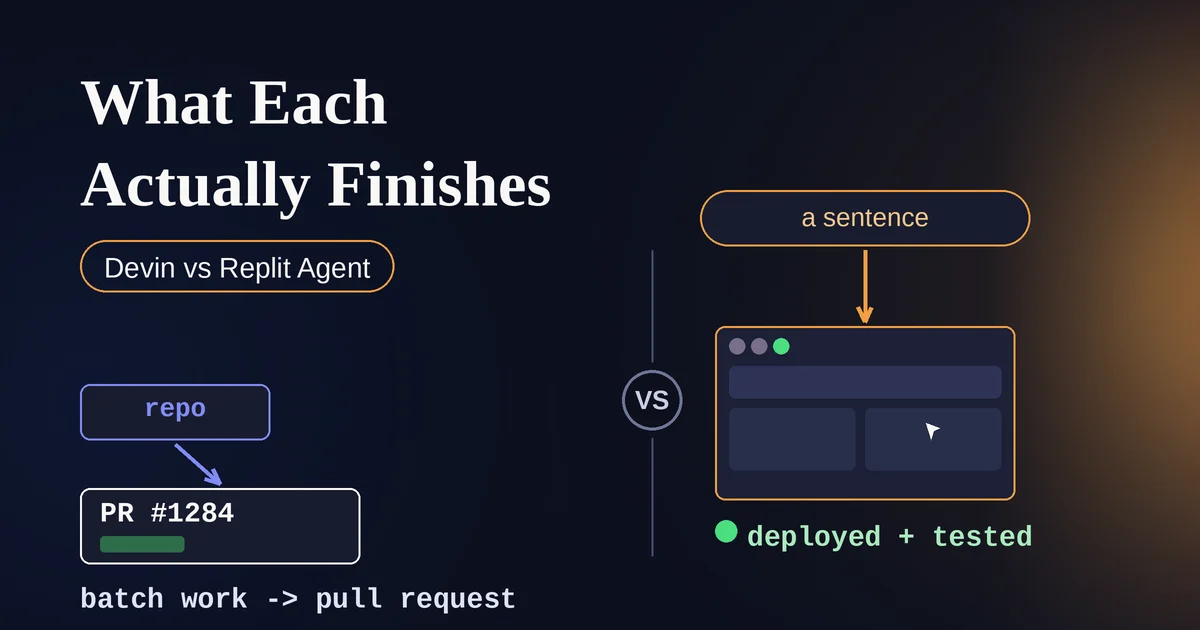
In March 2024, Devin launched with a demo that made a promise no coding tool had made before: an AI you could hand a task to, walk away, and come back to working software. Replit Agent made a different promise a few months later: describe an app in a sentence and watch it appear, deployed, in your browser. Two years later, both promises have quietly matured into real products, and the interesting question is no longer whether either agent can work autonomously. It is what each one actually finishes without you, and what that completion costs.
The two tools have also drifted apart. Devin's maker, Cognition, raised a billion dollars at a $26 billion valuation in May 2026 and now positions Devin as an enterprise engineering teammate that works inside existing codebases. Replit doubled down on building apps from scratch inside its own cloud, with Agent 3 capable of running itself for three-plus hours at a stretch. If you want to know which one deserves a slot in your workflow in late 2026, the honest answer depends almost entirely on what you're asking it to finish.
What Devin Actually Completes End-to-End
Devin today is a platform, not a single agent. There's Devin proper: a cloud-based agent with its own shell, editor, and browser that takes a task, plans it, executes it, and opens a pull request. There's Devin Desktop, launched in June 2026 as the successor to Cognition's Windsurf editor, which reframes the IDE as a command center for managing local and cloud agents. And there are the satellite products: Devin Review for pull requests, Ask Devin, and DeepWiki.
The work Devin genuinely completes without intervention is batch work on large existing codebases. That means migrations that touch thousands of files, sweeping lint or API deprecation cleanups, and broad security scans. Cognition's Agentic MapReduce architecture, published in July 2026, explains why this works: instead of one agent wandering a 50,000-file repo, Devin generates deterministic selectors that find candidate files, then fans out parallel child sessions that each investigate a bounded shard. Coverage is guaranteed by construction because the scan ends when a finite work queue is exhausted, not when the agent feels done.
The flagship application is Devin Security Swarm. In Cognition's own evaluation against pinned CVEs from the GitHub Advisory Database, detailed in the Agentic MapReduce announcement, Swarm reports 72% recall at $90.23 per run, compared to 68% for Claude Security at $131.87 and 26% for Cursor Security at $4.60. Those numbers come from the vendor's own benchmark, so treat them as directional, but the pattern matches what Devin is architecturally good at: exhaustive, verifiable sweeps where the deliverable is a report or a remediation PR.
What Devin does not do is hand you a deployed product. It opens pull requests against your repos. The deploy, the review, the merge, and often the final-mile fix remain human work, and Cognition says so plainly. When it launched Devin Desktop, the company's own framing was that some work "needs review and QA" and that engineers still jump in to "make the last-mile edit yourself."
What Replit Agent Actually Completes End-to-End
Replit Agent 3, released in September 2025 and still the current agent as of this month, has a different center of gravity: it builds and ships full-stack apps inside Replit's cloud, from a blank slate. The claim that matters is "10x more autonomous" than the previous generation, and the mechanics behind it are concrete.
The biggest one is App Testing, described in Replit's Agent 3 announcement. On by default, the agent periodically opens the app it's building in an actual browser and clicks through it: buttons, forms, APIs, data sources. You can watch its cursor move in the preview pane. When it finds breakage, it fixes the issue and reports back. It can even log into apps built with Replit Auth to verify the login flow works. This closes the loop that made earlier vibe-coding tools unreliable: an agent that never runs the app can't notice that the app is broken.
Max Autonomy, currently in beta, extends sessions to 200 minutes or more with minimal supervision. The agent maintains its own task list, monitors its own progress, and keeps building, testing, and fixing. Agent 3 can also build other agents and automations: Telegram bots, Slack agents that query Notion or GitHub, scheduled email digests, all deployed through Replit's integration flows rather than pasted API keys.
So the honest scorecard: Replit Agent does complete the full loop from "a sentence" to "a deployed, tested app on the internet" for greenfield projects of small-to-medium scope. Prototypes, internal tools, landing pages with a backend, dashboards. The frontier of that capability is not enterprise migration work. It's a working app you can put a real user in front of by tomorrow.
The Human-Intervention Reality Check
Here's where marketing and daily experience diverge, and where being precise matters more than being generous.
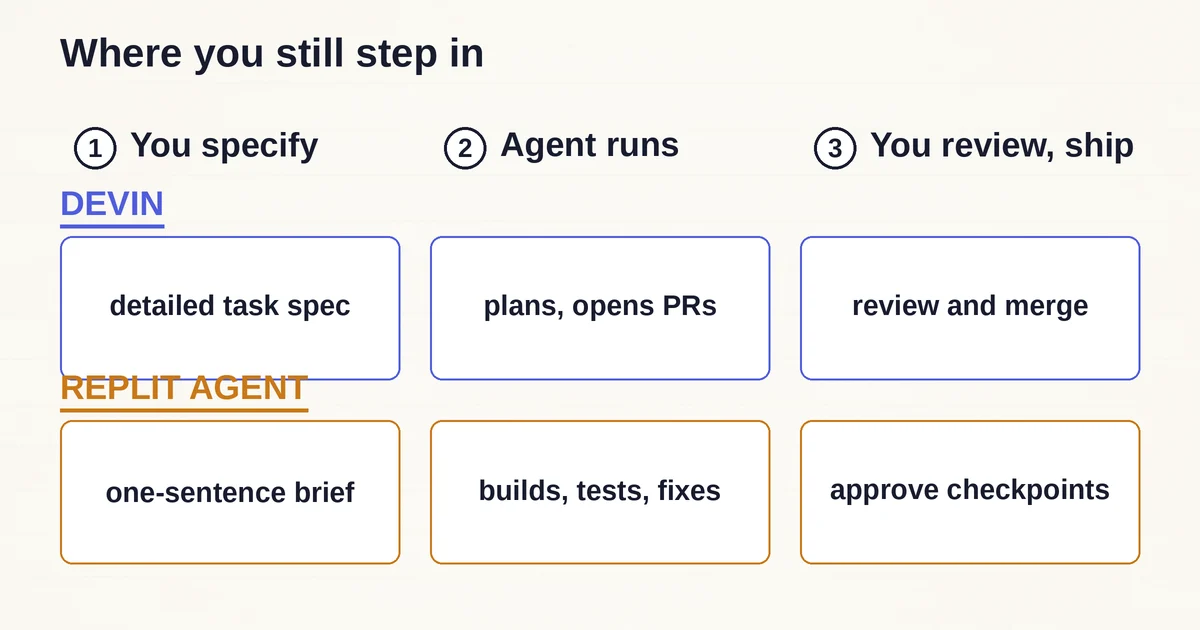
With Devin, the intervention point is upstream and downstream. You write a detailed task spec, and Devin plans before executing. You review the PRs it opens. Teams that get value from Devin report spending real effort on task framing, exactly as they would with a junior engineer. Cognition's own pricing shift reflects this: Devin Review, free during its preview, moved to paid usage-based billing in April 2026, with configurable triggers (manual only, on PR open, on every commit) because customers wanted control over when autonomous runs fire. When the vendor's headline feature request is "let me decide when the agent runs," that tells you autonomy still needs adult supervision.
With Replit, intervention is baked into the product surface. Every request ends in a checkpoint you can roll back to. Plan Mode exists specifically so you can approve scope before code changes happen, and Replit now charges for those planning conversations too, because reasoning work costs money. Replit's own pricing page carries the disclaimer that agent behavior is probabilistic and "may occasionally make mistakes." The failure mode users actually hit is scope drift: the agent decides a task implies more than you meant, and it runs with it. Longer autonomous sessions amplify both the wins and this drift.
The common denominator: neither agent asks for help mid-task the way a human would flag a blocked blocker. Devin either finishes or produces a PR with gaps you catch in review; Replit Agent either ships a checkpoint or burns credits on a direction you didn't want. Your job shifts from typing code to specifying precisely and reviewing relentlessly.
Cost Per Completed Task
Neither vendor publishes a clean "cost per finished task," but you can get close.
Replit's model is the more legible one. As the official billing docs explain, effort-based pricing produces one billable checkpoint per request: simple fixes have run as low as $0.06, and complex builds can land at several dollars each. On top of that, Core is $20 a month ($18 billed annually) with $20 of monthly model credit and up to 60 projects on the no-cost Free Mode, and Pro is $100 a month ($90 annually) with $100 of credit, 15 collaborators, and 10 parallel agents. Watch the failure mode Replit itself documented: in long sessions, every message resends the accumulated context, so a small edit late in a big project can cost more than the same edit would at the start. Starting a fresh chat is the cheapest fix nobody remembers to use.
Devin's per-task economics are murkier by design, because Devin tasks are bigger. The April 2026 pricing reset replaced the old $500-a-month team entry with Free, Pro at $20, Max at $200, and usage-based Teams starting at $80 a month plus $40 per full developer seat, per the current Devin pricing page. Overage is billed at underlying model cost. For a feel of scale at the enterprise end, the one published per-run figure is that Security Swarm scan at $90.23, which is a different unit of work entirely than a Replit checkpoint: it's a whole-repo security audit with runtime verification of confirmed findings.
A rough but useful translation: a Replit checkpoint buys you a feature-sized change to an app. A Devin run buys you a repo-sized operation. Comparing them per dollar is like comparing a handyman's hourly rate to a construction firm's contract price.
Devin vs. Replit Agent: Which Fits Your Work
| Dimension | Devin | Replit Agent |
|---|---|---|
| Sweet spot | Existing codebases, batch work, migrations, security sweeps | Greenfield apps built and deployed in Replit's cloud |
| Unit of completion | Pull request against your repo | Deployed, browser-tested app or automation |
| Signature autonomy | Distributed agent architecture (Agentic MapReduce) | 200+ minute Max Autonomy sessions, App Testing |
| Human intervention point | Task spec in, PR review out | Checkpoint review, Plan Mode approval, scope watching |
| Entry cost | Free tier; Pro $20/mo; Teams $80/mo minimum | Free tier; Core $20/mo; Pro $100/mo |
| Model access | SWE 1.7 free on paid plans, plus frontier models | Frontier models via modes (Free Mode, Power, Max, Turbo) |
The decision rule is simple. If your software already exists and lives in a serious repo, and your bottleneck is backlog, maintenance, or codebase-wide guarantees, Devin is the tool shaped for that job. If your software doesn't exist yet and you want it deployed this week without touching an IDE, Replit Agent is the one that will actually get you there. Plenty of teams will reasonably end up with both, using them for entirely different work, alongside the coding assistants covered in our guide to the three AI programming tools developers actually use daily.
One boundary neither tool crosses: neither is an autonomous substitute for judgment about what to build. Devin's enterprise customers don't use it to decide architecture, and Replit Agent's best outcomes come from people who specify tightly and review checkpoints ruthlessly. The autonomy in autonomous software engineering in 2026 is real, but it's autonomy of execution, not autonomy of intent.
Pricing and plan details are as published by the vendors around September 2026 and can change; confirm on the official sites before you commit. For a deeper look at how agents differ from plain automation, see our explainer on AI agents vs. AI automation.
Frequently Asked Questions
Is Devin or Replit Agent better for non-developers? Replit Agent, clearly. You describe an app, it builds, tests, and deploys it in Replit's cloud with no local setup. Devin assumes you have a real codebase, a git workflow, and reviewers.
Can either agent deploy production software without any human intervention? Replit Agent gets closest for small apps: it builds, browser-tests, and deploys, and you approve checkpoints. Devin finishes work as pull requests, so a human merge is always in the loop by design.