Two years ago, "I built an app this weekend" from someone who can't code meant a static page with buttons that went nowhere. In September 2026, the same sentence can mean a real application: a database, user accounts, a domain, actual humans using it. Bolt.new and Lovable are the two platforms most responsible for that shift, and the two names nearly every non-developer ends up comparing.
Most comparisons treat them as feature checklists: both have AI, both have databases, both export code, pick whichever feels friendlier. That misses what actually decides whether your app survives past the demo. The two platforms run your software in fundamentally different places, and that choice shapes everything else: what deploys in one click, what costs money at 2am, where the ceiling is.
So here is the comparison organized the way the decision unfolds: what each runtime architecture means for you, what you can deploy, where each one breaks, and what it costs to keep going.
The 30-second version, in table form
| Bolt.new | Lovable | |
|---|---|---|
| Where your app runs while building | In your browser, via WebContainers (a real Node.js runtime) | In Lovable's cloud, streamed back as a preview |
| Backend | Bolt Cloud databases, auth, storage, functions, or bring your own provider | Lovable Cloud, built on Supabase's open-source stack, on by default |
| What you deploy to | Bolt hosting, or Netlify/Vercel/Cloudflare with the exported code | Lovable Cloud hosting, one click |
| Code ownership | Yes, MIT-licensed open core, export anywhere | Yes, React code, GitHub sync, paid plans export |
| Unit of billing | Tokens, and they scale with project size | Credits, and they scale with task complexity |
| Entry paid price | $25/mo, from 10M tokens | $25/mo, 100 credits |
| Best fit | Frontend-heavy apps, framework variety, deployment control | Full-stack apps with real users and zero infrastructure decisions |
Two ways to run an app you can't code
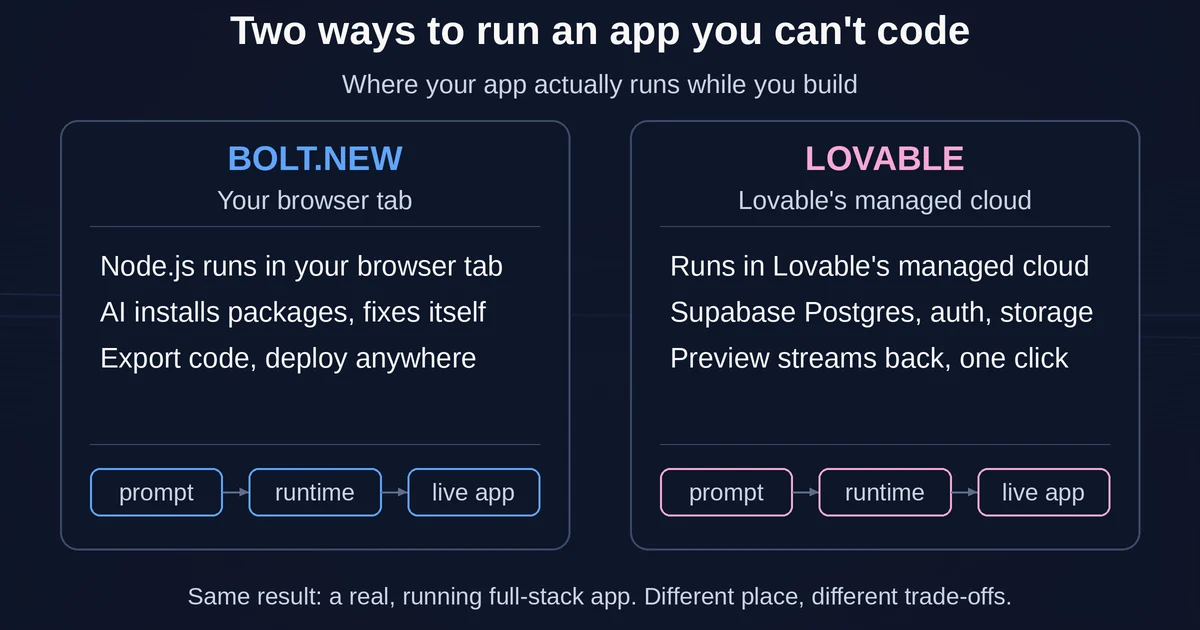
Bolt.new was built by StackBlitz, a company that spent years on WebContainers: a WebAssembly-based runtime that boots a complete Node.js environment inside your browser tab. When Bolt's AI writes your app, it doesn't run on some server far away. It runs locally, in the same tab you're typing in. The AI can install npm packages, start a server, hit third-party APIs, read the terminal, and fix its own mistakes before showing you the result. Bolt's open-source repo describes this as giving the model "complete control over the entire environment," not just the ability to autocomplete files.
Lovable made the opposite bet. Your app is generated and hosted in Lovable's cloud, and the preview streams back to you. What you see while building is the deployed shape of the thing: the same managed backend that will run it in production. That backend is not bespoke. Lovable Cloud is built on Supabase's open-source foundation, so your app gets a real Postgres database, real authentication, file storage, and edge functions, provisioned the moment a prompt needs them. Lovable's docs are direct: the built-in backend is "enabled by default, so most projects never need a separate Supabase account."
What you can actually deploy
This is where outdated advice still circulates. Through 2025, the standard line was "Lovable gives you a backend, Bolt.new just writes frontend code." That was true once. It is not now.
Bolt closed the gap with Bolt Cloud: managed databases, authentication, file storage, edge functions, and hosting, all wired into the platform. The current pricing page lists unlimited databases even on the free tier, plus expanded capacity and choice of provider on Pro, and hosting with custom domains. You can still export the code and deploy to Netlify, Vercel, or Cloudflare yourself, which matters if you ever want to leave.
Lovable's deployment story is simpler, and that is its genuine strength. You publish from within the editor, attach a custom domain on Pro, and you're done: frontend, backend, and database all run under Lovable's roof. Your code syncs to your own GitHub repository as real React, and you own it outright. Lovable's FAQ puts it plainly: "You own your code... apps, websites, customer data, AI output."
The real difference in 2026 is not backend versus no backend. It is who holds the keys. Lovable Cloud is a Supabase instance that Lovable manages: you never see a Supabase dashboard, never get a service role key, and the region is fixed once chosen. If you want direct control, connect your own Supabase project instead, which Lovable supports on all plans. But decide carefully, because Lovable is explicit that there is "no one-click migration from the built-in backend (Cloud) to Supabase or the other way." Pick a backend early; it is close to a one-way door.
Bolt takes the opposite position on keys: bring whatever you want. Export the codebase, choose your database provider, deploy to your own Netlify account. For a non-developer this is less immediately useful, but it is excellent insurance. If Bolt vanished tomorrow, your app is a standard Vite project sitting in your Git repo.
Where each one breaks
Complex logic. Both write React frontends well and both can produce real server-side functions. Where they wobble is multi-step business logic with edge cases: refund policies that depend on subscription state, a booking flow with overlapping time windows. On Bolt, the AI's ability to execute its own code catches many logic errors during the build, but every debugging round costs tokens (more below), so deep iteration gets expensive. On Lovable, Plan Mode is the damage-control tool: for exactly 1 credit per message, the AI reasons about the approach without touching code, so you can argue about the design of a tricky flow before paying build-mode prices.
Authentication. Solved on both, in different flavors. Lovable wires Supabase Auth behind the scenes: email, password, social logins, and row-level security policies land in your app automatically. Bolt's auth via Bolt Cloud needs more steering: you pick a provider and connect it, which is either a chore or freedom depending on your temperament.
Scaling. Lovable Cloud inherits Supabase's strengths and its ceiling. It is Postgres all the way down, so it scales further than most people expect, but running it is metered: since mid-2026, hosting and backend usage draw from the same credit balance as building, covered first by a monthly Cloud grant, then by your paid credits. A viral app can quietly eat the credits you meant to spend on new features. Bolt apps, once exported to a mainstream host with your own database, scale on that provider's standard pricing, usually cheaper at volume but requiring someone who knows what a connection pool is.
The honesty tax. Both platforms can produce confident, plausible code that is wrong in ways a non-developer cannot see: a security hole disguised as a "working" login, a database policy that lets any user read any row. Lovable's automatic security scanning narrows this gap. Bolt's execute-then-fix loop catches runtime errors but not design flaws. Neither replaces a professional review if the app will hold real customer data.
Pricing reality: tokens versus credits
Both platforms advertise "$25 a month," and both bills surprise people for opposite reasons.
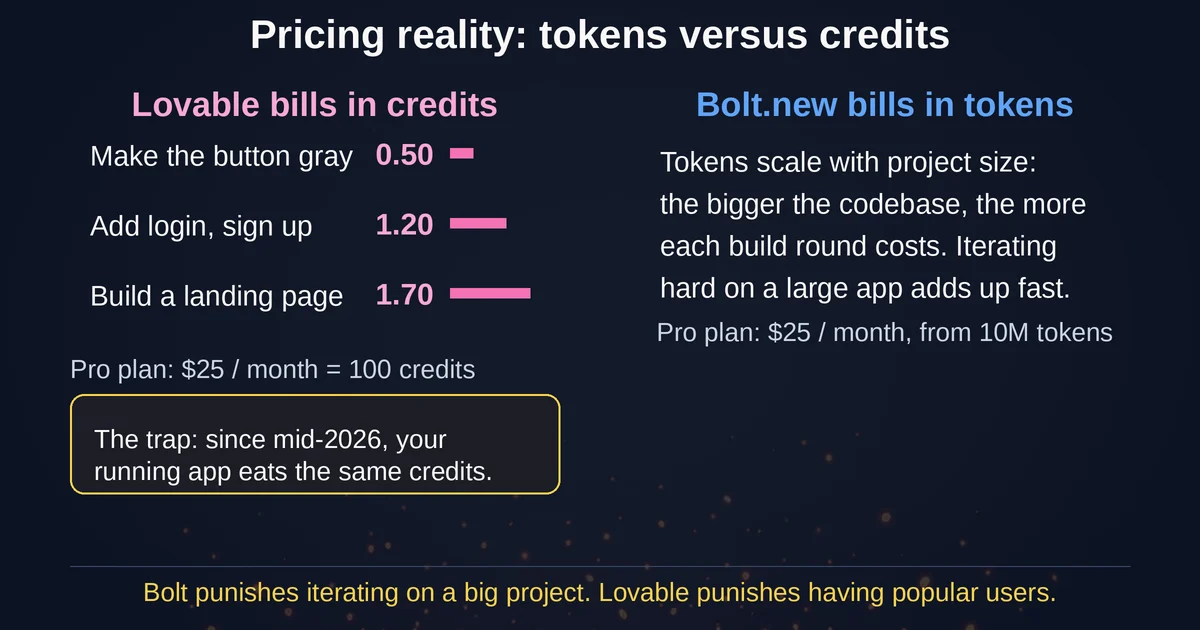
The practical difference: Bolt punishes you for iterating on a big project, Lovable punishes you for having popular users. Budget accordingly.
Pricing and plan details are as published by the vendors around September 2026 and can change. Confirm on the official Bolt and Lovable pricing pages before you commit.
Verdict by user
Full-stack app with real users, minimum decisions (founders, small businesses, internal tools): Lovable. The default-on backend means your first prompt can be "build me a booking app for my studio" and the third can be "add email login and take deposits," and everything, including hosting, is handled.
Frontend-heavy product or framework freedom (portfolio sites, marketing pages, React experiments): Bolt.new. The in-browser runtime is genuinely faster to iterate in, the generated code is standard React you can take to any host, and if your app grows up, no vendor holds any part of it.
Terrified of lock-in: Bolt, or Lovable with your own Supabase project connected. Both export real code; Lovable Cloud is the only component that resists leaving.
On a student budget: Lovable offers up to 50% off Pro with a student email. Bolt's Forge preview is the most generous building allowance in the category while it lasts.
You outgrow either one: that is a success problem, and the answer is the same. Export the code, hire or become a developer, and move the app to infrastructure you control. Both platforms are designed to let you, which is exactly why they beat every generation of no-code tool before them.
If you're weighing these two, look at the wider prompt-to-interface landscape too: our guide to AI UI prototyping tools shows where Bolt and Lovable sit among v0, Figma Make, and the design-first options, and our piece on why developers are adopting AI programming tools covers the engineering side of the same shift.
Two questions people always ask
Can I move an app from one to the other? Not directly. Both export React code to GitHub, but the backend wiring is platform-specific. Treat a move as a rebuild: keep the frontend, rewire auth and data.
Which one makes a "real" app, not a demo? Both. The demo ceiling is a 2024 memory. What separates a toy from a product in 2026 is whether someone reviews the security model before real users arrive. Spend $25 a month on either platform and the first $200 on an audit.
Pricing and plan details are as published by the vendor around September 2026 and can change - confirm on the official site.