The page just came in. Error rates are up on the checkout service, three dashboards disagree about when it started, and someone has pasted forty lines of a stack trace into Slack with the comment "any ideas?". Two years ago your options were a strong coffee and a grep. In September 2026 they include AI tools that read your logs, correlate them with deploys and metrics, and hand you a root cause with the evidence attached.
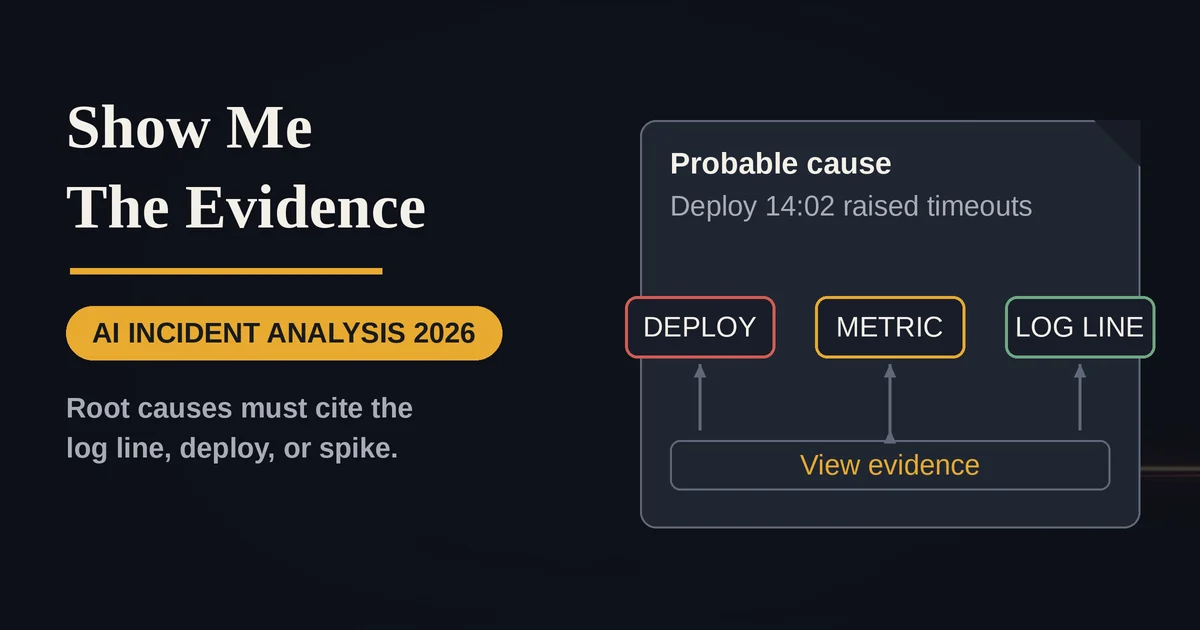
That last part is the whole story. Not the speed, not the natural language interface, the evidence. An analysis tool that gives you a confident answer with nothing behind it is worse than no tool: it points your sleep-deprived attention at the wrong part of the system with the authority of a machine. The tools worth using this year are the ones that treat a root cause claim as something to be proven, not something to be generated. So here is the test we will apply throughout: does every conclusion trace back to a specific line of evidence, and can you check it?
What AI incident analysis actually adds: condensation, not divination
Strip away the product pages and AI incident tooling does three things well, and all three are versions of the same skill: condensation.
First, it reads at machine scale. During an incident a human can hold maybe five open hypotheses. A tool can scan thousands of log lines, every recent deploy, the feature flag flips, and the last twenty similar incidents before you unmute on the bridge call.
Second, it correlates across sources humans keep in separate tabs. A deploy timestamp, a latency curve, and a timeout log line sitting next to each other is the most common root cause discovery in modern ops. The AI's contribution is doing that join across every source at once.
Third, and most underrated, it remembers. It can check whether the same pattern appeared in an incident from six months ago and what fixed it, knowledge that usually lives in one senior engineer's head.
What it does not do is reveal hidden truth. A model has no access to a root cause that is not present in your telemetry, your code history, or your change events. It is pattern matching over evidence you already collect, done faster and wider. When a tool's conclusion is right, it is right because the signal was there. That framing tells you exactly when these tools will fail: when the evidence is missing or contradictory, the model will still produce an answer. Whether that answer is labeled with its evidence, or just asserted confidently, is the difference between the products worth paying for and the ones worth skipping.
The evidence test, applied to a real-shaped incident
Take a composite timeline, anonymized and simplified but shaped like incidents almost every team has had:
- 14:02 - deploy ships to the payments service
- 14:09 - p95 latency on checkout starts climbing
- 14:11 - timeout errors appear in checkout service logs
- 14:13 - the payment provider's status page is green
- 14:15 - rollback; errors stop within minutes
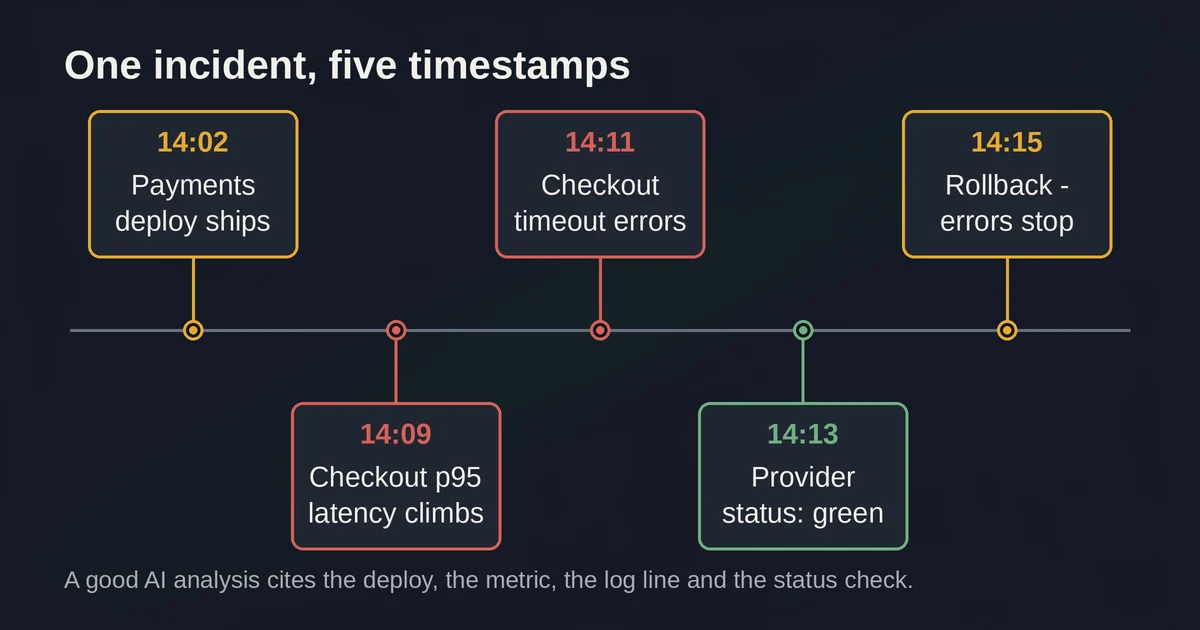
Now run three hypothetical AI outputs against it.
A supported conclusion: "The checkout timeouts starting at 14:11 correlate with the 14:02 deploy to the payments service. The timeout errors reference the payments client. The payment provider reports no incidents in this window. Likely cause: the deploy increased round-trip time to the payments service, causing checkout calls to breach their timeout budget. Rollback resolved it." Every clause checks out against the timeline. Even if the mechanism is subtly wrong, the pointers are right, and a responder can verify each one in seconds.
A half-supported conclusion: "A database issue is causing checkout failures." The right area, maybe, but nothing in the timeline points at the database. A responder who trusts it spends twenty minutes in slow query logs while the real cause sits in a deploy diff. This is the failure mode incident.io's own accuracy grading anticipates: a diagnosis that names the right area but would not have fixed the incident.
An unsupported conclusion: "Checkout is failing due to a database corruption event." Confident, specific, backed by nothing in the timeline. This is the one that costs you the incident, because specificity reads as certainty to a tired human.
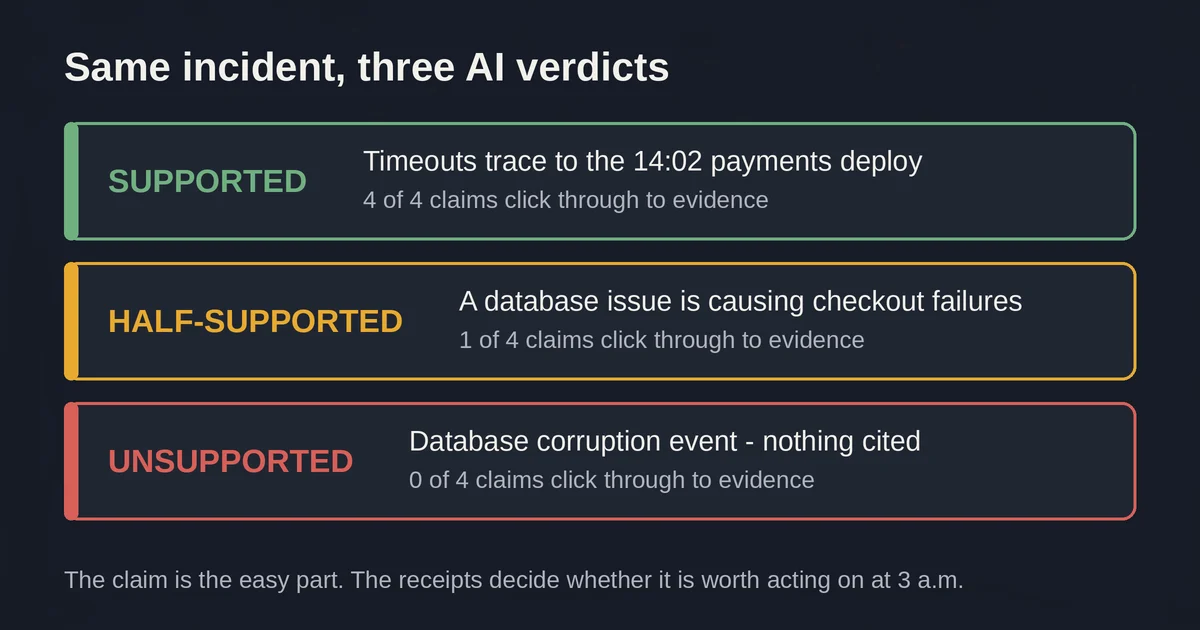
The evidence test is the same in all three cases: can you click through from each claim to the log line, the pull request, the metric spike, or the dependency status that supports it? If the tool shows the answer but not the receipts, you cannot distinguish case one from case three until it is too late.
The September 2026 tool landscape, checked against the test
The interesting thing about this market right now is that the serious vendors have converged, independently, on the same answer to the evidence test: make findings cite their sources. Here is where the major tools stand, verified against vendor documentation as of September 2026.
incident.io Investigations
Investigations went generally available on August 5, 2026, and it is currently the most explicit about the evidence problem. The moment an incident is declared, an investigation fans out in parallel across everything connected: past incidents, runbooks, telemetry, code repositories, change events, Slack discussion, and, with no setup, whether third-party providers like AWS, GitHub, or Stripe were having an outage at that moment. Within minutes it posts a root cause hypothesis into the incident channel, with the evidence behind it.
The design details that matter for the evidence test: every hypothesis states what broke, why, and how confident it is. Every finding links back to its source, whether a message, a pull request, or a spike in a metric, so you read the reasoning, not just the verdict. An adversarial agent pressure-tests the hypothesis before it reaches a human, and the investigation keeps running as new evidence lands, revising rather than defending its earlier theory.
Two things stand out as unusually honest. First, incident.io publishes how it grades its own accuracy: closed investigations are scored against the cause your responders established, on a four-point scale from "acting on this diagnosis would directly fix the incident" down to "points at a different part of the system entirely," and incidents closed without an established cause are marked not-scored rather than quietly counted. That is a vendor inviting measurement of its failure modes, which almost nobody else in the space does. Second, the action boundary is hard: the only change Investigations can make to your systems is a pull request a human reviews and merges.
Caveat: Nexus, the model underneath, is included on every plan per the launch changelog, but there is no public Investigations-specific pricing.
Datadog Bits Investigation
Bits Investigation is Datadog's always-on SRE agent: it investigates every alert the moment it fires, correlates telemetry, and produces root cause analyses that Datadog describes as "transparent, verifiable investigations." It suggests code fixes, learns from each investigation, and integrates with Slack, Jira, ServiceNow, and GitHub.
The evidence posture is decent on paper: RBAC, zero data retention with third-party AI providers, rate limits and cost controls, and findings you can question in chat. The numbers in Datadog's marketing, like "restore services 90% faster" and a testimonial claiming 70 percent MTTR reduction, are vendor and customer-reported, not independently benchmarked. Treat them as positioning.
The billing model matters before you pilot it: Datadog meters all its AI products, Bits Investigation included, through AI Credits, purchased in bundles of 500 per month or on demand. Credits reset monthly and do not roll over. Admins can toggle AI products off at the org level, which you will want: an always-on agent investigating every alert is exactly the kind of thing that silently expands.
PagerDuty SRE Agent and AIOps
PagerDuty spent 2026 turning its SRE Agent from an announcement into shipped software. The changelog tells the story precisely: the agent became generally available in the incident details page on April 30, recommended workflows arrived June 3, triggering from incident workflows landed July 31, and AI Orchestrations went GA June 1, suggesting automation rules mined from your historical incident data.
The SRE Agent answers the control question rather than the evidence question: it can join your schedules and escalation policies as a first-line responder, triaging and diagnosing before paging a human, and you decide whether it executes recommended remediations or waits for approval. It carries a memory of past incidents and diagnostics, the condensation skill applied to your incident history.
Pricing is public and legible: AIOps starts at $699 per month on consumption-based pricing, and the PagerDuty Advance add-on that includes the SRE, Scribe, Shift, and Insights agents starts at $415 per month on top of Incident Management. As with all consumption pricing, model your alert volume before committing.
Google SecOps and the Triage and Investigation Agent
If your incidents are security alerts, the same pattern is playing out in SecOps. Gemini in Google SecOps builds search queries and detection rules from natural language, and the Triage and Investigation Agent (TIN) evaluates incoming alerts for true or false positives, executes an investigation plan, and returns a structured analysis with findings and an explanation, including process tree reconstruction. A dashboard tracks investigation volume and token usage. Note the scope: this is alert triage in a SIEM, not general-purpose service RCA, so it earns its place here only if your team owns security operations too.
The guardrails: humans sign off on root cause, not on the fix alone
Whatever tool you pick, four practices separate teams that get value from teams that get confident nonsense.
Require linked evidence, and read it. The links are the product. Click three of them on the next incident. If the links are decorative or the tool cannot show its work, that is a disqualifier.
Treat the confidence label as a triage input, not a verdict. incident.io grades accuracy after the fact against your responders' established cause precisely because live confidence and after-the-fact correctness are different things. The hypothesis that arrives at minute two is a head start, and the obligation to check it still sits with a human.
Keep the action boundary in the PR. The best current tools converge here: incident.io acts only through a pull request you merge; PagerDuty's SRE Agent waits for approval or acts within permissions you set. Agents that explain incidents and agents that change production are different risk classes, and the boundary between them should be a code review, not a config flag. This connects to the governance picture we covered in the Akuity Agentic Control Plane launch, where agents inherit a named human's permissions and never exceed them.
Score your own tool. After each closed incident, note whether the AI's headline diagnosis would have fixed it. incident.io automates this grading; you can do it in a spreadsheet. The failure patterns to watch for are the ones in the real risks of AI agents nobody talks about.
One architectural note: incident.io hands its findings to coding agents over MCP, and Datadog integrates with GitHub and ServiceNow. If agent-to-agent incident workflows are where your team is heading, understanding the Model Context Protocol is becoming part of the responder's job description.
The verdict
The category is real now, and it earned that status this year by solving the trust problem before the capability problem. The genuinely useful tools do not guess better than last year's models, they show their work better: linked evidence, stated confidence, adversarial self-checking, accuracy graded against ground truth.
For most teams the practical read is: if you live in Datadog, Bits Investigation is the lowest-friction entry point, budgeted in AI Credits. If incident response itself is the discipline you are systematizing, incident.io Investigations has the most rigorous evidence and accuracy story, at unpublished pricing. If you are consolidating alert noise first, PagerDuty AIOps plus the SRE Agent, set to wait for approval, is the measured path. If your incidents are security alerts, the SecOps TIN agent is the same pattern in a different domain.
In all four cases the failure mode to watch for is not the hallucinated root cause. It is the unexamined one: a plausible diagnosis nobody verified, arriving at 3 a.m. with the confidence of a machine and the evidence of a shrug. The tools that deserve your money make checking them effortless. Your job, which no vendor will automate this year, is to actually check.
Two questions people actually ask
Will an AI tool analyze my production logs without me doing anything?
With setup, yes, and only inside the sources you connect. Bits reads Datadog telemetry, Investigations reads the providers you wire in, TIN reads your SecOps data. None of them can see logs you have not connected, and the analysis is bounded by the quality of those connections. A team with rich change events and centralized logs gets sharply better answers than a team with neither.
Is AI root cause analysis reliable enough to act on automatically?
For remediation, some teams run approved automated actions, and PagerDuty's SRE Agent supports it behind permission settings. For the diagnosis itself, no independent benchmark exists in September 2026 that would justify acting on a root cause claim without a human checking the evidence, and the vendors' own accuracy-grading mechanisms are the most rigorous public data available. Treat the diagnosis as a strong hypothesis from a fast, well-read colleague who is sometimes wrong, and you will calibrate right.
Pricing and plan details are as published by the vendor around September 2026 and can change, confirm on the official site.