Every AI test generation tool on the market can write you a passing test suite this afternoon. Copilot will do it from a chat prompt. Cursor will do it while running the tests and fixing its own failures. Qodo Cover will keep only the tests that raise your coverage number, and Diffblue will bill you exclusively for verified coverage it adds. All of that is real, and none of it answers the only question that matters when you adopt one: what happens to these tests six months from now, when someone changes the implementation?
That question separates this product category from almost every other AI coding niche. A generated function either works or it does not. A generated test has a third, much worse state: it runs, it passes, it inflates your coverage dashboard, and it verifies nothing. So this guide is organized around the maintenance burden, not the feature list. First what generated tests actually verify, then where AI genuinely helps at each test level, then a concrete test you can run in an afternoon to find out whether a tool's output will survive contact with your codebase.
The tautology trap: what generated tests actually verify
Here is the failure mode nobody's landing page mentions. A language model writes a test by reading your implementation. It infers the expected behavior from the code, then writes assertions that restate what the code does. The test passes, of course, because both the code and the test encode the same assumption. Change the code, and the test fails even when the change is correct. Or worse, the test asserts nothing beyond "the function did not throw", and it passes through anything.
Practitioners call these mirror tests, and they are the reason the tautology trap has a name. A test that restates the implementation is not a test. It is a copy of your code wearing a test's clothes, and it will happily wave through bugs that a hand-written test written from the spec would catch.
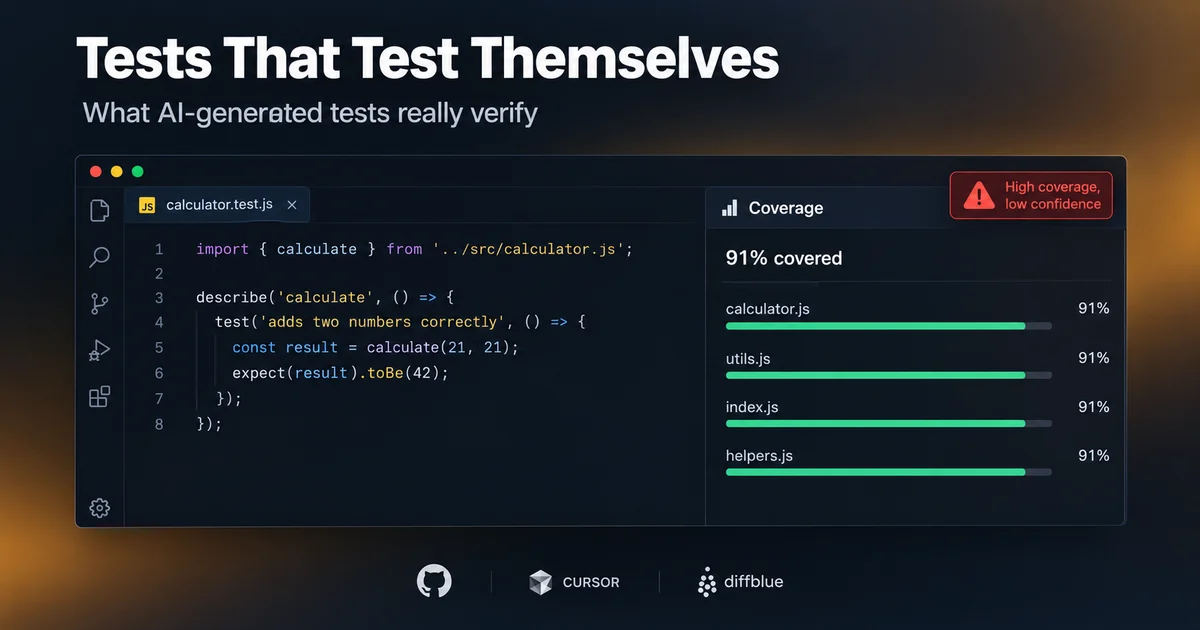
Line coverage makes this worse, because coverage is the metric every generation tool optimizes for. A test that calls a function and asserts nothing catches zero bugs while pushing your coverage report upward. Microsoft ran into this honestly in its own work on a polyglot test generator for Copilot: a specialized, repo-aware agent completed 92.1 percent of a set of 152 internal unit-testing tasks versus 78.9 percent for stock Copilot, but average branch coverage barely moved, 49.8 percent versus 49.1 percent. Better scaffolding, nearly identical verification. If a vendor quotes you a coverage number as proof of quality, that number is not proof of anything. The honest metric is mutation testing: deliberately break the code in small ways and count how many breaks your suite catches. It is slower and it hurts, and it is the only number that measures what you actually bought.
The change-the-code test: a 30-minute quality gate
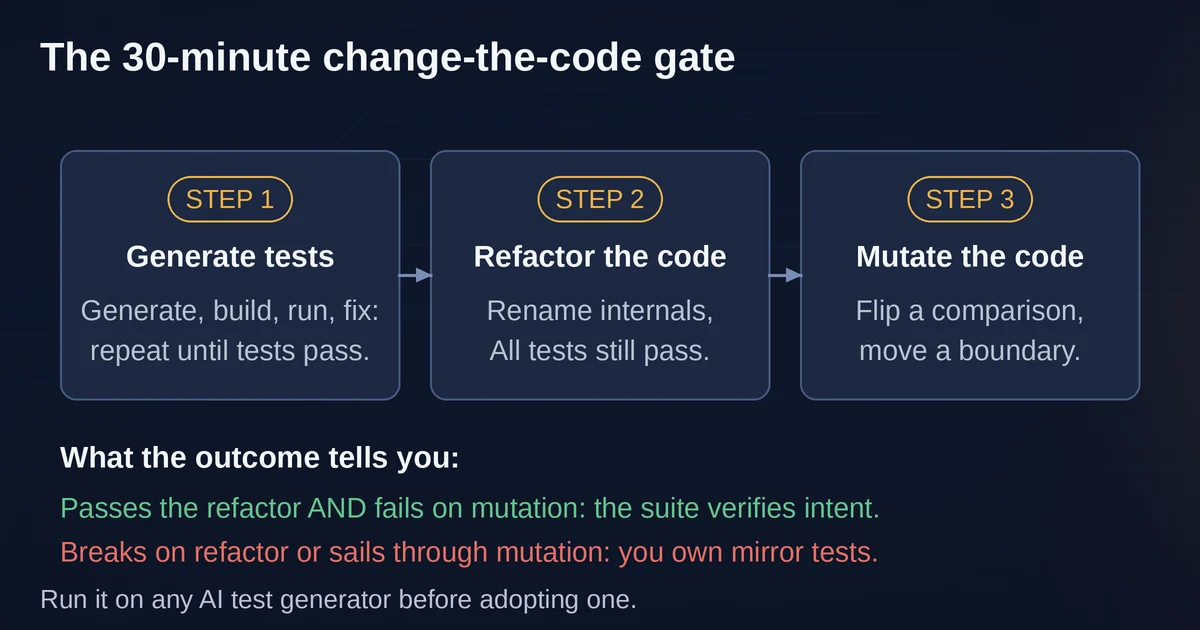
You can run this on any tool, on any codebase, this week. Pick one module with real edge cases, something with boundaries, malformed input, and a conditional or two. A pricing rule, a date parser, a validator. Generate tests for it with your candidate tool, let the tool's run-and-fix loop get everything green, and then do two things to the implementation.
First, refactor. Rename internals, restructure a loop, swap a data structure, without changing the contract. The tests should all still pass. If a quarter of them break on a pure internal refactor, that suite is coupled to the implementation, and you have just previewed your next year of maintenance pain.
Second, mutate. Flip a comparison operator, move a boundary by one, delete a validation branch. The tests should fail, loudly. Any mutation that sails through unmasks a mirror test that verifies nothing.
This is not a fringe technique. Microsoft's official review guidance for its test-generation tooling tells developers to confirm that generated tests "fail after a plausible defect such as a reversed condition or removed validation". The vendor whose job is generating the tests is telling you to assume the tests are mirrors until a mutation proves otherwise. Run both steps before you roll any of these tools out to a team, because the change-the-code test costs an afternoon and predicts the maintenance burden with uncomfortable accuracy.
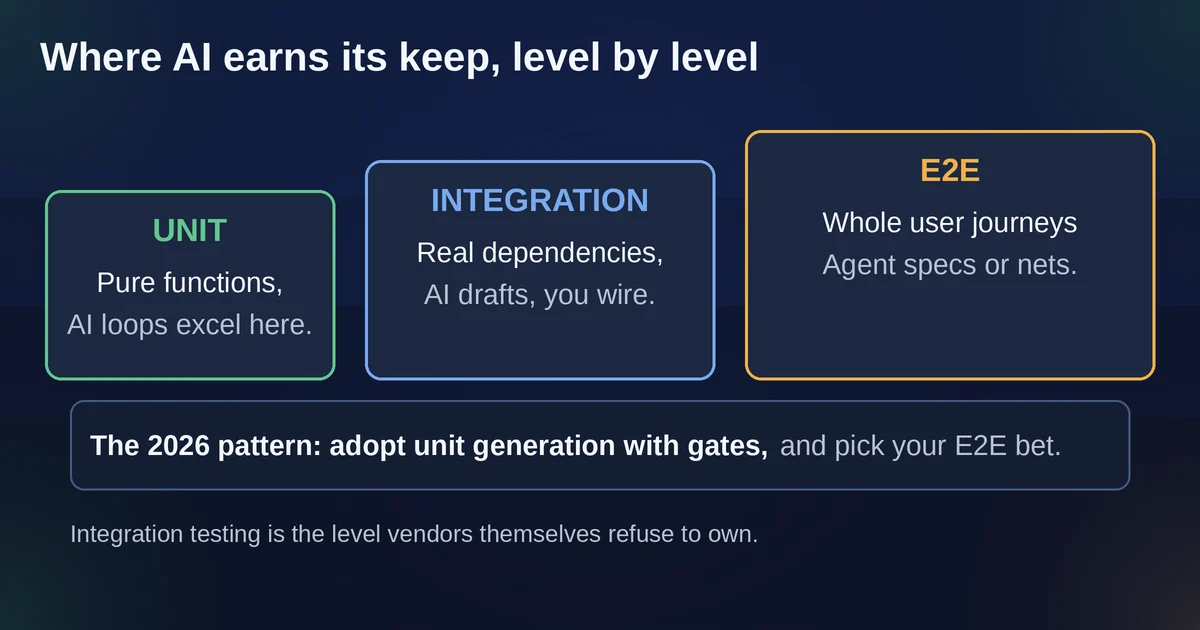
Level one: unit tests, where AI genuinely earns its keep
Unit tests are the category's success story, and the reason is structural. A pure function is a closed world: inputs in, output out, no environment, no async surprises, no test data to curate. That is exactly the kind of problem a model can explore exhaustively, and the tooling has converged on the same shape everywhere: a loop that generates, runs, reads the failure, and rewrites.
GitHub Copilot's testing story got a serious upgrade here. Copilot Testing for .NET went generally available in Visual Studio 2026 v18.3 in February 2026 as the @Test agent: it scopes to a member, a class, a file, a whole project, or just your git diff, then generates tests, builds, runs them, fixes failures, and re-runs until stable, with before-and-after coverage in the summary. For everything outside C#, the /tests slash command in Copilot Chat still does the job, with the known caveat that it is non-deterministic: two runs produce two different suites. Copilot's plans run from a free tier with limited usage through Pro at $10 a month up to Pro+ at $39, with usage metered in GitHub AI Credits per the official plans page.
Cursor takes the same loop and makes it the default way you work in the editor. Its test generation docs describe the workflow candidly: the agent reads your existing test files to learn your framework, structure, and naming, generates matching tests, runs them via the terminal, and iterates on failures. One of the documented workflows is precisely the maintenance case: generate tests that lock in current behavior before a refactor, then run them after each step to catch regressions. Cursor's Individual plan is $20 a month, Teams $40 per user.
The coverage-driven specialist here is Qodo Cover, the open-source agent that grew out of CodiumAI before the 2024 rebrand to Qodo. Its loop has a structural answer to the tautology trap, a partial one: a generated test is kept only if it passes and measurably increases coverage, otherwise it is discarded. That kills the "does not throw" test, though it cannot guarantee the assertions encode intent rather than implementation. The agent lives on GitHub, AGPL-3.0, installable via pip, with GitHub Actions that open patch PRs against your pull requests.
What none of these tools do well is decide what should be tested. They will hand you a thorough suite for a function whose behavior nobody actually depends on, and a thin one for the ten-line method that guards your revenue. Where they genuinely shine is bootstrapping coverage on untested legacy code, edge-case discovery on deterministic logic, and pre-refactor safety nets. That is a real, valuable, bounded job.
Level two: integration tests, the thin middle
Integration tests are where the category goes quiet, and the silence is informative. Microsoft's polyglot test generator explicitly declares integration tests, real databases, live APIs, deployed services, out of scope and instructs the agent to mock external dependencies instead. The one vendor that built the most repo-aware generator in the category looked at integration testing and said: no.
The reasons are unglamorous. An integration test is mostly environment: containers, seed data, network fixtures, teardown, the topology of what talks to what. Models guess at all of it, and a guessed topology produces a test that fails for infrastructure reasons rather than behavior reasons, which trains your team to ignore red builds.
The practical pattern that works in 2026 is a division of labor. Let the AI draft the scaffolding: the mock setup, the fixture builders, the assertion skeleton. You own the wiring, the test data, and the decision of what actually needs to run against a real dependency. That split gets you most of the typing savings without the flaky-suite tax, and it keeps integration tests, which are the most expensive tests to maintain, under human definition.
Level three: end-to-end tests, two very different bets
E2E is the most interesting level in 2026 because two genuinely different philosophies now compete for it, and they disagree about who owns the maintenance problem.
Bet one: the agent writes specs you own. Playwright, which now bundles its own MCP server and CLI, ships three role-specific agents you initialize into a repo with one command: a planner that explores the app and writes a test strategy, a generator that turns the plan into specs against the live DOM, and a healer that replays failing tests, patches the broken locator or timing, and re-runs until green or until it reports that the feature genuinely broke. That healer is maintenance automation, and the vendor is candid that generated tests "may include initial errors" that the healer fixes. Wire the Playwright MCP server into Claude Code, Cursor, or Copilot and the agent generates locators from the actual accessibility tree instead of hallucinating CSS from training data, which was the single biggest failure mode of prompt-to-test E2E a year ago. If MCP tooling is new to you, our plain-English guide to the Model Context Protocol covers how these servers expose app control to agents.
Bet two: the platform owns maintenance so completely that you never see a test. Meticulous records real sessions via a script tag in your dev and staging environments, then generates and continuously evolves a visual regression suite from what it recorded, mocking your backend by replaying recorded responses so runs are deterministic and side-effect free. When you open a pull request it shows the impact across user workflows before merge, and as the app evolves it adds tests for new behavior and deletes obsolete ones. The pitch is literally that you never write, fix, or maintain a test again, and after a $15M Series A in July 2026 it is being used by over 100 organizations, Notion and Dropbox among them. The trade-off is the mirror problem at suite scale: tests generated from current behavior lock in current behavior, bugs included. It is a regression net, not a spec. You are betting that catching regressions matters more than encoding intent, which for most frontend-heavy teams is a correct bet, but it is a bet you should make consciously.
The September 2026 landscape at a glance
| Tool | Level | What it verifies | Maintenance model | Starting price |
|---|---|---|---|---|
| GitHub Copilot | Unit, some E2E | Whatever you review it against | You review; @Test agent self-fixes at generation time | Free tier; Pro $10/mo |
| Cursor | Unit, E2E specs | Your conventions, learned from existing tests | Run-and-fix loop; CLI fixes CI failures | Hobby free; $20/mo |
| Qodo Cover | Unit | Coverage delta: only kept if it passes and raises coverage | Discard-on-failure keeps the suite lean | OSS free (BYO API key) |
| Diffblue | Unit, Java/Python | Compiles, passes, adds coverage, or you do not pay | Continuous maintenance of its own tests | $1,500 per 5,000 coverage lines |
| Meticulous | E2E | Pixel-level visual regression on recorded flows | Platform regenerates the entire suite | Demo-led, not public |
Two of those rows deserve a closer look, because both companies changed shape this year.
Diffblue repositioned around a Diffblue Testing Agent introduced in March 2026, an orchestration layer that runs on top of GitHub Copilot CLI or Claude Code and drives them across an entire codebase: coverage analysis, test planning, parallelized generation, verification, cleanup, PR preparation. Its pricing is the most interesting in the category: $1,500 for 5,000 net-new lines of coverage, about $0.30 a line, billed only for tests that compile, pass, and add coverage, with failed and flaky tests never counted, and you can verify the delivered number with JaCoCo or any standard coverage tool. A vendor that prices on verified outcomes has aligned itself with your interests in a way per-seat pricing never does. The company claims 80.7 percent average line coverage and 61.3 percent mutation coverage against a senior developer plus Claude Code managing 32.3 and 24.2 percent on eight enterprise Java repos; those numbers are vendor-reported, from Diffblue's own benchmark, so discount accordingly. The original Diffblue Cover, the deterministic, no-LLM engine for air-gapped Java, still exists alongside it.
Qodo, meanwhile, drifted. Its pricing page now sells an agentic PR code review platform metered in credits at $0.012 each, pooled across the team, with no permanent free tier, and test generation is no longer the headline. The open-source Qodo Cover is the part worth your time, and it remains free with your own model API key.
If you are evaluating the assistants themselves rather than specialists, our comparison of why developers run three AI programming tools instead of one covers how Copilot, Cursor, and friends split the workload, and the same division applies to their test-generation strengths.
The verdict: buy maintenance, not generation
Generation is solved. Every serious tool in September 2026 writes tests that compile, run, and pass, and the generate-run-fix loop is table stakes rather than a differentiator. What separates the tools is what happens after the first green build.
For unit tests, adopt now, with gates. The change-the-code test from earlier in this guide should be a standing policy: any AI-generated test must survive a refactor and fail on a mutation before it merges. Tools that enforce verification themselves, Qodo Cover's coverage-delta loop, Diffblue's pay-for-verified-coverage model, make that gate easier to hold. Tools that do not, Copilot's /tests in particular, need you to hold it manually.
For integration tests, keep AI on scaffolding duty. The category's best vendor explicitly refused this job, which tells you the problem is real, not that the vendor is behind.
For E2E, pick your bet by team shape. If you want readable, diffable specs your engineers own, run Playwright's planner-generator-healer pipeline through your agent of choice and budget review time for the output, because the healer fixes breakage but does not fix tests that assert nothing. If your frontend churn is dominated by regressions and your maintenance queue is the bottleneck, evaluate Meticulous and accept the current-behavior trade-off consciously.
And measure the thing that matters. Not line coverage, which every tool can now inflate on demand, but mutation score and refactor survival. The hidden cost of AI automation is always the maintenance that arrives after the demo, and generated tests are the purest example of that principle in the whole category: the suite you generate in an hour is the suite you will maintain for years, or delete in frustration. Choose the tools that help you keep it.
Pricing and plan details are as published by the vendors around September 2026 and can change. Confirm on the official sites before you budget.
Two questions people actually ask
Can AI-generated tests replace hand-written tests? Not today, and the reason is the tautology trap. AI tests infer expected behavior from the implementation, so they verify what the code does, not what it should do. Hand-written tests from a spec encode intent. The strongest 2026 pattern is a hybrid: AI for breadth and edge cases, humans for the assertions that encode business intent.
How do I check AI-generated tests are actually useful? Break the code on purpose. Flip a boundary, delete a validation, reverse a condition. If the suite still passes, the tests are mirrors. If it fails for the right reasons, and still passes after a behavior-preserving refactor, the suite is real. This takes about 30 minutes and is the single highest-value habit in AI-assisted testing.
Pricing and plan details are as published by the vendor around September 2026 and can change - confirm on the official site.