Somewhere in your repository right now there is a document that lies. It was accurate once, maybe for a whole week after someone wrote it. Then a pull request changed a default value, renamed an endpoint parameter, or quietly deprecated a flag, and the document kept describing the old world. Nobody updated it on purpose. Nobody updates it on purpose. That is the entire problem: documentation drift is not a writing problem, it is a maintenance problem, and maintenance is exactly the kind of work humans quietly stop doing.
What changed in 2026 is that drift has a bigger blast radius. Your docs are no longer read only by tired humans at 2am. They are read by coding agents, support agents, and search assistants, and those readers believe what they find. Mintlify's own midyear traffic report measured AI agents at 66% of web traffic across the docs sites it powers, with more than 213 million agent requests in July alone. When your quickstart rots, you are feeding wrong instructions to every tool that summarizes, answers, and codes on your behalf. Stale docs used to confuse a developer for ten minutes. Now they confidently mislead an agent that ships code.
So a small category of tools has formed around a specific promise: keep the documentation synchronized with the code, automatically. If the shape of that stack is new to you, our guide to AI tools for understanding large codebases covers the reading side; this article is about the writing side. Some tools generate docs from the codebase, some watch for changes, some draft updates at review time. They work differently, they fail differently, and there is a simple test that separates the ones that actually hold up.
What drift actually costs, in concrete terms
Drift is rarely dramatic. It is a rate limit that says 100 in the docs but is 50 in the code. It is an SDK snippet that imports a package from a path that was refactored away. It is a "required" parameter that is now optional, which means every integration built from your docs is built slightly wrong, and the first sign is a support ticket written in a confused tone.
The cost shows up in three places. Support load, because every stale example becomes a ticket. Onboarding time, because new engineers learn the codebase from docs and then have to unlearn parts of it. And now, agent quality: your team's AI coding tools read the same stale pages, so the internal assistant that is supposed to know your system inherits the same errors. A team that fixes docs only when someone complains runs a documentation system that is always one release behind, and in 2026 that system is also the context layer for every AI workflow the team has built.
Three ways tools attack the problem
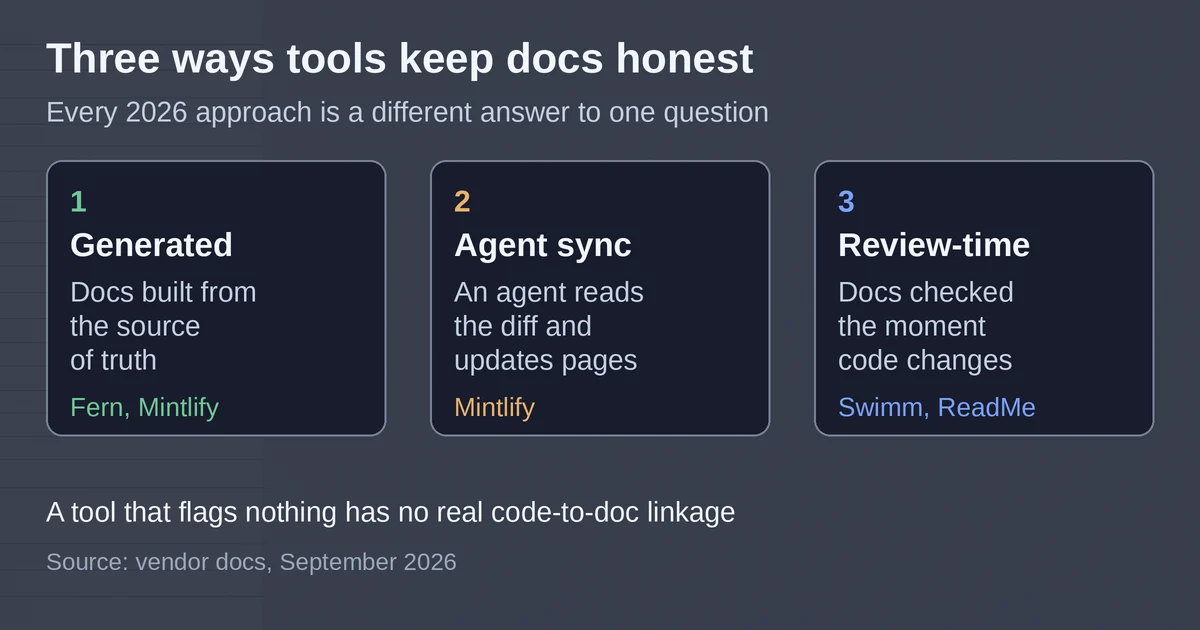
The tools in this space cluster into three approaches, and which one fits depends on where your docs hurt.
Generated docs, built from the source of truth. The oldest idea in the category: if documentation is generated from the thing it describes, it cannot drift, because regeneration is the update. Fern is the purest current example for API-first teams: it generates both the reference docs and client SDKs across nine languages from one API definition, so a spec change flows into the docs and the SDKs together. Mintlify takes a broader version of this for whole repos: paste your GitHub URL with github.com swapped for mintlify.com and it reads the codebase to produce a full docs site, API references included. That solves the cold start problem, the team that has code and users but never had three weeks to write docs. Generation is strongest where the source of truth is formal, like an OpenAPI spec. It is weakest for conceptual docs, the "why we designed it this way" pages, which live nowhere in the code.
Agent-monitored sync. This is the genuinely new shape of tool: an agent watches the code and acts on the docs. Mintlify's agent and its Automations system work this way. When code merges to main, the agent reads the diff, identifies what changed, and updates the corresponding pages. It compiles merged pull requests into a changelog entry after each release, drafts a first version of a docs page when a PR adds a new endpoint, and runs scheduled weekly audits that check for broken links, outdated code examples, and references to deprecated features. Depending on your review process setting, the agent either opens a pull request with its proposed changes or commits directly to the deployment branch. The important nuance: it validates its own output by running the Mintlify CLI checks so the docs still build, and you decide how much human gatekeeping applies.
Review-triggered updates. The third approach attacks drift at the moment it is created: the code review. Swimm sits inside this workflow. Its IDE plugins for VS Code, JetBrains, Cursor, and Windsurf flag the moment a code change invalidates a document, before you even push, because Swimm documents contain live references to real code elements, snippets, tokens, and paths. Its patented auto-sync verifies those references against the latest source on every change, and the GitHub app checks on every pull request whether the affected docs are still fresh, commenting with a suggested fix when they are not. The human still reconciles: you accept the proposed update, replace the element, or delete the outdated doc. ReadMe pushes the same idea into the agent era with an MCP server that gives your own coding agent, Claude Code, Cursor, Windsurf, read and write access to the docs hub, including an update-docs action and a draft-changelog action that builds a changelog entry from merged PRs.
None of these three approaches is strictly best. Generated docs buy accuracy on the parts that can be derived from code. Agent-monitored sync buys coverage on everything else, at the cost of reviewing AI-written prose. Review-triggered updates buy the strongest guarantee, docs checked at merge time, at the cost of a workflow change your engineers must actually follow.
The drift test: change your code and see who notices
Whatever a vendor's landing page says, the only honest way to evaluate a documentation sync tool is to make it fail. This is the discipline you would apply to a test framework, and almost nobody does it before buying.
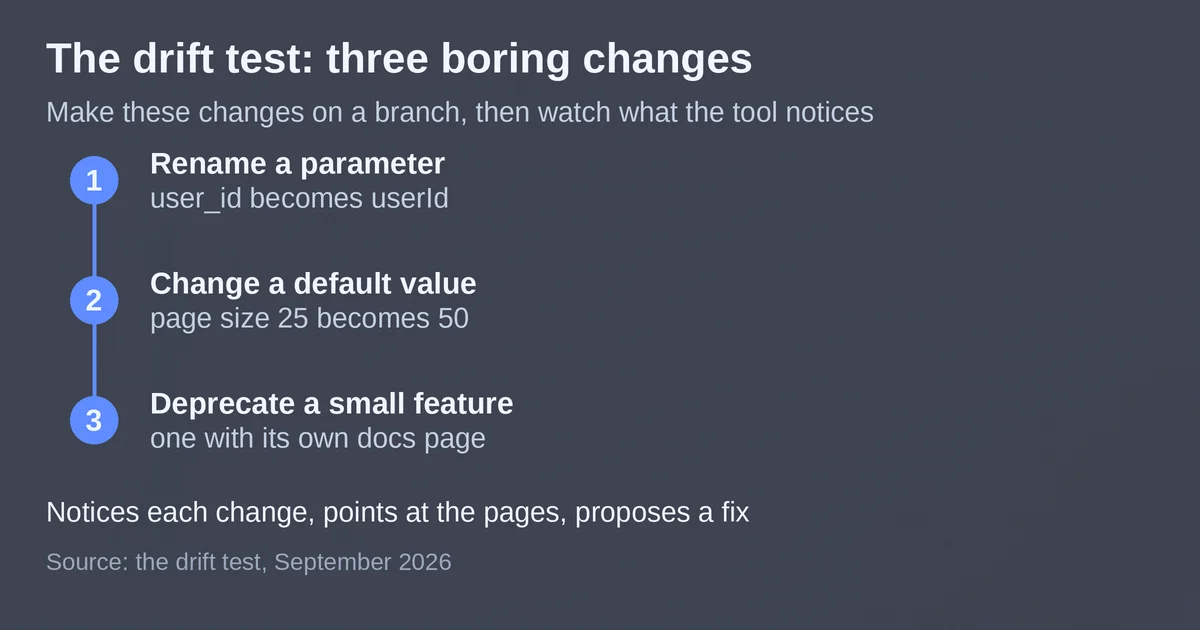
Pick a branch and make three boring, realistic changes:
- Rename a parameter on an endpoint your docs describe, something cosmetic like
user_idtouserId. - Change a default value that appears verbatim in a documented example, like a page size from 25 to 50.
- Deprecate a small feature that has its own short docs page.
Then merge, or open the PRs, and watch what happens. A tool that earns its keep should do three things: notice each change, point at the specific pages affected, and propose a fix a reviewer can approve in under a minute. The failure patterns are just as informative. A tool that flags nothing has no real code-to-doc linkage and is a writing assistant wearing a sync badge. A tool that rewrites whole pages that were barely affected will burn your review budget, because the team will stop reading its suggestions within a month. A tool that proposes confident, wrong prose is the most dangerous case, because the output looks maintained while being subtly false, which is worse than visibly stale.
Run the same test on the human workflow too. If the tool's answer is "a human will handle it in review," check whether that is actually happening on your team today, because that is the baseline the tool is meant to fix.
The tool landscape, September 2026
A quick tour of where the notable options stand right now.
Mintlify has positioned itself as the automation-heavy option: generate the initial site from the repo, then let the agent maintain it through Automations. Pricing has moved upmarket; the free Starter tier includes five editor seats and no AI credits, while Pro runs $450 per month on annual billing with 10,000 credits, where an automation-driven doc update costs 250 credits and you are not charged when the automation finds nothing to do. Every plan, including free, serves an MCP server and llms.txt, because Mintlify now designs docs to be read by agents first.
Swimm remains the strongest choice when the pain is drift inside a big legacy codebase rather than a public API reference. Its value is verification: documents are structurally coupled to code, so every PR can be checked for doc freshness mechanically. The IDE plugin surfaces documentation while engineers work, and its AI features draft docs from PRs and snippets. The catch is coverage discipline: auto-sync only protects docs written as Swimm documents in the first place, so adoption is a habit, not an install.
ReadMe is the option that treats docs as a two-way street. Bi-directional sync moves editor changes out to the repo and commits back in, and the MCP server lets the coding agents your team already uses update the docs themselves. If you are new to the protocol that makes that possible, our guide to the Model Context Protocol explains the plumbing. For teams that want the agent loop to close without a new tool, it is the most direct route.
Fern is what you want when the API definition is the product. SDKs and docs from one source mean drift between docs and libraries is structurally impossible, and every AI-suggested change arrives as a pull request, no direct-commit mode at all, the strictest review posture in the category.
Your existing coding agent is the wildcard. GitHub Copilot automations can run Copilot's cloud agent on a schedule or in response to repository events, which means a team with a docs-as-code setup can wire a DIY version of this: on merge, an agent reads the diff, updates the markdown, opens a PR. More assembly required and less validated than the dedicated tools, but for a small team it is often the cheapest honest experiment in the space.
What these tools still cannot do
The honest limits, none of which the landing pages volunteer.
They cannot capture intent. A tool can notice that a default changed from 25 to 50; only a human knows it changed because a major customer's ingestion pipeline broke. The "why" sections of your docs, design rationale and tradeoffs, still require someone who was in the room.
They are only as good as their code-to-doc linkage. A sync tool that does not know which pages reference which code is just a chatbot with repository access. Ask vendors precisely how they map a diff to affected pages; the drift test above answers this better than any demo.
Generated prose needs the same review as human prose, at lower cost per word but not zero. Mintlify's credit metering (250 credits per automation update) is a fair model only if your team actually reviews the PRs; direct-commit mode is efficient and quietly risky, and it suits changelogs better than guides.
And none of them fix ownership. If nobody is accountable for documentation being true, the tools just make it easier to produce plausible-looking pages faster. The tool sets the floor, not the ceiling.
A verdict you can act on
If you have no docs or ancient docs, start with generation: get a real site out of your repo with Mintlify, or out of your OpenAPI spec with Fern, then decide what still needs a human. If your docs exist but rot, Swimm's verification model and Mintlify's automations are the two strongest answers, and the choice is mostly whether your docs live next to the code in the IDE or in a hosted docs platform. If your team already lives in agent workflows, ReadMe's MCP loop is the most natural extension of how you already work.
Before you commit to any of them, run the drift test. Three small breaking changes, one afternoon, and you will know more about the tool than a month of vendor demos could tell you. The tool that catches the user_id rename, points at the exact paragraph, and opens a reviewable fix has earned the pipeline. The one that stays quiet has not, and your docs will keep lying, just with better tooling around them.
FAQ
Do AI documentation tools update docs automatically, or do they open PRs?
Both, depending on the tool and your settings. Mintlify lets you choose: the agent can open a pull request for review or commit directly to the deployment branch. Swimm proposes updates in the IDE and in PR comments that a human accepts. Fern routes every AI-proposed change through a pull request, no direct-commit option. In all cases, the review gate is the difference between automation and gambling.
Can AI keep docs in sync without a dedicated documentation tool?
Partially. GitHub Copilot automations, or a custom CI job around any coding agent, can read a diff and propose doc updates on merge. The gap is validation: dedicated tools maintain a structural map between code elements and doc pages and check it mechanically, while a generic agent re-derives the relationship every run and can miss the connection entirely. For critical reference docs, that structural linkage is the product.
Pricing and plan details are as published by the vendor around September 2026 and can change - confirm on the official site.