The question "Cursor or Windsurf for refactoring a big repo?" used to have a simple shape: two rival AI IDEs, two context engines, one winner. In September 2026 that question no longer exists in its old form, and pretending it does would make this article useless.
Two things happened while most comparison guides were on autopilot. Cursor, mid-2026, deleted the exact feature this debate used to be about: it shut down its server-side embeddings index and stopped building semantic codebase indexes entirely. And Windsurf, the product, ceased to exist. On June 2, 2026, Cognition (the company behind Devin, which acquired Windsurf in July 2025) pushed an over-the-air update that renamed the editor Devin Desktop, replaced its Cascade agent with a Rust rewrite called Devin Local, and repivoted the whole thing from "AI code editor" to "command center for managing agents."
So the honest version of this comparison, today, is Cursor versus Devin Desktop. That is what we will test, on the hardest case both products face: a repository-wide refactor that touches dozens of files neither tool has "read" yet.
The multi-file refactor test
The test is deliberately brutal:
Take a mature codebase, say 80,000 lines across 400 files. Now ask for something cross-cutting: "Replace our custom retry wrapper with the shared resilience library, update every call site, keep behavior identical, and update the affected tests." No single file reveals the answer. The correct edit set is scattered across services, helpers, fixtures, and tests, and half of the work is discovering which files those are.
This test breaks AI editors in two distinct places. First, retrieval: the agent has to find the relevant code before it can edit it, and naive strategies either drown the context window in irrelevant files or miss call sites entirely. Second, budget: repo-wide discovery plus multi-file edits is exactly the kind of long-horizon agent session that eats tokens by the million. An IDE can be genuinely good at both and still lose you on cost at scale, which is why context engineering has become the skill that separates people who get useful refactors from people who get confident nonsense.
Cursor's bet: delete the index, trust the grep
For two years, Cursor's signature feature was semantic codebase indexing. Your repo got chunked, embedded, and stored server-side, and @Codebase queries ran against it. In mid-2026 Cursor killed all of that, and it was not a quiet regression, it was a deliberate reversal.
In a detailed staff explanation on the Cursor forum, the team confirmed the removal is intentional: semantic indexing "is being turned down in favor of grep-based retrieval." The agent now leans on a tool called Instant Grep plus ordinary file reads. Practical consequences, if you last touched Cursor a few months ago:
- No embeddings, anywhere. Cursor no longer computes embeddings of your code or stores them on its servers. If your security review approved Cursor partly on that basis, that approval is now moot in the good direction.
- The index went local. Instant Grep builds a per-repo index stored inside
.git/cursor/, anchored to a git commit and updated incrementally. It never leaves your machine and is never pushed. Non-git projects fall back to plain ripgrep. - The old scale ceiling is gone. The semantic index capped out at 250,000 files; grep has no file-count limit.
.cursorignorestill works, blocking files from both search and agent access.
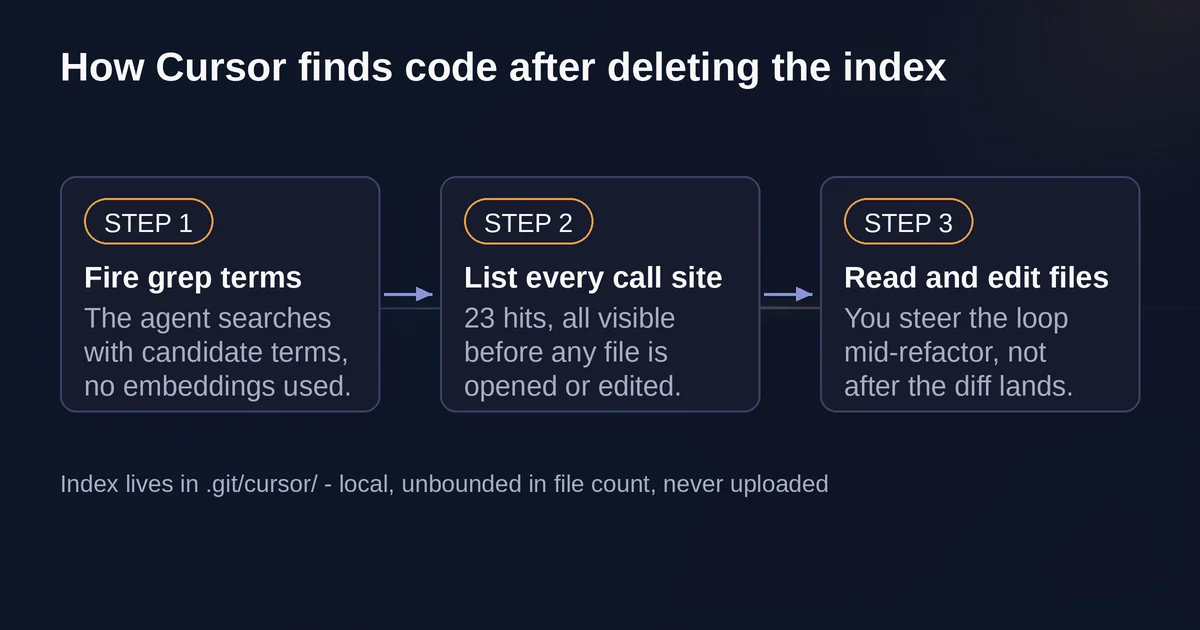
The reasoning Cursor gives is that frontier models got good at search: when the agent needs code whose name it does not know, it does not need a semantic lookup, it can fire several candidate grep terms in parallel, list directories, and read files to refine. Cursor's own changelog shows the same philosophy spreading: the @Codebase tool was removed from Ask mode because agents now search the codebase automatically.
For the refactor test, this means Cursor's discovery loop is transparent and verifiable. You watch the agent grep for retryWrapper, find 23 call sites, and read each one. When it works, it works visibly, and you can intervene early. The acknowledged cost is concept search: "where do we handle payment failures?" needs a seed token, and on codebases with inconsistent naming the agent burns extra turns guessing terms. Cursor's team admits the tradeoff; their claim is that current models handle it well.
Cursor's retrieval story keeps evolving: in September 2026 it launched Origin Code Hosting in early beta, with repos, pull requests, and GitHub sync on all paid plans.
Devin Desktop's bet: the IDE becomes an agent manager
If Cursor's move was "simplify retrieval and trust the model," Cognition's move with Devin Desktop was structural. The June 2 rename was cosmetic compared to what shipped underneath, per the official announcement:
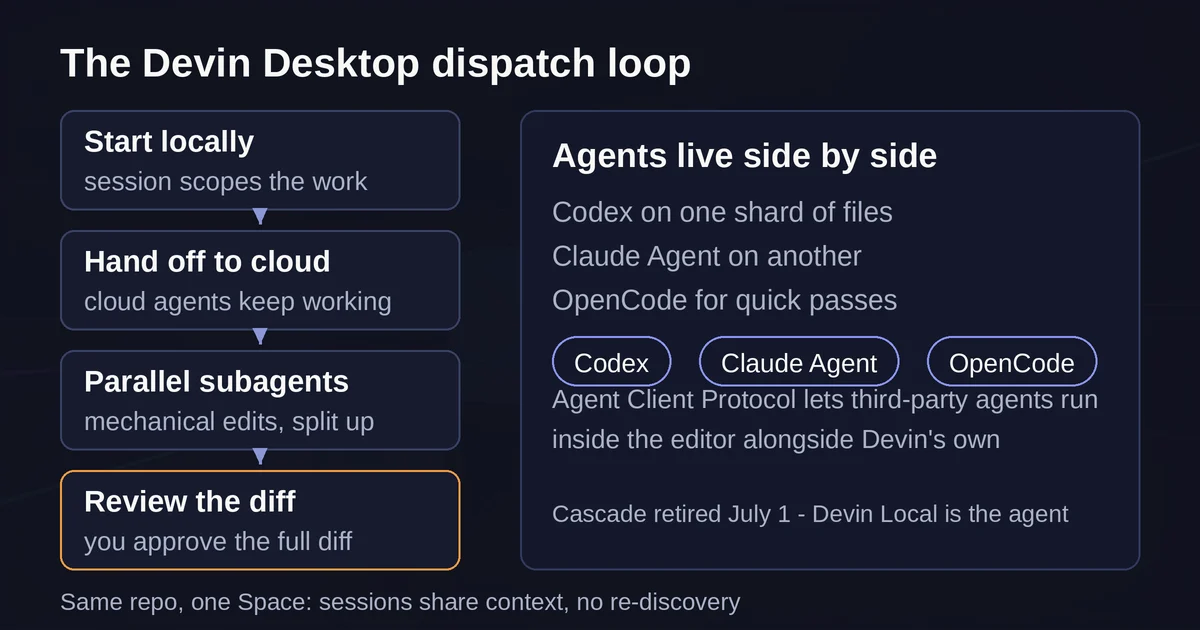
- Devin Local replaces Cascade. The agent that made Windsurf famous was rewritten from scratch in Rust. Cognition claims it is up to 30% more token efficient and adds subagent support. Legacy Cascade hit end-of-life on July 1, 2026, so if you are returning to Windsurf after a break, your muscle memory points at a retired agent.
- The Agent Command Center is the default surface. A Kanban view where local Devin Local sessions and cloud Devin sessions live side by side. You are no longer primarily editing code; you are dispatching and reviewing agents.
- Spaces share context across agents: sessions, PRs, and files grouped so parallel agents are not each rediscovering your repo from scratch.
- The Agent Client Protocol (ACP) lets third-party agents, Codex, Claude Agent, OpenCode, run inside the editor alongside Devin's own.
The retrieval layer for a big refactor is murkier. Windsurf's "Fast Context" engine, the automatic repo awareness that Cascade used, still appears as a premium plan feature. But per the Devin Desktop FAQ, launch-day Devin Local shipped without several Cascade capabilities developers relied on: the Fast Context UI, Codemaps, persisted Memories, and Workflows. Some of that is migration debt rather than deletion, but the thing you would buy the tool for on a large refactor, deep automatic codebase awareness, is the thing in flux.
The strong card for the refactor test is handoff: start the refactor locally, push the long tail of mechanical edits to Devin Cloud, and agents keep grinding after you close the laptop. For a 400-file change with a review gate at the end, that shape, dispatch, delegate, review the diff, is arguably the more realistic future of large refactors than one heroic local session. And if you like mixing models and agents per job, the same instinct that has developers using multiple AI programming tools is what ACP formalizes: Codex on one shard of files, Claude Agent on another, all in one command center.
Where each one wins on large repos
Cursor wins when discovery is the hard part. Transparent, local, unbounded search means you can audit exactly which files the agent considered before it touches anything, and .cursorignore gives precise control over what is off-limits. If your refactor's risk is "it edited a file it should not have," Cursor's approach is easier to trust and to debug. Its background cloud agents cover the parallel-work case too.
Devin Desktop wins when volume and time is the hard part. A refactor that is 70% mechanical edits across hundreds of files plays to subagents, quota-pooled cloud sessions, and the hand-off-and-review workflow.
Both are weaker than their marketing suggests when the refactor is genuinely architectural. Neither grep nor Fast Context substitutes for a design conversation. If the right answer is "extract a service and invert a dependency," the agent's retrieval matters far less than the plan, and that is where Model Context Protocol-connected tools and your own scoping discipline carry the day.
Pricing: converging numbers, different meters
Both vendors now anchor at the same price points, which makes the structure of billing the differentiator.
Cursor lists Hobby free, Pro at $20/month (with Pro+ and Ultra tiers above it for heavier agent use), Teams at $40 per user per month, and custom Enterprise, per its pricing page. Usage is metered as model usage with on-demand overage billed in arrears.
Devin Desktop lists Free, Pro at $20/month, Max at $200/month, Teams at $80/month plus $40 per full dev seat, and custom Enterprise; see windsurf.com/pricing, which now serves Devin's plans. Quotas refresh daily and weekly, and overage is billed at API pricing. A March 2026 overhaul retired Windsurf's old credit packs in favor of these quotas, and SWE-2, Cognition's coding model, is free in Devin Desktop and CLI through October 10, 2026.
For the refactor workload specifically, the meter matters more than the sticker. A repo-wide agent session is a worst-case consumer, so on Cursor you are watching dollar pools drain per model call, while on Devin Desktop a bad day burns a daily quota that resets tomorrow. Neither is cheaper in the abstract; the question is whether you prefer predictable windows or metered freedom.
Pricing and plan details are as published by the vendor around September 2026 and can change - confirm on the official site.
The verdict
If the question is literally "which one does multi-file refactoring best right now, in September 2026," my answer is Cursor, by a modest margin that is mostly about transparency. Its post-embeddings retrieval is auditable, locally stored, unbounded in file count, and the agent's search behavior is something you can steer mid-refactor instead of discovering problems in the diff afterward.
Devin Desktop is the more interesting bet, and for monotonous, high-volume refactors with a human review gate, its dispatch-and-delegate shape is genuinely better than sitting in one long local session. But you are adopting a product mid-pivot: the agent is new, beloved Cascade-era features are still landing in Devin Local, and the Fast Context workflow story is incomplete today. If you are choosing for a team, that flux is a real cost.
The uncomfortable truth both products confirm: retrieval stopped being the moat. Cursor deleted its index because models search well enough on their own, and Cognition folded an entire IDE into an agent fleet manager because the editor matters less than the orchestration. For your next big refactor, pick based on workflow, Cursor for surgical, auditable sessions, Devin Desktop for volume with review gates, and spend the saved evaluation energy on scoping the refactor into steps an agent can actually verify.
FAQ
Is Windsurf still available in September 2026? No. Windsurf became Devin Desktop on June 2, 2026 via an automatic update. The editor, extensions, and settings carried over, but the Cascade agent was retired on July 1, 2026 and replaced by Devin Local.
Does Cursor still index your codebase?
Not semantically. Cursor removed embeddings-based codebase indexing in mid-2026. Agents now use Instant Grep with a local per-repo index stored in .git/cursor/, and no code embeddings are computed or stored on Cursor's servers.