Key Facts at a Glance
- Created by: Anthropic, released November 2024
- Governed by: the Linux Foundation's Agentic AI Foundation, since December 2025
- Adopted by: OpenAI, Google DeepMind, Microsoft, and thousands of dev teams
- Today: the largest spec revision since launch, 2026-07-28, finalizes today
The Problem It Solves
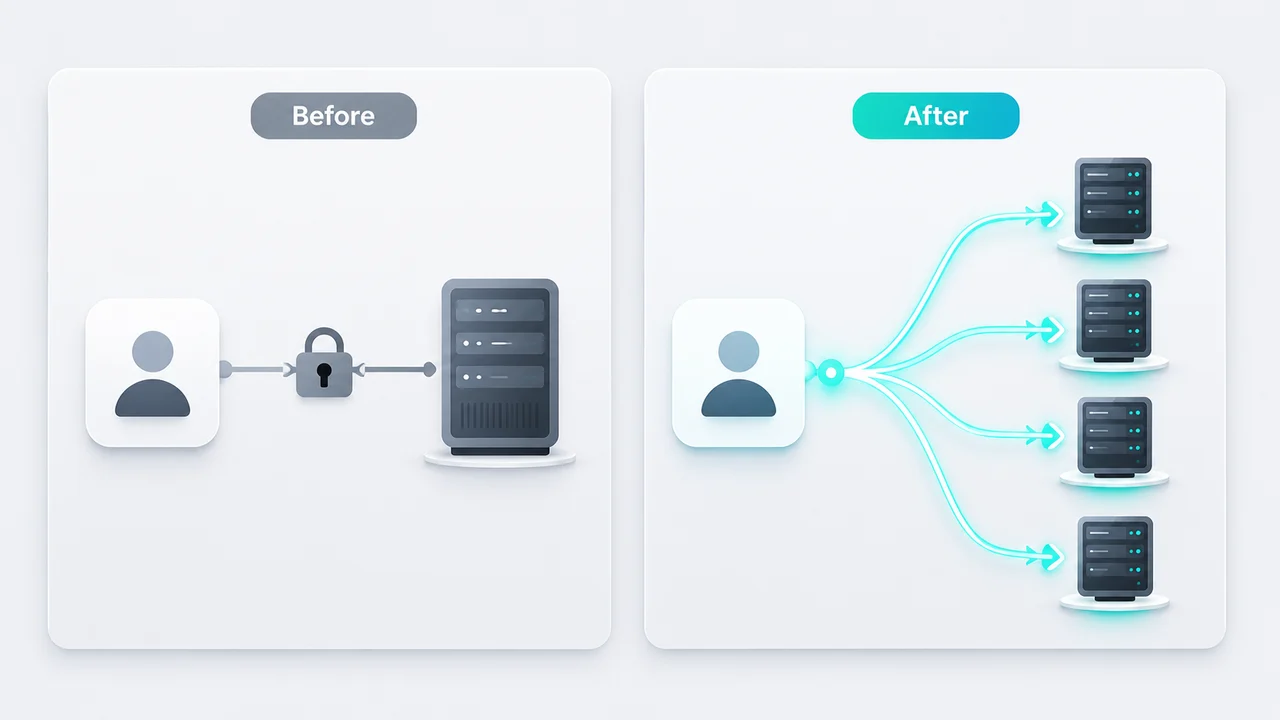
Before MCP, every AI-to-tool connection was custom-built, ten apps talking to a hundred tools meant up to a thousand fragile, one-off integrations. MCP replaces that with one protocol: build theconnection once, and it works with any MCP-compatible AI tool.
One developer described spending two weeks building a custom CRM plugin, then replacing it with an MCP server built in about four hours, one that worked with every model in their stack afterward. That ratio is the whole business case
How It Works
| Primitive | What it is | Who controls it |
|---|---|---|
| Tools | Functions the AI can call (create a file, query a database) | The model decides when |
| Resources | Data the AI can read (files, records, API responses) | The app or user decides |
| Prompts | Reusable templates for structured tasks | The user selects it |
Messages run on JSON-RPC 2.0. The real value: any MCP-compatible tool (Claude Code, Cursor, Windsurf, VS Code) talks to any MCP server without either side needing to know about the other in advance.
Who's Actually Using It
Not a niche standard a handful of teams are experimenting with:
- OpenAI: adopted MCP within about four months of its release
- Google DeepMind and Microsoft: followed within the same year
- Ecosystem scale: thousands of MCP servers now exist, spanning databases to deployment platforms, with SDKs seeing tens of millions of monthly downloads
- Governance shift: Anthropic handed control to the Linux Foundation in December 2025, turning MCP from a company-owned standard into a community-governed one, part of why rivals adopted it instead of building their own
Why This Actually Matters for You
- Build once, work everywhere - one MCP server connects your tool or database to ChatGPT, Claude, Gemini, and whatever launches next, with no rewrite each time a new model ships
- Less integration maintenance - replaces a custom, fragile connector per model with a single standardized one
- A real win for SaaS products - wrapping your API and docs in an MCP server lets coding assistants like Cursor or Claude Code answer questions about your product accurately, cutting support load without you building a chatbot yourself
What's Changing Today
"The most substantial changes we have made to the specification, probably since adding authorization." - Anthropic's David Soria Parra
- Goes stateless- the initialize handshake and Mcp-Session-Id header are removed, ending the sticky-session infrastructure production deployments used to need
- Scales easier - servers can now use ordinary round-robin load balancing
- Extensions go official - including MCP Apps (server-rendered UI) and a Tasks extension for
- long-running work
- Auth tightens, aligning more closely with OAuth 2.1 and OpenID Connect
- Some features deprecate (Roots, Sampling, Logging) but stay functional for a minimum 12 months
Not fully backward compatible, if you maintain an MCP server, check the migration notes this week.
What MCP Is Not
Does it replace REST APIs? No. MCP wraps existing APIs in a layer an AI model can discover and call correctly, it doesn't replace them for human or traditional service use.
Final Verdict
MCP is closer to plumbing now than a trend: unglamorous, mostly invisible when it works, and increasingly assumed by default. If an AI model needs to touch a real tool or workflow, a custom integration is now the harder path.
Sources & Official References
- Model Context Protocol Specification: modelcontextprotocol.io
- MCP 2026-07-28 release candidate: https://blog.modelcontextprotocol.io/posts/2026-07-28-release-candidate
- Anthropic, MCP announcement: https://www.anthropic.com/news/model-context-protocol
Reflects the protocol's status as of July 28, 2026. Check the official specification for the current version before building against it.