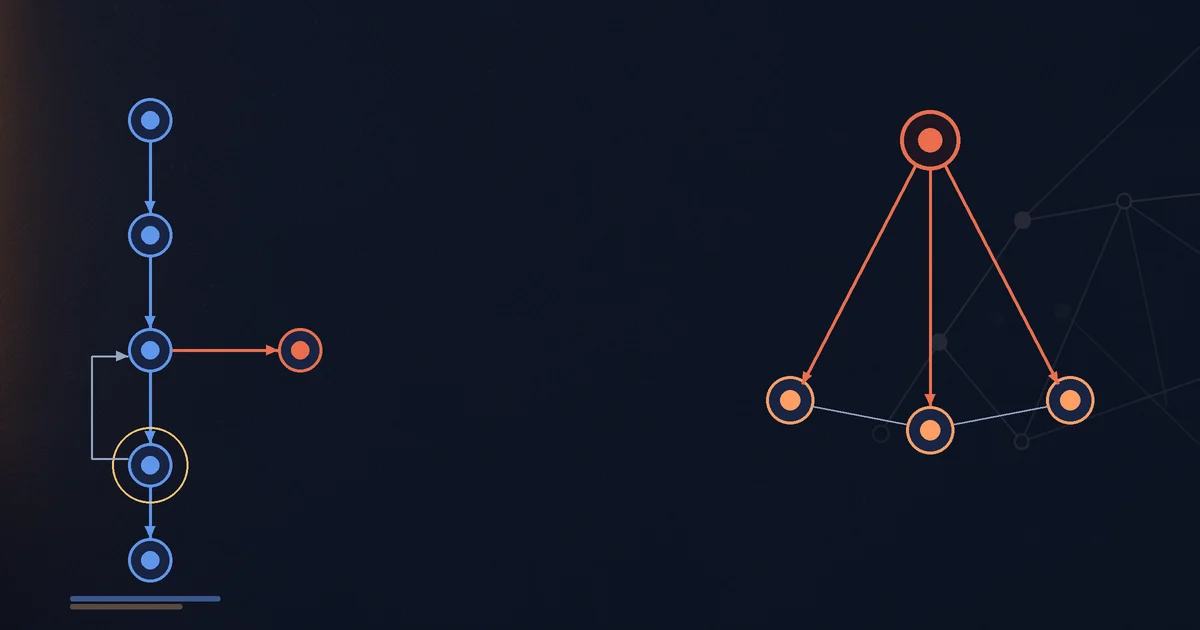
LangGraph and CrewAI both solve the same problem, the orchestration layer between your Python code and a pile of LLM calls, but they answer it with opposite philosophies. LangGraph says: model the workflow as an explicit state machine and keep every step inspectable. CrewAI says: describe a team of role-playing agents and let the framework handle the plumbing. By September 2026 both have matured into production-grade tools, LangGraph at version 1.2.x and CrewAI on its 1.15.x line, and the choice between them is more about the shape of your problem than the quality of the code.
This is the deep head-to-head. If you want the wider field, including where alternatives fit, our broader framework survey covers that. Here we stay narrow: state graphs versus crews, determinism versus delegation, and which builder profile each framework actually fits.
Two mental models: state machines versus teams
LangGraph's core abstraction is the graph. You define a State, a shared data structure that snapshots your application, then attach Nodes (functions that do work and return state updates) and Edges (functions that decide what runs next). Nodes and edges are just functions. They can call an LLM or do plain Python. Execution proceeds in discrete super-steps inspired by Google's Pregel: a node activates when it receives a message, runs, publishes updates, and the graph terminates when nothing is active and no messages are in transit. You must compile the graph before running it, and that compile step is where you attach checkpointers and breakpoints.
The consequence of this model is that control flow lives in your code, not in a model's judgment. If an edge says "after validation, go to the escalation node," it goes there. Every time. The state schema, usually a TypedDict or dataclass, plus reducer functions that define how updates merge, gives you a typed, inspectable record of everything that happened.
CrewAI's core abstraction is the crew: a collaborative group of agents, each defined by a role, a goal, and a backstory, working through a list of tasks. The default process is sequential, where each task's output feeds the next agent's context. The interesting mode is hierarchical: you supply a manager LLM, and it receives the objective, decomposes it into subtasks, delegates to your specialists, and validates results before proceeding. Task decomposition itself becomes an LLM decision.
That is the real philosophical split. In LangGraph, decomposition is something you did when you designed the graph. In CrewAI hierarchical mode, decomposition happens at runtime, by a model, based on the objective you gave it. One is an architecture you can draw on a whiteboard before deployment. The other is closer to hiring a team and trusting the lead.
Where determinism matters, and where it gets in the way
If you are building production workflows, and by that I mean things with audit trails, retry semantics, compliance requirements, and an on-call rotation, determinism is not a nice-to-have. It is the difference between debugging and archaeology.
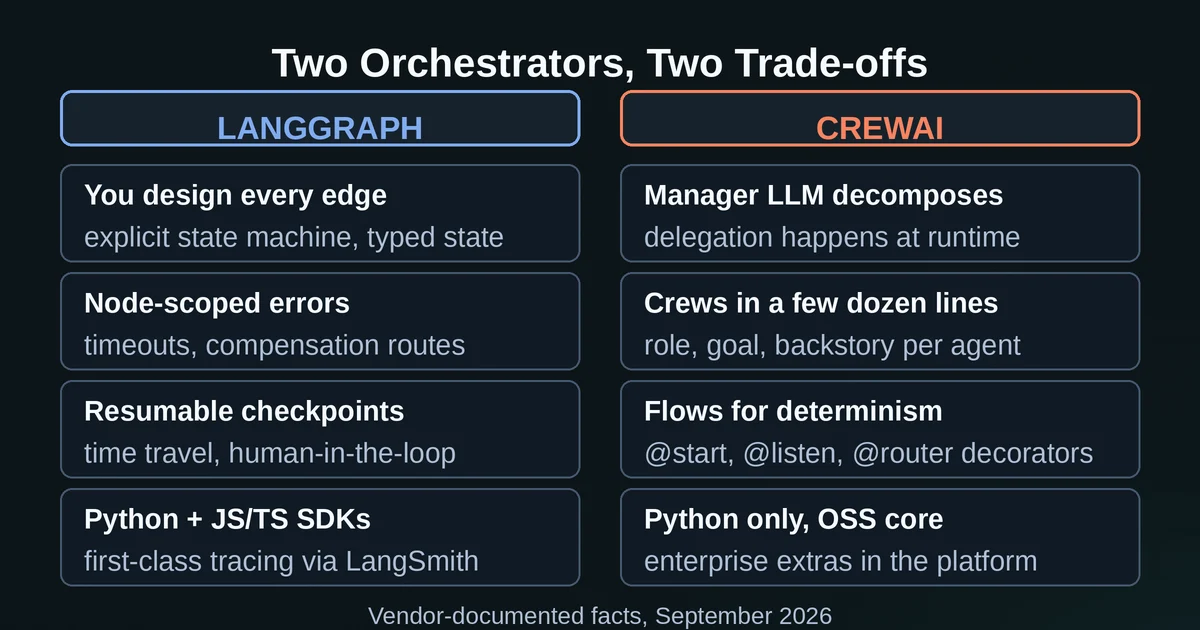
LangGraph's 2026 releases show exactly where the project is aiming. The v1.2 changelog added per-node timeouts with typed policies, node-level error handlers that can route to a compensation node after retries are exhausted (a Saga pattern, in effect), graceful shutdown that drains a run after the current super-step and saves a resumable checkpoint, and DeltaChannel, a channel type that stores only incremental deltas instead of re-serializing accumulated state at every step. That last one matters for long-running threads where the message history grows large; snapshot frequency becomes a tunable instead of a tax. Add the checkpointer architecture that has been there since earlier 1.x, and you get time travel, replay from any checkpoint, and human-in-the-loop interrupts that resume exactly where they stopped.
CrewAI knows this is its historical weak spot, and the 1.15.x line is a direct response. Flows give you event-driven pipelines built on decorators: @start marks entry points, @listen fires when a method completes, @router handles conditional branching, and state can be structured Pydantic or untyped, with a UUID per execution for tracking. Recent releases pushed this further with FlowDefinition (script and code-block actions, composite "each" steps), DMN mode support, and JSON-first crew projects, all of which push CrewAI toward declarative, reproducible orchestration. Crews themselves also gained an automatic checkpointing option and CLI task replay.
So the honest Sep 2026 picture: the determinism gap has narrowed. CrewAI Flows are genuinely deterministic where they say they are. But the framework's signature experience, hierarchical crews with a manager agent delegating work, remains probabilistic by construction. If the manager LLM misjudges the decomposition, the whole run takes a different path, and you find out from the output. There is a reason LangGraph's error handling story is node-scoped and typed: when a node fails, you know which node, which edge led there, and which state snapshot to resume from.
The flip side is that determinism has a cost. LangGraph makes you design the graph. Every branch, every loop, every parallel fan-out is your responsibility. For exploratory work, where you do not yet know what the workflow should be, that upfront design is premature. A crew where a reasonably smart manager figures out the decomposition is a faster way to learn the shape of a problem. Simplicity is not a failure mode; it is a phase.
The orchestration ceiling each framework hits
Every abstraction has a ceiling, and it helps to know where each one cracks before you build on it.
LangGraph's ceiling is upfront effort and team semantics. Graphs scale beautifully with complexity of control flow, but they never give you "a team" as a primitive. There is no built-in notion of an agent that owns a responsibility area and negotiates with peers; you build that out of nodes, shared state, and routing logic, and you rebuild it every project. The learning curve is real: state schemas, reducers, checkpointers, super-step semantics, and in 2026 both a Graph API and a Functional API to choose between. For a solo prototype this is a lot of ceremony. For a platform team standardizing how the whole company builds agents, that ceremony is the product.
CrewAI's ceiling is delegation opacity and runtime scale. When the manager agent works, it feels like magic. When it does not, you are debugging a decision a model made at runtime, and the failure modes are harder to reason about than a misrouted edge. The manager's judgment affects the entire crew, and a bad decomposition propagates. The framework is also Python-only, there is no official JavaScript or TypeScript SDK, which matters if your platform spans languages. And while CrewAI's open-source core covers a lot, some capabilities sit behind the enterprise platform: exposing a crew as an MCP server endpoint, for instance, is documented in enterprise guides rather than the OSS package. Observability exists via tracing integrations, but LangGraph's path to first-class tracing through LangSmith is tighter.
Both frameworks have converged on the same connectivity layer: Model Context Protocol support. If your agents need to reach internal databases, SaaS APIs, or MCP-exposed tools, either framework gets you there; our MCP explainer covers what that protocol actually does.
Verdict by builder profile
There is no single winner, so here is the decision rule by profile.
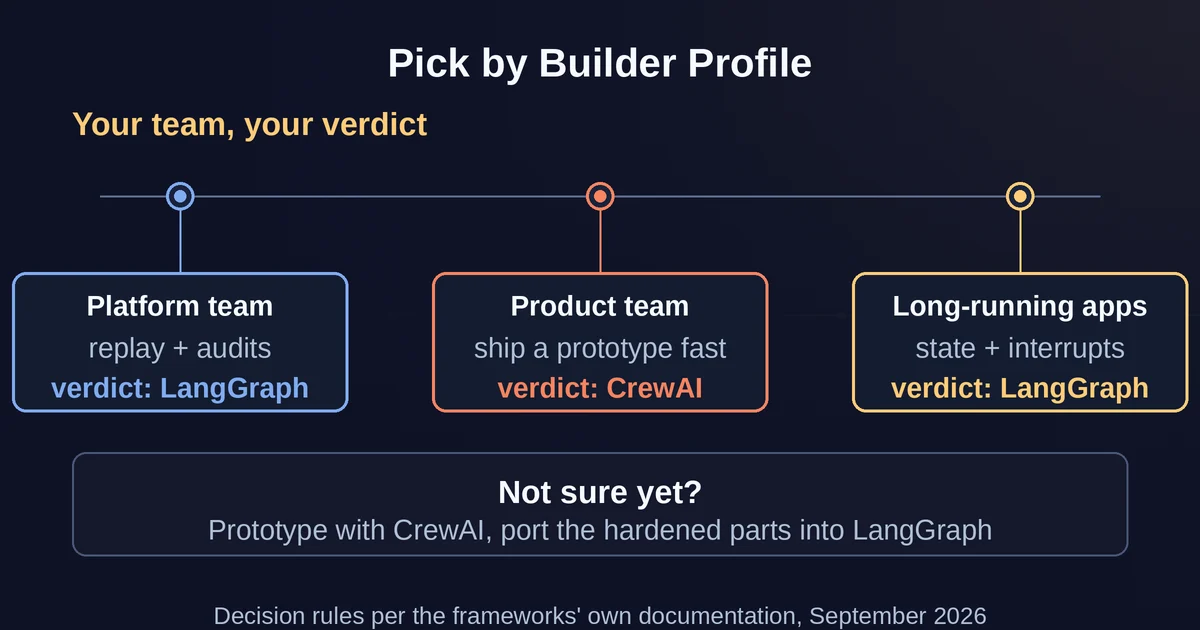
Platform or infrastructure team: LangGraph. The 1.2.x fault-tolerance features, timeouts, error handlers, graceful shutdown, delta channels, read like a requirements list from an SRE review. Checkpoints and typed state give you replay and auditability as architecture, not as an afterthought.
Product team shipping an exploratory feature fast: CrewAI. A sequential or hierarchical crew is a working multi-agent prototype in a few dozen lines, and if it proves out, Flows give you a credible path to production determinism without changing frameworks.
Team building stateful, long-running, human-in-the-loop apps: LangGraph, decisively. Interrupts, resumable checkpoints, and the persistence model are the core design center, not an add-on.
Team that wants delegation and adaptability at runtime: CrewAI hierarchical mode. If the value of the system comes from a model deciding how to split work, LangGraph makes you encode what should stay dynamic.
Polyglot organization: LangGraph today. LangGraph has a JavaScript/TypeScript ecosystem alongside Python; CrewAI is Python-only.
And a practical note for teams caught in between: the two are not mutually exclusive in a portfolio. CrewAI crews can be invoked as steps inside a LangGraph graph (CrewAI exposes a run interface that is straightforward to wrap in a node), so a common Sep 2026 pattern is LangGraph owning the deterministic spine: state, checkpoints, escalation paths, while crews handle fuzzy subproblems where a role-based team outperforms a hand-drawn branch.
Two questions people actually ask
Should I learn LangGraph if I already know LangChain? Yes, and it is cheaper than it used to be. LangChain 1.x and LangGraph 1.x were designed together; the higher-level create_agent factory in langchain is itself built on LangGraph. If you know LangChain's components, you already know half of LangGraph's vocabulary.
Is CrewAI production-ready in 2026? The core is MIT-licensed, stable at 1.15.x, and shipping frequent releases, including security fixes. The open-source package handles orchestration well; heavy production needs like compliance certifications, managed deployment, and audit logging sit in the paid enterprise platform. So: production-ready, with the usual caveat that the more enterprise the requirement, the more you are buying a platform, not just using a library.
Choosing between these two is less "which is better" and more "which failure am I more willing to debug": an over-engineered graph, or an under-specified team. If your system needs to behave the same way twice, pick the graph. If your system needs to figure out what to do, pick the team. And if you are not sure yet, prototype with CrewAI and port the parts that hardened into LangGraph, or start with our guide on where agents beat classic automation before you commit to either.