Voice is the hardest interface in software. A chatbot that takes four seconds to reply is fine; a phone agent that takes four seconds is a caller poking at the keypad wondering if the line dropped. Everything about building a conversational voice agent comes down to one unforgiving constraint: the pause between one person finishing and the other starting. In human conversation that gap runs a couple hundred milliseconds. Get your agent near that and people stop noticing it is a machine, or at least stop caring. Get it wrong and the most beautiful voice model on the planet reads as a buffering video call.
That constraint is what ElevenLabs built its agents platform around. If you looked at the company's "Conversational AI" product a year ago and wrote it off as a TTS API with a chat loop bolted on, it is worth a second look in September 2026. The product has been renamed and rebuilt into ElevenAgents, a full hosted runtime for voice agents, and it is now one of the few places where you can get speech recognition, reasoning, speech synthesis, and turn-taking from a single vendor with a single latency budget. Here is what it actually is, how the pieces fit together, and what it costs to run a support agent on it.
What ElevenAgents actually is in September 2026
Strip away the branding and ElevenAgents is a managed pipeline: audio goes in from a phone call, browser widget, or mobile app, and speech comes back out, with an LLM deciding what to say in between. The official docs describe agents that "accomplish tasks through natural dialogue," which in practice means the agent can look things up, call tools, and take actions mid-conversation.
The platform layers on the operational pieces that separate a demo from a support line you can actually point callers at:
- A visual workflow builder for multi-step call flows, plus system prompt configuration
- Your choice of hosted LLM, or a custom model endpoint (the docs cover Cloudflare and Groq Cloud integrations, and you can bring any OpenAI-compatible server)
- A knowledge base with RAG, so the agent answers from your help docs instead of improvising
- Tools and hosted MCP servers, letting the agent hit your CRM or order system mid-call
- Telephony via SIP trunks and providers like Twilio, an embeddable web widget, and native SDKs for React, Swift, Kotlin, and React Native
- Testing, evals, versioning, post-call webhooks, and conversation analytics for the production phase
If you are coming at this from the text-chatbot world, the interesting shift is that voice collapses the tolerance for everything. That is worth understanding before touching the architecture, because it shapes every design decision downstream, a theme we dug into in our piece on why AI agents are replacing chatbots.
The architecture: four stages, one latency budget
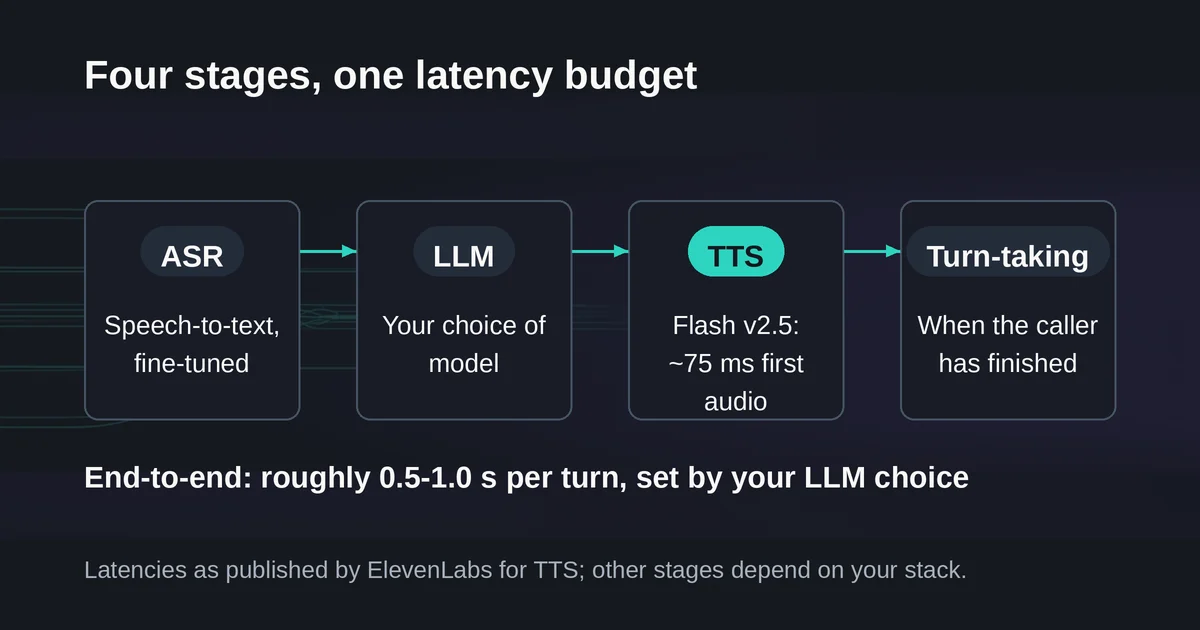
ElevenLabs publishes the pipeline plainly: a fine-tuned speech-to-text model, the LLM of your choice, a low-latency text-to-speech model drawing on 5,000+ voices across 70+ languages, and a turn-taking layer that decides when the caller has actually finished, when to interrupt, and when to stay quiet. The first three are the classic ASR, LLM, TTS chain. The fourth is the piece people underestimate, and it is what makes or breaks the "natural inflection" experience.
The turn-taking layer is what stops the agent from talking over a caller who paused to breathe, or from waiting three seconds of dead air before realizing the sentence was over. You configure it directly: the docs expose turn-taking, interruption, and timeout settings as first-class options. On a phone line, this is the difference between a conversation and two walkie-talkies.
Where does the time actually go? The only stage where ElevenLabs publishes hard numbers is TTS, and those are worth knowing cold:
- Eleven Flash v2.5 is the workhorse: roughly 75ms to first audio (model inference only, excluding application and network overhead), 32 languages, and about half the per-character price of the flagship models. It was designed explicitly for the agents platform.
- Eleven v3 Conversational is the expressive option: around 280ms to first audio, but with audio tags that let you script pauses, emphasis, and emotional delivery, across 70+ languages. The docs name support agents as a use case for it.
Add ASR, the LLM's first token, and network round trips, and your realistic end-to-end budget lives somewhere between half a second and a second, depending almost entirely on which LLM you pick and whether tools fire mid-turn. A fast hosted model gets you a conversation that feels snappy. A heavy reasoning model with a CRM lookup can push a turn past a second, at which point callers start to wonder about their signal. The engineering discipline is treating that total as a hard budget and spending it deliberately, because no TTS model, however fast, can rescue a slow brain.
A concrete build: a support line in an afternoon
Say you want an agent that answers "where is my order" calls:
- Create the agent. In the ElevenLabs dashboard (or via the Architect tool, which drafts agent configs for you), give it a first message, a system prompt, and a voice. For support, pick a calm voice and resist the urge to make it chirpy at 2am.
- Pick the LLM with latency in mind. Try a fast hosted model first. The docs include a cost calculator for expected LLM usage per agent, which tells you before deployment whether your clever reasoning model is affordable at your call volume.
- Wire the tools. Add a webhook or hosted MCP tool that takes an order number and returns status. If you are already using MCP in your stack, our MCP protocol explainer covers the pattern; the same servers your other agents use can often be reused here. Keep tool responses under about half a second, and if the lookup is slow, configure the agent's timeout behavior so it fills silence with "let me check that for you" rather than dead air.
- Ground it. Upload your returns policy and FAQ to the knowledge base and enable RAG, so policy answers come from your documents, not the model's imagination.
- Connect a channel. Embed the web widget on your support page, or attach a phone number through your telephony provider. For voice, the SDKs default to WebRTC for the browser and standard telephony integrations for calls.
- Test before trusting. The platform ships agent testing and evals. Run your top 20 real caller questions through it before opening the floodgates, then watch conversation analytics for turns where the agent went silent or a tool timed out.
None of this is exotic. The honest observation from teams running these in production is that the pipeline is the easy 20%: the real work is idempotent CRM writes, sensible handoff triggers to a human, and guarding the latency budget on every turn.
What it costs to run
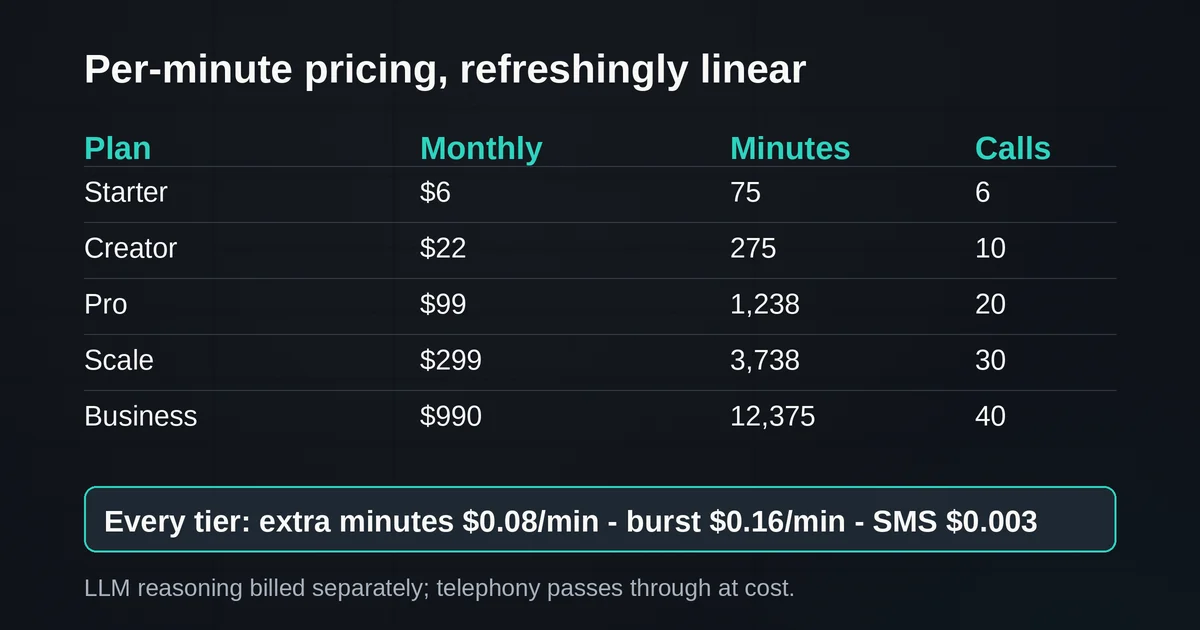
ElevenAgents pricing is billed by call minutes, and it is refreshingly linear. The Free tier includes 15 minutes with 4 concurrent calls, which is enough to test but not to serve. Paid tiers scale the included minutes and concurrency:
| Plan | Monthly | Included minutes | Concurrent calls |
|---|---|---|---|
| Starter | $6 | 75 | 6 |
| Creator | $22 | 275 | 10 |
| Pro | $99 | 1,238 | 20 |
| Scale | $299 | 3,738 | 30 |
| Business | $990 | 12,375 | 40 |
Beyond the included minutes, additional calls cost $0.08 per minute on every tier, burst capacity (for sudden call spikes) costs $0.16 per minute, and text messages run $0.003 each. TTS, speech-to-text, knowledge bases, RAG, and telephony are included on all plans.
The catch is the line item nobody budgets for: the LLM. Reasoning costs are billed separately and "vary by model," and telephony provider fees pass through at cost. So the true per-minute figure for a support agent is $0.08 plus your LLM tokens plus phone-company charges. A modest setup on a mid-tier hosted model lands somewhere in the $0.10 to $0.15 per minute range all-in, which against even the cheapest offshore contact center seat is not close. A 5,000-minute-per-month support line on the Pro plan costs $99 plus overage (about 3,700 extra minutes at $0.08 is roughly $296) plus LLM spend, and answers calls at 3am without a queue.
Pricing and plan details are as published by the vendor around September 2026 and can change, so confirm on the official site before committing.
Where it is not the right tool
Fair balance: if your support volume is ten calls a day, a $99 IVR from your phone provider plus a good callback form will beat this on simplicity. If your conversations are deeply scripted (appointment reminders, payment capture), a simpler voice API without an agent loop is cheaper and more predictable. And if you need fine-grained control over every acoustic nuance of a branded voice, you will wrestle with the tradeoff between Flash v2.5 speed and v3 Conversational expressiveness, because you cannot yet get both extremes in one model.
The real strength is the middle: open-ended support conversations where callers ask unexpected questions, interrupt, and change their minds, and where sounding human buys patience. That is precisely the pattern the platform was tuned for, and where chaining your own ASR, LLM, and TTS vendors tends to accumulate latency in all the wrong places.
Two questions people always ask
Is 500ms actually achievable? The TTS stage alone gets you to 75ms with Flash v2.5, and ElevenLabs' published figure for v3 Conversational is around 280ms. End-to-end sub-500ms depends on your LLM choice and tool latencies more than on ElevenLabs; a fast hosted model with no tool calls gets close, a reasoning model does not.
Can callers tell it is AI? With v3 Conversational voices, inflection and hesitation are good enough that most callers do not comment on it unprompted, especially on phone-line audio. Compliance still requires disclosing it is an AI agent in many jurisdictions, so disclose, and use that naturalness to make the disclosure land softly.
The verdict: for teams building a real support phone line in 2026, ElevenAgents is the most complete single-vendor voice stack available, and the per-minute math works as long as you watch the LLM bill. Build the pipeline in an afternoon, then spend a week on handoffs, tool reliability, and latency. The second week is what makes it production.