Somewhere in your publishing workflow, right now, there is an image nobody can prove is real. Maybe it came from a wire service. Maybe it came from a freelancer. Maybe it came from a source who screenshotted it off a Telegram channel. And somewhere in the back of your mind lives the question every editor is tired of asking: is this AI?
The obvious answer is to run it through an AI image detector. Dozens of them exist in September 2026. The less obvious answer, and the one that actually holds up under pressure, is to stop asking "does this look fake to a model" and start asking "can this file prove where it came from." Those are different questions with very different reliability levels, and the gap between them is the whole story of media verification right now.
The honest answer about AI image detectors
Start with the uncomfortable part. Purely statistical detectors, tools that inspect pixels and guess whether a model made them, have a track record that no serious newsroom should treat as final verdicts.
Consider what happened when the roundups and benchmarks of 2026 put these tools head to head. An Undetectable.ai test published in February 2026 ran ten AI-generated images, most of them from Google's Nano Banana, through five detectors. TruthScan classified all ten correctly at high confidence. Winston AI, meanwhile, caught three. Same images, same day, wildly different results. Independent benchmarking tells a similar story: tools score well on outputs from major generators like Midjourney and DALL-E, then fall apart on rarer pipelines, on heavily compressed files, and on images that were real photographs with a few AI edits sprinkled in.
The failure modes run in both directions, which is what makes detectors dangerous as a sole decision tool. A false positive brands a real photo fake, which can end a photographer's credibility. A false negative launders a fabrication through your publication. Compression, resizing, and screenshots routinely scramble the statistical artifacts these models rely on. And the generators adversarial actors actually use are precisely the ones least likely to cooperate with watermark-based detection, because watermarking only exists when the generator's creator chose to add it.
Human eyes do no better. A widely cited 2025 iProov study found that only 0.1% of participants correctly identified all real and manipulated content, and people were about 36% worse at spotting fake videos than fake images. Other 2025 research put unaided human accuracy close to chance. The eyeball test is not a control; it is a coin flip with confidence.
DeepfakeDetector.ai and TruthScan, examined
So where do the two most-hyped tools of the moment actually land?
DeepfakeDetector.ai is a real product with a real free tier: 50 detections per month covering images, audio, and video, a browser extension for right-click checks on anything you encounter on the web, and a developer API. Its API design is unusually honest about the limits above. Every call returns one of three verdicts: Authentic, Likely Synthetic, or Inconclusive, alongside a TrustScore from 0 to 100. That Inconclusive option matters. A tool that admits when heavy compression has masked the signals it depends on is more trustworthy than one that always commits to a number. Files are purged within 60 seconds unless you opt into retention, which will matter to anyone handling sensitive material.
TruthScan is the enterprise engine behind DeepAI's free AI image detector, and its headline number, 97%+ accuracy, comes from the vendor-commissioned Undetectable.ai benchmark described above. It performed well there, but ten images from a competitor-run test is a reason to shortlist a tool, not a reason to believe it. Notably, it did not appear in AIMultiple's May 2026 independent benchmark, so there is no independent dated result to set against the vendor number. A sub-500ms API and batch processing make it plausible for production triage, but any accuracy percentage you read about it, treat as directional until third-party evidence exists.
The pattern to internalize: nearly every accuracy number in this market is vendor-reported or vendor-commissioned. When a tool refuses to publish a percentage and says, as one roundup noted, that "anyone claiming 100% is marketing to you," that skepticism is the product feature worth paying for.
C2PA: the standards answer to a detection problem
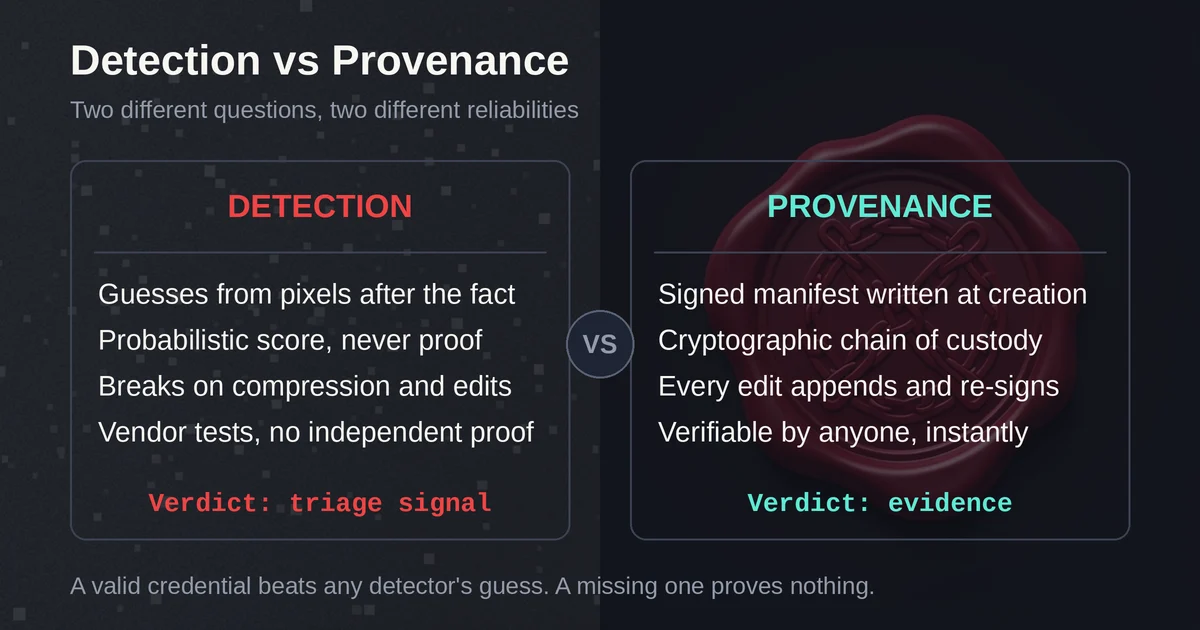
The deeper problem with all detectors is epistemological. Analyzing pixels after the fact is guessing. Knowing how a file was created is evidence. That is the bet the industry has now made in the form of C2PA, the open technical standard from the Coalition for Content Provenance and Authenticity, whose steering committee includes Adobe, Amazon, the BBC, Google, Meta, Microsoft, OpenAI, Sony, TikTok, and Truepic.
C2PA's Content Credentials, from the Coalition for Content Provenance and Authenticity, work like a nutrition label for digital content. A compliant camera, editing app, or AI generator writes a cryptographically signed manifest into the file recording what made the content, what was done to it, and whether AI was involved at any stage. Every subsequent edit by a supporting tool appends and re-signs. You cannot silently tamper with the record without breaking the signature chain, much like an HTTPS certificate.
The effect on your verification workflow is transformative, when the credential exists. You are no longer estimating whether pixels look synthetic; you are reading a signed declaration from the creating tool. A present, valid credential beats any detector's guess. When ChatGPT generates an image, OpenAI's tools attach C2PA metadata, and LinkedIn will show the CR icon when such a file is uploaded. The trap is the inverse case: a missing badge proves nothing. Most media online carries no credential at all, either because the tool never wrote one or because a platform stripped it on upload. Absence is not evidence of AI; it is evidence of no evidence.
That asymmetry is exactly how Ukraine's public broadcaster Suspilne decided to fight deepfakes. After a Zelenskyy deepfake circulated early in the war and a fake video misusing the Suspilne logo appeared in May 2024, the broadcaster spent a year working with BBC Media Action to sign its published photos at capture with C2PA-enabled Sony cameras, re-sign every crop and resize in its CMS using the open-source CAI Rust library, and attach CAWG assertions proving who published each image. Passing C2PA conformance took a little over a month. Readers can now see Content Credentials directly on Suspilne's site. As the broadcaster's own framing puts it, in wartime a cryptographic signature is the only defense that does not require the audience to rely solely on the publisher's word.
The real verification landscape for publishers in 2026
Neither approach alone covers a working newsroom. Here is what the layered stack looks like right now:
- C2PA Verify (the coalition's free web app at contentcredentials.org/verify): drag any file in, see the manifest, the edit history, and whether the signature validates. Runs locally in your browser, no account, nothing uploaded.
- Generator-side credentials: OpenAI attaches C2PA metadata to its image outputs; Google embeds SynthID invisible watermarks and C2PA signals, and surfaces provenance in Search's About this image; Adobe Firefly signs its generative output.
- Capture-side signing: Leica, Nikon, Sony, and Canon now ship C2PA-capable bodies; Pixel and Samsung devices sign at the phone. If your photographers control the chain, the chain holds.
- Statistical detectors as fallback: DeepfakeDetector.ai, AI or Not, DeepAI's TruthScan-powered checker for free single looks; Hive Moderation and Reality Defender for API-scale triage. Use them to prioritize human review, never to end an argument.
- Old-school forensics: reverse image search for earliest appearance, EXIF inspection, error level analysis. A fabricated image often appears suddenly with no earlier footprint, which no detector tells you.
What publishers should actually do
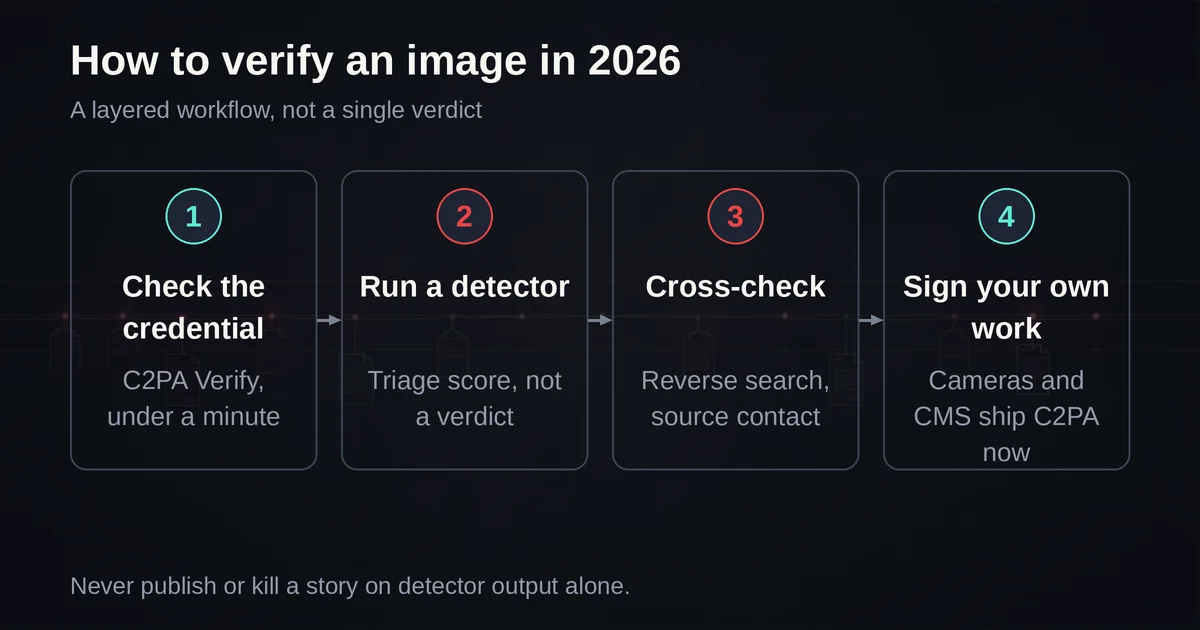
- Check the Content Credential first. It takes under a minute in the C2PA Verify app and, when present, it is your strongest signal.
- If no credential exists, run a detector, but treat the output as a triage score, not a verdict. Inconclusive is an acceptable and common outcome.
- Never publish or kill a story on detector output alone. Cross-reference reverse image search, original source contact, and human review.
- Start signing your own original photography. Camera support is shipping now, and the EU AI Act's Article 50 already mandates machine-readable marking of AI-generated and manipulated content, with C2PA as the leading open path to compliance. This is one of the hidden risks of AI nobody talks about: the liability lands on whoever publishes, not whoever generated.
- Publish the credential. The full value arrives when your audience can verify you, not just when you can verify others. Think of it as context engineering for your media pipeline: the metadata you attach now is the trust layer your readers consume later.
The verdict
DeepfakeDetector.ai and TruthScan are legitimate entries in a market that cannot, on its own, solve the problem they sell against. Detection is probabilistic and adversarial; provenance is cryptographic. The tools worth your budget are the ones that admit this, ship an Inconclusive verdict, and slot into a workflow where Content Credentials are checked first and detector scores are advisory. The publisher's real defense in 2026 is not a better guess. It is a signed chain of custody for everything you publish, and a signed question mark for everything else.
Frequently asked questions
Do AI image detectors actually work in 2026? Partially. On fresh, uncompressed outputs from major generators, good detectors score high; on edited, compressed, or niche-generator content, results degrade sharply. Nearly all headline accuracy numbers are vendor-reported. Treat detector output as one signal in a layered workflow.
Is a missing Content Credential proof an image is AI-generated? No. Most images online carry no credential because the tools in their chain never added one or a platform stripped it. A valid credential is strong evidence; its absence is no evidence at all.
Pricing and plan details are as published by the vendor around September 2026 and can change - confirm on the official site.