You ran ten usability sessions last week. Somewhere in those recordings is the answer to whether your onboarding redesign works, and you have a stakeholder review on Thursday. This is the moment AI research synthesis tools were built for: paste in the transcripts, let the model tag, cluster, and summarize, and walk out with themes.
Then it happens. The tool hands you a tidy list, and one theme says users found the checkout "confusing and expensive." But you sat through every session, and nobody said anything about price. The model read hesitation, a misheard word, and one participant's aside about their own budget, and braided them into a finding that never existed. You almost put it in the deck.
That is the real test of an AI synthesis tool in 2026. Not how fast it produces themes, but whether every theme survives you clicking through to the evidence behind it. The tools that pass are genuinely useful. The ones that fail will quietly write your research conclusions for you, with material you never gathered.
Why AI synthesis fails: the false theme
There is now actual research on this failure mode, and it names the problem precisely. A 2025 arXiv study, based on interviews with 21 UX researchers, product managers, and designers, found most participants reported low trust in AI-generated insights, for consistent reasons: lack of traceability, inconsistent outputs, missing content, and hallucinated or inaccurately attributed user quotes. A researcher in that study could not even tell whether a quote attributed to a participant had actually been said.
False themes come in four recognizable shapes:
- The braided quote. Fragments from different participants, or different moments, merged into one fluent "quote" nobody said. The most dangerous kind, because it reads like evidence.
- The over-cluster. One genuine issue split into three "themes" because participants worded it differently. Dovetail shipped a 2x improvement to Magic Cluster theme accuracy and granularity precisely because granularity errors are a known, actively-repaired failure mode, not a solved one.
- The generic-theme collapse. Themes like "users want the experience to be simpler" fit literally any dataset ever recorded. A theme that would survive in a competitor's data proves nothing about yours.
- The loud-participant theme. One talkative participant says something three ways, and the model promotes it to a major finding with a count of three.
The ACM Interactions piece on the synthetic persona fallacy calls the broader pattern epistemic freeloading: adopting the language and authority of research while abandoning its standards. In synthesis, the mild version is a confident theme with no receipts. The rule that fixes it fits on a poster: a finding that cannot be clicked back to a moment in the source data does not go in the report. Not as background color, not as "worth exploring." It does not exist.
What good synthesis actually looks like
Good AI-assisted synthesis has three properties, and they build on each other.
Every finding is evidence-linked. Each theme and summary sentence carries a pointer back to specific transcript moments, video timestamps, or session notes. Dovetail's docs describe this shape explicitly: Magic highlights are generated from project data, and the platform marks AI-generated content with its own contributor icon so you can filter to include or exclude machine-made material when you search. Looppanel builds its whole pitch around it; the product's analysis page says "trace data back to the source, edit, review and check AI notes, tags and search." Notably's repository automatically tracks where each piece of data came from and who contributed it. This is no longer a nice-to-have. In 2026 it is the dividing line between a research tool and a text generator.
The human owns the code frame. AI proposes, the researcher disposes. Notably's canvas is a good mental model even if you never use the product: the assistant clusters sticky notes by theme, sentiment, or journey stage, and you can move any note anywhere, because the point is that you stay in control of the interpretive layer. Dovetail offers the same control as a setting: Magic automation can run fully automated, offer suggestions, or be disabled per project. If your tool has no equivalent of that dial, treat its output as a rough draft of a rough draft.
Counts are honest. "8 of 10 participants struggled with the search bar" is a finding. "Several users had concerns" is a vibe. Any tool worth paying for shows, per theme, how many participants contributed evidence. A beautiful theme with no numerator is asking you to trust vibes with your reputation attached.
The workflow: from ten transcripts to a defensible read
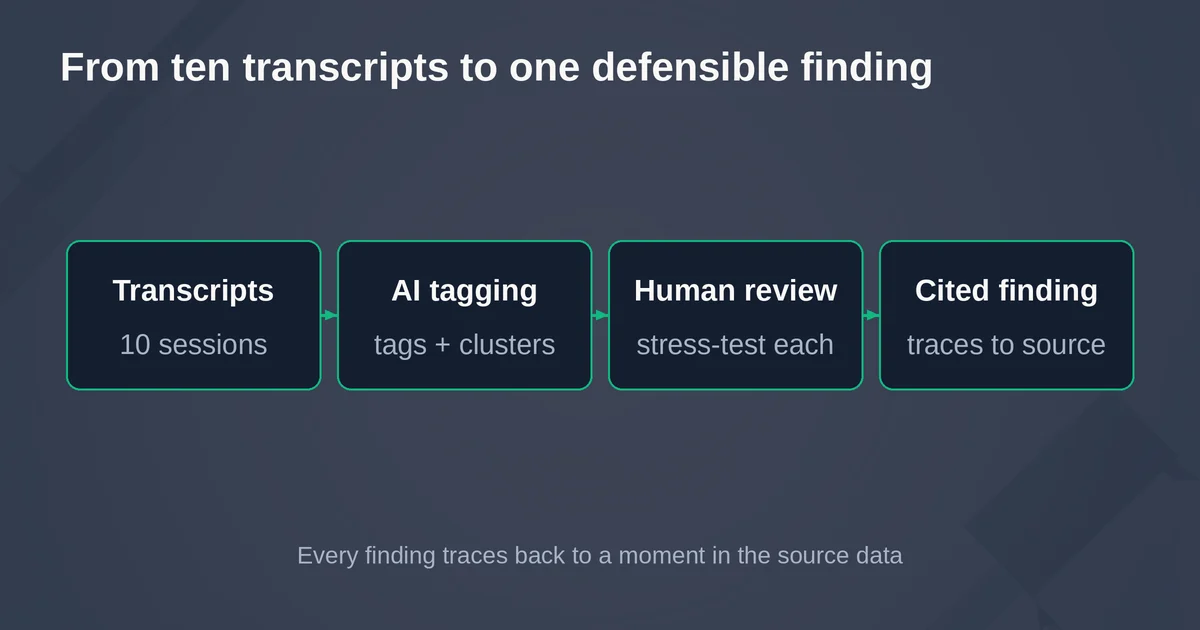
Here is a workflow that has held up well for interview, usability, and session-note data alike. It assumes roughly ten sessions.
- Ingest with structure. Import transcripts, recordings, and notes into one project, and attach metadata first: participant ID, session type, segment, date. Metadata is what later lets you ask "was this only the enterprise participants?"
- Auto-transcribe, then spot-check. Transcription is commodity-level now; Dovetail runs on Amazon Transcribe and AssemblyAI with automatic language detection, and Looppanel transcribes in 17 languages with unlimited hours on its Pro plan. Spot-check one minute per file anyway; misheard words are the raw material of braided quotes.
- Let the AI tag and highlight, but with your taxonomy. The best results come when the tool tags against a structure you defined, not one it invented. Looppanel tags by your discussion-guide questions or by theme; Dovetail's Magic highlights classify against your existing tag structure. A tool inventing fresh tags across ten sessions is how you get the over-cluster.
- Cluster, then immediately stress-test each theme. Click into every theme and read the evidence behind it. Anything that fails the checks below gets deleted or renamed, in the tool, so the next person who opens the project sees the corrected version.
- Run the false-positive test before writing. See the next section; twenty minutes, and it is the highest-leverage step here.
- Write findings as evidence-linked statements. One sentence each, then the participant count, then linked quotes or clips. Highlight reels and 1-click clips (both Looppanel and Dovetail generate these) make the evidence shareable in a stakeholder meeting, which is the point: the meeting argues about what a user did, not what the AI said.
The tool landscape in September 2026
The market has sorted itself along one axis: how much the tool insists on evidence. Here is the honest read.
| Tool | What it is | Evidence story | Watch out for |
|---|---|---|---|
| Dovetail | Customer intelligence platform; ingests interviews, tickets, calls, reviews continuously | AI content visibly marked as a contributor; Claude-powered insight reports; Magic automation dial per project | Breadth. For a small team doing pure discovery it can feel like an enterprise warehouse when you wanted a filing cabinet |
| Looppanel | Interview analysis and repository, now under new ownership | Trace-to-source built into every AI note and tag; discussion-guide-aligned tagging | Acquired by Cyces (September 16, 2026) with an "agentic UX research" roadmap; expect change |
| Notably | Canvas-based synthesis with the Posty AI assistant | Automatic provenance tracking; researcher-edited clusters; usability recap templates | Smaller ecosystem; fewer integrations |
| Marvin (HeyMarvin) | Repository with Ask AI over all ingested research | Ask AI returns cited answers traced to sources | Paid tiers need a sales call; specifics mostly vendor-reported |
A few notes that do not fit in a table. Dovetail has repositioned itself well beyond UX research into an always-on customer intelligence platform, which matters if your feedback also lives in support tickets and sales calls, and less so if you just want ten interviews analyzed by Thursday. Looppanel's acquisition is the biggest news in this niche all year: Cyces announced the deal on September 16, 2026, saying it will accelerate development toward agentic UX research, and Looppanel's co-founder emphasized the team had "built AI systems that could understand the complexity of qualitative research without taking control away." Whether the roadmap keeps that instinct is what to watch. Notably remains the most researcher-craft-flavored of the four, with templates for interview debriefs and usability recaps that mirror how practitioners write up sessions. Marvin's Ask AI pattern, cited answers over a repository, is where the category is heading.
None of these will rescue a bad study. If your moderator guide was vague or your participants were the wrong people, AI synthesis will just make you wrong faster, with better formatting.
Pricing note: Looppanel's Pro plan is published at $395 per month with five editors, unlimited transcription, and three auto-analysis runs per project; Dovetail and Marvin do not publish comparable per-seat prices without a conversation. Pricing and plan details are as published by the vendor around September 2026 and can change, especially post-acquisition, so confirm on the official site.
The false-positive test: run this before you believe the output
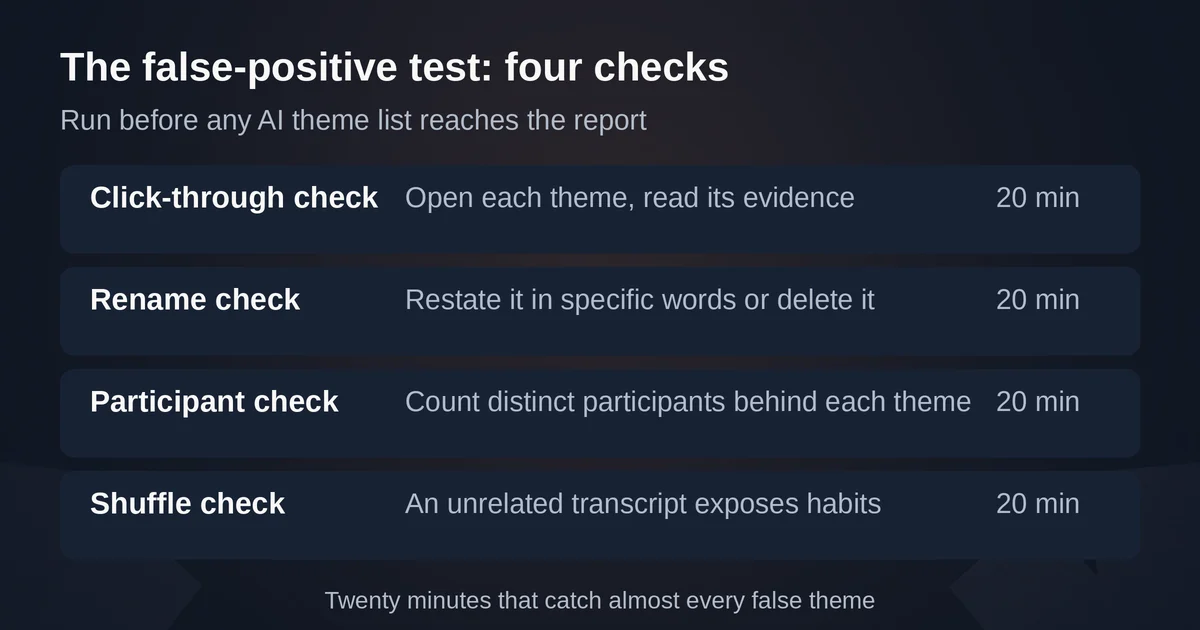
Take the AI's theme list and put it through four checks. Twenty minutes, and it catches almost everything.
- The click-through check. Open every theme and read the underlying moments. Delete any theme whose evidence reads differently than the title. This catches braided quotes outright.
- The rename check. Try to restate each theme in your own words. If you cannot make it specific ("checkout error recovery," not "friction"), it is probably a generic-theme collapse.
- The participant check. Count distinct participants per theme. One participant three times is an anecdote, not a theme. Two out of ten is a flag, not a headline finding.
- The shuffle check. Feed the tool one transcript from an unrelated study you know well. Any theme that appears in both datasets is one the tool generates reflexively; discount it everywhere.
If your tool makes any of these four impossible, because themes cannot be opened or counts are hidden, that is your answer about the tool.
Two questions people actually ask
Can AI do thematic analysis end to end? No, and the practitioners in the arXiv study mostly agreed it should not. The pattern that worked for them was AI doing quote-level coding and evidence extraction while the human grouped, interpreted, and committed to findings. Treat the model as a fast, occasionally overconfident junior analyst whose every claim needs a source link.
Do I need a dedicated tool, or will a general chatbot do? For one transcript, a chatbot with a careful prompt is fine. For a corpus, no. General chatbots do not maintain participant-level provenance, cannot show per-theme counts, and will happily merge two participants into one composite voice. The dedicated tools above exist to keep evidence attached to claims.
The verdict, for teams deciding this quarter: AI research synthesis is past the hype phase and into the useful phase, and the tools that earned trust did it by becoming auditable rather than smarter. Pick the one whose evidence trail you would defend line by line in a room full of skeptics, run the four checks before every report, and you get the speed without the false themes.