Somewhere between the fifth "price changed" email for a plan you don't sell and the third daily digest of papers you'll never read, most people quietly give up on monitoring. The tools didn't fail. The watchlist did. A monitoring setup is not a subscription, it's a list of sources you have to defend your attention against every single morning, and most lists lose that fight within a month.
The failure mode is always the same shape: you start broad, the alerts come fast, almost none of them change what you do that day, and your brain learns to ignore the channel. That learned blindness is the expensive part, because it survives even after you fix the list. The question worth asking in September 2026 isn't "which monitoring tool is best", it's "how do I design a watchlist where a meaningful share of alerts actually deserve a reaction".
What you actually need to watch
Source monitoring sounds like one problem but it's really three, because papers, competitor pages, and policy pages change on completely different rhythms.
Research papers are a high-volume, low-urgency stream. arXiv publishes new submissions every weekday, organized by category, and gives you two native ways in: category RSS feeds (for example the cs.CL or cs.AI feeds at rss.arxiv.org) and email alerts you can configure per category from arXiv's subscription page. The stream is fast but the cost of missing something for three days is nearly zero, so papers want a daily digest, not a push notification. Google Scholar adds keyword, author, and citation alerts on top, and citation alerts on a paper that anchors your field are often the earliest signal that a subfield is moving.
Competitor pages are the opposite: low-volume, high-urgency. A pricing page that changes on a Tuesday morning matters that Tuesday, and it will not announce itself in any news feed. These are static pages with no RSS, which is exactly why page-change monitors exist. We have covered AI website monitoring tools that explain what changed in depth elsewhere; here the focus is the upstream decision, which sources earn a slot at all. A competitor's pricing page, changelog, security or subprocessor list, and status page are the four URLs that tend to carry real information.
Policy pages are low-volume, high-consequence, and unforgiving about attention lapses. The EU AI Act is the live example: the official implementation timeline shows that the majority of the Act's rules came into force and enforcement began on 2 August 2026, with transparency rules under Article 50 now applying. The next milestones are 2 December 2026 (new prohibitions plus an Article 50(2) transition deadline for some providers) and December 2027 for high-risk rules under Annex III. Regulators publish these changes on quiet web pages that update a few times a year, which is the worst possible rhythm for a human to check manually and the easiest possible job for a monitor.
The relevance problem: most alerts are noise
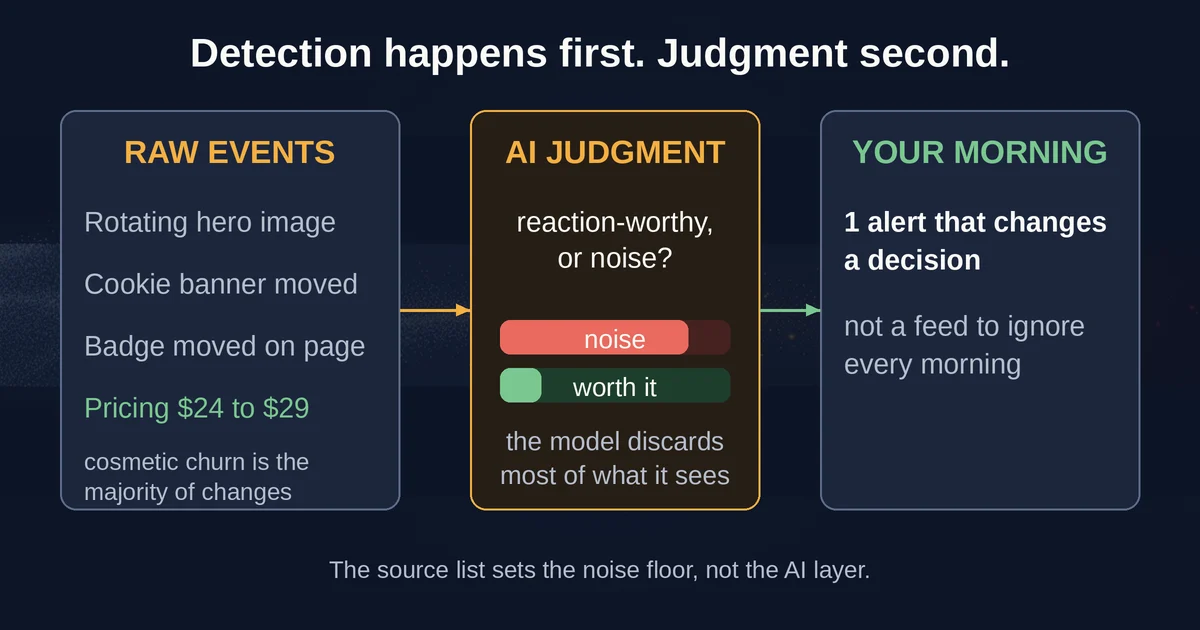
Here is the uncomfortable architectural truth about almost every monitoring tool on the market: detection happens first, and judgment happens second.
The tool fetches a page, compares it to the last snapshot, and only then asks an AI layer whether anything meaningful happened. That ordering puts a hard ceiling on relevance. If the noise floor is "any pixel moved", the model's job is to throw away most of what it's handed on every run, forever. A rotating hero image is a change. So is a cookie banner that renders differently, a "most popular" badge that moved, and a testimonial carousel. On the open web, cosmetic churn is not an edge case, it's the majority of all change events.
Research alerts fail differently but just as reliably. A broad Scholar or arXiv alert like "machine learning" will bury you, because keyword matching has no concept of what you're actually working on. And Scholar's index runs days behind preprint servers, so broad alerts deliver volume and lag simultaneously.
A 30-source watchlist you can actually maintain
Thirty sources is the sweet spot: large enough to cover a real beat, small enough that you can tell a human story about why each one is on the list. The split that works for most AI-adjacent teams:
Papers, 10 sources. Two or three arXiv category feeds for your core areas (cs.CL and cs.AI if you build on language models, cs.LG for anything training-related), one or two keyword alerts with genuinely narrow queries, and four or five Google Scholar citation or author alerts on the specific people and papers your work builds on. The citation alerts do most of the useful work here, because they key on intellectual lineage rather than keywords.
Competitor pages, 10 URLs. For each of two or three competitors: pricing page, changelog or release notes, and the docs page where new capabilities surface. Skip homepages. Homepage changes are marketing churn with rare exceptions, and they are the single biggest source of false positives in any page-monitoring setup. If you sell into regulated industries, one status or subprocessor page per competitor earns its slot.
Policy and reference pages, 10 URLs. The EU AI Act timeline and guidance pages, your national regulator's AI page if you're in the EU market, the US side if relevant (FTC and state-level AI pages move more often than federal ones), plus reference pages you depend on: a vendor's model deprecation page, a data processing agreement, terms pages you've signed. These pages change a few times a year, and the whole job is being told the week it happens instead of the quarter after.
Two design rules keep the list honest. First, every source must have a stated reason: "I would change a roadmap item, a compliance task, or a purchase if this page changed". If you can't finish that sentence, the source isn't on the list. Second, no vanity breadth. A 300-source watchlist is a subscription to guilt.
One week, one number
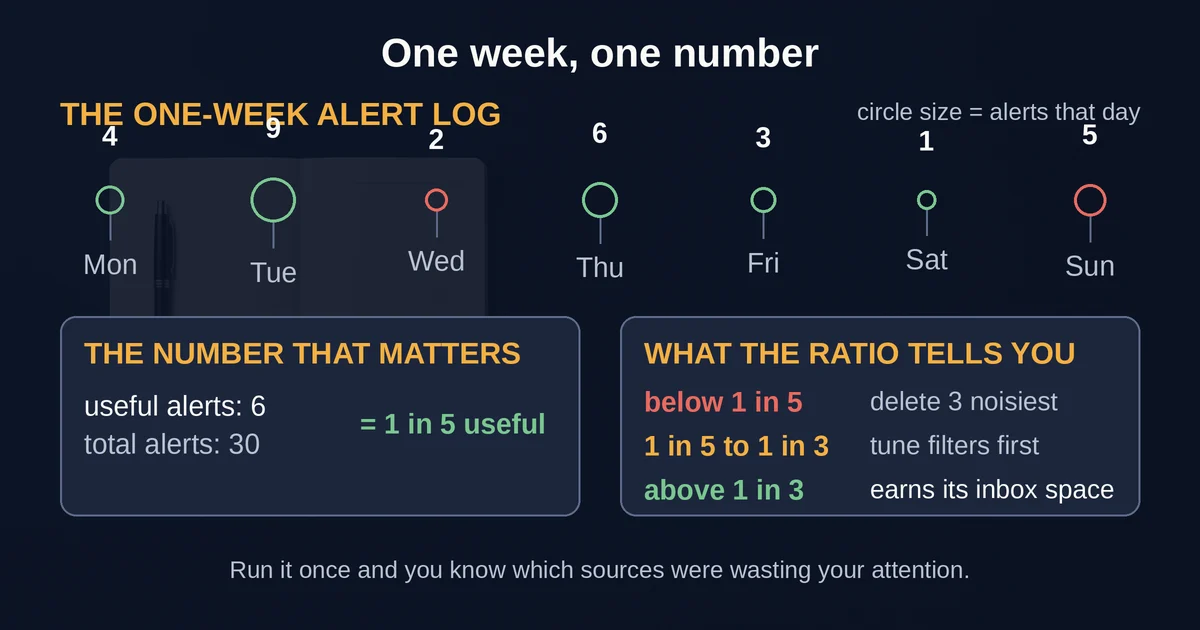
Run the watchlist for one week and keep a dead simple log. Every alert gets one line: source, what changed, and a verdict. Was it worth the interruption, yes or no? "Worth it" means you did something, even if the action was just adding a line to a research note.
At the end of the week compute the only number that matters: useful alerts divided by total alerts. Then look at where the noise came from, because noise is not evenly distributed. It clusters. One homepage monitor can single-handedly produce half your week's alerts. A too-broad paper alert will bury real finds in a list of maybes. Policy pages will produce almost nothing, and when they do, it will be the alert you're glad you got.
Use these thresholds: below 1 in 5 useful, the list needs surgery, delete the noisiest three sources and re-run the week. Between 1 in 5 and 1 in 3, tune the noisy sources' filters before deleting anything. Above 1 in 3, you have a watchlist that earns its inbox space. When a source produces three useless alerts in a row, kill it on the spot.
The tool landscape, September 2026
All of the tools below were verified current around September 2026, and the specifics come from their own pages.
For papers, the free options are genuinely good. arXiv's native feeds and alerts cost nothing and cover everything on the server. Feedly wraps those feeds in a reader with an AI layer: the free tier holds 100 sources, the Leo AI assistant and AI feeds live on Pro+, and for teams doing this professionally, Feedly Market Intelligence starts at $1,600 per month for 100 AI feeds and up to 10 seats, per the official pricing page. For individuals, that enterprise tier is not where the value is; a free Feedly account pointed at arXiv feeds plus five well-chosen Scholar alerts covers the papers side of the list.
For competitor pages, one tool can carry the whole load. Visualping is the category default, and its pricing is worth understanding precisely: the free plan monitors 5 pages at 150 checks per month with hourly checks at best, per the vendor's own pricing page, personal plans start at $10 per month with 1,000 checks across up to 10 pages, and business plans start at $100 per month. Two things distinguish it from the pack: every alert on every plan, including free, gets an AI summary with an "IMPORTANT" flag that classifies whether the change matches your criteria, and its browser-based rendering catches changes that text-only diffs miss. The honest caveat is that checks are metered, and frequency burns quota fast, so a 30-source list needs the paid tier, not the free one.
The self-hosted alternative is changedetection.io, an Apache-2.0 open source project you can run yourself for free, or use hosted at $8.99 per month with up to 5,000 watched URLs, checks as fast as every five minutes, and more than 85 notification formats. It does element-targeted watching, browser steps like logging in, and price and restock detection. The AI relevance layer is thinner than Visualping's, but the list design does the filtering here, not the model.
Distill.io and Inoreader also belong in the survey. Distill takes a rules-based approach, region selection refined with XPath and conditions rather than model judgment, which is more predictable when you know exactly what matters. Inoreader folds keyword monitoring into a general RSS reader. Both are alive and actively developed; neither changes the recommendation below.
The verdict
The best September 2026 stack for the 30-source watchlist described here is boring and mostly free. arXiv feeds and Scholar alerts for the papers, in whatever reader you already open daily. changedetection.io self-hosted, or Visualping Personal if you'd rather not run a container, for the competitor and policy URLs. And the one-week relevance measurement as a recurring habit, not a one-time setup, because sources rot and the ratio drifts.
If you go deeper on the papers side, the next step is not more alerts, it's better digestion. Tools like Elicit and Consensus, which we compared in our AI literature review guide, turn the papers your watchlist surfaces into structured summaries you can actually reason over.
Where AI genuinely helps in this stack is narrow and real: it reads the diff so you don't have to, and it flags importance before you've had your coffee. Where it doesn't help is deciding what's worth watching in the first place. No model can rescue a badly designed watchlist, and the detect-then-classify architecture every major tool shares means your noise floor is set by your source list, not by the AI. Choose ten papers, ten competitor pages, and ten policy pages you can defend, measure the ratio for one week, and prune what fails. That's the whole discipline, and it's the difference between a monitoring habit that lasts and one you'll silently abandon by October.
Pricing and plan details are as published by the vendor around September 2026 and can change, confirm on the official site.
Two questions people actually ask
Is there a tool that alerts me only when a source changes meaningfully? Partly. Visualping's IMPORTANT flag and changedetection.io's filter rules both try to judge relevance, and both work better the tighter your criteria are. But every mainstream tool detects first and classifies second, so the reliable path to "meaningful only" is a disciplined source list plus element-level targeting, not the AI layer alone.
How do I monitor new papers without drowning? Skip broad keyword alerts. Use arXiv category feeds for coverage, then add a handful of highly specific Scholar alerts: citation alerts on the papers your work builds on, and author alerts on the researchers whose output you'd read regardless of topic. Lineage beats keywords for relevance.