There is a specific moment every heavy AI user knows. You paste your paragraph into the rewrite box. The output comes back clean, confident, grammatically perfect. And completely anonymous.
The grammar was never the problem. Your problem is that the sentence you wrote at 7 a.m., the one with your actual opinion in it and your slightly odd word order, has been replaced by something that could have been written by ten thousand other people asking the same model the same thing. Editors call it beige prose. Readers just call it boring. And if you write in English as a second language, or you are a founder whose entire brand is that you sound like a human, beige is worse than a typo.
Here is the good news from September 2026: every serious rewriting tool now has a mechanism for "sound like me, not like you". Claude analyzes your writing samples and builds a custom style. ChatGPT stores standing instructions in every conversation. LanguageTool has a personal style guide. Wordtune offers five alternatives per sentence so you keep the veto. The tools are not the hard part. The hard part is that most people show up with nothing to feed them.
This article is about the thing you feed them: a small style card, ten sentences and a forbid list, and how to use it across the three rewriting jobs you actually have.
Editing is not generating
Before the tools, one distinction, because it decides everything downstream.
Generation is when the model writes the first draft. Editing is when you wrote the draft and the model improves it. These feel similar and behave completely differently.
When you generate, the model has no choice but to impose its default voice, because there is no other voice in the room. You are hearing the average of its training data: "it's worth noting", balanced clauses, a conclusion that restates the introduction, and a mild, agreeable tone aimed at nobody in particular. That averaging is the same flattening force behind why AI hallucinates and confabulates: the model returns what is most probable, not what is most you.
When you edit, your voice is already on the page. Every rewrite the model produces starts from your word choices, your rhythm, your actual opinion. The model's job shrinks to fixing what is broken. That is a much easier job, and the output is dramatically better, because the raw material is yours.
The mistake most people make is using rewriting tools on text that was already good, which generates beige from scratch, instead of using them on text that is genuinely broken, which polishes without touching the character. A style card keeps that line bright.
A style card that fits on a sticky note
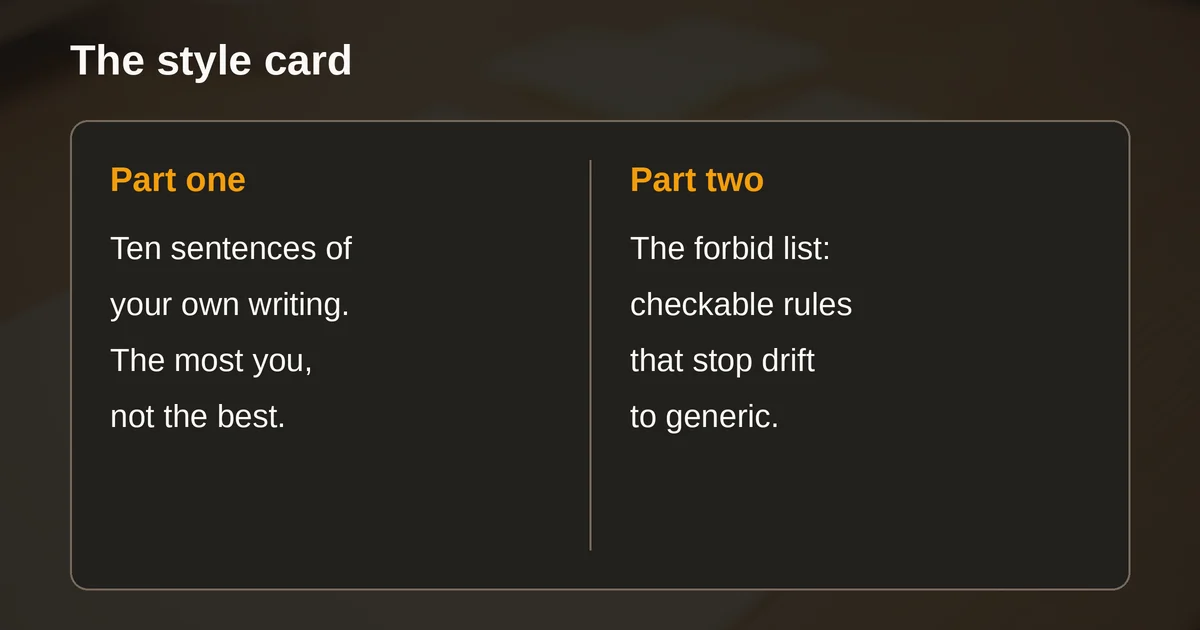
A style card is a short, reusable description of how you write. Not an essay. Not a brand guidelines document. Small enough that you can paste it into any chat, any tool, any day of the week, without thinking. If you have gone deep on custom instructions before, this is the same instinct people apply when they prompt ChatGPT, Claude, and Gemini differently; the difference is that a style card is about who you are, not what you want done.
It has exactly two parts.
Part one: ten sentences of your own writing. Not your best writing. Your most you writing. The email you sent without thinking. The Slack message where someone replied "this is so you". The paragraph you would be embarrassed to show a copywriting course because it breaks three rules and works anyway. Ten sentences is enough for a model to pick up your sentence lengths, your hedges, your habits. It is a fingerprint, not an archive.
If you write in English as a second language, do not polish the samples first. The specific phrasings that a native speaker would never produce are often the most distinctive thing about your voice, and readers respond to them as personality, not error. Feed the model the real thing or it will produce the generic thing.
Part two: the forbid list. This is the part everyone skips, and it matters more than the samples. A model averages your samples toward its default; the forbid list is the fence that stops the drift. Negative rules outperform positive ones because they are checkable. "Be clear and engaging" means nothing a model can act on. "Never open with a rhetorical question" is a rule.
Here is a worked forbid list, borrowed from what actually goes wrong in AI rewrites:
| Forbid | Why |
|---|---|
| No em dashes in my voice | The single most recognizable AI rewrite tell |
| No "it's worth noting", "arguably", "in many cases" | Hedging I never do; if I hedge, I hedge with specifics |
| Keep my sentence lengths; do not balance them | My long sentences are load-bearing |
| Keep my specific numbers and dates; never round them | "About eight years" replaces "almost eight years" and loses the point |
| Do not add a summarizing final sentence I did not write | My paragraphs end where I decide they end |
| Keep my idioms and my phrasing, even where unusual | Correcting my word choice to the average is the erasure I am paying you to avoid |
Six rules is a real forbid list. Write yours once, keep it in a note, paste it into every session. It is twenty minutes of work that upgrades every future rewrite.
The trick is that the style card is a living document. When a rewrite comes back and something feels off, name the specific thing in one line and add it to the card. "Too cheerful, I write dry." That correction teaches the next rewrite. "Make it better" teaches nothing.
Wordtune: options, not verdicts
Wordtune is the right tool when you distrust wholesale rewrites, because it never commits to one. You highlight a sentence and it offers several alternatives, formal to casual, shorter to longer, and you click the one that is closest and edit from there. The veto always stays with you, which is the entire point of a rewriting tool that does not erase you.
The free Basic plan is genuinely usable: it caps daily rewrites but the corrections are unlimited, and the plans page describes it as "for limited use only", which is accurate. Paid tiers step up the limits: Advanced is $6.99 per month billed annually for daily-but-capped use, and Unlimited at $9.99 per month billed annually removes the caps. Monthly billing costs roughly double, so the annual numbers are the honest ones. There is a 3-day free trial on paid plans, card required, and the refund policy is explicit that there are none, so cancel before a cycle starts, not after.
Where Wordtune fits the voice problem: it is sentence-level, so your paragraph structure, your transitions, and your endings survive untouched. Where it does not fit: it will happily iron a flat sentence into a smooth, characterless one, because smoothness is what it optimizes for. Give it your genuinely broken sentences, not your distinctive ones, and keep the distinctive ones out of its reach.
LanguageTool: the tool that touches the least
If the problem you are solving is correctness rather than style, LanguageTool is the tool that respects your voice by barely interacting with it. It is a proofreader with an open-source core that covers more than 30 languages, which matters enormously if you write in English as a second language: it catches the errors that actually are errors (agreement, tense, word order, punctuation) across a much wider language range than its English-first competitors, and it suggests rather than rewrites. The free tier checks up to 2,000 characters per text field with three AI rephrases per day, no account needed in most browsers. Premium, on the official pricing page, raises the text field limit to 150,000 characters and adds unlimited AI paraphrasing, full Picky Mode (stricter style rules), and a personal Style Guide where you define custom rules to enforce your own consistent wording, which is the closest thing to a native forbid list in any proofreader. Premium runs $24.90 month-to-month, $69.90 per year (about $5.83 a month), or $119.80 for two years, with a 14-day money-back guarantee, which is more forgiving than most.
For a non-native English speaker, the workflow is almost embarrassingly simple: write the whole thing in your own voice, run it through LanguageTool, accept the grammar fixes, and reject every "style" suggestion that would make you sound like everyone else. The tool flags overused words and wordiness; you decide case by case whether your "wordiness" is actually your rhythm. That judgment call, kept in your hands, is the whole method in miniature.
A chatbot with rules: the strongest option, used correctly
For paragraphs that need real surgery, meaning, structure, clarity, not just polish, a frontier chatbot with your style card attached is the most powerful rewriter you have, and in 2026 both major assistants have first-party mechanisms built exactly for this. If you are still choosing which assistant to standardize on, our Claude vs ChatGPT comparison covers the fundamentals; what matters for rewriting specifically is below.
Claude has had custom styles for a while, and they work the way you would hope: you paste or upload writing samples and Claude analyzes them and generates a matching style, or you describe the style in words, or, for control freaks, you set custom instructions (advanced) that Claude follows exactly. You can edit the generated instructions manually, rename and preview styles, and switch between them per conversation.
One thing to know if you read older tutorials: Claude is currently migrating styles into skills. Custom styles are being converted automatically, activated with a slash command in the format /your-style-name-style, the Concise, Explanatory, and Formal default styles are going away, and the styles menu itself is disappearing. If you would rather not track the migration, the Help Center's simpler path still works: describe your voice once in account-wide "Instructions for Claude" and it applies to every conversation.
ChatGPT's equivalent is custom instructions, found in Settings under Personalization, available on every plan and applied immediately to all chats, including conversations you have already started. The size limit depends on your plan: 1,500 characters on Free and Go, 5,000 on Plus, Pro, Enterprise, Business, and Education. Fifteen hundred characters is roughly two paragraphs, which sounds stingy until you realize a good forbid list is six lines. The constraint is a feature: it forces you to write rules a model can check rather than adjectives a model will average away. (One honest note: OpenAI says information from custom instructions is also used to improve model performance, so keep anything sensitive out of that box.)
The prompt that ties it together, in any chatbot:
Here are ten sentences of my writing. Here is my forbid list: [list]. Rewrite the paragraph below. Fix grammar and clarity only. Do not balance my sentence lengths, do not add transitions, do not add a concluding sentence. If a phrase of mine is unusual but correct, keep it. Show me what you changed and why, in a short list.
The last line is the underrated one. Asking the model to annotate its own edits turns a black-box rewrite into a diff you can approve line by line, and it catches the model in the act every time it changes something it should have left alone.
Before and after, annotated
Here is a messy paragraph from a hypothetical founder update, in a real voice, warts included:
"We almost doubled users since March (from 4,100 to about 7,900, still mostly word of mouth, we spent maybe $300 on ads total). Support is eating us alive right now, my inbox is a war zone, so next month the roadmap is basically: kill tickets before features. I know some of you asked for the API thing. It's coming, just not in Q4."
And here is what a default AI rewrite does to it:
"Our user base has experienced significant growth since March, nearly doubling from 4,100 to approximately 7,900 users, driven primarily by organic word-of-mouth with minimal advertising expenditure (around $300). Support demands have increased considerably, presenting operational challenges. Consequently, next month's roadmap will prioritize reducing support tickets over shipping new features. Regarding the API requests we've received: this feature is planned, though it will not ship in Q4."
Annotation, line by line, of what the model changed that it should have left alone:
- "almost doubled" became "experienced significant growth, nearly doubling". Four words became seven, and the punch of the original is gone. Verdict: should have left it.
- "still mostly word of mouth, we spent maybe $300 on ads total" became "driven primarily by organic word-of-mouth with minimal advertising expenditure". "Maybe $300" is the founder's voice; "minimal advertising expenditure" is a press release. Verdict: erased.
- "Support is eating us alive right now, my inbox is a war zone" became "Support demands have increased considerably, presenting operational challenges". This is the sentence where the founder actually lives. The rewrite deleted the person. Verdict: worst change on the page.
- "I know some of you asked" became "Regarding the API requests we've received". The direct address to investors, the relationship, smoothed into third person. Verdict: erased.
- The rewrite also added "Consequently" and a tidy forward-looking close, both classic default-model filler. Verdict: invented.
Now the same paragraph through the style card, forbid list attached: the numbers stay exact, "eating us alive" stays, the parenthetical stays, the Q4 honesty stays, and the model only fixes "doubled users" to "doubled our user count" and one missing comma. The founder is still on the page. That is the entire difference between a rewrite and an erasure, and it came from six lines of forbid rules, not from a better model.
The humanizer trap
A word on the category of tools that promise to make AI text "undetectable".
They are solving the wrong problem. If an AI rewrite of your writing reads as AI, the issue is not that a detector noticed; it is that your voice left the text. A humanizer works by adding deliberate noise, odd synonyms, chopped rhythm, fake imperfections, to text that is still, underneath, generic. You end up with beige prose wearing a disguise. It reads worse, it can break your actual meaning, and if you wrote the draft yourself, you have paid a tool to damage your own writing to satisfy a detector that may or may not exist on the other side.
The style card does the same job legitimately. It does not add fake human texture; it stops the model from removing your real texture. And it survives any detector, because the text is actually yours.
If you have written something yourself and you are worried a detector will flag it, the right response is to keep drafts and timestamps, not to launder your own paragraphs through a noise machine. Humanizers exist because rewriting without a style card produces text worth hiding. Fix the rewriting.
Verdict
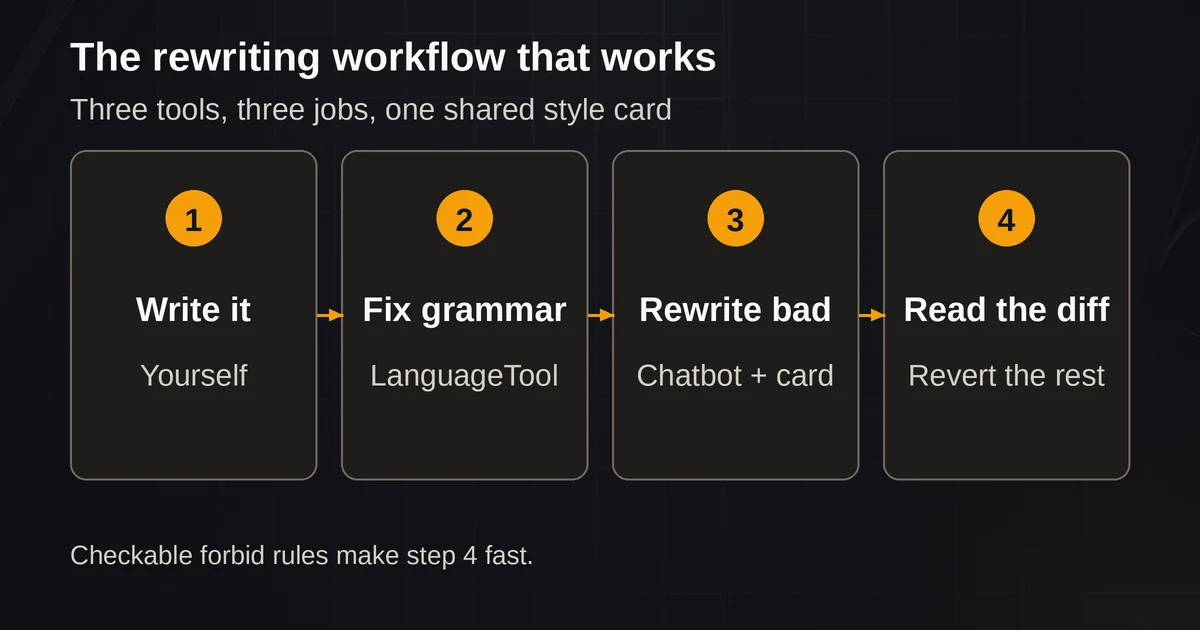
The workflow that works in 2026 is not one tool, it is three tools with three jobs and one shared style card:
- Write the draft yourself. No model in the room. Your voice gets on the page only if you put it there.
- Run it through LanguageTool for grammar and the style guide rules. Accept correctness fixes, reject character fixes.
- Take the genuinely broken sentences to Wordtune and pick from its alternatives, or take the genuinely broken paragraphs to Claude or ChatGPT with the style card and the annotated-rewrite prompt pasted in.
- Read the diff. Revert anything the model changed that was not broken. The forbid list exists to make this step fast.
Build the style card once, this week, while the idea is annoying you. Ten sentences, six forbid rules, one note you never have to think about again. Every rewrite you do afterward is a repair instead of a replacement, and your 7 a.m. sentences survive contact with the machine. The same philosophy applies to any AI prompt that instantly improves your output: constraints written by someone who knows what they want beat compliments about the tool's intelligence.
Pricing and plan details are as published by the vendor around September 2026 and can change, so confirm on the official site.
FAQ
Does a style card work if English is not my first language? It works better, not worse. Non-native phrasing is highly distinctive, and distinctive is exactly what a style sample needs to be. Paste ten unpolished sentences of your real writing plus rules that forbid the model from "correcting" your unusual-but-correct phrasing, and Claude's custom styles or ChatGPT's custom instructions will preserve it instead of averaging it away.
Wordtune, LanguageTool, or a chatbot, which should I pay for first? For correctness, LanguageTool: the free tier already covers grammar in 30+ languages, and Premium at $69.90 per year is the cheapest of the three. For restructuring whole paragraphs, a chatbot subscription you probably already have, used with the style card. Wordtune only earns its $6.99 if you rewrite sentence by sentence every day and want choices rather than decisions.