AI hallucinates because it predicts likely words instead of looking facts up, and its training rewarded guessing over saying "I don't know." The result sounds confident whether it is true or not.
Short answer: An AI hallucination is a "plausible but false" statement from a chatbot, in OpenAI's words. It matters because the fake sounds exactly as sure as the truth, so names, dates and citations need checking.
How it works: AI predicts words, so rare facts get guessed
A chatbot writes by predicting the next word, again and again. Think of it as your phone's autocomplete after reading a huge slice of the internet.
The problem: each step picks a likely word, and likely is not the same as true. Here is how that plays out:
- It learns from text with no labels. In pretraining, OpenAI says, "there are no 'true/false' labels attached to each statement."
- Common patterns get learned well. Spelling follows consistent patterns, "so errors there disappear with scale."
- Rare facts stay blurry. "Arbitrary low-frequency facts, like a pet's birthday, cannot be predicted from patterns alone and hence lead to hallucinations."
- The model answers anyway. It fills the gap with something that fits the pattern.
Recent events are a second gap. Google built search grounding to "answer questions about recent events and topics."
OpenAI tested this on one of its own paper's authors, Adam Tauman Kalai. Asked for the title of his PhD dissertation, "a widely used chatbot" gave three different answers. None were correct. Asked for his birthday, it gave three dates, all wrong. Our guide to how AI models actually get smarter covers what training does and doesn't teach.
Why AI guesses instead of saying "I don't know"
The scoring rewards guessing. OpenAI's research post argues that "standard training and evaluation procedures reward guessing over acknowledging uncertainty."
Picture a test question about a birthday the model never saw. A guess like "September 10" has a 1-in-365 chance of being right. That's about 0.27%. "I don't know" scores zero. Over thousands of questions, the guesser looks better on the scoreboard.
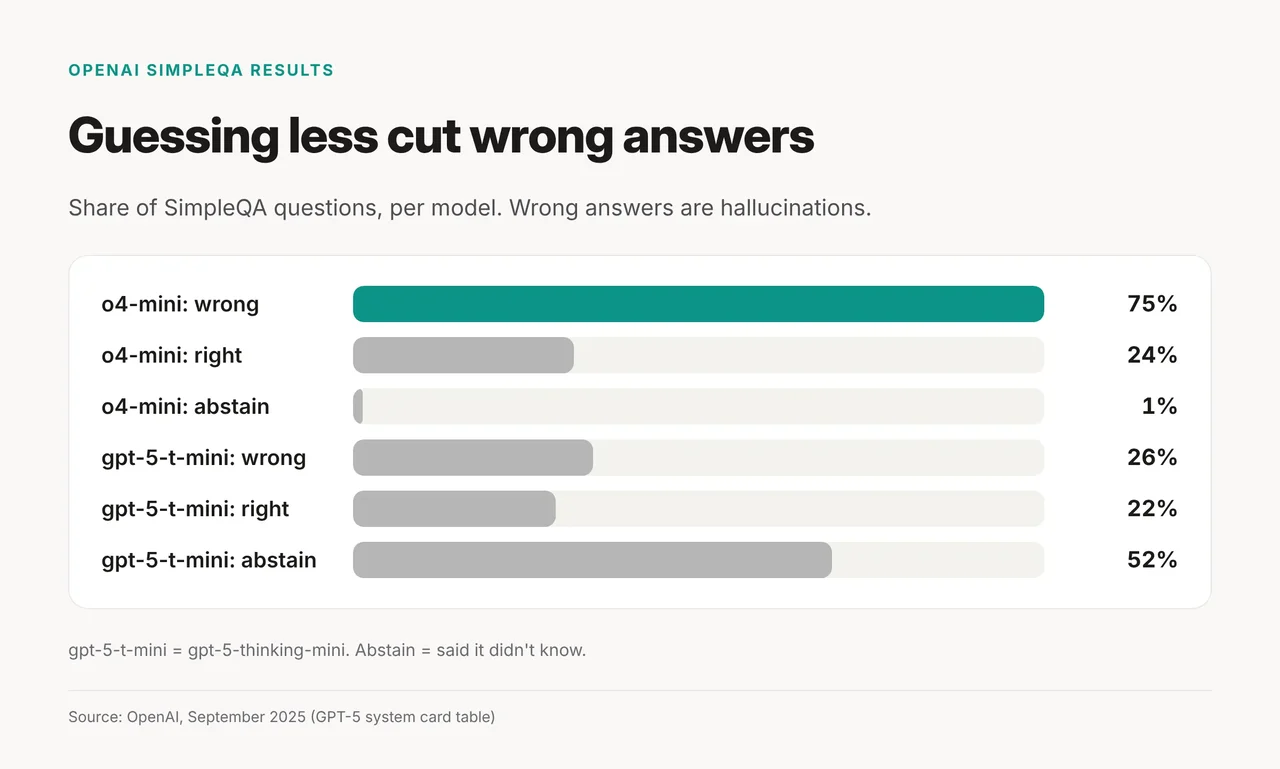
OpenAI's own numbers show the trade. On SimpleQA, a fact-question test whose results OpenAI shows from its GPT-5 system card, older o4-mini got 24% right, 75% wrong and abstained 1% of the time. gpt-5-thinking-mini got 22% right, 26% wrong and abstained 52%. Accuracy barely moved. Wrong answers fell from 75% to 26% because the newer model said "I don't know" far more often.
OpenAI draws three lessons:
- Accuracy alone won't fix it. Accuracy "will never reach 100%" because some questions are unanswerable.
- Hallucinations aren't inevitable. Models "can abstain when uncertain."
- Bigger isn't required. "It can be easier for a small model to know its limits."
Do newer models still do it? Yes. In September 2025, OpenAI said GPT-5 "has significantly fewer hallucinations especially when reasoning, but they still occur."
Hallucination vs a low score: what's the difference?
A hallucination is a confident wrong answer. A low score can also come from refusing to answer. The SimpleQA numbers show why that difference matters.
- Hallucination: the model states something false as fact. o4-mini did this 75% of the time.
- Abstention: the model says it doesn't know. That is a miss, not a fake.
- Accuracy: right answers only. It hides how often the rest were invented.
So a model with slightly lower accuracy can be the safer one to trust.
What hallucinations cost: two real cases
The best-known case put fake court decisions in front of a federal judge.
Mata v. Avianca. Roberto Mata sued the airline Avianca on February 2, 2022. He said a metal serving cart struck his left knee on a flight from El Salvador to JFK. His lawyers at Levidow, Levidow & Oberman needed earlier rulings to support the case.
Steven A. Schwartz asked ChatGPT to "provide case law" and "show me more cases." The chatbot complied by making them up. He then asked, "Is Varghese a real case." ChatGPT said it had supplied "real" authorities found on Westlaw and LexisNexis.
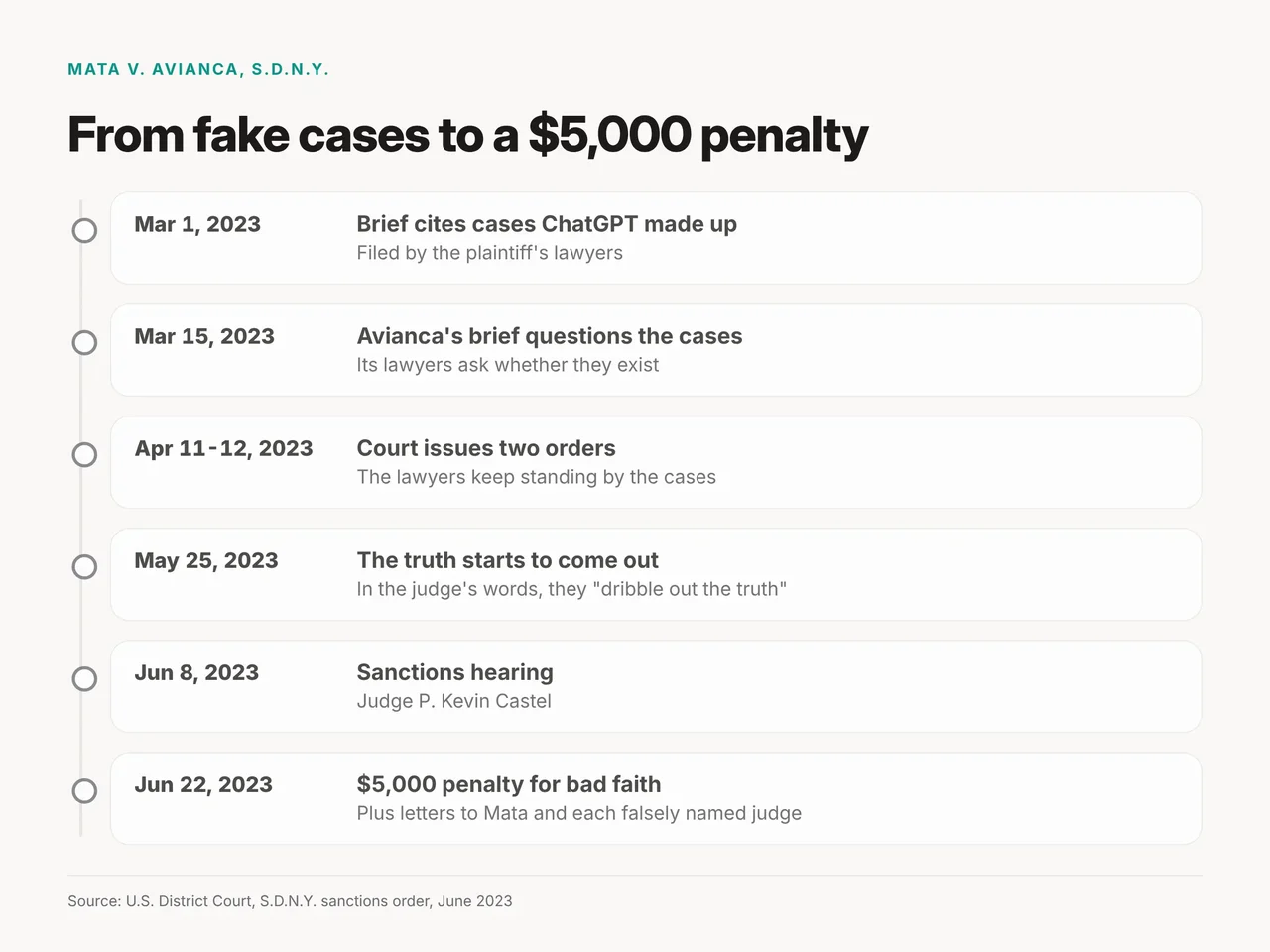
The brief went in on March 1, 2023. Avianca's lawyers questioned the cases two weeks later, and the court issued orders in April. The lawyers "doubled down" and only began to "dribble out the truth" on May 25.
On June 22, 2023, Judge P. Kevin Castel found "bad faith." He named six decisions, including "Varghese," "Shaboon" and "Petersen," that "were generated by ChatGPT and do not exist." The lawyers and firm owed a $5,000 penalty. They also had to send letters to Mata and to each judge falsely named as an author.
The judge was clear that the tool wasn't the crime: "there is nothing inherently improper about using a reliable artificial intelligence tool." Not checking was.
Google's Bard. In a promotional video, Bard (now Gemini) said the James Webb telescope took "the very first pictures of a planet outside the Earth's solar system." Astronomers pointed out that a 2004 team did that first. Alphabet lost more than $100bn in value that day, with shares down 9%. The Guardian tied the drop to fears about Microsoft too, so it was a market move with several causes, not the price of one sentence.
See it yourself: five checks that catch fakes
Try this now. Ask any free chatbot for three sources on a niche topic, then open each one. Notice how many exist and say what the bot claimed.
- Ask for the source, then open it. This is the step the Mata lawyers skipped. Our guide to AI fact-checking and citation verification goes deeper.
- Ask twice and compare. Anthropic's guide says "inconsistencies across outputs could indicate hallucinations." Three different birthdays are three alarms.
- Ask the bot if it's sure, but don't trust the yes. ChatGPT told Schwartz the fake cases were real.
- Demand a quote for each claim. Anthropic's rule: "If it can't find a quote, it must retract the claim."
- Raise your guard on rare and recent facts. Names, dates, citations and recent news are where pattern-guessing fails.
Which fix works for which job?
You can't remove the cause with a prompt, because it sits in training. You can lower the risk:
| Your job | What to do | Who documents it |
|---|---|---|
| Recent news or niche facts | Turn on search, or grounding | Google: grounding can "reduce model hallucinations" |
| Any chat | Give explicit permission to say "I don't know" | Anthropic: it "can drastically reduce false information" |
| Answers from your files | Tell it to use only your documents | Anthropic |
| Research with citations | Require a quote per claim, or retract | Anthropic |
| High-stakes answers | Run the prompt several times and compare | Anthropic |
Building an app? Put the "I don't know" permission in the system prompt. For document answers, see what RAG is. For current facts, pick a model with search built in.
Anthropic adds that these techniques "don't eliminate them entirely. Always validate critical information."
FAQ: quick questions about AI hallucinations
Can I just tell the AI "don't hallucinate"? Not reliably. No vendor lists it as a fix, because the habit comes from training: "If the main scoreboards keep rewarding lucky guesses, models will keep learning to guess," OpenAI says. Anthropic's documented step is to give the AI explicit permission to say "I don't know."
Does turning on search or RAG stop hallucinations? No. Google says grounding can "reduce model hallucinations," and Anthropic says such techniques "don't eliminate them entirely." Still open the sources.
Why do I get a different wrong answer each time? The model predicts again rather than looking anything up. That's why comparing answers works as a check.
Was the Mata lawyer jailed or disbarred? No. The June 22, 2023 order set the $5,000 penalty and the letters. The judge declined to force an apology: "a compelled apology is not a sincere apology."