
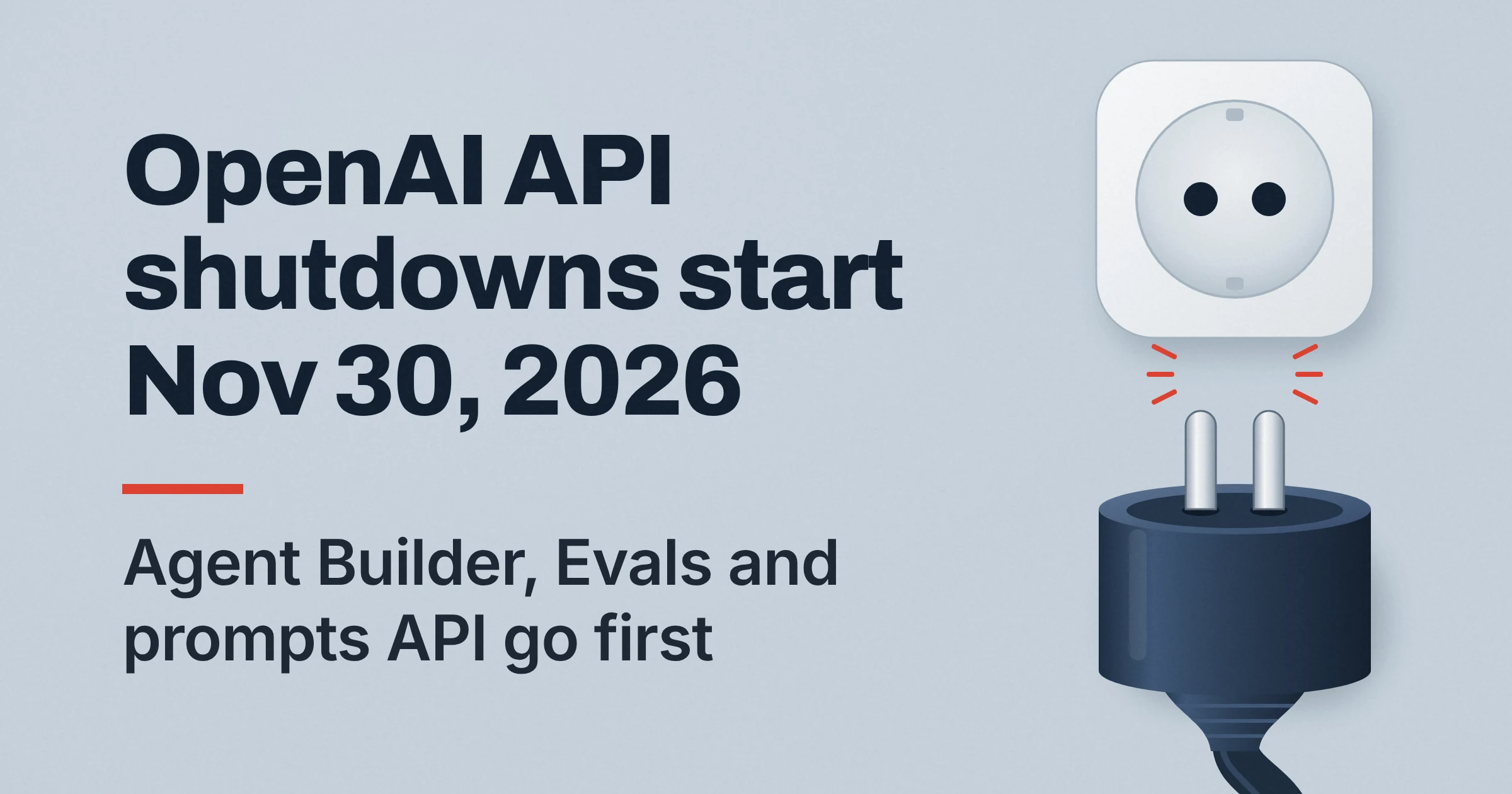
On November 30, 2026, OpenAI shuts down Agent Builder, the Evals dashboard and API, and the v1/prompts API. Anthropic's tentative retirement date for Claude Sonnet 4.5 (claude-sonnet-4-5-20250929) is the same day. More OpenAI API deprecations follow:
- older GPT Image models on December 1;
- older GPT-5 and o3 snapshots on December 11;
- a run of speech, audio and GPT-4 series removals in January 2027.
Fix the product shutdowns first. They need real migration work. Most model retirements only need a model-ID swap and a test run.
Which OpenAI API deprecations land on November 30, 2026, and what follows?
As of November 2026, the OpenAI and Anthropic API shutdown schedule runs from November 30, 2026 to April 1, 2027. OpenAI's product shutdowns and the Claude Sonnet 4.5 retirement all land on the first day. The table below merges OpenAI's deprecations page and Anthropic's model deprecations page into one list, sorted by shutdown date.
| Shutdown date | Vendor | What goes away | Notice given | Vendor's path forward |
|---|---|---|---|---|
| Nov 30, 2026 | OpenAI | Agent Builder | Deprecated June 3, 2026 | Export to Agents SDK code, or a ChatGPT workspace agent |
| Nov 30, 2026 | OpenAI | Evals dashboard and API, including eval graders | Existing evals read-only since Oct 31, 2026 | Recreate evals in Promptfoo |
| Nov 30, 2026 | OpenAI | v1/prompts API (reusable prompt objects) | Prompt creation de-emphasized from June 3, 2026 | Move prompt content into your app code |
| Nov 30, 2026 (tentative) | Anthropic | claude-sonnet-4-5-20250929 | Notified Sept 30, 2026 | Replacement listed on Anthropic's page |
| Dec 1, 2026 | OpenAI | Older GPT Image models | Notified June 2, 2026 | Replacement listed per row on OpenAI's page |
| Dec 11, 2026 | OpenAI | Older GPT-5 and o3 snapshots | Notified June 11, 2026 | Replacement listed per row on OpenAI's page |
| Jan 6, 2027 | OpenAI | tts-1, tts-1-hd, gpt-4o-mini-tts snapshots | At least three months | Replacement listed per row on OpenAI's page |
| Jan 14, 2027 | OpenAI | GPT-4o, GPT-4o mini, GPT-4.1, GPT-4.1 mini | Notified Oct 14, 2026 | Replacement listed per row on OpenAI's page |
| Jan 20, 2027 | OpenAI | Legacy audio, realtime and transcription families and snapshots | Notified July 20, 2026 | Replacement listed per row on OpenAI's page |
| Feb 26, 2027 | OpenAI | whisper-1 and the gpt-4o transcribe models | Not in the sources we checked | Replacement listed per row on OpenAI's page |
| Apr 1, 2027 | OpenAI | gpt-5.3-codex, gpt-5.1, gpt-5.4-nano | Six months | Replacement listed per row on OpenAI's page |
One rule covers the whole table:
- OpenAI says every deprecated model and endpoint has a shutdown date, after which it is no longer accessible.
- Anthropic says requests to a model past its retirement date fail.
Neither vendor describes a grace period, so treat each date as a hard stop.
How do I check which models my app uses will be shut down?
OpenAI's List models endpoint (GET /v1/models) returns an optional shutdown_date field for each model. It's OpenAI's documented way to check programmatically which models already have a date. It tells you what is retiring, not what your app calls, so you also need to search your code and logs.
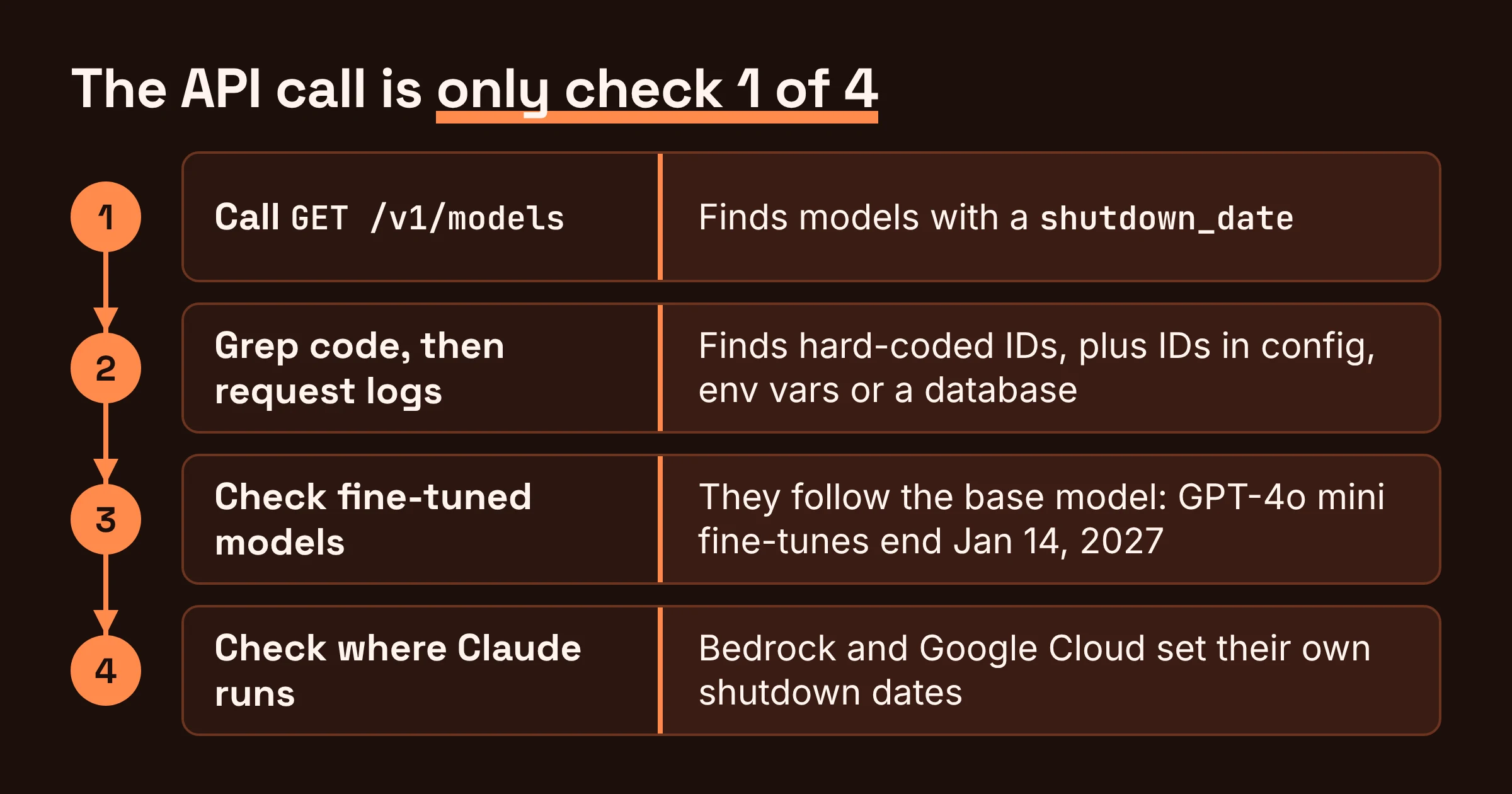
Step 1: pull every model that has a shutdown date.
import os, requests

resp = requests.get(
    "https://api.openai.com/v1/models",
    headers={"Authorization": f"Bearer {os.environ['OPENAI_API_KEY']}"},
)
resp.raise_for_status()
for model in resp.json()["data"]:
    if model.get("shutdown_date"):
        print(model["id"], model["shutdown_date"])
Step 2: find which of those IDs your code actually calls. A blunt grep catches most hard-coded IDs:
grep -rnE "gpt-4o|gpt-4\.1|gpt-5|o3|whisper-1|tts-1|claude-sonnet-4-5" .
Expect some noise. The o3 pattern matches unrelated strings, and gpt-5 matches newer models that aren't retiring. Model names stored in config, environment variables or a database won't show up at all. For those, check the model field in your request logs.
Step 3: check your fine-tuned models. OpenAI says fine-tuned versions follow the same shutdown schedule as their base models. It also says inference on them continues only until the base model is deprecated. So a fine-tune of GPT-4o mini is on the January 14, 2027 list, even though its ID looks custom.
Step 4: check where you run Claude. Anthropic's dates apply to Anthropic-operated platforms. Amazon Bedrock and Google-managed Claude on Google Cloud set their own retirement schedules, so the same model can have a different date there. The Anthropic sources we checked don't describe an equivalent of OpenAI's shutdown_date field, so read Anthropic's deprecations table directly.
What happens to my Agent Builder workflows after November 30?
Agent Builder stops being available on the OpenAI platform on November 30, 2026. OpenAI deprecated it on June 3, 2026. OpenAI recommends two routes:
- the Agents SDK for workflows that continue as code;
- Workspace Agents in ChatGPT for natural-language use cases.
The export path is less automatic than it sounds. Per OpenAI's Agent Builder migration guide, the export produces Agents SDK code, not a converted copy of your workflow graph. OpenAI also says it doesn't guarantee identical behavior.
| Route | What you end up with | Best for | Watch out for |
|---|---|---|---|
| Export to Agents SDK code | Code you run, version and test yourself | Workflows that continue as code, especially deterministic ones | Not a graph conversion; some behavior may need manual recreation |
| ChatGPT workspace agent | An agent that lives inside ChatGPT | Natural-language use cases | Needs a Business, Enterprise or Edu workspace with access to workspace agents and permission to create them. OpenAI warns that strongly deterministic workflows may not migrate faithfully |
After exporting, OpenAI says to review control flow, triggers, tools and permissions while you test. Think of the export as a moving van, not a teleporter: the furniture arrives, but you still check that every drawer opens. If you have several workflows, budget each one as its own export-and-test job rather than one bulk move.
Does ChatKit keep working?
OpenAI says ChatKit remains available after the Agent Builder wind-down. If your ChatKit front end is backed by a workflow hosted in Agent Builder, that workflow is still being shut down. The sources we checked don't explain how to wire ChatKit to exported Agents SDK code, so test that exact path before November 30.
If you're rebuilding on OpenAI's code-first agent stack, our guide to the OpenAI Agents API and hosted sandboxes covers that side in more depth.
Is OpenAI Evals being shut down, and what replaces it?
Yes. The OpenAI Evals dashboard and API shut down on November 30, 2026, and existing evals became read-only on October 31, 2026. OpenAI recommends Promptfoo for evaluation workflows going forward. Graders documented for eval workflows are part of the same transition.
There is no export button. OpenAI's Promptfoo migration guide covers manually recreating each eval in a promptfooconfig.yaml file. Here is what maps where:
| What you had in OpenAI Evals | What you recreate in promptfooconfig.yaml |
|---|---|
| The prompt under test | Prompts |
| The model you evaluated | Provider |
| Your dataset rows | Test cases |
| Your graders and pass criteria | Assertions |
One more catch: OpenAI says a migrated Promptfoo run is separate from earlier OpenAI Evals runs. Your history doesn't carry over, so you compare results by hand. While the read-only dashboard is still up, copy the latest scores for each eval somewhere you control. That gives you a baseline for your first Promptfoo run.
If you're choosing a wider testing setup at the same time, our roundup of AI evaluation tools for hallucinations, RAG and agents compares the options.
What do I do about v1/prompts reusable prompt objects?
The v1/prompts API stores reusable prompt objects on OpenAI's side, and it shuts down on November 30, 2026. Prompt creation was de-emphasized from June 3, 2026. OpenAI's migration advice is to move the prompt content into your application code.
OpenAI says code gives you more control over review, testing, deployment and versioning. In practice, a prompt edit becomes a pull request instead of a silent change on a dashboard.
Here is the before/after for one prompt:
- Before: your request references a stored prompt object by ID, and the actual instructions live on OpenAI's platform.
- Copy out: while the API still works, fetch each prompt object's content and save it as a file or constant in your repo.
- After: your request sends that text directly, and the stored ID disappears from your code.
- Verify: search for any remaining prompt-object IDs and run your test suite. The Promptfoo setup above can double as a regression check.
When does claude-sonnet-4-5 retire, and what should I switch to?
Anthropic lists claude-sonnet-4-5-20250929 as Deprecated, with a tentative retirement date of November 30, 2026. It notified developers on September 30, 2026. "Deprecated" means the model still works but is no longer recommended, and Anthropic provides a recommended replacement and a retirement date.
Anthropic's page names the official replacement, so start there. In the same table, claude-sonnet-5-5 is Active, with retirement not sooner than September 28, 2027. That makes it the obvious Sonnet to test first, but confirm it against Anthropic's recommendation. Anthropic advises testing newer models well before your current model's retirement date. With weeks left, that means now.
Which other Claude models should you watch?
Anthropic's "not sooner than" dates are floors, not shutdown announcements. A model can stay active well past its floor, but you can't count on it.
| Model ID | Status (as of November 2026) | Earliest retirement | What it means for you |
|---|---|---|---|
claude-sonnet-4-5-20250929 | Deprecated | Nov 30, 2026 (tentative) | Migrate now |
claude-opus-4-5-20251101 | Active | Not sooner than Nov 24, 2026 | No retirement date set yet, but the floor lands this month |
claude-haiku-4-5-20251001 | Active | Not sooner than Oct 15, 2026 | Floor has passed, so a notice could come at any time |
claude-sonnet-5-5 | Active | Not sooner than Sept 28, 2027 | Longest runway in this table |
Anthropic gives at least 60 days' notice before retiring publicly released models. So even for Claude Haiku 4.5, you'd get a warning before anything breaks. That promise covers Anthropic's own platforms. Bedrock and Google Cloud schedules can differ.
Which OpenAI models retire in December 2026 and January 2027?
As of November 2026, OpenAI removes older GPT Image models on December 1, 2026 and older GPT-5 and o3 snapshots on December 11, 2026. January 2027 brings three more removals:
- text-to-speech models on January 6;
- certain GPT-4 series models on January 14;
- legacy audio, realtime and transcription families on January 20.
The details for each date:
- December 1, 2026: older GPT Image models. Notified June 2, 2026. If you generate images through the API, check which image model ID you pin.
- December 11, 2026: older GPT-5 and o3 snapshots. Notified June 11, 2026. "Older" means specific dated snapshots. OpenAI's deprecations page lists the exact IDs, so match them against your audit output.
- January 6, 2027: text-to-speech.
tts-1,tts-1-hdandgpt-4o-mini-ttssnapshots, with at least three months' notice. - January 14, 2027: GPT-4 series. GPT-4o, GPT-4o mini, GPT-4.1 and GPT-4.1 mini. Notified October 14, 2026. Fine-tunes of these follow the same date.
- January 20, 2027: legacy audio. Legacy audio, realtime and transcription model families and snapshots. Notified July 20, 2026.
Check the GPT-4 series row most carefully. These models often hide in background jobs nobody has touched in months: the nightly summarizer, the support-ticket classifier, the email triage script.
After January, two more batches go:
whisper-1and the gpt-4o transcribe models on February 26, 2027;gpt-5.3-codex,gpt-5.1andgpt-5.4-nanoon April 1, 2027.
How much notice do OpenAI and Anthropic give before retiring a model?
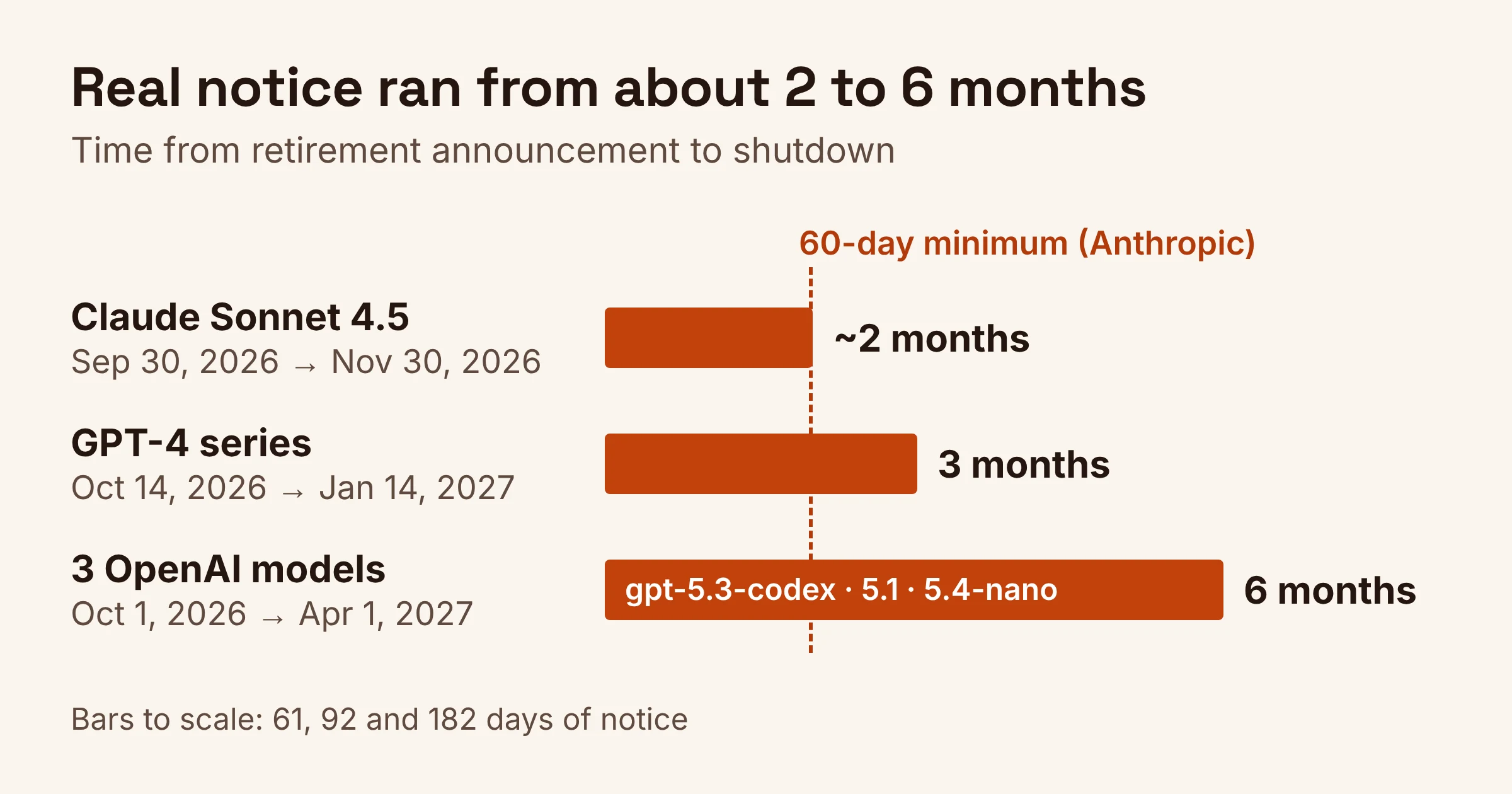
OpenAI promises at least 6 months' notice for generally available models and at least 3 months for specialized variants, unless safety or compliance concerns require a faster timeline. Preview models can go with much shorter notice, such as 2 weeks. Anthropic promises at least 60 days for publicly released models.
| Vendor | Model type | Minimum notice (vendor policy) | Caveat |
|---|---|---|---|
| OpenAI | Generally available | At least 6 months | Shorter if safety or compliance require it |
| OpenAI | Specialized variants | At least 3 months | Same exception |
| OpenAI | Preview | Can be much shorter, such as 2 weeks | Don't ship production work on previews without a fallback |
| Anthropic | Publicly released | At least 60 days | Bedrock and Google Cloud set their own schedules |
Now compare those policies with the real dates in the calendar:
- Claude Sonnet 4.5 was notified on September 30, 2026 for a November 30, 2026 retirement, close to Anthropic's 60-day minimum.
- The GPT-4 series was notified on October 14, 2026 for removal on January 14, 2027.
- The April 1, 2027 batch got six months.
Plan around the shortest gap you've actually seen, not the longest one a policy suggests. Run the GET /v1/models audit on a schedule, such as monthly, and re-read Anthropic's table at the same time.
What should you fix first?
Fix by deadline first, then by effort. The November 30 product shutdowns come before any model swap because they have no drop-in replacement. A model retirement usually means changing an ID and re-running tests. Agent Builder, Evals and v1/prompts mean moving logic off OpenAI's platform and into your own code.
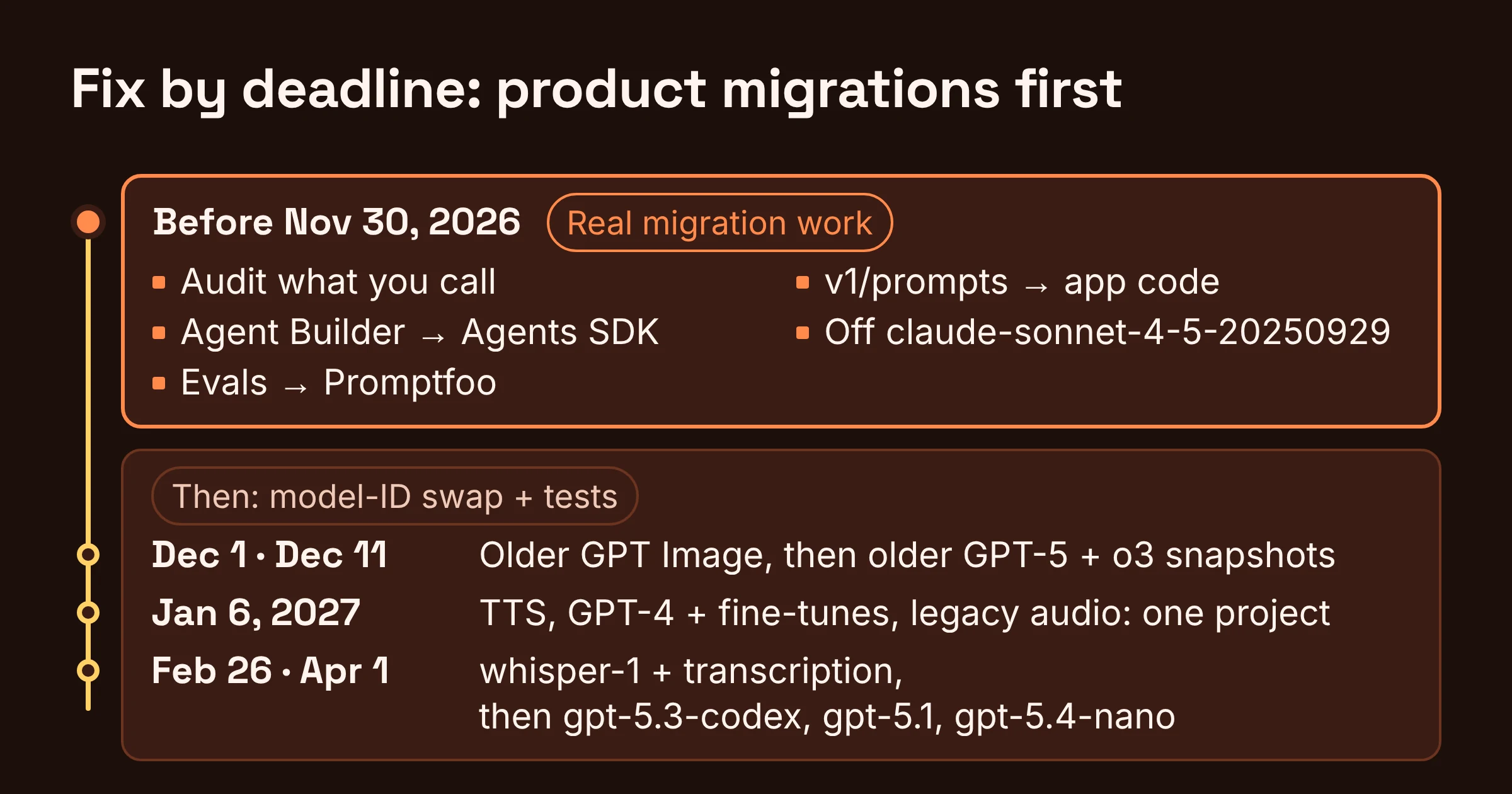
This week (before November 30, 2026):
- Run the audit. Call
GET /v1/modelsfor shutdown dates, grep for hard-coded IDs and check your logs for config-driven IDs. If you run Claude on Bedrock or Google Cloud, check those consoles too. - Export each Agent Builder workflow to Agents SDK code. Test control flow, triggers, tools and permissions, and test any ChatKit front end end to end.
- Copy your current OpenAI Evals scores, then recreate the evals that matter in Promptfoo.
- Pull every v1/prompts object into your repo and remove the stored IDs.
- Test the replacement Anthropic recommends, then move off
claude-sonnet-4-5-20250929.
Before December 1 and December 11, 2026: swap any older GPT Image models, then any older GPT-5 and o3 snapshots your audit flagged.
Before January 6, 2027: handle text-to-speech, the GPT-4 series (including fine-tunes) and legacy audio as one project. All three land in the same January stretch, and holiday code freezes eat into the weeks before it.
Before February 26 and April 1, 2027: transcription first, then gpt-5.3-codex, gpt-5.1 and gpt-5.4-nano.
If your team also uses Custom GPTs on the ChatGPT side, see our separate guide to moving Custom GPTs into Projects.
Dates checked on OpenAI's and Anthropic's deprecation pages in November 2026. Both pages change as new notices go out.