
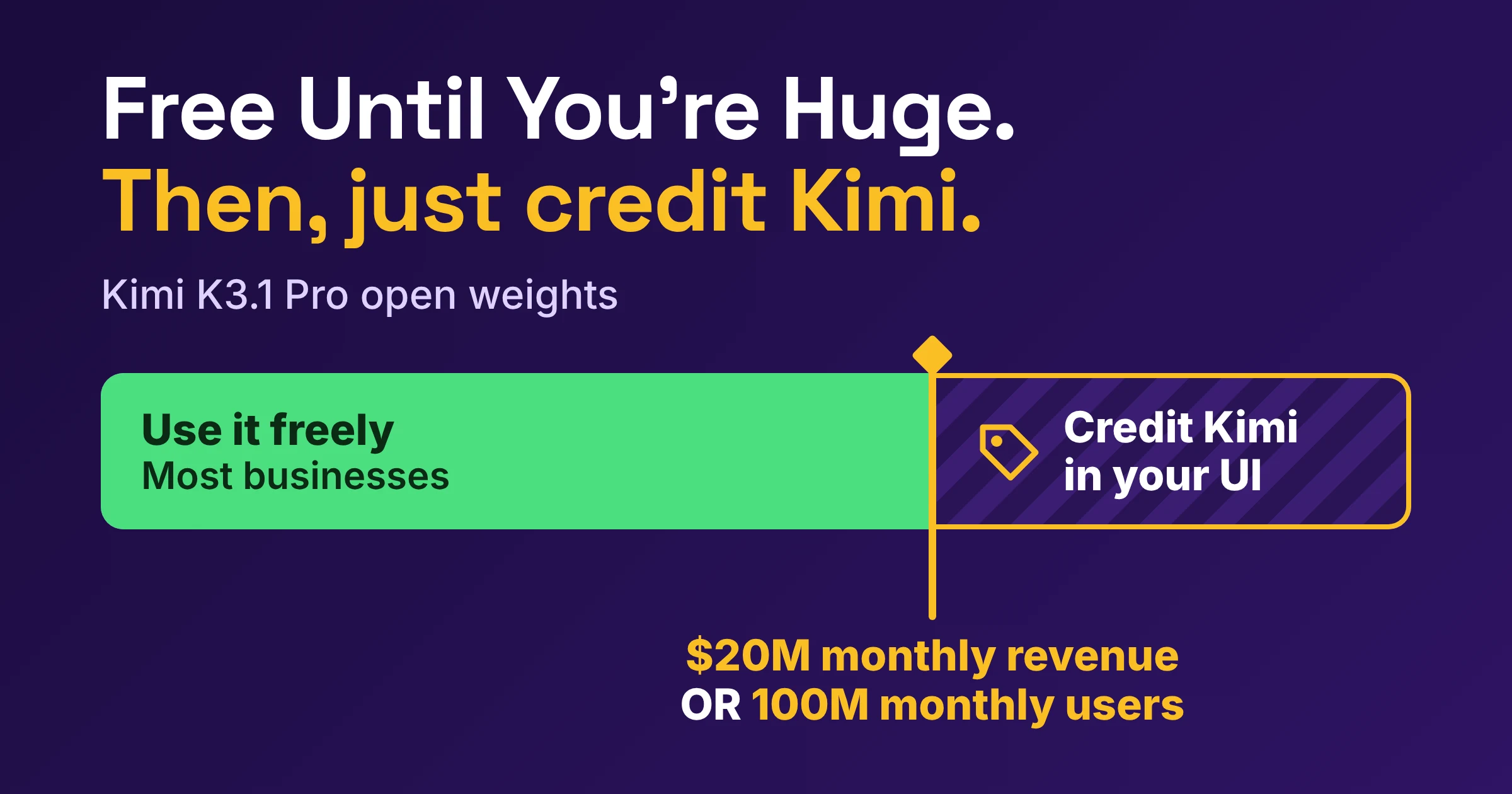
For most businesses, yes: the Kimi K3.1 Pro open weights license lets you use, modify and even sell the model without a separate deal with Moonshot AI. The conditions only apply at large scale. They cover selling model access with more than $20 million in revenue over 12 months, or running a product with more than 100 million monthly users or $20 million in monthly revenue.
The real barrier is hardware. The main weights take about 1.56 TB on disk, and the simplest tested setup uses 8 data-centre GPUs.
So for a typical team, "open weights" changes less than the headlines suggest. Below you'll find the decision rule from the license text, what self-hosting really involves, and when Moonshot's pay-as-you-go API is the saner choice. This is a plain reading of the license, not legal advice. If you're anywhere near the thresholds, read the full license file yourself.
Is Kimi K3.1 Pro really open source?
Kimi K3.1 Pro is open-weight, not open source in the strict sense: as of November 2026, Moonshot's model card calls it an "open-weight" model. Anyone can download the trained files, but the license attaches business conditions that kick in once you get very large.
Open weights means the model's trained parameters (the billions of numbers that make it work) are free to download and run. The term says nothing on its own about the training data or the rules for using the model. Those rules live in the license.
As of 4 Nov 2026, the weights were on Hugging Face. According to On The Wire, the repository was public and not gated, so you don't have to request access.
Think of it as a recipe you can cook, tweak and sell. The catches only show up at enormous scale: if your restaurant chain becomes enormous, the chef's name goes on the menu, and if you sell the recipe as a service at huge scale, you need a separate deal with the chef. Calling that "fully open source" skips those catches, and they're exactly the part that matters if you grow.
Can my business use Kimi K3.1 Pro commercially for free?
For most companies, yes. Kimi K3.1 Pro's license conditions only apply to Model as a Service businesses above $20 million in 12-month revenue, and to products above 100 million monthly users or $20 million in monthly revenue. "Free" refers to the license only: you still pay for servers or for the API.
Find your row:
| Your situation | Everyday example | What the license requires | What to do |
|---|---|---|---|
| Internal tool only | Staff assistant that drafts reports on your own servers | Nothing extra (internal use) | Use it |
| Customer-facing feature, below every threshold | Chatbot inside your booking app | Not internal use, but no condition is triggered | Use it, and track users and revenue |
| You sell model access, at or under $20 million over 12 months | Small hosting company reselling an API | Model as a Service, below the line | Use it, and track revenue including affiliates |
| You sell model access, over $20 million over 12 months | Large inference provider | Separate agreement with Moonshot | Contact Moonshot before launch |
| Product over 100 million monthly users or $20 million monthly revenue | Major consumer app | Show "Kimi K3.1-Pro" prominently in the interface | Add the name to your UI |
| You use Moonshot's own products or a certified partner | Calling the model through a certified host | The conditions don't apply | Confirm the partner is certified |
The short version: if you aren't selling model access at scale and you aren't running a giant consumer product, the license conditions don't touch you. Your real question is whether to host the model yourself.
What exactly does the Kimi K3.1 Pro license say?
The Kimi K3.1 Pro license lets you use, copy, modify, publish, distribute, sublicense and sell the software, and that includes fine-tuning (training it further on your own examples) and building derivative works. Three clauses decide whether any strings attach: internal use, Model as a Service, and name display.
Internal use: the conditions don't apply
The license defines internal use as any use that doesn't make the software, its outputs or its underlying capabilities available to third parties. For internal use, the Model as a Service and name-display conditions don't apply.
Example: you run the model on company servers so staff can summarise contracts and draft internal reports. Nothing leaves the building, so you're in the clear.
Watch the word outputs. If customers see what the model writes, such as replies from a support bot, you're no longer in internal use. For most companies that still changes nothing, because the remaining conditions only bite at the very large thresholds below.
Selling model access: the $20 million line
The license defines "Model as a Service" as giving a third party access to language model inference (getting answers from the model) or fine-tuning, for example through an API. An app that simply relays requests to models hosted by others is excluded from that definition.
If you run a Model as a Service business and your combined revenue with affiliates exceeds $20 million over any 12 months, you need a separate agreement with Moonshot. Below that line, the license's broad grant covers you.
Example: you host Kimi K3.1 Pro and sell API access to other developers. That's Model as a Service, so keep an eye on your trailing 12-month revenue, including revenue from affiliated companies.
Do I have to show the Kimi name?
Only if your product is huge. Commercial products with more than 100 million monthly active users, or more than $20 million in monthly revenue, must show the model name: the license says "Kimi K3.1-Pro" must be prominently displayed on the user interface of such a product or service.
Below those numbers the display condition doesn't apply, and it never applies to internal use. If you redistribute the weight files themselves, check the full license text for any notice you need to keep alongside them.
The exemption: official products and certified partners
The conditions also don't apply when you access the model through Moonshot's official products or its certified inference partners. If you plan to lean on this exemption, get your provider to confirm it's certified.
How big is Kimi K3.1 Pro, and what hardware does it need?
Kimi K3.1 Pro is a data-centre model. Its Hugging Face repository holds 96 weight files, the vLLM project puts the main weights at about 1.56 TB on disk, and vLLM's simplest working NVIDIA setup is a group of 8 GPUs: either two GB300 trays or one B300 node.
Here's the download, piece by piece:
- 96 safetensors shards (the files the model is split into). The first is 2.34 GB, and most of the rest are about 17 GB each.
- Already compressed. Moonshot ships the weights in a compact MXFP4 format with MXFP8 activations, trained with quantization-aware training (teaching the model to work well in the smaller format from the start). So 1.56 TB is already the slimmed-down size.
- Some parts stay larger. According to vLLM, attention, the shared experts and the vision tower are kept in the higher-precision BF16 format.
The model card itself gives no GPU guidance, according to On The Wire. vLLM's recipe fills that gap, with two caveats. vLLM says throughput was not tuned for the 8-GPU baseline. And serving across several machines requires an InfiniBand interconnect (a very fast network link between servers).
Neural Brew put it bluntly: this is "far from a model that can run on a workstation." If you were picturing a powerful desktop under someone's desk, picture a rack humming in a server room instead.
What you get for all that bulk is a 1-million-token context window, which Moonshot's API docs list as 1,048,576 tokens. A token is a small chunk of text, roughly a piece of a word, so that's room for a stack of long contracts in one go.
Which inference engines run Kimi K3.1 Pro?
According to On The Wire, the Kimi K3.1 Pro model card recommends three inference engines: vLLM, SGLang and TokenSpeed. An inference engine is the software that loads the model onto your GPUs and serves its answers.
vLLM has published a dedicated Kimi K3.1 Pro recipe with a tested hardware baseline, which makes it the practical starting point if your team has never served a model this size.
Is the downloadable Kimi K3.1 Pro the same as the hosted one?
Not necessarily: Moonshot says it removed cybersecurity-related data from training the open-weights version of Kimi K3.1 Pro to limit its offensive capabilities, as reported by Neural Brew.
For everyday work like writing, research or coding, the sources we checked don't include a side-by-side comparison of the downloadable and hosted versions. Don't assume they behave identically, especially on security-related tasks.
How much does the Kimi K3.1 Pro API cost?
Per Moonshot's pricing page (November 2026), kimi-k3.1-pro costs $2.00 per million input tokens and $10.00 per million output tokens, with cached input at $0.20. Billing is pay-as-you-go with no subscription plan, and the API accepts both OpenAI-style and Anthropic-style requests.
| Model | Input (per million tokens) | Output (per million tokens) | Cached input | Cache write, 5 min | Cache write, 1 hour | Best for |
|---|---|---|---|---|---|---|
| kimi-k3.1-pro | $2.00 | $10.00 | $0.20 | $2.00 | $4.00 | Most work; the cheaper option |
| kimi-k3.1-pro-highspeed | $4.00 | $20.00 | $0.20 | $4.00 | $8.00 | When speed is worth double the price |
Details that change your bill:
- Flat pricing. Moonshot says the price per token stays the same across the whole context window, with no extra tiers for long inputs.
- Batch discount. Batch inference (jobs you submit to run later rather than instantly) is billed at 60% of the standard price.
- Thinking is always on. Moonshot says K3.1 Pro always has thinking enabled, so you can't switch it off.
- Easy switching. Because the API is OpenAI- and Anthropic-compatible, many existing tools can point at the model name kimi-k3.1-pro with little rework.
A worked example
Say your team feeds in a pile of reports totalling 1 million input tokens and gets 100,000 output tokens of summaries back.
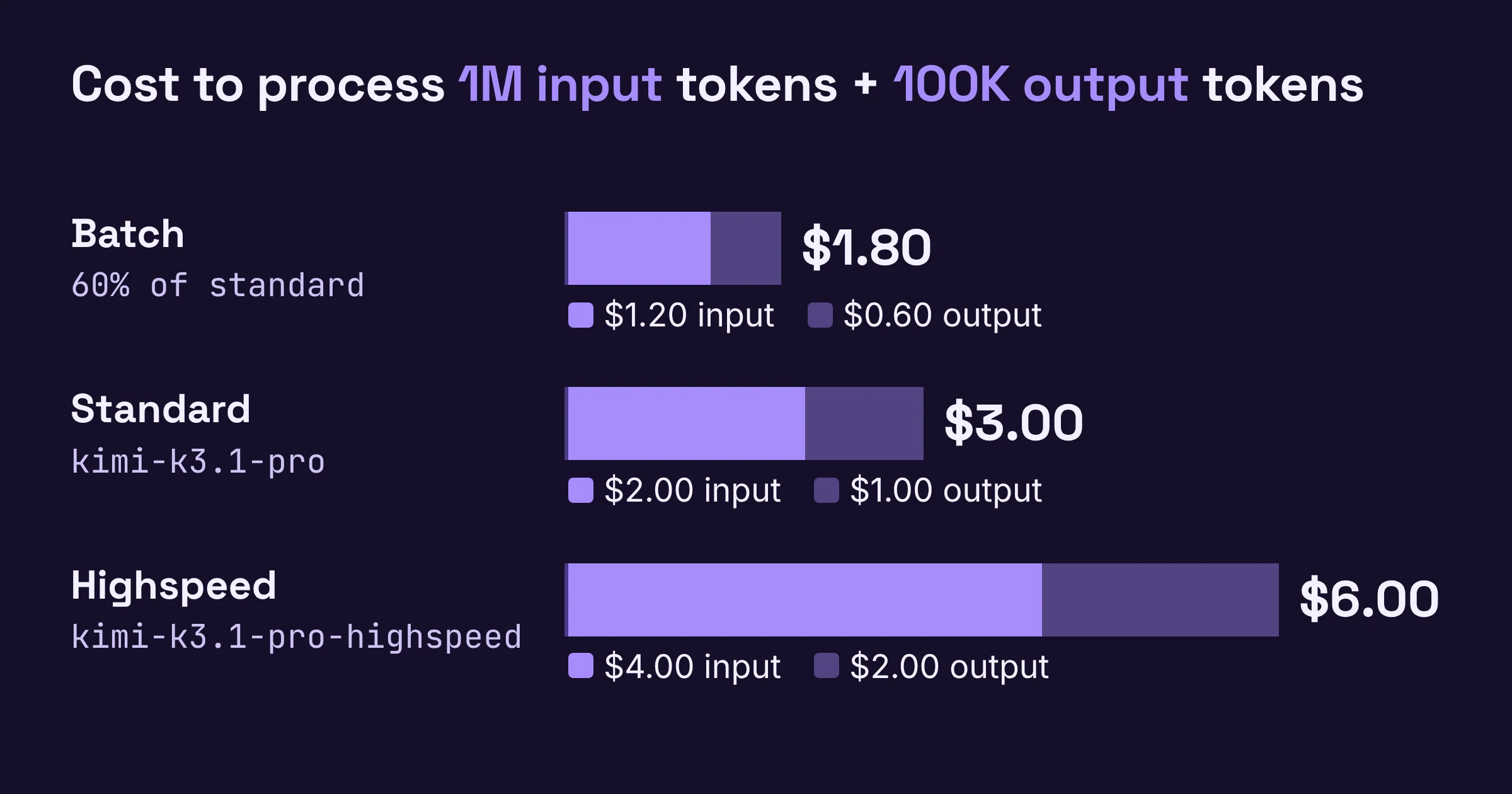
- Standard: $2.00 for input plus $1.00 for output = $3.00
- Batch (60% of standard): $1.80
- Highspeed: $4.00 for input plus $2.00 for output = $6.00
Now picture keeping an 8-GPU server powered, cooled and staffed before your first summary is even written. For occasional or moderate use, paying per token is far simpler.
Should you download the weights or just use the API?
Most teams should use Moonshot's API or official products, and only self-host Kimi K3.1 Pro when data must stay on their own servers and they already have serious GPU capacity. The license rarely stops you; the roughly 1.56 TB of main weights and the 8-GPU baseline usually do.
Use the API or Moonshot's products if:
- you want Kimi K3.1 Pro's abilities without running hardware;
- your usage is occasional, bursty or still being tested;
- you'd rather pay per token than maintain a server.
Self-host if:
- your contracts or regulators require models to run on-prem (on your own servers);
- you already run, or can rent, an 8-GPU GB300 or B300 class setup and have people who can operate it;
- you want to fine-tune the model on private data and keep everything internal.
Talk to Moonshot first if:
- you sell model access and expect more than $20 million over 12 months, including affiliates;
- your product could pass 100 million monthly users or $20 million in monthly revenue.
Your starter plan
- Find your row in the decision table above. If no condition applies, the license isn't your blocker.
- Price a realistic month on the API using the worked example, and use the batch rate for anything that doesn't need instant answers.
- Only if self-hosting is still on the table, hand your IT team the vLLM recipe and the 1.56 TB figure, and ask whether you have an 8-GPU node to spare (plus an InfiniBand interconnect if you plan to serve across several machines).
Prices and limits checked on Moonshot's pages in November 2026; they change often.