You ran eight customer interviews. The transcripts sit in a folder, forty thousand words of "um" and tangents between the sentences that matter. So you do the 2026 thing: you paste them into a model and ask for a summary of key themes. Ten seconds later you have a beautiful list:
- Users want faster onboarding
- Users need better integrations
- Users prefer a mobile-first experience
Looks like research. Reads like research. Here is the problem: you cannot tell, from that list, which sentences came out of a human mouth and which ones the model invented. That is not a hypothetical risk. Large language models are trained to produce coherent output, and when your transcripts are messy, the model smooths them into the summary a product person would expect. One loud interviewee becomes "users." An offhand "I guess that could be useful" becomes "users need." And themes nobody stated appear anyway, because they fit the genre of a customer research summary.
The fix is one rule, and it is the whole article: every insight in your brief must link to a sentence a real customer actually said. If the model cannot produce that sentence, the insight does not go in the brief. Call it the quote rule. It is cheap to state, brutal to satisfy, and it is the single highest-leverage thing you can do when turning interviews into a product brief with ChatPRD or Claude. It converts your AI from a summarizer you have to trust into a clerk you get to check.
The failure first: what an invented consensus looks like
Let's make this concrete with a small worked example. Fictional product, fictional customers, real failure mode.
Imagine you interviewed eight users of a scheduling tool for small clinics. Three quotes from the transcripts:
"Honestly, the thing I dread is double bookings. It happened twice last month and both times the patient just showed up anyway.", front desk lead, Interview 3
"I never log in on my phone. The screen is too cramped, so I wait until I'm back at the desk.", practice manager, Interview 5
"If it talked to our billing software I'd save maybe an hour a day. Right now I retype everything.", office administrator, Interview 7
Now you ask a model for "key themes and a product brief." Almost every model, on almost every run, will hand you something like:
- Users are frustrated by scheduling conflicts and want conflict prevention. (Fine. Traceable.)
- Users want a mobile app. (Watch this one.)
- Users want AI-powered smart scheduling recommendations. (Nobody said this.)
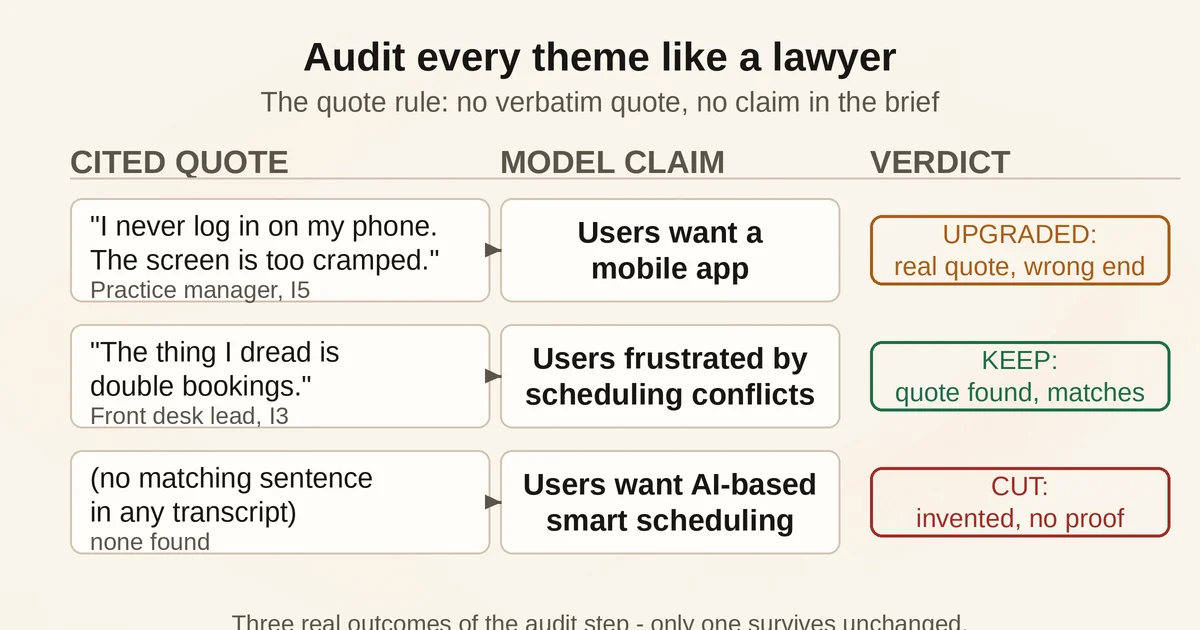
The second theme is the dangerous kind of half-truth. One person said the mobile screen is cramped and she waits until she's at the desk. The model read a mobile complaint, pattern-matched it to the most common product conclusion in its training data, and upgraded "the mobile view needs work" into "users want a mobile app," which is a different, more expensive conclusion. The third theme is pure invention: "AI-powered smart scheduling" matches what a 2026 product brief is supposed to say, so the model said it.
This is the same mechanism behind ordinary hallucination, fluent output with no source, but it is worse in interview synthesis because the ground truth is a private document nobody else will ever check. A wrong date in a news article gets caught by readers. A wrong theme in your brief gets caught by nobody, becomes roadmap, and costs a quarter.
Here is how the quote rule catches both. You ask the model to attach, to every single insight: the verbatim sentence, who said it, and which interview it came from. "Users want a mobile app" now has to produce its evidence. The best the model can do is the cramped-screen quote, which supports "improve the mobile view for desk-checking users," not "build an app." The AI recommendation theme produces nothing at all. No quote, no ticket. Both failures become visible in seconds instead of months.
From transcript to themes, with quotes forced in
Here is the full workflow. It works with any capable model, and the last two sections show how to run it in ChatPRD and Claude Projects specifically.
1. Prepare the transcripts. Strip your own questions out if you can, and label every speaker turn. The model cannot cite speakers it cannot identify, so "Interview 7, Administrator:" prefixes are what make citation possible. If you record calls, most transcription tools export speaker-labeled text; keep that labeling.
2. Set the rule before you ask for anything. Your first prompt is not "summarize this." It is something like:
"You are helping me synthesize customer interviews. Rule: every insight you report must include (a) the verbatim sentence a participant said, (b) the speaker role, and (c) the interview number. If you cannot quote a participant for an insight, either mark it clearly as MY HYPOTHESIS, NOT FROM TRANSCRIPTS, or drop it. Do not generalize one participant into 'users.' Do not add themes that fit a typical product brief unless someone said them."
Notice the escape hatch. Letting the model flag "this is what I'd expect but no one said it" turns hallucination into a labeled suggestion you can consciously test in the next interviews, instead of unlabeled poison in your brief.
3. Ask for themes, not a document. Themes first, brief later. If you ask for the finished brief immediately, the model spends its effort on formatting and prose instead of evidence, and the invented-consensus problem comes right back. Themes with quotes is a boring artifact that is hard to fake.
4. Audit the output like a lawyer. For each theme, actually open the transcript and search for the quote. Two things happen when models cite transcripts: sometimes they quote accurately, and sometimes they paraphrase or stitch words together. A stitched quote usually means the theme is real but the model was lazy, so fix the citation. A quote you cannot find at all means the theme is suspect, so cut it or mark it. This step is minutes of Ctrl-F per theme, and it is the entire quality guarantee.
5. Keep the contradictions. The model's instinct is to resolve disagreement into consensus. Don't let it. If three clinics say double bookings are the top problem and one says she's never had one, your theme is "double bookings: a severe problem for 3 of 8, not experienced by all," not "users struggle with scheduling conflicts." The first version is true, segmented, and tells you the feature matters for a specific reason. The second version is how products get built for the average of a room. For more on why models flatten messy sources into confident-sounding output, our piece on how AI hallucination actually happens covers the pattern.
6. Write a one-line decision per theme. Ship it, park it, or test it in the next interviews. This is the bridge from research to brief, and it forces you to say what the evidence is actually worth.
The brief skeleton that only accepts evidenced claims
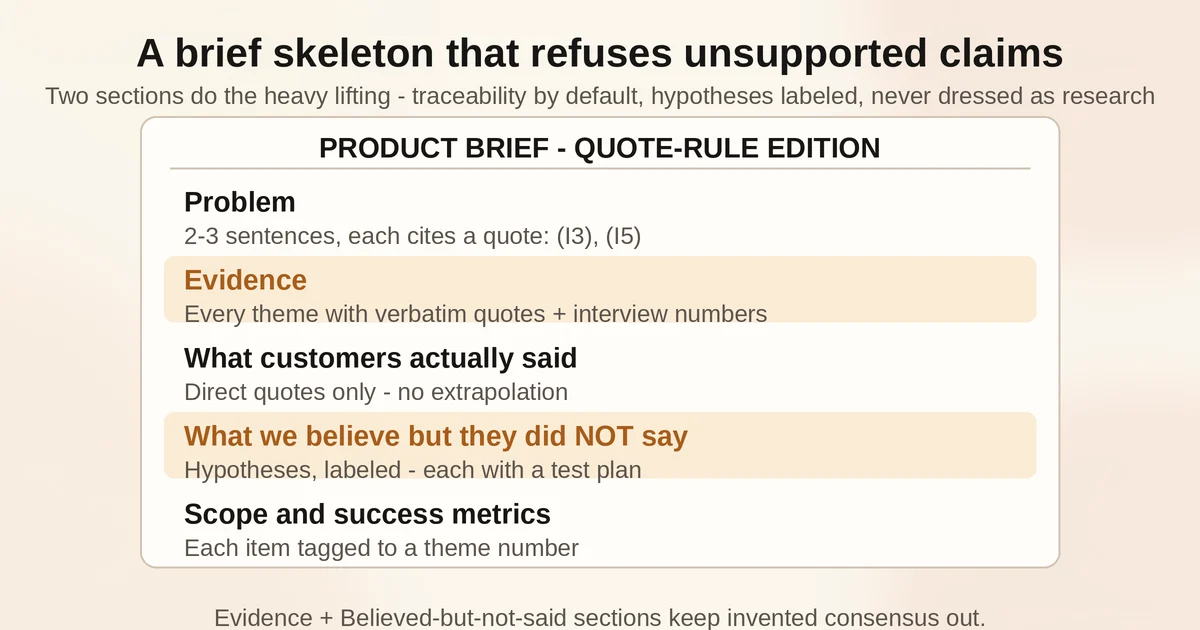
Once themes are audited, generate the brief. But shape it so it structurally refuses unsupported claims. Here is a skeleton that has worked well:
# [Feature name]: Product Brief
## Problem
[2-3 sentences. Every sentence cites a quote: (I3), (I5)...]

## Evidence
Theme 1: [claim]. Strength: [4 of 8 interviews].
- Quote: "..." (Front desk lead, I3)
- Quote: "..." (Office administrator, I7)
Theme 2: ...

## What customers actually said about [the solution area]
[Only direct quotes and near-quotes. No extrapolation.]

## What we believe but customers did NOT say
[Hypotheses, clearly labeled. Each one gets a test plan.]

## Scope
[What we will build, each item tagged to a theme number.]

## Success metrics
[How we'll know the evidenced problem got smaller.]
Two parts of this skeleton do the heavy lifting. The "Evidence" section makes traceability the default format, so anything unsupported looks naked sitting there without a quote under it. And the "believe but customers did NOT say" section is the pressure valve: it gives every model-invented or team-favorite idea a legitimate home where it cannot masquerade as research. In the clinic example, "AI-powered smart scheduling" lands there, tagged for a test question in round two of interviews, instead of landing in Scope wearing a quote that never existed.
One habit worth stealing from research teams: keep the quote file separate from the brief and keep both in version control. When someone in a roadmap meeting says "customers want X," the file answers in ten seconds. That is the entire payoff of this discipline: meetings argue about what to do with evidence, not about what the evidence was.
Running it in ChatPRD
ChatPRD is the purpose-built option: it is an AI platform specifically for product managers, and as of September 2026 it has three tiers plus enterprise. The free plan gives you 3 chats with a basic model and basic templates, enough to evaluate it. Pro is $15 a month (billed $179 a year) and includes unlimited chats and documents, premium models, custom templates, projects with saved knowledge, and file uploads. Teams is $29 per seat per month (billed $349 per seat annually) with shared workspaces, shared templates, real-time collaboration and comments, plus Linear, Slack, and Notion integrations. Pricing and plan details are as published by the vendor around September 2026 and can change, confirm on the official site.
The workflow maps onto three ChatPRD features:
- Custom templates. ChatPRD ships 20+ built-in templates (its default PRD, plus product strategy docs, go-to-market plans, user personas, customer journey maps, usability test plans, and more). You can build your own, and you should: recreate the evidence-first skeleton above as a custom template so the quote-linked Evidence section is the default output shape, not something you paste in each time. The template library distinguishes between ChatPRD templates and your custom ones, so the "brief, quote-rule edition" lives alongside the standard PRD.
- Projects with saved knowledge. Upload your transcripts once into a project; every chat inside it sees them. You can run the themes pass, then the audit pass, then the brief pass, all against the same stored transcripts without re-pasting 40,000 words.
- Verbosity control. ChatPRD's writing modes (concise / balanced / detailed) matter here in a specific way: use concise for the themes artifact, because compression is where fabrication hides. The more prose the model produces around each insight, the more room it has to embellish. Themes should read like a list of receipts.
What ChatPRD will not do for you, and be clear-eyed about this: nothing in the product enforces quote traceability. It is a document generator with product-domain templates and a polite, helpful disposition, which is exactly the temperament that produces invented consensus when fed messy transcripts. The quote rule is yours to enforce through the template and the audit step. If you want the rule itself enforced mechanically rather than procedurally, that is what dedicated research platforms attempt, and that is a different budget and a bigger team.
Running it in Claude Projects
If you already pay for Claude, you can run the same workflow with no new subscription. A Claude Project is a self-contained workspace with its own chat history and knowledge base: you upload documents, write persistent project instructions, and every chat inside the project sees all of it. Projects are available to all Claude users, including free accounts (free users can create up to five projects), and paid plans get enhanced project knowledge with retrieval that Anthropic says expands capacity up to 10x for large document sets. Claude Pro is $17 a month with the annual subscription, $20 billed monthly, per the Claude pricing page.
The setup that works:
- Create a project called something like "Clinic interviews, Sept 2026." Upload all speaker-labeled transcripts to the project knowledge. You can also add supporting docs: your product strategy, previous research, the existing brief.
- Put the quote rule in project instructions. This is the killer feature for this use case. Project instructions persist across every chat in the project, so the rule text from step 2 above stops being something you paste into every prompt and becomes the constitution of the workspace: every insight needs a verbatim quote, speaker, and interview number, or it gets labeled as hypothesis.
- Run the passes as separate chats. One chat for themes, one for contradictions, one for the brief generation against the audited theme list. Because they share knowledge and instructions, the brief chat does not drift from the themes chat.
- Ask for a quotes-only artifact. A useful prompt inside the project: "List every verbatim quote in these transcripts about scheduling problems, with speaker and interview number." This gives you the raw receipts file to Ctrl-F against during the audit step.
One current-events note: Anthropic is rolling out a new beta version of Projects through 2026, starting with Claude Code, where a project becomes a single conversation that Claude breaks into parallel threads running in the cloud, with a Library that collects everything you add and everything Claude produces. The existing Projects work the way described above and keep working; if you are on Pro or Max you may see the new interface first in the Code tab. For interview synthesis either version works fine, since your loop is a few sequential chats over the same knowledge base, not heavy parallel execution. Anthropic's help center article on Projects tracks the rollout state.
ChatPRD vs. Claude for this job, honestly: ChatPRD's advantage is the product-shaped output. Its templates, coaching features, and Notion/Linear/Slack integrations are built for the document you eventually hand engineers, and if you write product docs weekly, it earns the $15. Claude Projects' advantage is the enforcement surface: persistent instructions over a fixed document set is the cleaner mechanism for a rule you want applied identically on every pass, and RAG-backed knowledge handles large transcript sets. For one brief from eight interviews, either is plenty. For a rolling research habit, use both: themes and audit in a Claude project, final brief generation in ChatPRD with a custom template. And this is also the practical difference between prompting tools and picking models; the discipline matters more than the brand on the tab, as we covered in how to pick the right AI model.
When you already have Dovetail
If you work inside a company with a research team, you may already have Dovetail, and you should use what exists before adding tools. Dovetail is a genuine customer intelligence platform: as of September 2026 its public pricing is a free tier (one channel, one project) and a custom-priced Enterprise tier with unlimited agents, channels, and dashboards, plus SSO, redaction, and Slack/Teams integrations, per the Dovetail pricing page. It stores calls, documents, and surveys, tags them, clusters them, and lets you pull highlight reels.
But know what it does not solve. Dovetail organizes evidence; it does not absolve you from reading it. Its AI features will summarize and cluster your interviews, and those summaries are subject to the same smoothing instinct, just with better furniture around it. The quote rule still applies, and Dovetail actually makes step 4 easier, because quotes are linked to the source moments in the original recordings. If you are a solo PM or a freelancer, Dovetail is more platform than you need for a single brief: the ChatPRD or Claude path costs $0 to $20 and an afternoon. The enterprise tier is priced for organizations standardizing research across teams, not for one person with eight transcripts.
Two questions people actually ask
How many interviews before the AI synthesis is trustworthy? The quote rule changes the answer. Without it, you need enough interviews that your own judgment can check the model, call it ten-plus. With it, the artifact is self-auditing, so even five or six interviews produce a brief where every claim is traceable. What you lose at low n is coverage, not truth: five interviews give you an evidenced but narrow brief, and the "believe but did not say" section tells you exactly where the gaps are for round two.
Can I skip the manual audit if the model always cites quotes? No, and the reason is specific: models sometimes produce plausible stitched quotes, sentences that look like the transcript but combine two passages or tidy the grammar. Quote the audit prompt exactly ("verbatim, word for word, from the transcript"), and still spot-check every theme with one Ctrl-F. It is the five minutes that keeps the other five hours honest.
The pattern generalizes past interviews, too. Sales call notes, support tickets, survey open-ends: any workflow where a model stands between raw human words and a decision document benefits from the same "no quote, no claim" constraint. The tool in the middle changes. The rule does not.
The verdict
The 2026 tooling is good enough that transcript-to-brief is a real afternoon's work, not a week. ChatPRD gives you the product-shaped end of the pipeline for $15 a month; Claude Projects gives you a rule-enforcing workspace for $20; both reward the same discipline. The model will still invent consensus. It will still upgrade one cramped mobile screen into "users want an app." The difference between a brief you can defend and a brief you can only believe is not the model. It is whether every insight in it comes with a sentence someone actually said.