Short answer: yes, you should build an AI support agent, and you can start this month. Keep it on the boring, everyday questions. Keep a human one door away.
Here is a strange thing happening in customer support right now. Nearly four in five organizations expect AI agents to handle at least half of the work soon. Almost nobody has actually done it yet.
The numbers come from a big industry survey, the Adobe 2026 AI and Digital Trends report, put together with Oxford Economics, who surveyed 3,000 executives and practitioners plus 4,000 customers in October and November 2025. In it, 78% of organizations say they expect agentic AI (AI that can take actions, not just chat) to handle at least half of their customer support interactions within 18 months. And how many organizations report they have actually embedded it organization-wide for support? 16%.
That gap is the whole reason this guide exists. Expecting is easy. Shipping is hard. And the space between the two is not filled with mystery. It is filled with ordinary, buildable work, and this post walks you through all of it.
Here is the picture to hold in your head the whole way down: a helpful store assistant. The assistant stands at the front of the shop and answers "where's the milk?" a hundred times a day without ever getting tired or grumpy. But when a customer starts shouting, or asks for a strange refund, the assistant smiles and says, "let me get the manager for you." A good AI support agent is exactly that. Great at the everyday questions. Honest about when it is time to fetch a human.
By the end of this post you will know what an AI support agent should and should not touch, the five-part setup that makes it work, what to build first, which metrics tell the truth, and a small pilot you can start this month.
In short
- Most companies expect AI to handle at least half of their support. Very few have done it. That gap is why this guide exists.
- A good AI support agent is like a store assistant: it answers "where's the milk?" all day long, and fetches the manager for refunds and angry customers.
- Build the boring stuff first: order status, returns policy, password resets.
- The assistant reads answers from your help docs, like a cook reading the store's recipe binder. It never guesses from memory.
- Always tell customers they are talking to AI, and always let them ask for a human.
The gap everyone talks about, few have crossed
Every town in the country says it is going to build a swimming pool. Ribbons get cut. Posters go up. Speeches are made. But if you drive around and actually look, almost no town has water in its pool yet. That is customer support with AI agents right now.
The short version: most teams expect support automation to handle at least half of support soon, but only 16% have embedded it so far. What is missing is not smarter AI. It is data plumbing and honest measurement.
The Adobe 2026 AI and Digital Trends report asked organizations what they expect and what they have actually shipped. 78% of organizations expect agentic AI to handle at least half of their customer support interactions within the next 18 months. But only 16% report having embedded agentic AI organization-wide for customer support. There is a second, gentler number from the same research program, its customer-engagement spotlight: 30% of organizations have moved beyond the pilot stage, into organization-wide or cross-functional deployment. Read those two numbers carefully, because they measure different things. The 16% is about embedding agents fully, across the organization, for support. The 30% counts anyone who has moved past pilots in any meaningful deployment shape. Either way, most teams are still standing at the pool's edge.
Why is the pool empty? The same report points at two plain reasons, and neither is "the AI isn't good enough yet."
First, the pipes are missing. To answer a customer usefully, an agent needs to know who the customer is, what they bought, and what happened last time. That context lives in your data systems. But only 39% of organizations say they have a customer data platform capable of supporting agentic AI, and 75% cite data integration and quality as their top implementation challenge. You cannot serve drinks from an empty tap.
Second, the scoreboard is missing. Only 31% of organizations say they have a measurement or ROI framework for agentic AI. Nearly half, 47%, have no framework at all or do not know whether one exists. If you cannot say what success looks like, you cannot tell whether your agent is helping or quietly hurting.
And there is a third, quieter gap on the customer side of the counter. Customers are picky about how this is done, and rightly so. In the same survey, 68% of organizations rank clear disclosure that AI is being used as the most important thing for customer trust, and customers say the option to switch to a human at any time is the disclosure they value most. Get this wrong and it costs real money: 37% of customers say they would disengage from a brand on learning they had been talking to AI when they expected a person. (The Adobe report, with all the figures in this section, is here.)
So the pool is not empty because building pools is impossible. It is empty because the pipes and the scoreboard come first, and almost nobody has built them. The rest of this guide is the plumbing manual.
What the assistant does well (and what stays human)
Back to our store. The assistant at the front has a job description, and it is a humble one. "Where's the milk?" "When do you close?" "Do you have this in blue?" A hundred small questions a day, answered politely, every time. But the shouting customer goes straight to the manager, and so does the man asking to return a three-year-old sandwich "as a favor." The assistant knows exactly which job is theirs. That is the honest split, and every technical decision in this post flows from it.
In one sentence: customer service AI handles the routine, high-volume questions it can answer from your own docs. Humans keep judgment calls, money, and angry customers.
What do AI support agents do well? Answering questions from your own help docs and knowledge base. Resolving routine, high-volume issues that repeat every single day. Sorting each incoming message by what the customer actually wants, then sending it to the right place. Sitting at the desk all night, after hours, when no human is awake. These are not guesses about what agents might do. They are what organizations themselves expect to get: 63% expect agents to automate routine customer service tasks, and 69% expect agents to help with knowledge retrieval, per that same Adobe research. Mature products document exactly these capabilities: Zendesk's AI agents page, for example, describes autonomous resolution powered by "connected knowledge," meaning the agent reads the company's own knowledge base to resolve issues (as of September 2026; vendor product pages change often). (Zendesk's AI agents page is here.)
- The assistant's desk (good for AI agents): questions answered from your own docs, routine high-volume issues, sorting and routing messages, after-hours triage. High volume, low risk, easy to check.
- The manager's office (keep human): judgment calls like refunds and exceptions, angry or emotionally charged customers, and any conversation where the customer expects a person.
The "stays human" side is not sentimentality. It is what Adobe's customer data says. That 37% of customers would disengage when AI turns up unannounced is one warning. Here is another: 49% of organizations think customers will eventually prefer AI agents as their main way of interacting, but only 19% of customers agree. Companies consistently imagine customers are more comfortable with agents than customers actually are. The honest split is not a limitation you grudgingly accept. It is the design.
The store map: a realistic architecture
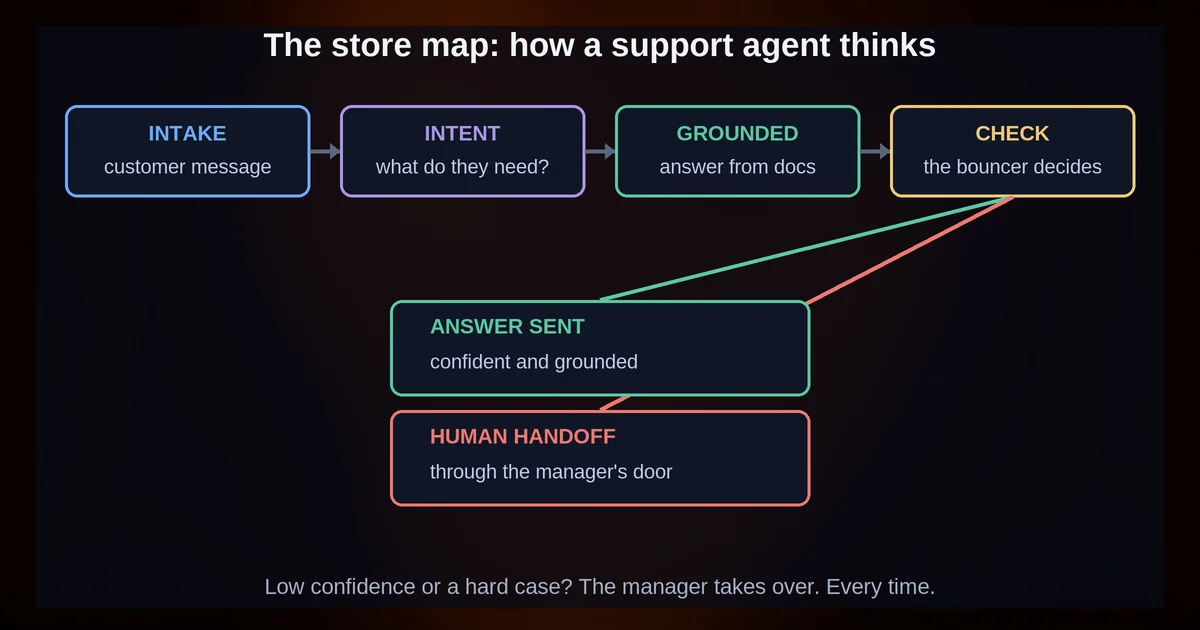
Before the assistant's first shift, the store needs a map. Where is the front door? Where is the recipe binder? Which door is the manager's? Without the map, the assistant wanders. With it, every customer walks the same sensible path: in the front door, "what do you need?", check the recipe binder, taste-test the answer, and, if needed, the manager's door. Engineers call this path the support-agent loop, and it has five steps. This is a build pattern, not any one vendor's diagram, and you can build it with almost any modern tooling.
Put simply: a support agent architecture has five parts. Intake, intent classification, a grounded answer, a confidence check, and human handoff. The list below walks through each step.
- Intake (the front door). A message arrives, from chat, email, or anywhere else. The system loads the customer's context: who they are, what they bought, what happened recently. Honest note: this step is where most teams are actually unready. Only 39% of organizations say they have a customer data platform able to support agentic AI, per Adobe. If the pipes are missing, this is where the clog shows.
- Intent classification (what do you need?). The system sorts what the customer wants: a how-to question, an order status check, a billing issue, a complaint, a refund request. Each kind goes to the right handler. Anthropic's engineering guide "Building effective agents" calls this the routing workflow: classify the input, then direct it to a specialized followup task.
- Grounded answer (the recipe binder). For questions in scope, the agent searches your indexed help docs, policies, and order system, pulls out the actual passages it needs, and writes an answer from what it found. It never answers from memory. Anthropic calls this the augmented LLM: a model given retrieval, tools, and memory, and one that can generate its own search queries against your sources. OpenAI's agent documentation lists file search and retrieval as standard building blocks the same way (as of September 2026). (Anthropic's "Building effective agents" is here; note it was published in December 2024 and tooling has moved since, so treat its patterns as the durable part.)
- Confidence check (the taste-tester spoon). Before the answer goes out, a second check grades the draft: did the retrieved sources actually support what was written? If the grade comes back low, the agent does not guess. It says so and fetches a human. Anthropic names this the evaluator-optimizer pattern: one call generates, another evaluates. The grading call is separate, so no call marks its own homework. (Anthropic's separate-instance advice, and why it performs better, shows up in the guardrails section below.)
- Human handoff (the manager's door). When escalation is needed, the agent hands over the full transcript and context, so the human never starts by asking the customer to repeat everything. Intercom's Fin product page documents exactly this feature: a handoff to the human team that maintains full customer context (as of September 2026). We cover the when of handoffs two sections down.
Two small habits belong in this loop from day one, not bolted on later: always disclose that the customer is talking to AI, and log every interaction. The trust numbers from the first section are the reason. And one piece of engineering advice is worth pinning to the wall: start simple. Anthropic's guidance is to find the simplest solution possible and only add complexity when needed. For most first builds, a single grounded model call with retrieval beats a fancy multi-agent system.
Build the boring 20% first
When you open a lemonade stand, you sell lemonade. You do not open with a twelve-item menu of tamarind sparklers and matcha floats. You sell the drink everyone actually orders, and you sell it well. Your AI support agent's first version should work the same way: build the boring things everybody asks, and save the exotic menu for later.
Build the boring 20% first: FAQ answers, order-status lookups, message routing, and after-hours triage. Each one is high volume, low risk, and easy to check.
The boring stuff is not a consolation prize. It is where the actual money is. In the Adobe survey, 45% of organizations name automating repetitive tasks and workflows as a top AI goal, right behind personalization and customer satisfaction. The near-term uses organizations themselves name are exactly the boring ones: 63% expect agents to automate routine customer service tasks, and 69% expect agents to help with knowledge retrieval.
So here is the first-build list. This is our recommendation, shaped by the patterns above, not a quote from anyone's brochure:
- FAQ answering from your help docs. The "where's the milk?" of support: returns policy, shipping times, how to reset a password. High volume, low risk, every answer checkable against a real doc.
- Order-status lookups, via a read-only tool. The agent checks the store's ledger rather than guessing: connect it to the order system with permission to look, not to change anything.
- Intent classification and routing. Sorting incoming messages so the right handler, or the right human, gets them.
- After-hours triage. The night shift. Answer the easy things, queue the rest for morning with full context attached.
Each item is high-volume, low-risk, and verifiable, which is the whole trick. Notice what is not on the list. Anything from the "stays human" side of the honest split in the previous section does not get built in v1, no matter how tempting the deflection numbers look. The lemonade stand does not start with refunds.
And keep it technically boring too. Anthropic's simplicity-first advice again: for many applications, a single LLM call with retrieval and good examples is enough. A simple thing you can trust beats a clever thing you cannot.
The recipe binder: grounding in your real docs
Two cooks start work at the same diner. One answers every question from memory: "I think the pie takes maybe 40 minutes, or was it 20?" The other pulls down the diner's recipe binder, finds the pie page, and reads the real answer out loud. Which cook would you want quoting your recipes to customers? That is the difference between an agent that answers from your help docs and one that answers from its training memory. The technical name for the binder is retrieval-grounded answering, sometimes called RAG (retrieval-augmented generation), but the picture is simpler than the name: before answering, the agent looks it up.
Put simply: the AI support bot reads every answer from your real help docs and live order system. It never guesses from memory.
Why does an ungrounded agent fail? Not because the model is dumb, but because of how it works mechanically. With nothing to retrieve, the model has no source of truth, only general patterns. Your return window changed last month; its memory did not. It cannot cite where an answer came from, because there is no "where." And order or account facts are not general knowledge at all; they need live lookups against your systems, not memory. An ungrounded agent is not a bad employee. It is a confident one with no binder.
What goes in the binder:
- Help-center articles and how-to guides.
- Returns, refunds, and shipping policies, current versions.
- The order system, connected live so the agent looks up real orders rather than stale snapshots.
The agent searches this binder at answer time, and modern ones can write their own search queries to find the right page, as Anthropic describes. This is not exotic engineering anymore. OpenAI's Agents documentation ships file search and retrieval as first-class parts of the standard agent toolkit, and Zendesk describes its knowledge base as powering "every resolution with connected knowledge" (both as of September 2026). The build pattern is settled: index your docs, retrieve at answer time. The choice of which model powers those grounded calls is its own small puzzle, and we've written a plain-English guide to picking the right AI model for exactly this kind of job.
One quality note that saves careers: a garbage binder makes garbage answers. When the pilot fails on a question, the fix is often not in the code. It is in the docs. The failed-answer log becomes your to-do list for better help articles, which loops straight into the scoreboard section below.
Guardrails and the manager's door
A bouncer stands at the club door. His job is not to answer every question anyone shouts at him. His job is to decide who gets an answer and who goes straight to the manager's office. The assistant behind him does the same thing: whenever it is not sure, it says "let me check with the manager" instead of guessing. Both of these are guardrails, and they are what turn a clever chatbot into a support agent you can leave alone with your customers.
An AI customer support agent needs three guardrails: refuse when unsure, screen every message before answering, and hand off to a human the moment the customer asks.
The first guardrail is the confidence gate. The taste-tester spoon from the architecture section: if the retrieved sources did not actually support a solid answer, if the question is ambiguous, or if solving it needs a multi-step judgment call, the agent does not guess. It refuses politely and escalates. Framed as engineering practice, this is the evaluator pattern from before: refusal on low confidence is a design choice you make, not a feature you hope a vendor shipped.
The second guardrail is a separate safety and scope screen, the bouncer himself. A second model instance reads each incoming message and checks for sensitive topics, unsafe requests, and out-of-scope intents before the main agent even starts working. Anthropic's engineering advice is that this two-instance arrangement performs better than one call trying to answer and screen at the same time. One employee, one job.
Then there is the manager's door list: the moments the conversation goes to a human, no debate.
- The customer asks for a human. Always, immediately. Remember from the first section: the option to switch to a human at any time is the disclosure customers value most.
- Low confidence. The taste-tester said no.
- Sensitive intents. Refunds, billing disputes, anything legal or health-related, formal complaints.
- Detected frustration. An upset customer needs a person, not a machine apologizing in a loop.
About refunds and money, plainly: keep monetary exceptions behind human approval. That is this post's recommendation. No verified source documents letting an agent autonomously issue refunds as safe practice, so do not let the demo do it either. The assistant can carry the refund request to the manager; the manager signs it.
And disclosure is a guardrail, not garnish. It is not a legal footnote in six-point gray type; it is the first line of trust. 68% of organizations rank clear AI disclosure as most important for customer trust, and 61% rank easy escalation, per Adobe. (Product-wise, tone and behavior configurability exists too: Intercom's Fin page, for example, documents configuring the agent's tone and behavior without engineering work, as of September 2026. Fin's page is here.) Skipping guardrails is not speed. It is debt with a very high interest rate, and we've written about what breaks when agent guardrails are skipped if you want the longer version.
The scoreboard that tells the truth
Imagine a scoreboard that only counts goals your team scores. Every game, you win 5-0. Wonderful, right? Except it never counted the other team's goals, so you have no idea if you are actually good. A lying scoreboard. Support metrics have a version of this trap, and it is the most common way AI support projects fool themselves. You need the goals AND the misses. Here are the four honest metrics, defined plainly.
Track four metrics together: deflection, CSAT, first contact resolution, and escalation rate with cost per ticket. AI ticketing numbers alone can lie, because a closed ticket is not always a solved customer.
| Metric | Plain-English meaning | How it's measured | The honest caveat |
|---|---|---|---|
| Deflection | Share of incoming tickets resolved without a human touching them | Automated tickets ÷ total tickets | Can be gamed: a bot closing a ticket is not the same as a customer getting an answer |
| CSAT | How satisfied customers were with the interaction | One question, rated 1-5; score = (4s and 5s ÷ total responses) x 100, per Qualtrics' definition | Only captures customers who respond, so watch the response rate too |
| FCR | First contact resolution: tickets fully solved on the first attempt | Tickets resolved on first try ÷ total tickets, per Zendesk's definition | Zendesk notes high FCR from simple issues reaching humans can mean your self-service is lacking |
| Escalation rate + cost per ticket | How often the agent fetches the manager, and what each resolution costs | Standard operational metrics, defined in-house | No universal number to hit, so compare against your own baseline |
The deflection warning deserves its own paragraph because it is the trap. Deflection alone can be gamed. A bot that closes every ticket looks like 100% deflection and a triumph, unless you notice the customers came back angrier. That is deflection theater: tickets closed, customers unresolved. Deflection is a fine number, but only as one instrument on the dashboard, paired with CSAT, FCR, and escalation rate. (These pairing and gaming warnings are this post's analysis, not a vendor's.)
Why does this section matter so much? Because measurement is the honest bottleneck. Only 31% of organizations say they have a measurement or ROI framework for agentic AI, and 47% have none or do not know, per the Adobe report. Worse, 52% of organizations struggle to show measurable returns on AI using customer-experience metrics, while 56% of leadership evaluates AI outcomes purely through money. So the agent team is asked for numbers it never set up to collect. Adobe's own prescription from the report is worth quoting as advice: define how AI success will be evaluated across both financial and customer experience metrics before scaling agentic AI. Before. Not during, after, or once the board asks.
The phased rollout staircase
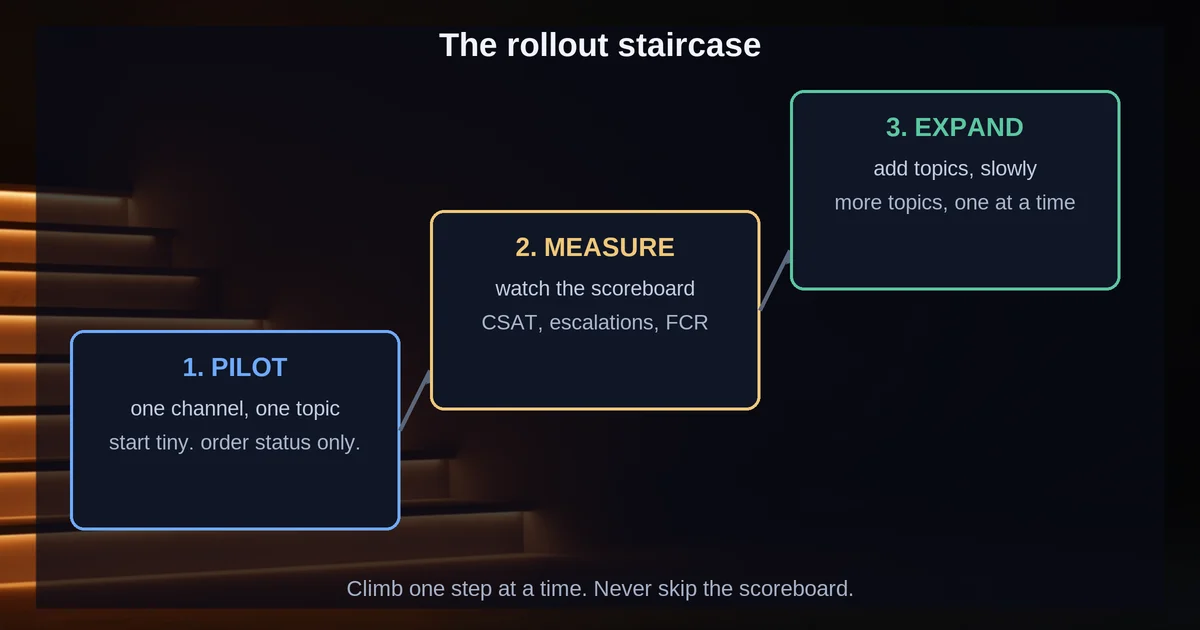
Nobody jumps from the sidewalk to the third floor. You take the staircase one step at a time, and after each step you check that it held your weight before trusting the next one. Rolling out a support agent works the same way: pilot, measure, expand. Three steps, in order, no skipping.
Roll out a support agent in three ordered steps: pilot on one channel, measure against baselines you set first, then expand. Skipping a step is how these projects fail.
- Step 1 - Pilot. One channel, one or two low-risk intents (FAQ and order status are the classics), clear AI disclosure from the very first message. You are trying a tiny spoon before serving the whole pot.
- Step 2 - Measure. Define your baselines for deflection, CSAT, FCR, escalation rate, and cost per ticket BEFORE you scale anything. This is Adobe's explicit recommendation, and it is the step everyone skips. Decide in advance what "good" means, in money and in customer experience.
- Step 3 - Expand. Only after the measurement framework and the data foundation exist. The readiness numbers explain why this step is last: 39% have a customer data platform ready, 75% cite data integration and quality as the top challenge, 30% have moved beyond pilot, 16% are org-wide. The staircase is not caution for its own sake. It is what the whole industry's gap looks like, drawn as a diagram.
While you climb, watch for the honest failure modes. Each one is real, and each one is avoidable:
- Scaling ambition without a data foundation. The 78% expecting versus 16% embedded gap is not a mystery. It is this failure, at industry scale.
- Deflection theater. Closed tickets, unresolved customers. The lying scoreboard again.
- Trust breakage from undisclosed AI. Remember the 37% of customers who say they would disengage on finding AI where they expected a person.
- The measurement vacuum. Only 31% have a framework; without one you cannot tell success from deflection theater.
- Over-complex architecture. Build the simplest thing that works, add complexity only when the simple thing proves insufficient.
The start-this-month takeaway
No new analogy needed. You already know this assistant. The realistic path from the 78% who expect AI support agents to the 16% who have actually embedded them company-wide is not a better model or a bigger budget. It is the ordinary work from the sections above: pick ONE boring topic, order status is perfect. Pick ONE channel. Ground every answer in your real docs, the recipe binder. Put the manager's door in place from day one: disclosure, easy escalation, human approval for anything involving money. Measure honestly, with all four instruments, before you expand. Then expand slowly.
That is the whole difference between the town that talks about the pool and the town with water in it. Not magic. Pipes, a scoreboard, and an unlocked manager's door. Be the store that hired a good assistant AND kept the manager's door open.
Support agent FAQs
What percentage of companies have actually deployed AI support agents organization-wide?
16% of organizations report embedding agentic AI organization-wide for customer support, while 78% expect agents to handle at least half of their support interactions within 18 months, per the Adobe 2026 report. A separate Adobe cut finds 30% have moved beyond pilots into organization-wide or cross-functional deployment, a broader measure than the 16%. Both are survey self-reports, not observed outcomes.
Will AI support agents replace human support teams?
No. The honest split: agents take the routine, high-volume, doc-grounded questions, while judgment calls, angry customers, and money exceptions stay human. Companies also overestimate customer appetite: 49% of organizations think customers will eventually prefer AI agents as their main interaction, versus 19% of customers who agree, per the Adobe 2026 report.
What kinds of tickets should never go to the AI in the first place?
Refunds and exceptions, billing disputes, legal or health-sensitive cases, and formal complaints. Plus any case where the customer clearly expects a person, since 37% of customers say they would disengage on discovering an AI they did not expect, per the Adobe report.
When should the AI hand a conversation to a human mid-chat?
Four triggers: the customer asks for a human, the confidence check comes back low, a sensitive intent is detected, or frustration shows up in the conversation. The customer asking is non-negotiable; switching to a human at any time is customers' most valued disclosure.
Is deflection rate a good success metric on its own?
No. A closed ticket is not the same as an answered customer, so deflection alone can be gamed. Pair it with CSAT, FCR, escalation rate, and cost per ticket, and remember only 31% of organizations even have an agentic-AI measurement framework to hold these numbers, per the Adobe report.