Somewhere in a submitted proposal right now there is a sentence your security team never approved. It says your product supports a control, or holds a certification, or encrypts data in a specific way. It reads fluently, it fits the tone of every other answer in the document, and it was written by a machine that found nothing in your company knowledge base to support it. If the buyer's auditor ever checks, that sentence becomes your problem, not the tool's.
This is the failure mode that matters for AI RFP response tools in 2026. Not speed: every serious platform in this category now drafts a 150-question questionnaire in minutes. Not formatting: export back into the buyer's original Word or Excel file is table stakes. The differentiator that separates a tool you can deploy from a tool that quietly manufactures contractual risk is whether every generated answer traces back to a source your team stands behind, and what the system does when no such source exists.
Here is how the category actually works, where the unsupported-claim risk lives, and what a real evaluation should look like before you sign anything.
How RFP AI actually works: retrieval first, generation second
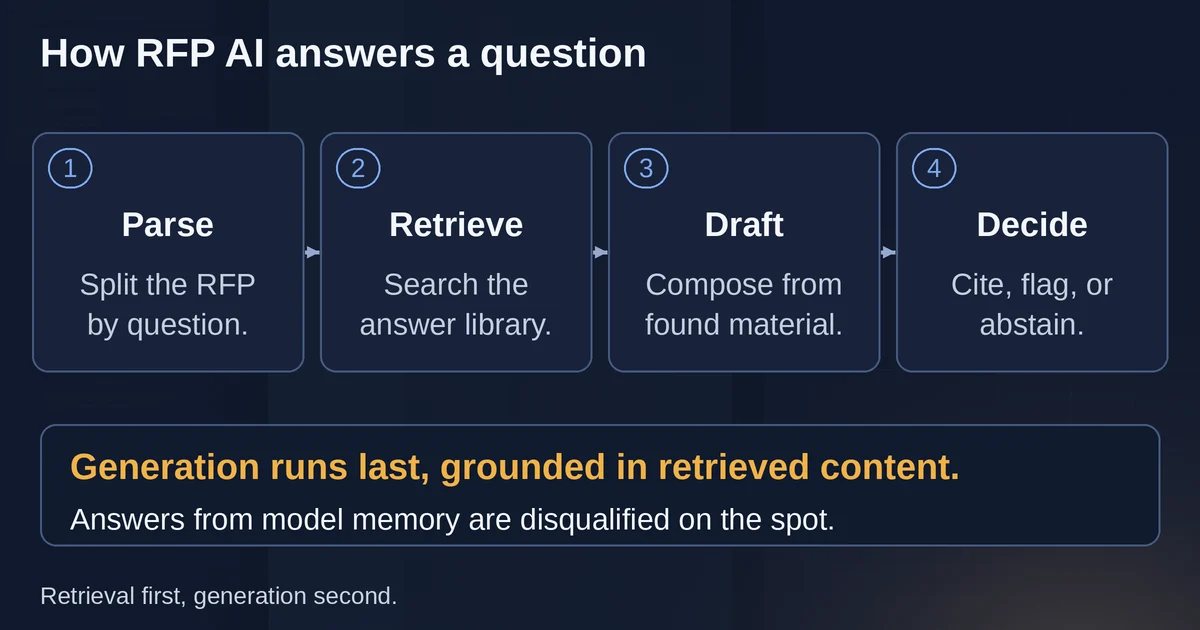
The most common mental model is wrong. People imagine the AI reading the questionnaire and writing answers the way ChatGPT writes an email: from general knowledge, with some luck. That is not what the current tools do, and any tool that did do it should be disqualified on the spot.
A purpose-built platform runs a retrieval pipeline. It parses the incoming document, detecting every question, section, and answer field, even in messy Excel workbooks and portal exports. For each question it searches your approved content: the answer library, past responses, and connected systems like SharePoint, Confluence, or Google Drive. Then it either inserts an existing approved answer, composes a draft from the retrieved material, or flags the question as unanswerable from what it found. The generative step sits at the end, and it is supposed to be grounded in retrieved content, not in the model's general knowledge of what companies like yours tend to say.
You can see this architecture in how the vendors describe themselves. Loopio's AI documentation states that its search engine retrieves relevant entries from your content sources and generates from that material, never pulling answers from the open web, and that generative AI is disabled by default until an admin turns it on. Responsive's AI governance page describes the same retrieval-augmented design against a curated content library. Arphie shows the source documents, confidence scores, and reasoning behind every generated answer.
The consequence of this architecture is the single most useful fact for buyers: the AI is only as trustworthy as the library underneath it. Retrieval grounds the model, which eliminates most invented-from-nothing answers, but it introduces a different failure mode that vendors talk about far less.
The unsupported-claim problem
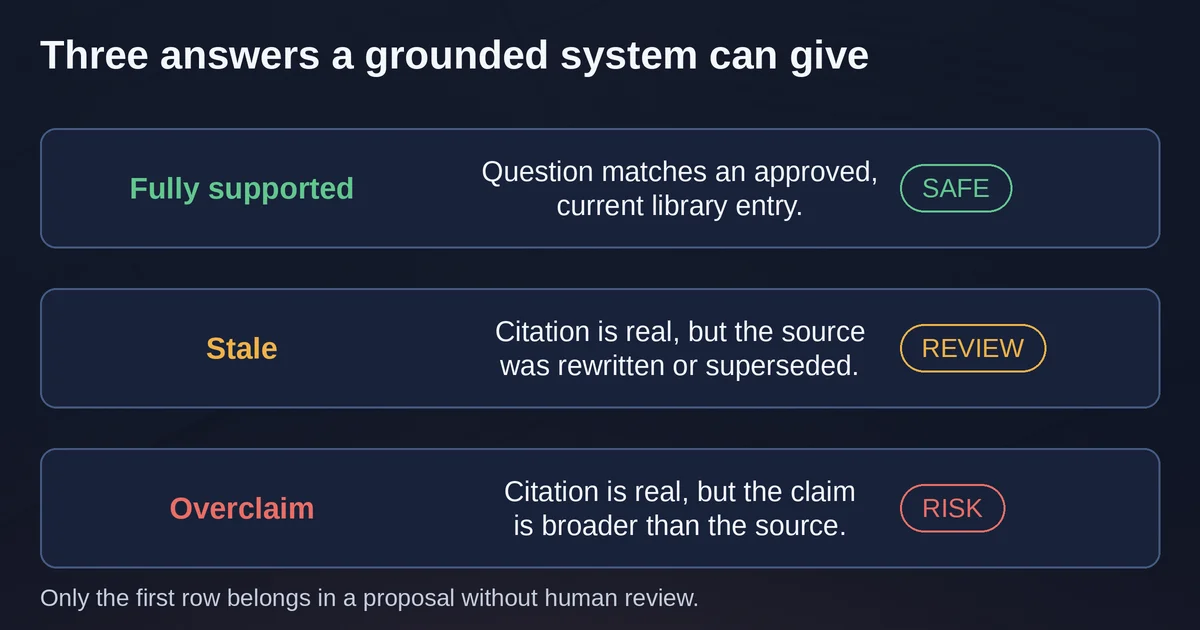
A grounded system that retrieves from your content produces three kinds of answers, and only one of them is safe.
The first kind is fully supported: the question matches an approved library entry, the entry is current, and the citation points at it. This is what you paid for.
The second kind is the stale answer. The retrieval worked, the citation exists, and the claim was true when it was approved. Your encryption answer cites the policy you rewrote in March. Your SOC 2 answer cites a report that has since been replaced. Nothing was invented, but the answer is still wrong, and a grounded system will present it with the same confidence as a fresh one. Responsive frames this honestly on its governance page: when answers come from approved content, a wrong answer usually means the library is out of date, a fixable content problem rather than an invented fact. That framing is correct, and it also tells you exactly where the residual risk sits.
The third kind is the dangerous one: the overclaim. The question asks whether your product supports SSO across all environments, and the library contains a case study mentioning your SSO beta for one product line. The retrieval step finds real, relevant, current content. The generation step bridges the gap between what the source says and what the question asks, and writes a confident yes. The citation is real, the claim is broader than the source, and the reviewer skimming a 200-row spreadsheet sees a cited answer and moves on. This is how retrieval-based systems manufacture unsupported claims without any component hallucinating in the classic sense. If you want the mechanics of why models fill gaps this way, we covered the root causes of AI hallucination in detail elsewhere.
The unsupported-claim problem is why "the demo showed 95% accuracy" tells you almost nothing. Accuracy on questions the library covers well says nothing about behavior on the questions it does not, and the failure cases are statistically invisible in a demo and contractually visible in an audit.
The test: run one questionnaire and inspect every claim
Before evaluating any vendor, run the same practical test. It takes an afternoon and it will tell you more than any sales demo.
Take a real security questionnaire your team answered recently by hand, ideally 40 to 60 questions with known-good answers. Seed the tool's library with only genuinely approved sources: current policies, current certifications, and the answers your team actually submitted. Exclude marketing pages and old responses deliberately, because you want to see what happens at the edges.
Then generate the full draft and grade it on four counts. How many answers carry a citation? For each cited answer, open the source and check whether it actually contains the claim being made, at the scope being claimed. How many answers cite content that is out of date or superseded? And most importantly: what did the system do with the questions your library cannot answer?
That last question is the whole evaluation. A safe system either abstains, marking a question as unanswerable and routing it to a human, or drafts with a visible low-confidence flag. An unsafe system fills every row with fluent prose, and its weakest answers look identical to its strongest ones. Some newer platforms now market exactly this behavior, returning an explicit "no answer found" rather than improvising, which is a good sign the category is maturing. When you run the test, count the overclaims personally: answers citing real sources but asserting more than the source supports. If a vendor's output produces even a few of these on your own questionnaire, you have learned what your review burden will actually be.
Knowledge-base hygiene is the prerequisite, not the cleanup
Everything above points at the same conclusion: the library determines the answers, so the library is the project. Vendors now build tooling for this, which tells you how real the problem is. Loopio ships freshness indicators, duplicate detection, scheduled review cycles, and library health reporting that shows which answers are reused most. Arphie's Smart Merge exists to clean up duplicate Q&A entries, and its agents connect live to Google Drive, SharePoint, Confluence, and Notion so drafts draw on current documents rather than a snapshot from onboarding. Responsive calls content hygiene "upstream governance," which is the right phrase: it happens before generation or it does not meaningfully happen at all.
Four practices carry most of the value. Every library entry needs a named owner, because unowned content goes stale silently. Every entry needs a review cadence, quarterly for security claims, less often for stable product facts. Duplicates need merging, because two contradictory approved answers is how you ship a contradiction to a buyer. And scoping metadata matters as much as freshness: an answer that is true for one product, region, or deployment model needs to say so, or the retrieval step will happily apply it to a question about a different one.
None of this is optional overhead. Practitioner reviews across this category repeat the same complaint: answer quality degrades when the library falls behind. The teams getting real value from these tools are the teams that treat the answer library as a maintained product, with roughly the same seriousness they treat their codebase.
The tool landscape in September 2026
The market has split into two layers, and understanding the split saves you from buying the wrong layer. The RFP response platforms handle the full pursuit: long proposals, DDQs, intake, multi-team review, narrative writing. The customer-trust platforms handle the security-review slice: questionnaires, trust centers, evidence sharing. Most companies answering both RFPs and security questionnaires at volume end up with one of each, or pick the layer that matches where their pain is.
Loopio is the strongest fit for structured, library-first RFP operations. Its content governance is the deepest in the category: per-answer owners, review cycles, freshness scoring, permissions that follow users into AI generation, and a Verbatim mode that inserts approved answers word-for-word with no AI alteration, which is what you want for compliance-critical questions. Its AI drafts only from content the user has permission to see, and generative features are off by default, which is a governance posture regulated industries will appreciate. Its limits are the flip side: the library is curated manually, so the maintenance work is yours, and its pricing page lists Foundations, Enhanced, and Enterprise tiers with no public prices. Earlier in 2026 the entry tier was published around $20,000 per year; that figure has since come off the page, so budget from a quote.
Responsive, formerly RFPIO, is the broadest platform, covering RFPs, security questionnaires, DDQs, intake, and a Trust Center in one system. Its answer-integrity tooling is the most explicit in the market: the TRACE Score grades every AI answer on transparency, relevance, accuracy, completeness, and ethics, and a Quality Check layer flags inconsistencies and contradictions across a whole document, the exact failure that manual review cannot catch at scale. Responsive holds ISO 42001 certification for AI management alongside SOC 2 Type II and ISO 27001, and it publishes an entry price: the Lite edition starts at $5,000 per year for 5 users. It is quote-based above that, and its breadth means implementation is a real project, not a weekend.
Arphie is the AI-native challenger. Founded in 2023, it skips the manually curated Q&A-pair model and drafts from live connections to your existing systems, with sources, confidence scores, and reasoning shown for every answer, and Quick-Ask extending the same knowledge into Slack for sales follow-ups. Its published customer stories are strong: one customer reports most questionnaires reaching 85 to 90 percent completion within ten minutes of import, before human review. Treat that as customer-reported, and note the tradeoff: drafting from live documents moves the maintenance burden from a curated library to the underlying systems, which only works if those systems are themselves accurate. Pricing is custom quote.
Conveyor anchors the customer-trust layer. Its focus is the security-review workflow: questionnaire response with citations on every answer, plus a buyer-facing Trust Center where prospects self-serve your SOC 2 report and security documentation under NDA, which deflects a chunk of questionnaires before they exist. It publishes pricing, which is rare here: a free tier with limited trust-center credits, and a Business plan starting at $9,600 per year with unlimited seats and 20 questionnaire credits, scaling on usage rather than per-seat licensing. If your pain is specifically inbound security questionnaires rather than full RFPs, start here.
Secureframe covers the compliance-automation angle: if you already run your SOC 2 or ISO 27001 program in it, its Comply AI drafts questionnaire answers from your policies and knowledge base and cites the source documents it used, and its vendor-risk side answers review questions from uploaded audit reports with document-and-page citations. It is not an RFP platform; it is a questionnaire answerer bolted onto the system where your compliance evidence already lives, which is exactly the right grounding if that is where your evidence lives.
A note on a name you may encounter in this research: SafetyAI appears in some tool lists for this category, but the SafetyAI that surfaces first-party is an occupational-safety AI company for construction sites, not a questionnaire tool. Verify before you shortlist.
A workflow that keeps a human accountable
Whatever you buy, the deployment pattern that works is the same, and the platforms are built around it. Import the questionnaire in its native format, Word, Excel, PDF, or a portal scrape. Let the tool estimate coverage before you commit effort: a library-coverage percentage is your go or no-go signal on whether the bid is even worth answering. Generate the full first draft. Then review in strict priority order: high-confidence answers get a skim, low-confidence flags get real scrutiny, and unanswered questions get routed to the subject expert with a deadline. Approve at the question level, so a named person owns every claim that leaves the building. Export in the buyer's format, and feed the answers that changed during review back into the library so the next questionnaire starts smarter.
Two controls make the difference between a workflow and a liability. The first is verbatim enforcement for security and compliance answers: approved language goes out exactly as approved, no AI polish. Loopio and Responsive both ship a version of this. The second is the review gate itself, and it is worth being blunt about why: an AI-generated security claim in a procurement document is a representation a buyer relies on and a contract may reference, and the same reasoning applies to the broader operational risks of deploying AI agents with no human accountable for their output. If your team is also answering questionnaires about the AI systems you deploy, the prompt injection risks your buyers will increasingly ask about are the same ones you should be probing in these tools, since they retrieve from documents that buyers and third parties sometimes touch.
Where is this tooling not worth it? If you answer fewer than roughly one questionnaire a month, a well-organized drive folder, a spreadsheet of approved answers, and a capable general-purpose model under a human's supervision will beat a five-figure platform, and the honest vendors will tell you so. If your knowledge base is small and mostly stale, the platforms will faithfully reproduce that staleness at machine speed, and your first investment belongs in content, not software. And if your questionnaires are mostly bespoke essays rather than repeated factual questions, the retrieval advantage shrinks and you are mostly buying workflow plumbing.
Two questions buyers actually ask
Can AI safely answer security questionnaires? Conditionally, yes. Safe means drafts from approved sources, citations on every answer, abstention or low-confidence flags when no source exists, and a named human approving before anything is sent. Unsafe is a general-purpose model writing security claims from memory with no source and no gate, which produces fluent answers that may be wrong in ways that carry contractual weight.
What should I demand from a vendor before buying? Run the same-questionnaire test described above on your own content. Require citations by default, a real abstain behavior, enforced review gates, configurable confidence thresholds, and written data-handling terms covering whether your answers train external models. Any vendor confident in its grounding will let you test on real questions; hesitation is itself an answer.
Pricing and plan details are as published by the vendor around September 2026 and can change, so confirm on the official site. Most platforms in this category are quote-only beyond their entry tier, and implementation effort varies as much as license cost.