Somewhere in your Zendesk instance right now there is a sentence that explains exactly why your activation numbers are flat. A customer wrote it in fourteen seconds, between anger and apathy, and it is more precise than anything on your roadmap. The problem was never that feedback is missing. It is scattered across support tickets, app reviews, survey verbatims, sales-call transcripts, and community threads, arriving at a volume no human team can read.
So in 2026 most teams hand the pile to an AI clustering tool and ask it for themes. The tools are genuinely good at this now. They are also good at something nobody asked for: inventing a consensus that no customer ever stated. That is the failure mode this article is about, because it is the one that quietly corrupts roadmaps instead of loudly breaking things.
The invented-consensus problem
Feed three thousand support tickets into a generic language model and ask for top themes, and you will get a confident list back: onboarding confusion, performance issues, pricing friction, integration gaps. The list reads beautifully. The sentences sound like customers. And some percentage of those themes will be extrapolations, aggregates, or outright inventions, with no customer sentence behind them.
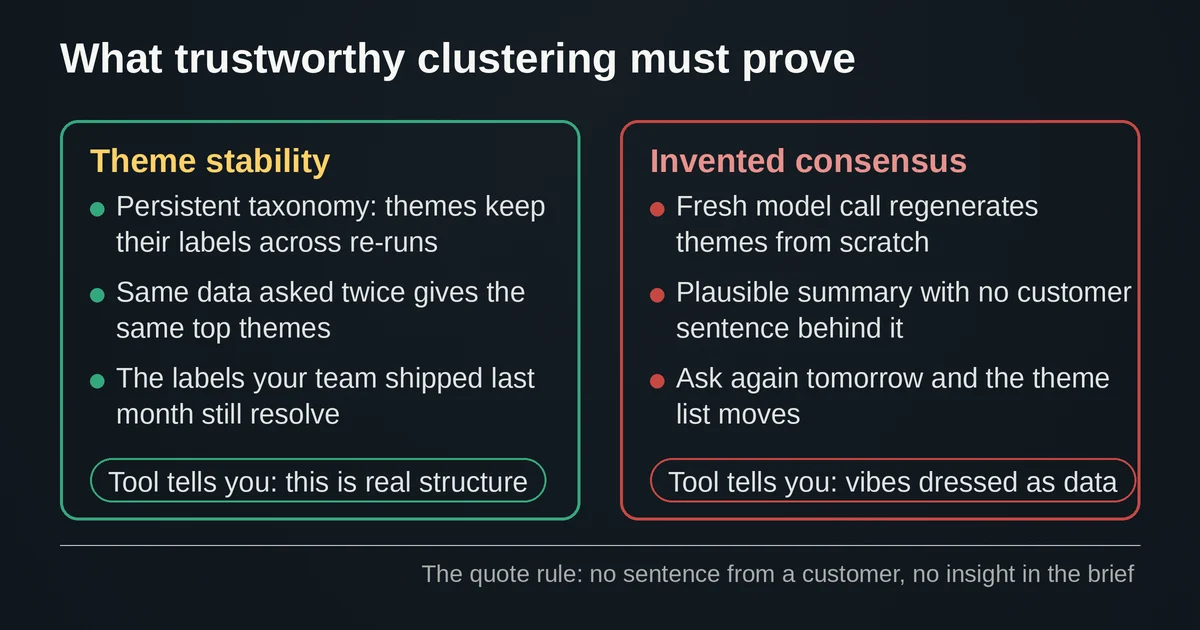
This is not a hypothetical risk, and vendors in this market now admit it openly. Enterpret's own documentation for its Wisdom assistant describes the underlying problem in one line: "LLMs give different answers each time you ask. Without persistent taxonomy, your themes shift constantly." Ask the same question twice about the same tickets and the theme list moves. That instability is not a bug you can prompt away, because a fresh model call has no memory of last week's taxonomy, no commitment to the labels your team already shipped to stakeholders.
The deeper failure is quieter than instability. It is the plausible insight that no one can trace. "Users find the onboarding flow confusing" is the kind of statement that survives into a quarterly plan because it sounds like something a customer must have said. Then someone asks for the source, and the answer is a summary of a summary of an embedding cluster. Nobody said that sentence. A model assembled it. We have covered the anatomy of AI hallucination before, and this is its most seductive commercial form: not a fake citation in a term paper, but a fake consensus in a roadmap review.
The defense is a discipline, not a feature. Call it the quote rule: every insight that lands in a brief must link to a sentence a real customer actually said. If the tool cannot produce the sentence, the insight does not ship. Simple to state, and it turns out to be the single best filter for choosing a feedback clustering tool in 2026, because it immediately separates the tools built on evidence from the tools built on vibes.
What good clustering actually looks like
A trustworthy clustering result has two properties, and neither is about the model doing the clustering.
Theme stability across runs. Re-run the same dataset tomorrow, or ask the same question a different way, and the major themes should not shuffle. Stability comes from a persistent taxonomy, a fixed layer of labels and definitions that the AI classifies into rather than regenerating from scratch each time. Enterpret calls this Adaptive Taxonomy and treats it as core infrastructure: themes evolve with your product, but they evolve deliberately, and the tool keeps "the structure, context, and evidence teams need" so answers do not drift. Dovetail's Channels works the same way at the data layer: your feedback is continuously classified into a stable set of themes that you can edit, rename, and extend, rather than re-derived nightly from raw embeddings.
Quote traceability on every claim. Every theme, and ideally every count, should expand into the actual records behind it. Enterpret's Wisdom guide promises that every response "links directly to actual customer feedback" and that clicking a citation shows "the verbatim quote in full context." Dovetail's AI Chat similarly returns "cited, evidence-backed answers" across your channels, and Dovetail's Channels 2.0 attaches "every account and quote" tied to an idea. Productboard says Spark performs "statistically accurate analysis of your organization's entire body of feedback, citations included." Notice what all three have in common: they are selling traceability itself, because the market learned the hard way that summaries without evidence are not analysis, they are lore.
Stability tells you the clustering is real. Traceability tells you the themes are honest. A tool with only one of the two is half a product.
The tool landscape in September 2026
The interesting news this year is not new clustering features, it is how much the ground moved under the tools themselves. Pricing models collapsed or split, one well-known vendor quietly died, and the category stratified into three rough tiers: research platforms, product-management suites, and enterprise feedback infrastructure. A quick map before the details:
| Tool | Best at | Pricing shape (Sep 2026) | Traceability |
|---|---|---|---|
| Dovetail | Research + high-volume Channels | Free $0, then custom Enterprise | Cited chat, quotes on every idea |
| Productboard Spark | Feedback-to-roadmap workflow | $0 / $19 / $59 per maker, credits | "Citations included" on analysis |
| Enterpret | Enterprise VoC infrastructure | Sales-led, no public pricing | Verbatim quotes, deep-link citations |
| Unwrap.ai | Always-on trend alerts | From ~$24,000/yr (vendor-reported) | Records behind trends |
Dovetail: the research platform that went all-in on volume
Dovetail started as the repository where researchers kept interview notes, and its 2026 identity is a fight between that heritage and a much bigger ambition. The pricing page now lists exactly two options: a genuinely free plan for individuals, and a custom-priced Enterprise tier. There is no self-serve paid plan anymore. The mid-market per-seat tier that most comparison articles still quote is gone; if you read a $30-something per editor figure somewhere, that article predates the change and the number is no longer buyable.
What the free plan is useful for is evaluation: one channel, one project, AI chat and summaries within that single project. What you cannot do is run a real multi-source operation on it, because one channel means one feedback source, and the entire premise of clustering is comparing what support hears against what reviewers say.
The paid story is Channels, Dovetail's engine for high-volume feedback. It continuously classifies tickets, reviews, and survey responses into themes as they arrive, from sources including Zendesk, Intercom, Front, Freshdesk, HubSpot Service Hub, Jira Service Management, App Store, Google Play, and G2. Channels 2.0 entered open beta on September 1, 2026, and it is a meaningful redesign: instead of broad theme labels, it now surfaces concrete ideas (bugs, feature requests, pain points) ranked by revenue impact, each carrying the accounts affected, the ARR at stake, and the customer quotes behind it, enriched from Salesforce or HubSpot. Dovetail says it has classified more than 61 million data points since Channels 1.0 launched. One click sends an idea to Jira, Linear, Claude, Claude Code, Figma, or ChatGPT with the evidence attached.
That one-click detail matters for the quote rule: the evidence chain survives the handoff to engineering, which is exactly where it usually dies.
Productboard Spark: clustering inside the PM workflow
Productboard did the opposite of Dovetail this year: it collapsed its plans into a Spark-centric lineup with a real free tier and published per-seat prices. The pricing page reads Free $0, Plus at $19 per maker per month billed annually ($25 monthly), Business at $59 ($75 monthly, two-maker minimum), and custom Enterprise. Every plan includes the MCP server and MCP connectors, which is unusually generous and matters if your team wants feedback data inside Claude or ChatGPT rather than in yet another dashboard.
The catch is metering. AI usage is billed in credits: 50 per month workspace-wide on Free, 250 per maker on Plus, 500 on Business, 800 on Enterprise. Productboard's own examples put analyzing 100 feedback items at roughly 30 to 50 credits, so a Free plan covers about one analysis pass over a hundred items per month, and the repository itself is capped at 500 feedback notes until Business. The quote-rule implication: Spark's feedback analysis includes citations, but on cheap plans you cannot afford enough passes to verify them, which defeats the point. If you evaluate Productboard, budget for the Business tier's unlimited repository before judging the clustering quality.
Also worth knowing: AI Themes, the deepest theme-detection feature, is Enterprise-only. Below that you get Spark's findings, summaries, and reports, which are good but not the full taxonomy machinery.
Enterpret: evidence infrastructure for enterprises
Enterpret is the most explicit in the market about the two properties from earlier, because they are literally its architecture. A persistent Adaptive Taxonomy keeps themes stable over time, and a Context Graph ties every signal to accounts, segments, revenue, and churn, so the answer to "what is driving churn in our biggest accounts" arrives with ARR attached. Its Wisdom assistant and its MCP server both return citations with verbatim customer quotes and speaker attribution; the MCP upgrade even added a tool whose entire job is finding the user quote behind a claim. In July 2026 it went further, letting you attach up to five citations to a conversation and generate 30 to 60 second clips from Gong calls, so an executive can hear the customer say the thing instead of reading a paraphrase.
There is no public pricing. Enterpret sells enterprise contracts shaped by feedback volume and integrations, which makes it a poor fit for small teams and a strong fit for companies with serious ticket volume and a stake in account-level context. If your feedback is mostly consumer app reviews and you have three people in product, this is not your tool.
What happened to Viable, and why it matters
A cautionary tale, because several "best AI feedback analysis tools" listicles published this year still recommend Viable. Don't buy it. When we checked askviable.com in September 2026, the domain serves unrelated content and the product is not operable; third-party trackers report the company wound down around 2025 without an official announcement. The lists were never updated.
The lesson is bigger than one dead startup. Your feedback history, your taxonomy, your evidence links, all live in someone else's platform. When the vendor dies, the sentence your customer actually said dies with it, and the quote rule becomes retroactively unenforceable. Vendor viability is part of traceability. Favor tools that let you export raw feedback and theme definitions on demand, and treat a vendor with no pricing page, no changelog, and no visible momentum the way you'd treat an untraceable insight: as something you cannot afford to build on.
Unwrap.ai and the trend-alert alternative
If Enterpret is the enterprise end of the spectrum, Unwrap plays a similar volume-priced game one tier down: custom plans by feedback volume (published starting point around $24,000 per year, vendor-reported), a 30-day trial run on your actual data, and never charged by seat. Its differentiator is proactive alerting: trend detection that pings you when a theme spikes rather than waiting for someone to run a report, plus an MCP server (announced May 2026) for querying feedback from Claude, ChatGPT, or Cursor. For teams whose real need is "tell me when something breaks in the app store," this shape beats a full VoC platform.
The verification workflow: same data, two tools
Here is the practical test this article promised, and it costs an afternoon. It follows the same philosophy as picking an AI model by testing rather than vibes: trust cross-examination, not demos.
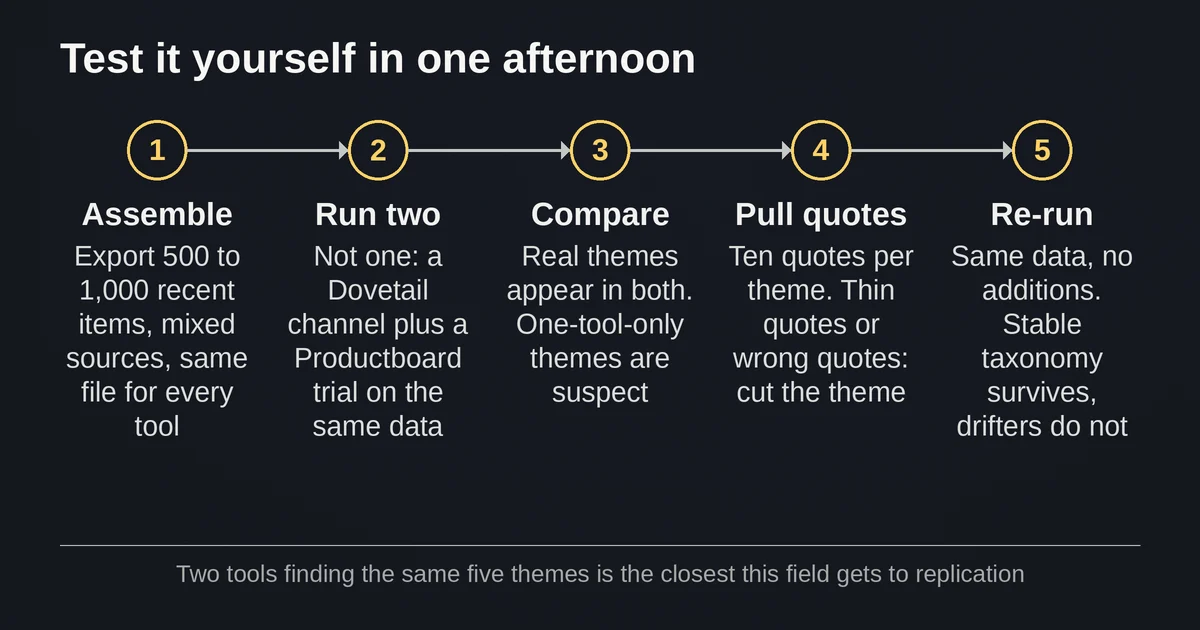
- Assemble one shared dataset. Export 500 to 1,000 recent items, mixed sources if possible: tickets, reviews, survey verbatims. Same CSV for every tool. Note five or ten known themes by hand first, from your own reading. This is your ground truth.
- Run it through two tools. Not one. A Dovetail channel and a Productboard trial, or Productboard plus an Enterpret or Unwrap evaluation on the same data. Import identically, touch nothing, let each tool classify.
- Compare the theme lists, not the prose. Map the two outputs side by side. Real themes (onboarding, sync failures, price objections) should appear in both, with similar proportions. A theme that exists in only one tool is either the tool's specialty or the tool's imagination. Check those first against your hand-labeled ground truth.
- Pull ten quotes at random per theme. Every theme should open into real sentences. If a theme has a big count and thin quotes, or quotes that do not actually say what the theme claims, cut the theme. This is the quote rule doing its job mechanically.
- Re-run in a week. Same data, no additions. Check whether the theme lists moved. Stable taxonomy survives this. Regenerated-from-scratch clustering does not, and now you know which kind you bought.
- Watch the agent layer with the same skepticism. Both Dovetail and Enterpret now ship monitoring agents that alert you when themes spike. That is genuinely useful, and it is also automation rather than judgment: an agent can tell you a theme is trending, only the evidence link can tell you whether the theme is true. Keep the human spot-check in the loop permanently.
The two-tool step is the one teams skip and shouldn't. When both systems independently find the same five themes in your tickets, that is the closest thing this field has to a replicated experiment, and it changes the tenor of the roadmap conversation from "the AI says" to "two independent analyses of our customers say."
Two questions people actually ask
Do I need a dedicated feedback tool, or is ChatGPT enough?
For a one-off batch of a few hundred survey responses, a general chat model with a long context window gets you serviceable themes, and it is a reasonable place to start. It fails the two tests from this article: the taxonomy does not persist between sessions, so themes shift every run, and quotes are only as traceable as your own discipline in checking them. Dedicated tools earn their price when feedback is continuous and volume is high, because the value is the stable layer and the citation plumbing, not the raw summarization ability. Both now also expose their data over MCP, so the boundary between "chat model" and "feedback platform" is thinning; the persistent taxonomy is what stays differentiating.
How many feedback items do I need before clustering beats reading?
Roughly: past a few hundred items per month, nobody reads everything and clustering becomes the only honest option, because sampling by hand introduces its own bias. Below that, clustering still helps with consistency, but your own reading is better evidence. The volume also drives cost more than seats do in this category: Dovetail bills Channels by data points, Productboard by AI credits, Unwrap and Enterpret by feedback records. Estimate your monthly volume before you look at a single pricing page.
Pricing and plan details are as published by the vendor around September 2026 and can change, confirm on the official site.