Your buyers have stopped googling. Somewhere this week, a person asked ChatGPT or Perplexity "best CRM for a small team" or "who should I hire for SEO," got a confident three-paragraph answer, and made a shortlist. If your brand was not in that answer, you lost a pitch you never knew existed. There was no analytics event, no dropped ranking to investigate, nothing. Just silence.
Generative Engine Optimization, or GEO, is the practice of measuring and improving how often your brand shows up in those AI-generated answers. The measurement half is the part almost every team skips, so this guide is an audit protocol: a repeatable way to find out where you stand across ChatGPT, Perplexity, Google's AI Overviews, Gemini, and Copilot, judge how much of the data you can trust, and decide whether any of the paid tools are worth your money.
What GEO is, and what it is not
The term comes from research, not marketing. "Generative Engine Optimization" was coined in a Princeton and IIT Delhi paper presented at KDD 2024, which framed it as a black-box optimization problem: generative engines combine a search engine with a language model, so classic ranking signals do not map cleanly onto how they assemble answers. The authors built a benchmark called GEO-bench and showed that specific content changes, things like citing sources and adding statistics, could boost visibility in generated responses by up to 40% in their experiments, and by up to 37% when tested against Perplexity. You can read the paper yourself on arXiv.
Since then the acronym has drifted. In 2026 marketing usage, GEO mostly means one of two jobs:
- Measurement: tracking how often AI answers mention, cite, or recommend your brand relative to competitors. Some vendors call this answer engine optimization, or AEO. Same job, different initials.
- Optimization: changing your content, PR, and third-party footprint so those mentions happen more often. That is a bigger project, one we covered in our GEO playbook for earning AI citations.
What GEO is not: a guarantee machine. Nobody can force ChatGPT to recommend you, and anyone promising a fixed position in AI answers is selling something that does not exist. It is also not a replacement for SEO. The two channels are measured, and gamed, differently. For a map of which AI surfaces even exist, see our guide to AI search engines and research assistants.
Step one: build a prompt set that mirrors real buying questions
An audit is only as honest as its prompt set. The mistake teams make is auditing brand-name queries, "is Acme Corp good," which you will win because the model has no alternative. The prompts that matter are the ones buyers ask before they know your name:
- Category queries: "best project management tool for agencies," "top expense automation software."
- Problem queries: "how do I stop missing client deadlines," "cheapest way to automate invoice chasing."
- Evaluation queries: "is [category] software worth it," "what does [tool category] cost per month."
Fifteen to thirty prompts is a workable first set. Fewer than ten and a single weird answer distorts the picture; more than fifty and the manual version becomes a chore nobody repeats.
Then multiply by engine. The same prompt can produce different answers on ChatGPT, Perplexity, Gemini, AI Overviews, and Copilot, because each engine retrieves from a different index and weighs sources differently. A brand can be prominent in Perplexity and nearly invisible in Gemini. Auditing one engine is auditing a fifth of the problem.
Step two: run the audit, and make it repeatable
Here is the core protocol. It is deliberately boring, because boring survives contact with a busy quarter.
- Fix the prompt set in a spreadsheet. Columns: prompt, engine, date, mentioned (yes/no), position (first mention, mid-list, buried), sentiment (positive/neutral/negative), cited sources, and competitors named.
- Run every prompt on every engine, and log what you see. Do not paraphrase; paste the actual answer text. AI answers are non-deterministic, so record whether a re-run five minutes later changed the recommendation.
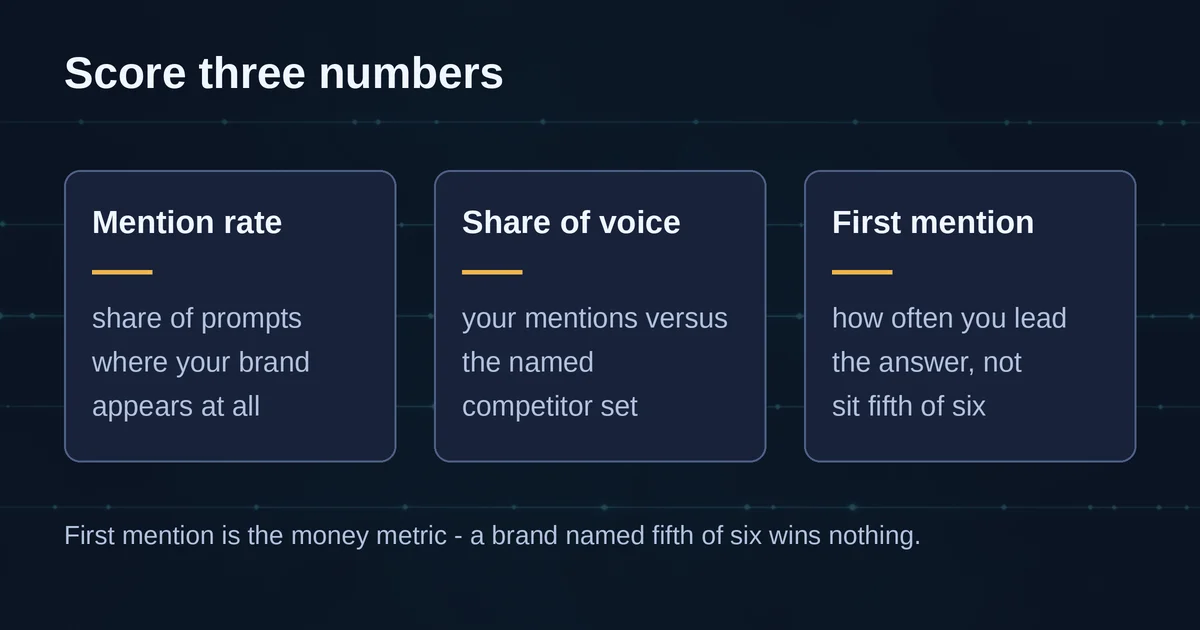
- Score three numbers: mention rate (share of prompts where you appear), share of voice (your mentions versus the competitor set), and first-mention rate (how often you lead the answer). The third one is the money metric; a brand named fifth in a list of six wins nothing.
- Note which sources the engines cite when competitors get recommended. If Perplexity keeps citing the same three roundup posts and one Reddit thread, that is your earned-media shopping list.
- Re-run monthly, same prompts, same engines. A single audit tells you where you are; three audits tell you which direction.
- Escalate on facts, not vibes. If an engine states something false about your pricing, that is a fact-correction problem with a different playbook from a visibility problem.
At small scale this is an afternoon a month with a spreadsheet and five browser tabs. It costs nothing and, importantly, it teaches you what the data actually looks like before a vendor's dashboard abstracts it.
The honest limits of what any GEO audit can claim
This is where most GEO content goes soft, so let's be concrete about what your numbers cannot tell you.
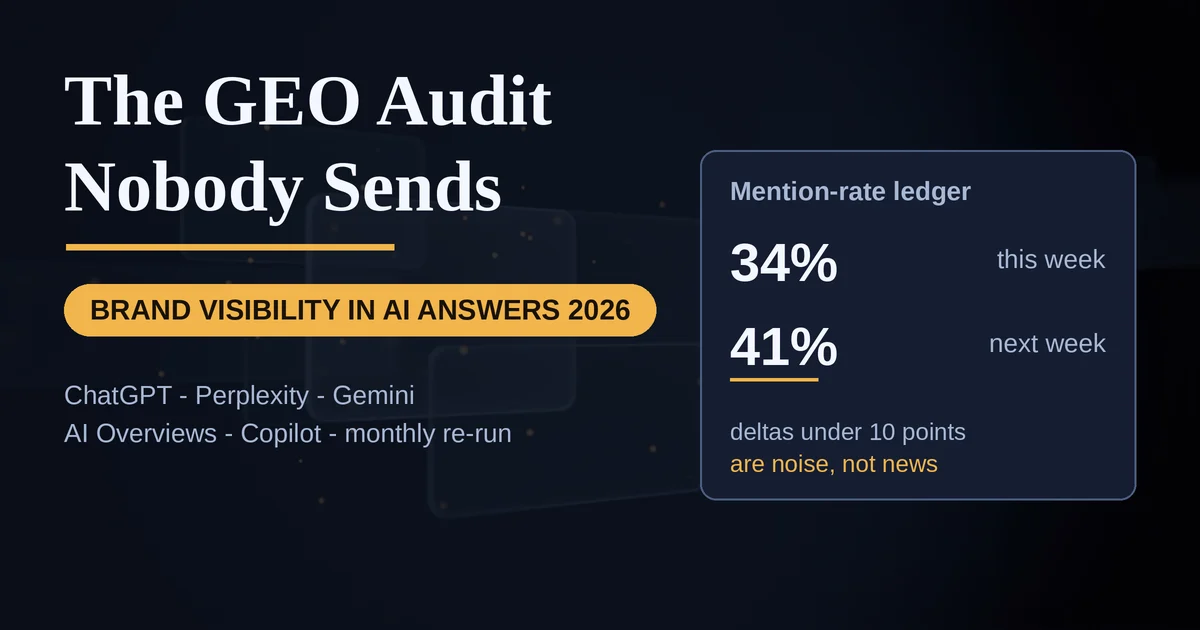
AI answers are unstable by nature. Ahrefs, launching its custom prompt tracking in January 2026, was blunt about the measurement problem: answers change frequently, platforms do not share query data, and the same question can surface different recommendations from one moment to the next. A brand at 34% mention rate one week may genuinely be at 41% the next with nothing changed on your site. Treat any single-week delta under ten points as noise.
Sampled data is not market data. Most trackers run your prompts on a schedule and count what comes back. That is a sample of the answers, not a census of what actual users saw. Profound differentiates itself with licensed panels of real user conversations, which is more defensible, but you are still buying an estimate from a vendor with an interest in the estimate being interesting.
Correlation is not control. When a vendor shows a case study claiming a 7x visibility increase after onboarding, remember there is no holdout group; your competitor probably shipped content the same month.
No tracker sees the whole market. Engines differ, regions differ, languages differ. Coverage claims, "13 models," "10+ engines," describe the enterprise tiers, not the plan you will actually buy.
The practical stance: use GEO audits the way a CFO uses pipeline forecasts, as a directional signal worth acting on, not as ground truth to quote in a board deck.
The tool landscape in September 2026
The manual protocol above scales to about fifty prompts before it hurts. When you outgrow it, here is what is actually alive and shipping this month, verified against vendor pages.
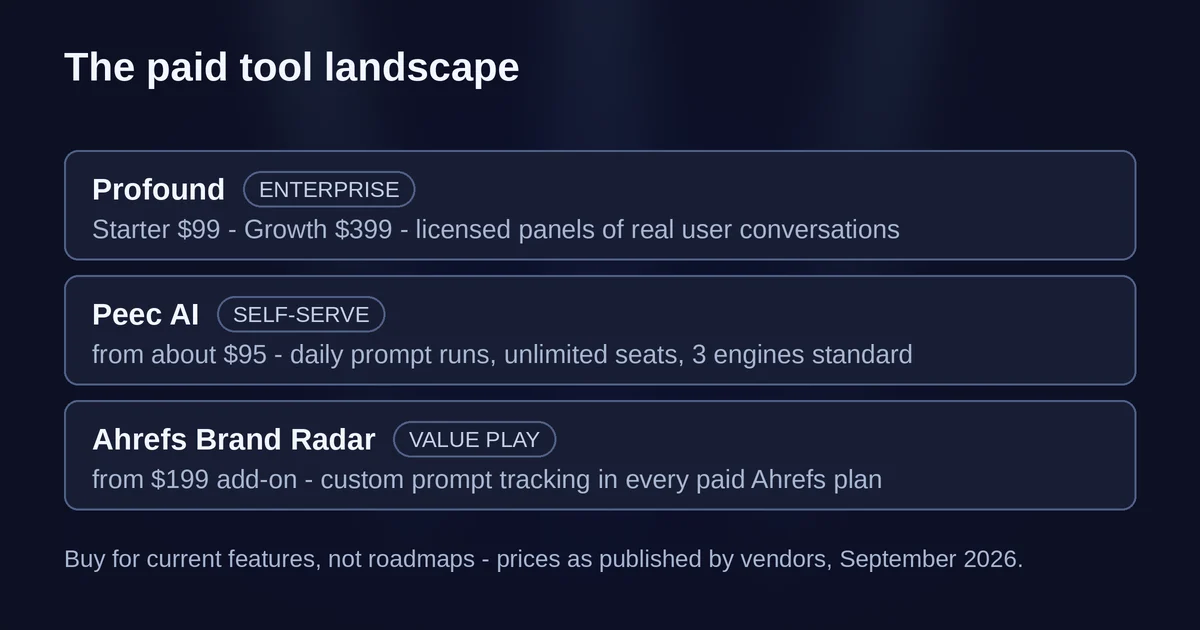
Profound is the enterprise heavyweight. Founded in 2024, it raised a $96 million Series C in February 2026 at a reported $1 billion valuation, and its customers include a meaningful slice of the Fortune 500. It tracks visibility, share of voice, sentiment, and citations across ChatGPT, Perplexity, Google AI Overviews and AI Mode, Gemini, Claude, Copilot, Grok, and more, plus crawler analytics showing how AI bots read your site. Published pricing on the Profound pricing page: Starter at $99/month tracks ChatGPT only with 50 prompts; Growth at $399/month adds three engines and 100 prompts; Enterprise is custom, unlocking up to nine engines, SSO, and SOC 2 reporting. It is the most complete platform in the category and the most overkill purchase for a ten-person team.
Peec AI is the self-serve middleweight, Berlin-built and popular with agencies. It runs your chosen prompts daily and reports visibility, position, sentiment, and cited sources, with unlimited seats on every plan and a Looker Studio connector on the Advanced tier. The Peec pricing page structures plans by prompt volume: Starter covers 50 prompts, Pro 150, Advanced 350 with multi-country tracking, and Enterprise unlocks up to 13 tracked models. Entry pricing is around $95 a month in recent independent reviews, with a 7-day trial. The catch: standard plans cap you at three engines, and extra models are paid add-ons, so real coverage costs more than the sticker.
Ahrefs Brand Radar is the value play if you already pay for Ahrefs. It measures AI visibility across AI Overviews, AI Mode, ChatGPT, Perplexity, Gemini, and Copilot, running its index over 460 million monthly prompts, and it distinguishes mentions from citations. Custom prompt tracking is included in every paid Ahrefs plan, and the Brand Radar page positions the full AI visibility index as an add-on from $199 a month. Ahrefs has also been publishing genuinely useful research: its Q1 2026 benchmark report, covering 75,000 brands, found that YouTube mentions correlated with AI visibility more strongly than any other signal, while link volume and page count showed only weak correlation. That finding alone should reshape a few budgets away from link farms and toward video.
Worth knowing but not profiled here: Semrush bundles an AI visibility toolkit into existing subscriptions, Otterly is the cheapest paid entry point, and Scrunch, now owned by Sitecore, plays in the same space. The category is crowded and consolidating; buy for current features, not roadmaps.
When you should not buy any of this
A paid tracker is a bad purchase in three situations. If few people are asking AI engines about your category, your prompt set is small enough to run by hand. If nobody will look at the dashboard monthly, you are renting a chart. And if your plan is to "do GEO" without a content or PR motion to act on the gaps, the audit just documents your absence in higher resolution.
The sequence that works: run the free manual audit for a month. If the trends are real and the gaps are commercially meaningful, buy the cheapest tool that covers your actual buyer engines, which for most teams means ChatGPT, Perplexity, and Google AI Overviews, and spend the rest on creating the content the audit says you are missing.
Pricing and plan details are as published by the vendors around September 2026 and can change; confirm on the official sites before you commit.
FAQ
How many prompts should a first GEO audit use? Fifteen to thirty is the sweet spot. Enough to see patterns across engines, small enough that a monthly manual re-run stays realistic.
Is a GEO audit a replacement for rank tracking? No. Google rankings still drive most sites' traffic, and AI visibility typically builds on the same content foundations. Run both, but report them separately, because a flat rank chart and a rising AI mention rate tell different, both true, stories.