AI search stopped being an experiment somewhere in 2025. Google put AI Mode directly into Search for everyone, OpenAI opened ChatGPT Search to people who never even created an account, and every major lab now ships an agent that will spend ten minutes researching a question for you. What used to be a curiosity is now a real purchasing decision, and most roundups are still thin listicles with stale 2025 facts. Here is a current map: what each tool is genuinely best at, what the tiers really cost, and which one fits your actual job.
In short - the best AI search engines and research assistants right now
Before the justifications, the verdicts:
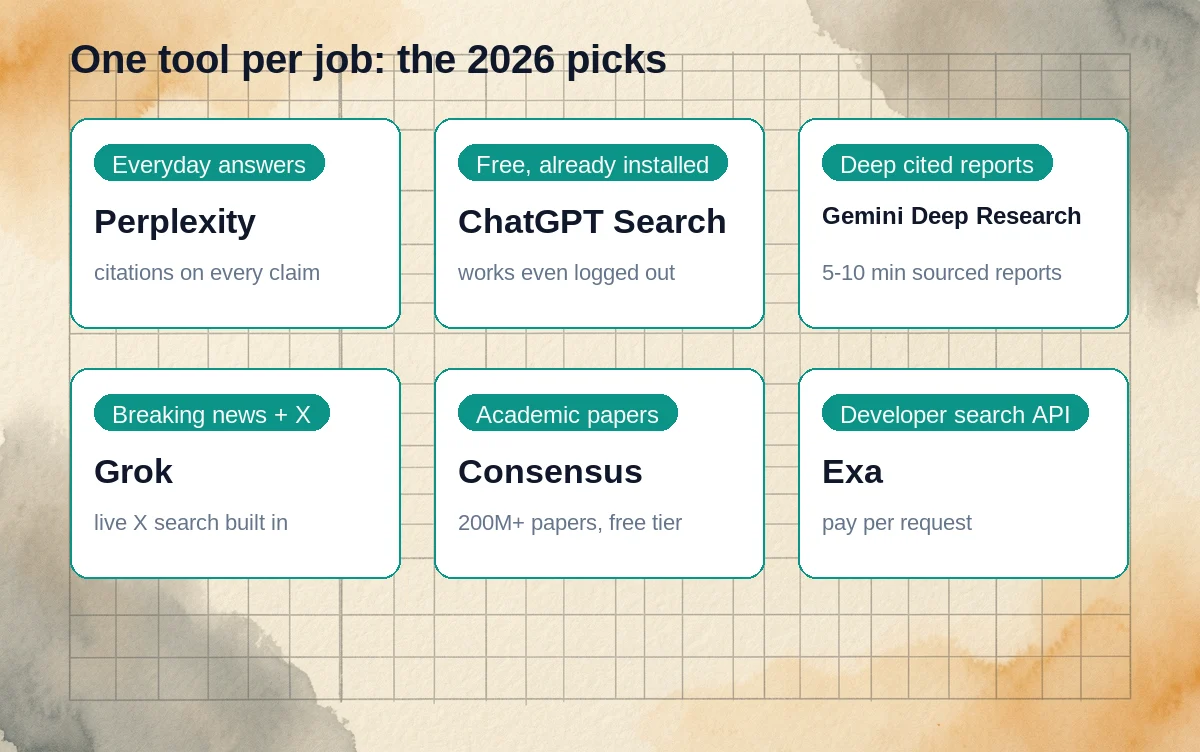
- Best overall AI search: Perplexity - citation-first answers with a permanent free tier
- Best free pick: ChatGPT Search - full web search on every plan, even logged out
- Best deep-research reports: Gemini Deep Research, with ChatGPT Deep Research a close second and Claude Research the natural pick for Anthropic shops
- Best for breaking news and X: Grok - live X integration nobody else has
- Best for academic papers: Consensus, with Elicit the better fit for systematic reviews
- Best for developers building search into agents: Exa - a pay-as-you-go search API built for agents
How we compared them
We ran the same everyday, news, and academic questions through every tool in this list before ranking anything, and we judged the results on citation quality, freshness of the index, use-case fit, and free-tier reality. We verified pricing against the vendors' own pages (perplexity.ai, chatgpt.com, one.google.com, claude.com/pricing, x.ai/pricing) rather than affiliate blogs or tracker sites, and where a vendor's own pages disagree, like Consensus's free-tier message count, we flag the disagreement instead of picking one. Tools that could not be verified from a primary source, like Phind's pricing, simply do not get numbers.
Best overall - Perplexity
After running the same question set through every tool here, Perplexity is still the cleanest answer to "just search the internet and show me the sources." Every answer carries inline citations you can hover and open, follow-up questions keep their context, and the interface rewrites your query before it hits the index, which quietly fixes a lot of bad searches. The free tier is permanent and genuinely usable rather than a demo that expires.
The paid ladder is straightforward. Pro (Individual) adds extended Pro Search, access to advanced AI models, image and video generation, and higher limits for file uploads, plus faster support. Max (Individual) sits on top with the full suite of advanced models from OpenAI, Anthropic, and others as they release, more powerful models running Research and Create, and high usage limits. Max also gets you Perplexity Computer, and the "Brain" capability is rolling out to Max subscribers in free Research Preview. Pro runs $20 a month (or $17 a month billed annually) and Max $200 a month (or $167 a month billed annually), so Max is a deliberate power-user purchase, not an impulse upgrade.
The honest weakness: Perplexity is a brilliant answer engine, not a research project manager. For questions that deserve a ten-page cited report rather than a three-paragraph answer, the deep-research agents below beat it.
Best free pick - ChatGPT Search (and where Google AI Mode fits)
Can you just not pay? Yes, and two of the best free options are ChatGPT Search and Google AI Mode. ChatGPT Search is available on every plan, including to people who are not signed in, at chatgpt.com and in the desktop and mobile apps. It partners with third-party search providers rather than building its own index, rewrites your queries, and you can trigger it manually with the "/" shortcut. If you already live in ChatGPT, this is the free answer engine you will actually use, and Plus at $20 a month is the natural upgrade when usage limits start biting.
Google's answer is AI Mode, which rolled out to all US users with a dedicated tab in Search and the Google app. It replaces ten blue links with a Gemini-powered conversation, and the Gemini 3 "Thinking" experience is arriving for paid subscribers first with higher limits. The sleeper feature is Deep Search: query fan-out that can issue hundreds of searches and return an expert-level, fully cited report in minutes, inside the search box you already use.
Free versus free: ChatGPT Search is better for conversational follow-ups and local results, AI Mode is better when you want search-native answers with links to the web and zero new accounts. Neither costs anything, so there is no reason not to use both where each is strong.
Best deep-research agents - Gemini vs ChatGPT vs Claude
The agentic shift is the real story of 2026, and it is the part most roundups miss: Gemini Deep Research, ChatGPT Deep Research, and Claude Research do not answer a query; they plan and execute a small research project. They fan out searches, read what they find, adjust, synthesize, and cite.
Gemini Deep Research is available to signed-in users 18 and over, with higher daily report limits and a higher-quality model for Google AI Pro and Ultra subscribers. Reports typically take five to ten minutes, sources can include your own Gmail, Drive, uploads, and NotebookLM notebooks alongside Google Search, and Ultra-tier reports can include charts, diagrams, and even interactive simulators. Google's AI Ultra plans run $100 or $200 a month depending on tier, which is the ceiling of this whole category.
ChatGPT Deep Research works in Chat, Work, and Codex, and its differentiator is control: it proposes a research plan you can edit before it runs, you can filter it to specific websites, and you can watch and interrupt progress. Every plan including Free gets some deep research, but allowances are plan-dependent, reset every 30 days from first use, and OpenAI deliberately does not publish public numbers - an in-product counter shows what you have left. Treat that counter as the real spec sheet.
Claude Research is the pick for Anthropic shops. It "operates agentically, conducting multiple searches that build on each other," with easy-to-check inline citations. The plan gating is the honest differentiator: per Anthropic's pricing table, Research is off the Free plan, on Pro, and scaled 5x and 20x on the two Max tiers (Max starts at $100 a month), while basic web search is available on all tiers including Free. Pro runs $20 a month, or $17 a month with the annual subscription discount ($200 billed up front), per Claude's pricing page. The frontier models behind these three agents move fast; we compare them head to head in GPT-6 Astra vs Claude Fable 5.1 vs Gemini 3.8 Flash if you want that angle.
Best for breaking news and real-time X - Grok
News is the use case the big labs still serve badly, because breaking stories live on X first and no one else can search it live. Grok searches the web and X simultaneously with citations, supports follow-up questions and a multi-agent mode for harder questions, and works on web, iOS, and Android. The free plan includes limited real-time web and X search plus voice mode and connectors, which makes it the only free tool in this list that can tell you what happened on X in the last hour.
SuperGrok costs $30 a month and adds higher rate limits, access to frontier Grok models, the Expert feature, connectors, image and video generation, and SOC 2 compliance. That price is confirmed on x.ai's own pricing page, and it is the cheapest way to get frontier-lab models with built-in real-time web and X search, which makes Grok the budget ticket into live-search AI.
Best for academic papers - Consensus (and Elicit for systematic reviews)
Consensus exists because students and researchers get the worst deal from general AI search: Google and ChatGPT summarize whatever ranks, not what peer review actually says. It is built to fix that, with search across more than 200 million academic papers. The free tier includes unlimited paper search plus Pro messages and Deep Searches, rate limited to around 10-15 Pro messages a month - the vendor's own pages disagree between 10 and 15, so check the live page. Pro is confirmed at $20 a month or $144 a year, and adds unlimited Pro messages, 15 Deep Searches and reviews per month, unlimited Study Snapshots, and 500 API and MCP calls. The student deal is the best in this whole space: one year free with a verified .edu or .ac email, then 40% off until graduation.
Elicit searches more than 125 million papers and is the tool when your project is a systematic review rather than a quick lit search. Basic is free with unlimited search and chat with four papers at once; Plus is $12 a month with more PDF extractions and columns; Pro is $49 a month with a guided Systematic Review workflow, a screening step, and up to 20 high-accuracy extraction columns. Consensus is the better daily driver; Elicit is the better methodology tool. If you are wiring these into a study workflow, our NotebookLM and ChatGPT study duo piece covers the note-taking side, and ChatGPT's study mode is worth pairing so you learn the material instead of just collecting it.
Best for developers building search into agents - Exa
The last pick, Exa, is for a different buyer entirely: you are not using the chat, you are building the tool. It is a pay-as-you-go search API for agents, with indexes spanning the web, people, companies, and scholarly works. You get $20 in credits on signup plus $10 in free credits every month without a payment method, and per-endpoint pricing after that: Search at $7 per thousand requests, Deep Search at $12, Deep-Reasoning Search at $15, and Contents at $1 per thousand pages. An MCP server and 50+ integrations mean your agent can be searching within minutes, and Cursor uses Exa for coding-agent docs retrieval, which is as strong a production reference as this market has.
Worth knowing: You.com has pivoted to a developer-focused Web Search API with a $100 free credit to start. Phind keeps getting mentioned in roundups, but no verifiable primary pricing page surfaced in our checking, so we pass on repeating numbers for it.
Weaknesses every AI search engine shares - and how to mitigate them
Three failure modes recur across every tool in this list, paid or free.
First, hallucinated or generic citations. AI search engines sometimes cite a real domain with a claim the page does not make, or a page that does not exist. The mitigation is boring and non-negotiable: open the cited source before you quote it, every time.
Second, stale or shallow indexes. Chat-style search indexes lag days behind the live web and thin on niche topics. For anything load-bearing, re-run the question in a second tool - a Perplexity answer plus a Consensus paper search catches most gaps.
Third, paywalled sources. A fluent summary of an abstract is not the study. Ask the tool for open-access versions, or use Consensus or Elicit, which are built around papers you can actually reach.
The quick decision - which one should you actually use?
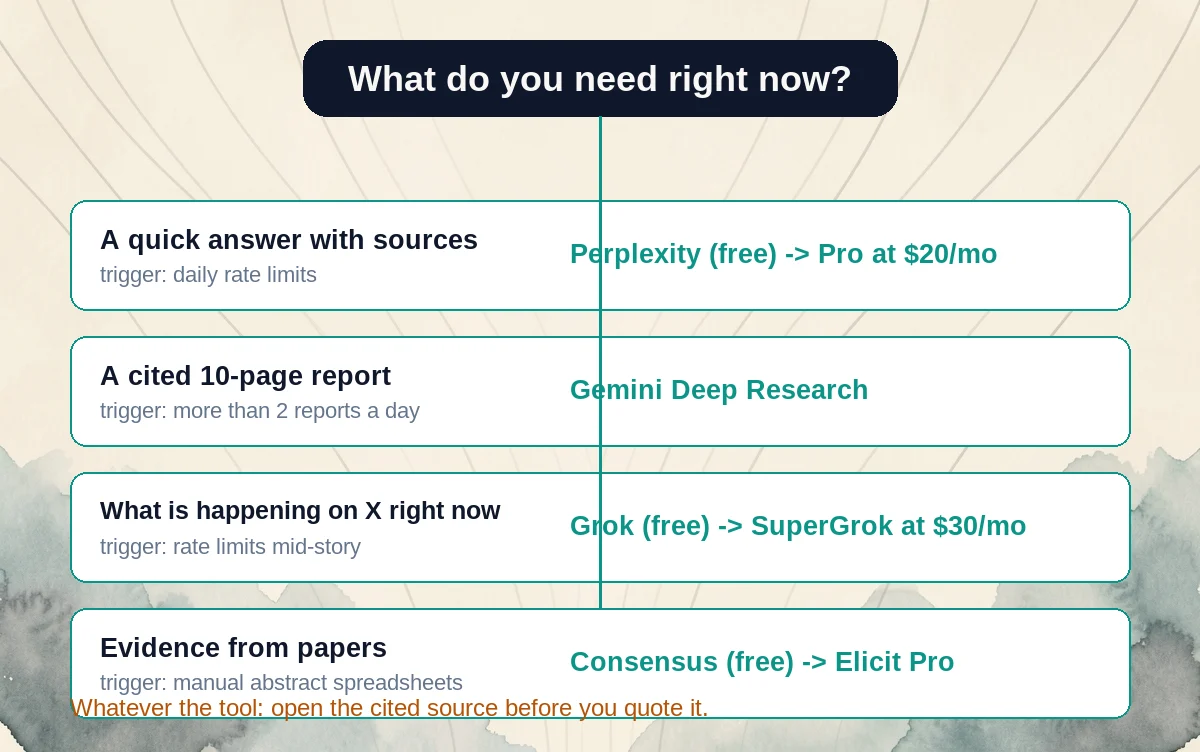
- Students and academics: start with Consensus's free tier and the student deal; move to Elicit Pro when a real systematic review demands screening and extraction. Upgrade trigger: you are copying abstracts into a spreadsheet by hand.
- Knowledge workers: Perplexity free for daily questions, Gemini Deep Research for anything worth a cited report. Upgrade trigger: you need more than a couple of reports a day.
- News junkies: Grok free for anything breaking on X; SuperGrok at $30 a month is the cheapest paid plan that bundles frontier models with real-time X search. Upgrade trigger: rate limits during a live story.
- Developers: Exa's free monthly credits for prototyping; pay-as-you-go once your agent ships. Upgrade trigger: 10 queries per second stops being enough.
If you want to compare these tools side by side with live feature data, our tools directory keeps current entries for each one. Otherwise, the one-line summary: Perplexity for answers, Gemini for reports, Grok for news, Consensus for papers, Exa for APIs.
FAQ
Is Perplexity still free in 2026?
Yes, the free tier is permanent, not a trial. Free includes standard search with citations and lower usage limits on Pro Search, which covers most everyday questions. Pro at $20 a month adds extended Pro Search, advanced AI models, image and video generation, and higher upload limits, so most people can stay free until they hit daily rate limits regularly.
Which ChatGPT plan do you need for Deep Research?
Some deep research exists on every plan, including Free, so you do not need a paid plan to try it. The allowance is plan-dependent and resets every 30 days from first use, and OpenAI does not publish public numbers for it - an in-product usage counter shows exactly how many tasks you have left, which is the only authoritative source.
Is Claude's Research feature available on the free plan?
No - Anthropic's pricing table lists Research as available on Pro and Max only, with scaled usage (5x and 20x) on the two Max tiers. Basic web search is a separate feature and is available on every tier including Free, so free users can still get cited web answers in Claude; they just cannot get the multi-search agentic Research runs.
What is the cheapest way to get an AI research assistant for academic papers?
Consensus's free tier is the cheapest real option, and it is genuinely useful: unlimited search across 200 million-plus papers plus limited Pro messages and Deep Searches every month. If you have a verified .edu or .ac email, Consensus's student deal makes it free for a full year, then 40% off until graduation. Elicit Basic is the free fallback for systematic-review workflows with unlimited search across 125 million-plus papers.
Are AI search engines accurate enough to cite?
They are accurate enough to find and summarize sources, not accurate enough to cite blindly. Every tool in this roundup occasionally cites a real-looking source that does not support the claim, so the working rule is simple: open the cited source before you quote it. Citation-first tools such as Perplexity and Consensus make that check fast because the source is one hover away, which is a real accuracy advantage over chat-search hybrids.
Pricing and plan details are as published by the vendor around September 2026 and can change - confirm on the official site.