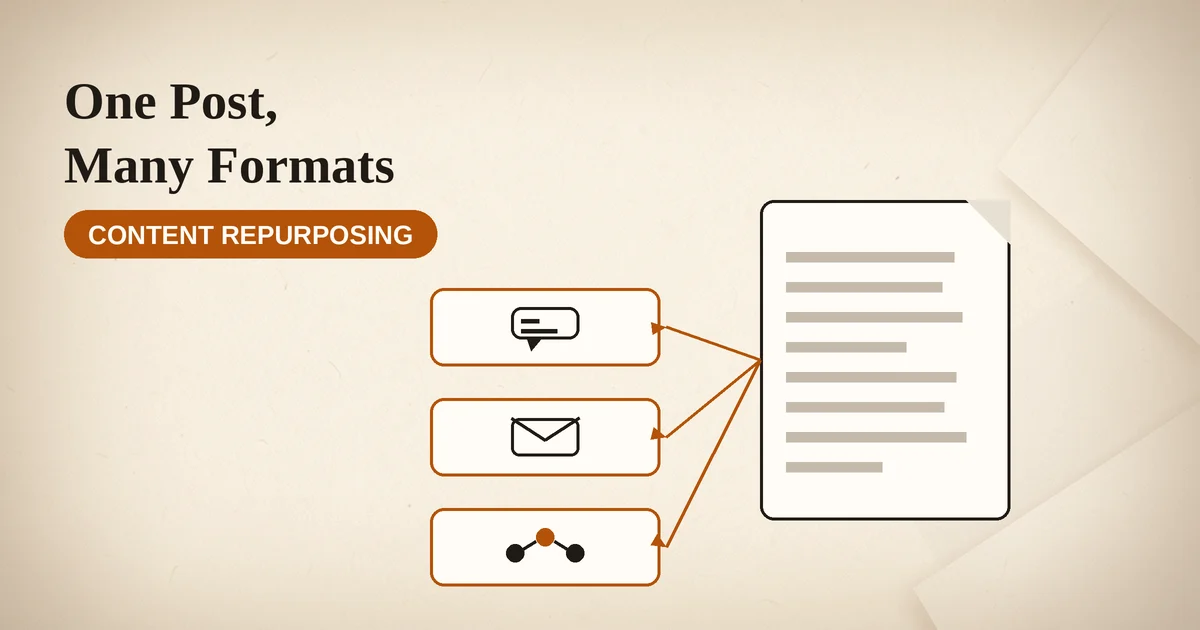
The math sounds irresistible. One 2,000-word blog post becomes 8 social posts, 2 newsletters, a script outline, and a thread. One 60-minute podcast becomes show notes, a blog post, and a month of LinkedIn content. AI repurposing tools make the multiplication real, and in 2026 the tooling is genuinely good at it.
But the multiplication only counts when the copies are true. A LinkedIn post that flattens "this tool costs $48 per month, billed annually" into "this tool costs $48" is not a derivative, it is a wrong statement. A newsletter that paraphrases your podcast guest into an opinion they never voiced is a correction email waiting to happen. The failure mode of AI repurposing is not low quality anymore. It is subtle distortion: the derivative that is 90% faithful and quietly drops the one fact that made the original worth writing.
So the useful question in 2026 is not "which tool turns one piece into many" because several do that well. It is "which tool turns one piece into many without losing the facts and links that make it worth reading". That is the test applied here.
The fidelity requirement: what every derivative must keep
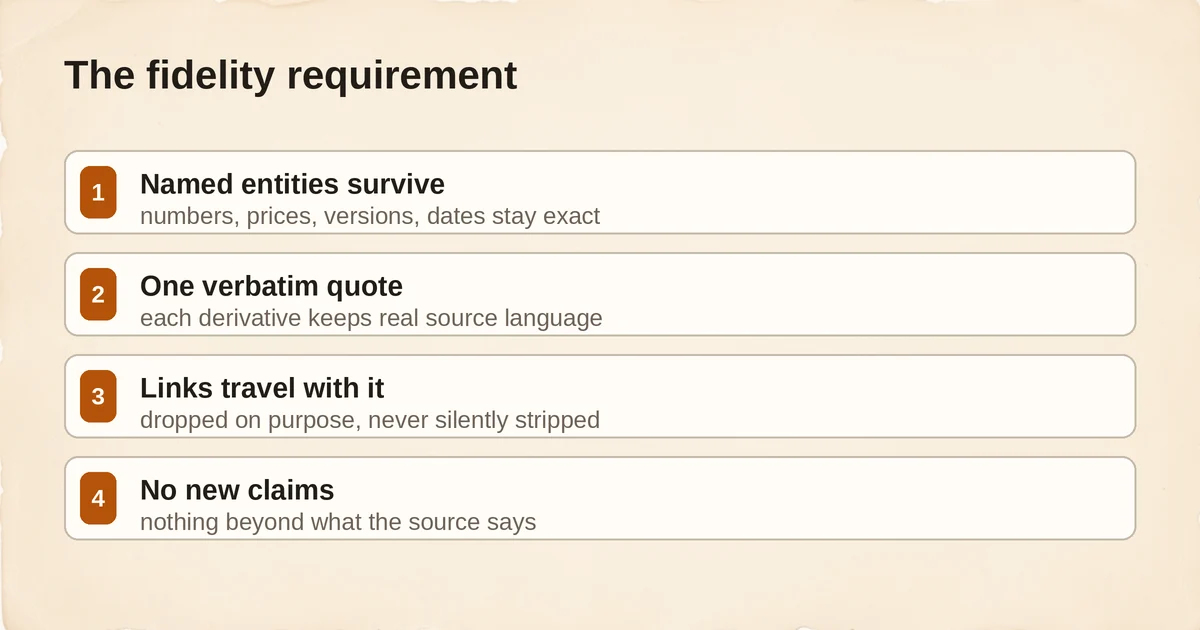
Before choosing a tool, define what a derivative owes the source. This is a checklist, and it is short:
- Named entities survive. Numbers, prices, tool names, dates, versions, job titles. If the source says Claude's Hobbyist plan costs $19 per month billed annually, no derivative may say just "$19" without the annual qualifier.
- At least one verbatim quote per derivative. Compression is where distortion lives. Forcing one exact quote grounds the piece in the source's real language and makes the rest auditable.
- Links travel, or are consciously dropped. A newsletter should carry the source links. A tweet thread should carry the primary link in a deliberate spot. What must never happen is a tool silently stripping links because the format "does not support them".
- No new claims. The derivative may not contain any factual statement that is not in the source. This single rule eliminates almost every hallucination problem, because you are not asking the model to know things, only to not invent them.
Every tool below gets evaluated against this list, because no repurposing tool markets itself on it. They market on volume: Castmagic's homepage promises to turn one recording into 100 content assets. Volume is the easy part. The 100 assets only help if they are all still telling the truth.
The atomization pipeline: one source, a fixed derivative set, one check step
The workflow that survives contact with reality has four steps. It works the same whether your source is a blog post or a podcast, and whether the tool is a dedicated platform or a chat window.
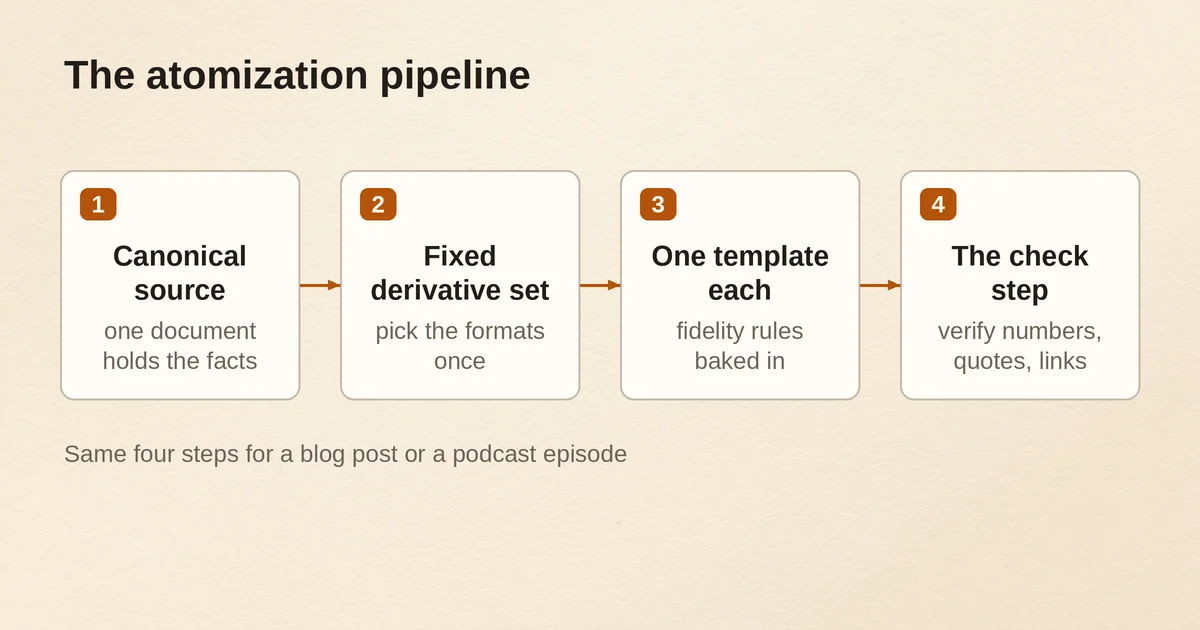
Step 1: Make the source canonical first. One document holds the truth: the final blog post, or the corrected transcript of the episode. Before you atomize, list the facts that must survive (the fidelity checklist above) at the top of that document. If you skip this, you will not notice a missing number until a reader does.
Step 2: Fix the derivative set before generating. Decide once what you actually publish: say, two LinkedIn posts, one X thread, one newsletter section, one short-video hook script. A fixed set beats "generate everything" because each format gets a template you have already checked, instead of whatever a generic prompt produced this time. Two posts that earn their place beat ten that dilute each other.
Step 3: One template per format, with the fidelity rules written into it. This is where the specificity problem gets solved (next section), and it is the same mechanism everywhere: in Castmagic it is a custom prompt, in Swell AI it is a content template, in a chatbot it is project instructions. Write the rules once, reuse forever.
Step 4: The check step. Before anything ships, compare each derivative against the fact list from step 1. Do the named entities match? Is the quote verbatim? Did any claim appear that is not in the source? Is the primary link present? This takes about a minute per derivative and it is the only part of the pipeline no vendor sells you. Tools that cite back to the source make this easier: Castmagic's newer MCP connector makes every transcript searchable by Claude with answers that cite the exact moment, which is the direction the whole category should be moving.
Why the output is generic, and how to force specificity
Most people's first attempt at blog-to-social produces that unmistakable AI voice: "In today's competitive landscape, teams must leverage automation strategically." It is not a model failure, it is a prompt failure. The model was asked to summarize and it compressed your specific piece into the average of everything ever written on the topic. Specific details are exactly what compression throws away first.
Three fixes, in order of impact:
Demand verbatim material. "Write a LinkedIn post about this article" produces generic output. "Write a LinkedIn post that opens with the sentence where the author says most automation projects fail in week three, keep the $48 figure with its annual-billing qualifier, and do not add any fact not present in the article" produces a post that could only have come from your piece. This is a single sentence of prompt and it changes the output completely.
Feed the exact source, not a memory of it. Paste the full text or upload the file. In ChatGPT, Projects let you add files as project context and set project instructions that apply inside that project, overriding your global custom instructions (OpenAI documents the whole setup in its help center). In Claude, every Project has a knowledge base: uploads there are used as context across all chats in the project, and you can set instructions per project, as Anthropic's help center explains. Both are free-tier-accessible (Claude's help center notes free users can create up to five projects) and both mean the model is working from your document, not its average impression of your document. This is also why "just ask ChatGPT about my podcast episode" fails when you paraphrase the episode instead of uploading the transcript.
Ban the abstractions. Add one line: do not use the words "leverage", "landscape", "game-changer", or "in today's world". Banning specific generic phrases sounds crude but it works, because the model reaches for those phrases when it has no concrete detail in hand. When it cannot reach for them, it reaches for your facts instead.
The same three fixes port directly to dedicated tools. Castmagic and Swell AI both let you save custom prompts or templates that run on every episode, so the specificity rules apply every time instead of only when you remember.
The tool landscape in September 2026
A year or two ago this category was a graveyard of show-notes generators. It has since split into clear tiers. (For turning long video into vertical shorts specifically, see our comparison of Opus Clip, Descript, and Submagic, which covers the clipping side and its misquote problem.)
The content operating systems: Castmagic and Swell AI. These take one recording and produce the full bundle. Castmagic, which has repositioned itself from podcast tool to content platform, imports audio or video from a URL (it claims 1,800+ platforms) or a file upload up to 1GB, and returns transcripts with timestamps, summaries, blog drafts, social posts, and unlimited clips and audiograms. Its Magic Chat lets you query your own transcript ("pull the three strongest quotes about pricing"), which matters for fidelity because you are extracting exact language rather than letting the tool paraphrase. Pricing as published on its pricing page: Hobby at $19 per month billed annually ($239/year) with 30 transcribed hours, Starter at $48 per month annually ($579/year, 100 hours, API access), Team at $139 per month annually with 400 hours, and business tiers from $699 per month. Hours are a library total rather than a monthly allowance, which is worth knowing before you upload a back catalog. Swell AI does the same job with a slightly different shape: transcripts, clips, show notes, articles, newsletters, social posts, and even midroll ad scripts, with a transcript editor where you highlight a section and it becomes a clip, plus brand voice settings and reusable templates across multiple shows. Its public pricing page has become hard to pin down (the pricing URL currently returns a 404 for crawlers), so verify current plans in the app before comparing. Between the two: Castmagic is the more mature bundle generator and its transcript-first design serves the fidelity requirement better; Swell is a credible alternative worth a trial if Castmagic's hour-based pricing does not fit your volume.
The editor tier: Descript. Underlord, Descript's AI co-editor, now reads your script, watches the video, and takes feedback in plain language, and it will batch the tedious edits. As a repurposing tool it is indirect but powerful: because Descript edits the recording through its transcript, the corrected transcript you end with is the ideal canonical source for every text derivative, and hobbyist plans start at $16 per month. What Descript will not do is hand you a finished bundle of platform-specific posts. You drive; it assists. For teams whose bottleneck is assembly rather than generation, that is the better shape anyway.
The chatbot path: ChatGPT or Claude with a project. The most underrated repurposing tool in 2026 is the chatbot you already pay for, pointed at a document. Create a project, upload the blog post or transcript, write the fidelity rules into the project instructions once, and then generate derivatives on demand: a LinkedIn post, a newsletter section, a script. You get total control over the fidelity requirement (the dedicated tools give you custom prompts; here the entire context is yours), and the marginal cost is a subscription you may already have. The tradeoff is volume: no automatic pipeline, no RSS ingestion, no clip rendering. A podcast network processing weekly episodes should use a platform; a solo operator repurposing one post per week can do the whole job in a Claude or ChatGPT project and skip the extra subscription entirely.
Where tools do not help. None of these tools will decide which derivatives are worth publishing, and the "generate 100 assets" pitch is a trap: 100 unedited outputs is not a content strategy, it is a queue you will never review. The value is in the fixed derivative set you chose in step 2, not the ceiling of what the tool can produce.
Podcast to newsletter: the highest-fidelity derivative
If you publish a podcast and a newsletter, the single best repurposing investment is episode-to-newsletter, and both Castmagic and Swell generate newsletter drafts directly from audio. It is the highest-fidelity format for three reasons: newsletters carry full text, so quotes travel verbatim; links travel intact (unlike social posts, where character limits and link handling eat them); and your newsletter audience tolerates length, so the derivative can stay close to the source instead of compressing it into distortion. The workflow: correct the transcript first (speaker labels included), pull the two or three best passages as exact quotes, and let the draft connect them with framing rather than paraphrasing them. A newsletter built on quotes is almost impossible to get wrong.
For the distribution side, our guide to building an AI newsletter pipeline with beehiiv covers the delivery end of this workflow.
Two questions people actually ask
Do I need a dedicated repurposing tool, or is a chatbot enough? If you repurpose one or two pieces a week and publish in two or three formats, a chatbot project is enough. If you have a recurring show, want automatic ingestion, or need clips and audiograms rendered, a platform earns its subscription. The fidelity rules are identical in both.
How do I check a derivative fast? Read only the claims: every number, name, and link, in order. That takes under a minute and catches the failures that matter. Do not proofread the prose first; the prose being wrong is recoverable, the facts being wrong is the actual risk.
Verdict
AI content repurposing in late 2026 is solved on volume and unsolved on trust. Castmagic and Swell AI will hand you a bundle of derivatives from one recording in minutes, Descript gives you the transcript-first editing that makes any of them truthful, and a ChatGPT or Claude project gives you the same power with the most control and the least cost. Whichever you choose, the differentiator is not in the tool: it is the fidelity checklist you write once and bake into every template. One canonical source, a fixed derivative set, one verbatim quote per piece, no new claims, and a one-minute check before publishing. That pipeline turns one piece into many useful formats. Without it, you are just multiplying the chance to be wrong somewhere new.
Pricing and plan details are as published by the vendor around September 2026 and can change: confirm on the official site.