A literature review used to fail quietly. You would spend a weekend in the library databases, skim forty abstracts, and maybe miss a key paper. The failure mode was incompleteness, and incompleteness is survivable.
The new failure mode is louder and worse: a reference that looks perfect and does not exist. A 2026 audit of 111 million references across 2.5 million papers on arXiv, bioRxiv, SSRN, and PubMed Central estimated that LLM-assisted writing produced roughly 146,932 hallucinated citations in 2025 alone, and found that preprint moderation and journal review catch only a fraction of them. A Nature analysis reached the same conclusion from the other direction: fabricated references are now appearing in published, peer-reviewed papers, not just in drafts.
One quick note on integrity before the tool talk: using AI to find and summarize papers is legitimate research practice at most institutions, provided you follow your school or journal's AI disclosure policy and verify what you cite. What ends careers is not the tool use. It is citing a paper you never opened. Nothing in this article is about hiding AI use, because that is both unethical and, increasingly, detectable.
So the real question is not "can AI write my lit review." It is: which tools retrieve real papers instead of generating plausible-looking ones, and how do you check before a fake lands in your bibliography?
Why a chatbot is the wrong first step
When you ask a general-purpose chatbot for sources, it does not look anything up by default. It predicts what a citation should look like: a real author name, a plausible title, a prestigious journal, a believable year. The GhostCite study benchmarked 13 major models across 40 research domains and found citation hallucination rates ranging from 14% to nearly 95%.
It gets worse in biomedicine. A September 2026 evaluation of 26 models on biomedical reference generation found that 55.4% of all references produced were fabricated, and even the best model was fully correct, in journal, year, and author list, only about half the time. That last part matters: a model can find a real paper and still give you the wrong journal or the wrong first author. Fake paper and wrong metadata are two different failure modes, and you have to check for both.
The tools below take the opposite architectural bet: retrieve real papers first, then use AI only to summarize what was actually retrieved. That does not make them hallucination-proof, but it removes the structural cause of the fake citation.
The three tools, and how they actually differ
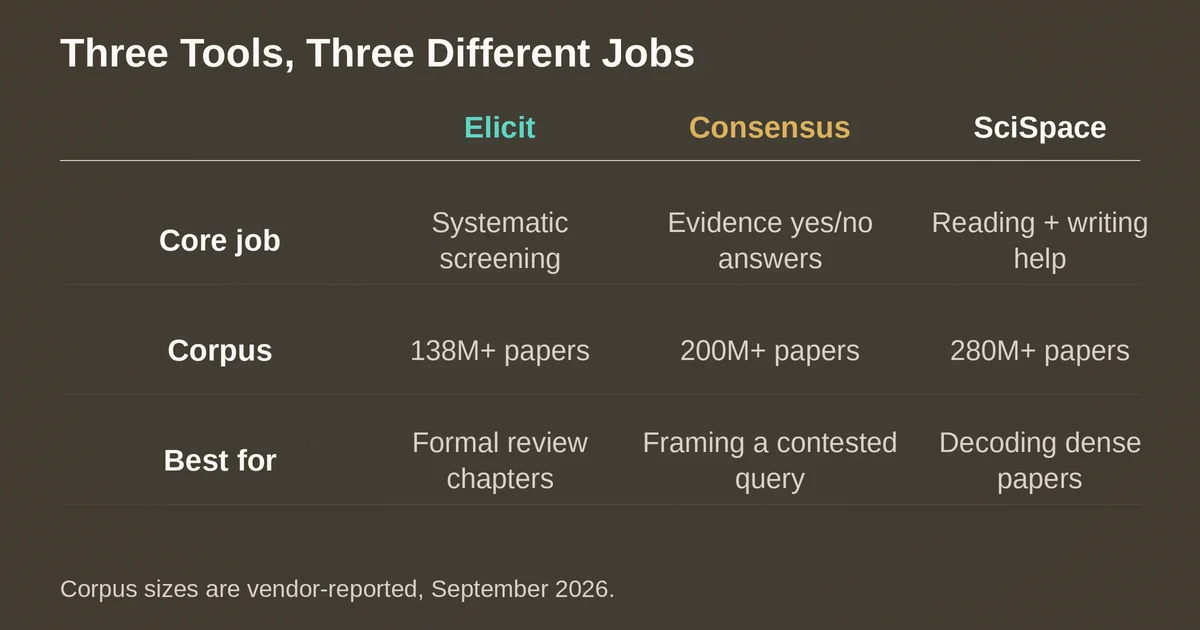
All three sit on real indexes, but they are built for different jobs.
| Elicit | Consensus | SciSpace | |
|---|---|---|---|
| Core job | Systematic-style screening and data extraction | Yes/no evidence questions and quick synthesis | Reading papers and writing support |
| Corpus | 138M+ papers, 545k clinical trials | 200M+ peer-reviewed papers | 280M+ papers (vendor-reported) |
| Signature move | Extraction tables with supporting quotes | Consensus Meter across top 20 papers | Copilot chat inside the PDF |
| Best for | Review chapters, systematic methods | Framing a contested question | Decoding dense papers you must read |
| Weakest at | Quick vibes-check browsing | Humanities and non-empirical topics | Anything requiring novel retrieval |
Elicit: when your review needs a methods section
Elicit is the closest thing to a systematic-review engine you can use as a student. Ask a research question and it searches over 138 million papers, screens for relevance, and extracts data into tables where every cell links to a supporting quote from the source paper. Its paid Pro plan includes a full Systematic Review workflow that screens up to 5,000 papers with PRISMA-style audit trails, and its reports cite at the sentence level rather than just pointing at a reference list.
That last detail is the anti-hallucination feature that matters most: you are not trusting a summary, you are one click away from the exact sentence the claim came from. The trade-off is that Elicit is slower and more structured than a quick search. It shines when your review chapter needs rigor, and it is overkill when you just need to check whether a supplement works.
Consensus: when the question is "does the evidence agree"
Consensus is an evidence-map generator. Ask a yes/no question, and the Consensus Meter sorts the top 20 retrieved papers into Yes, No, Possibly, or Mixed, with each position showing recency, study designs, journal quality scores, and citation counts. The pipeline retrieves first and summarizes second, which means a fabricated citation is structurally impossible: the AI only ever describes papers the index actually returned.
Two honest limits. The Meter needs at least five relevant papers to fire, so niche or emerging topics fall back to plain search. And the whole "consensus" framing fits empirical and clinical questions, not humanities or theory-heavy work where agreement is not a meaningful concept.
SciSpace: when the bottleneck is comprehension
SciSpace's strength is not retrieval, it is reading. Upload a dense PDF and its Copilot explains terminology, walks through equations, and answers questions grounded in that specific paper, alongside a literature search across its 280-million-paper index and formatting tools for the writing phase.
For literature reviews, treat it as the second step: use Elicit or Consensus to find the right papers, then SciSpace to actually digest the eight you have to read closely. Its writing and paraphrasing tools are the part that shifts the verification burden back onto you, because anything that generates prose can misstate a finding, so keep the DOI-check habit (next section) alive no matter which tool produced the sentence.
Where Perplexity fits
Perplexity is a genuine research tool, but it is a web-search engine: it cites web pages, not a curated peer-review corpus. It is excellent for scoping a field, finding recent coverage, and chasing down leads before you commit to a research question. It is not where citation-grade sentences should come from. Use it for directions; use the three tools above (or PubMed and Google Scholar directly) for the bibliography. If you want to go deeper on retrieval-first AI search generally, we compared the best AI research assistants and search engines separately.
The 30-second DOI check
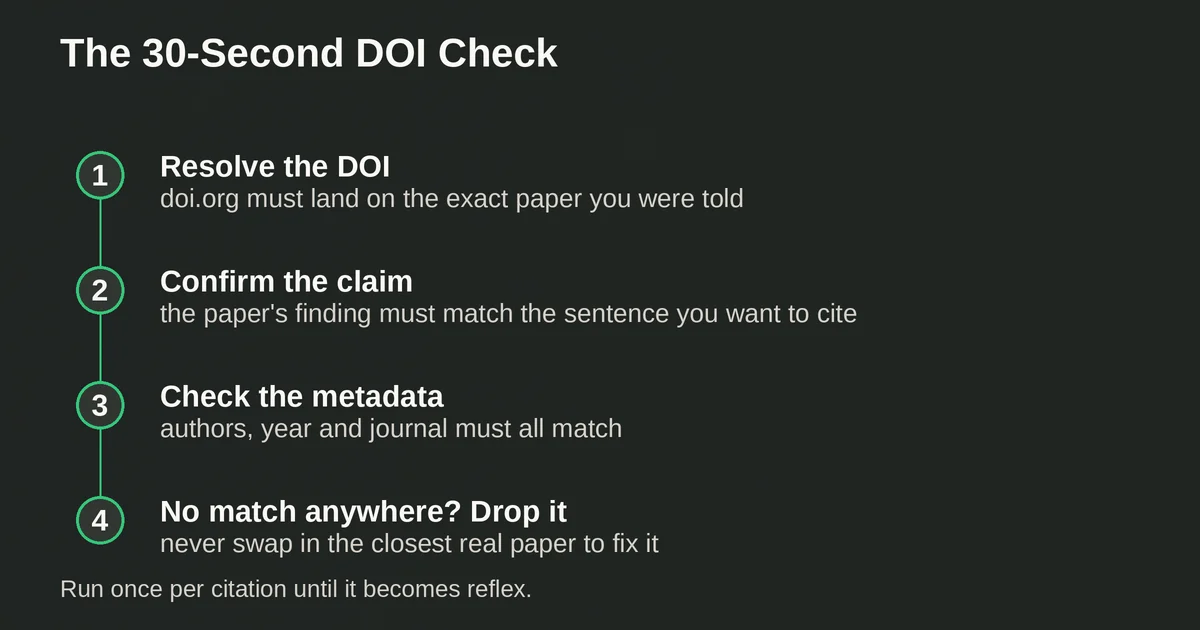
Whatever produced a citation, chatbot or research tool, the verification step is the same, and the GhostCite authors recommend exactly this: check each cited title in a trusted index and treat missing DOIs or inconsistent metadata as red flags. Here is the workflow, run once per citation until it becomes reflex.
- Resolve the DOI. Paste it after
https://doi.org/in your browser. It should land on the publisher page for a paper whose title matches what you were told. If there is no DOI, search the exact title in Google Scholar or PubMed. - Confirm the claim is in the abstract. Read the actual abstract. Does the paper's stated finding match the sentence you want to cite? The most common semi-fake citation is real paper, wrong claim: the study exists but says something narrower than the sentence implies.
- Check the metadata you are about to put in your bibliography. Author names, year, journal. Remember the biomedical evaluation: models that find real papers still botch these fields half the time.
- No match anywhere? Drop it. Do not "fix" the citation by finding the closest real paper. Either find the right source yourself or cut the sentence.
That fourth step is where most people go wrong, according to the same study's survey data: 41.5% of researchers copy-paste BibTeX entries without ever checking them. Reviewers miss these too. The system will not catch it for you, which is precisely why the check is yours to run.
For writers and non-academics doing the same dance with web sources, we wrote up the broader AI fact-checking and citation verification workflow separately; the DOI variant above is the academic instance of the same discipline. And if you want to understand why models invent references with such confidence in the first place, our piece on real AI hallucination examples breaks down the mechanics.
A workflow that survives review
Here is what a safe cycle looks like in practice.
- Scope with Perplexity (or your library database) to refine the question.
- Map the evidence with Consensus: get the Yes/No/Mixed landscape and identify the pivotal studies.
- Screen and extract with Elicit: build the table of papers, populations, methods, and findings, with quotes attached.
- Read deeply with SciSpace: digest the must-read papers in full.
- Verify every citation with the DOI check before it enters your draft. Every one.
- Disclose AI use per your institution's policy, and keep your screening notes so you can show where each source came from.
A useful discipline test: pick one narrow question in your field and count how many of the tools' suggested papers resolve to a real DOI and actually support the sentence you wanted to write. In our experience with these three tools, retrieval-first design means almost everything resolves; the failures are almost always mischaracterized claims, not fake papers. That is exactly what step 2 of the DOI check catches.
The deeper pattern here is worth naming, because it applies far beyond lit reviews: AI is reliable when it summarizes what it retrieved and unreliable when it generates from memory. Chemists reviewing literature with claim-centered retrieval AI run the same playbook, and we cover that approach in our guide to claim-centered retrieval and AI literature synthesis. The tools change; the rule does not: retrieval first, generation second, verification always.
FAQ
Do Elicit, Consensus, and SciSpace ever hallucinate citations? Fabricated papers are structurally nearly impossible for all three, because they summarize retrieved records rather than generating references from memory. But mis-summarized claims and wrong metadata still happen, so the DOI check stays mandatory.
Which one should a student pick first? Consensus, if your field is empirical and you need the evidence landscape fast. Elicit, if you are writing a formal review chapter or thesis with structured extraction. SciSpace, if your bottleneck is understanding the papers you have already found. The free tiers of all three are enough to learn which fits your workflow before paying anything.
Pricing and plan details are as published by the vendors around September 2026 and can change; confirm on the official sites before subscribing.