
The Claim-Centered Fix for AI Literature Synthesis
AskChem, a system from researchers at NYU and Matterstack including Kyunghyun Cho, proposes a deceptively simple idea: stop retrieving documents and start retrieving claims. The system digests 147K chemistry papers into 2.4M atomic, typed claims, each carrying a source DOI and a verbatim quote from the original text. When a language model grounded in this claim store answers synthesis questions, it resolves every cited DOI correctly, compared to roughly nine in ten without retrieval grounding. That gap, measured on a benchmark of 30 cross-paper chemistry questions, is the headline result, but the deeper contribution is architectural. AskChem argues that the retrieval unit for scientific AI should be a self-contained, provenance-carrying proposition, not a paragraph fragment or a document summary.
The work appeared on arXiv in late July 2026 and quickly rose to the top paper spot on HuggingFace. The system is live at askchem.org with open-source code and dataset, and it ships an MCP server for agent integration. For developers building retrieval-augmented generation pipelines for scientific literature, the paper offers both a working blueprint and a pointed challenge to chunk-based RAG conventions.
Why Document-Centric Search Breaks for Science
Language models hallucinate scientific citations at alarming rates. A 2025 Nature study on OpenScholar found that GPT-4o fabricates citations between roughly four-fifths and nine-tenths of the time when asked to synthesize recent literature without retrieval grounding. Even with a strong model like GPT-5.5 answering from parametric memory alone, AskChem's own benchmark shows that about one in eight cited DOIs cannot be resolved to a real paper.
The root problem is granularity. Standard RAG pipelines split documents into chunks, embed them, and retrieve the most similar fragments for a given query. This works adequately for question answering over a single document, but scientific synthesis demands something subtler. A researcher asking whether a particular catalyst works under aqueous conditions does not want the third paragraph of a methods section. They want the specific claim that the catalyst was tested in water, the measurement that resulted, and the paper that reported it, all in one retrievable unit.
Chunk-based retrieval also severs provenance. A chunk carries its source document metadata, but the specific sentence within the chunk that makes a claim is not individually addressable. When a model cites a chunk, it cites a location, not a proposition. AskChem's bet is that making the proposition itself the atomic unit fixes both the citation problem and the synthesis quality problem at once.
Atomic Claims as the Retrieval Unit
AskChem uses two extraction pipelines. A high-throughput extractor processes paper abstracts quickly, while a deeper extractor parses full-text PDFs to capture claim types that abstracts omit, such as hypotheses, limitations, and surprising findings. Full-text processing accounts for roughly two-thirds of all extracted claims, which means abstract-only processing would miss a substantial portion of the scientific substance.
Each extracted claim is a structured object. It carries a claim type (property, measurement, hypothesis, and others), a source DOI, a verbatim quote from the original text, chemistry-specific fields like reactants and conditions where applicable, numeric ranges where relevant, and an extraction confidence score. The claim schema is validated on every extraction call, so malformed or incomplete claims are rejected before indexing rather than silently polluting the store.
Traditional RAG gives you a filing cabinet where each drawer is a paper and each folder is a chunk. AskChem gives you a card catalog where every card is one scientific assertion, stamped with its origin and typed by what kind of assertion it is. You can pull all measurement claims about a specific reaction in seconds without ever opening a drawer.
Three Structures Over One Claim Store
The claim store sits in SQLite with FTS5 full-text search and a vector index, served through FastAPI. Over this store, AskChem layers three complementary structures.
Faceted Taxonomy
A stabilized faceted taxonomy with roughly 307K nodes organizes claims hierarchically by reaction type, substance class, application, technique, mechanism, claim type, data, and time. This mirrors how chemists already categorize their field, enabling structured browsing and filtering so a query can be constrained to, say, oxidation reactions in aqueous media reported in the last decade.
Evidence Graph
The evidence graph contains 171K typed directed edges connecting claims across papers. Edge types include supports, contradicts, extends, derives_from, and cites_as_evidence. Manual verification of a stratified sample found nearly 98% edge-type precision, meaning the system correctly identifies whether one claim supports, contradicts, or extends another almost all the time. The API endpoint for traversing this graph returns a claim's neighborhood of inbound and outbound edges with confidence scores and provenance, letting an agent walk the web of evidence around any assertion.
Two of the sampled edges were undecidable even by domain experts, a reminder that evidence relationships in science are sometimes genuinely ambiguous.
Living Taxonomy
A third structure organizes claims by scientific principles rather than by operational facets. The paper describes this as exploratory, representing a bet that taxonomies should evolve with the field rather than be fixed at index time.
What the Benchmark Actually Shows
AskChem-Bench measures citation groundedness and relevance across 30 cross-paper chemistry synthesis questions. The key comparison pits GPT-5.5 grounded in AskChem against GPT-5.5 answering from parametric memory alone.
| Configuration | Resolvable DOIs | Citations per answer | Relevance score |
|---|---|---|---|
| GPT-5.5 alone | 88.3% █████████░ | not reported | not reported |
| GPT-5.5 + AskChem | 100% ██████████ | 18 | 2.15 |
The 100% DOI resolution rate is the headline, but the marginal improvement is about 12 percentage points over an already strong baseline. The more telling signals are citation density and relevance. AskChem-grounded answers averaged 18 verified citations per answer, the highest among five tested systems, and achieved the top relevance score. Closed agents like Edison Scientific extracted slightly higher quantitative detail in some cases, though AskChem led in overall relevance.
The benchmark is small, and the authors do not claim it generalizes beyond chemistry synthesis. What it does show is that claim-level retrieval produces answers that are denser in verified evidence and more relevant to the question asked, not merely better at avoiding fake citations.
Implementation and Agent Integration
AskChem's technology choices are deliberately modest. The system runs on SQLite with FTS5 for full-text search and a vector index for semantic retrieval, all served through FastAPI. No exotic vector database, no distributed cluster, no graph database. The claim store, the taxonomy, and the evidence graph all live in the same SQLite database. This matters for practitioners: the architecture is reproducible by a small team. The extraction pipeline is the expensive part, requiring LLM calls to segment every paper into atomic claims, but the serving layer is lightweight. Author disambiguation and paper-level metadata come from OpenAlex.
The system exposes four interfaces: a web UI for humans, a REST API for programmatic access, an SDK for developers, and an MCP server for AI agents. The MCP server lets agents query AskChem's claim store directly: search by text or vector similarity, filter by taxonomy facets, traverse the evidence graph, and retrieve structured fields including reactants, conditions, and measurements. The code is open source, the dataset is on HuggingFace, and the MCP server follows the standard protocol that an increasing number of agent frameworks support. You can point an MCP-compatible agent at AskChem and immediately give it access to 2.4M provenance-carrying chemistry claims without building any extraction pipeline yourself.
Claim-Level vs Chunk-Level RAG
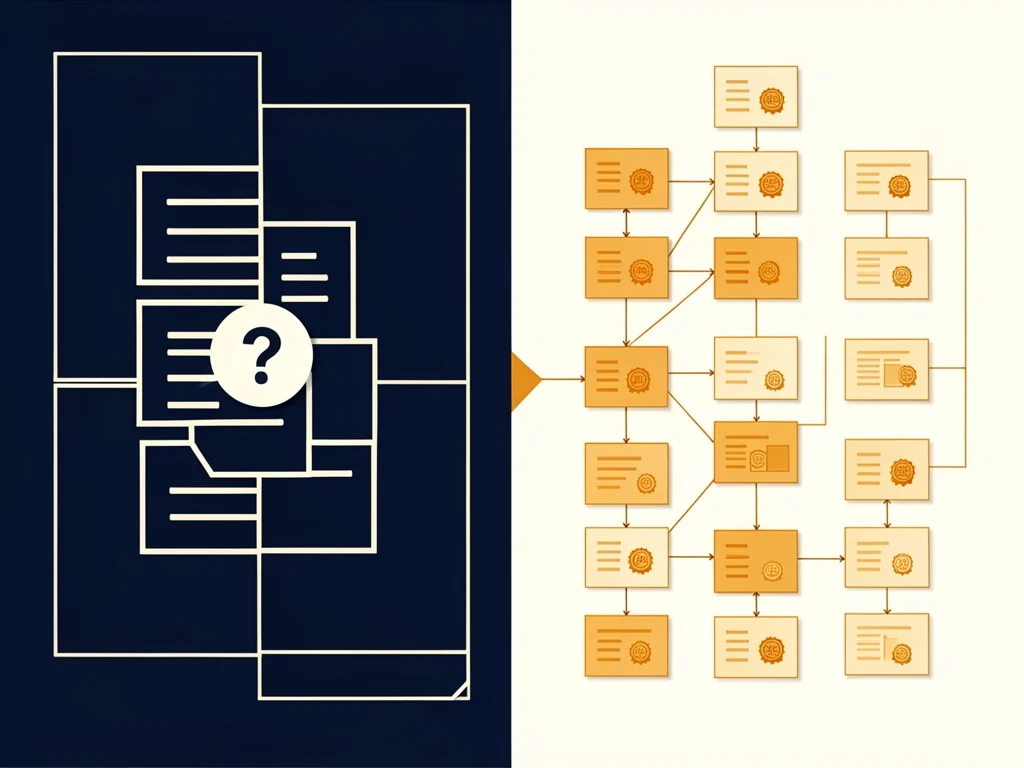
The central tradeoff is extraction cost. Chunk-based RAG is cheap to build: split documents, embed chunks, retrieve. Claim-level retrieval requires an LLM to read every paper and extract structured claims before indexing can even begin. For 147K papers, that is a substantial upfront investment.
The payoff comes at query time. Claim-level retrieval eliminates citation hallucination because every retrievable unit carries its own DOI. It enables cross-paper navigation through the evidence graph, which chunk-based systems cannot replicate without additional relationship extraction. And it produces denser, more relevant answers because the retrieval unit matches the synthesis unit.
OpenScholar, described in the Nature study, takes a different path. It indexes 45M open-access papers with over 200 million passage embeddings and uses a self-feedback inference loop to improve citation-backed synthesis. Its approach scales to far more papers but operates at passage granularity, not claim granularity. The two systems represent a genuine fork in the road for scientific RAG: breadth with passage-level retrieval and feedback loops, or depth with claim-level retrieval and evidence graphs.
The retrieval unit should match the synthesis unit. If you want verified, cross-referenced scientific claims, retrieve claims, not chunks.
Limitations Worth Taking Seriously
The 30-question benchmark is the most obvious limitation. A perfect DOI resolution rate on 30 questions is impressive but not conclusive. The authors acknowledge that provenance checks establish traceability rather than full semantic correctness. A claim may be correctly sourced to a real DOI with an accurate verbatim quote and still be semantically misinterpreted during extraction.
The evidence graph's near-98% precision is strong but not perfect, and the two undecidable edges in the sample suggest that some scientific relationships resist clean classification. Full-text extraction captures two-thirds of claims, which means the remaining third come from abstract-only processing and may miss hypotheses, limitations, and surprising findings that only appear in the body of a paper.
Finally, AskChem is chemistry-specific. The claim schema includes chemistry-specific fields like reactants and conditions. The approach generalizes conceptually to other scientific domains, but the extraction prompts, the taxonomy facets, and the claim types are tailored to chemistry. Adapting the system to biomedicine, materials science, or physics would require rethinking the schema and retraining the extraction pipeline.
None of these limitations undermine the core insight. AskChem is a proof that claim-centered retrieval works, built and deployed at meaningful scale, with open code and open data. The question for the rest of the field is whether the chunk-based RAG conventions that dominate current pipelines are worth defending against an approach that treats scientific assertions as first-class citizens.