

What Grok Build actually is
Grok Build is xAI's, now SpaceXAI's, terminal-based AI coding agent. It runs as a full-screen TUI application from the grok command and, according to xAI's own product documentation, reads a repository's structure, searches symbols and text, opens and edits files across multiple locations at once, runs shell commands, and inspects Git state directly from the working directory.
Its core feature set, per xAI's product page and independent write-ups, includes:
- Plan mode, a separate planning state that keeps a proposed implementation visible before file changes are applied, subject to approval.
- Subagents, which delegate research, implementation, and review work to specialized child sessions that can run concurrently, each in its own Git worktree so parallel edits don't collide.
- Headless mode, for running the agent inside CI pipelines without the interactive TUI.
- Skills, plugins, hooks, and MCP servers, all manageable from a single extensions modal in the TUI, opened with /plugins, /hooks, /skills, or /mcps.
- /skillify, a command that captures an entire session as a reusable, shareable skill.
- Five built-in skills maintained by xAI: Word Documents, Presentations, Spreadsheets, PDFs, and a Skill Creator that scaffolds new skills.
- Sandbox and permission controls, restricting filesystem and process access at the operating-system level.
The deliberate compatibility play
The single most strategic decision in the whole product, according to xAI's documentation, is that Grok Build automatically reads Claude Code's marketplaces, plugins, skills, MCP servers, agents, hooks, and instruction files, including CLAUDE.md, Claude.md, CLAUDE.local.md, and .claude/rules/, with zero configuration required. Point Grok Build at a repository already set up for Claude Code, and it picks up that configuration and runs.
Rather than build a competing ecosystem of skills and plugins from scratch, xAI imported Anthropic's format wholesale. A side-by-side test by DataCamp confirms the feature parity is real: plan mode, subagents, skills, hooks, MCP, headless mode, sandboxing, and worktrees are present in both tools. The practical implication is that anyone who has already invested in writing Claude Code-style project instructions does not need to rewrite them to try Grok Build.
The ten weeks that shaped this product
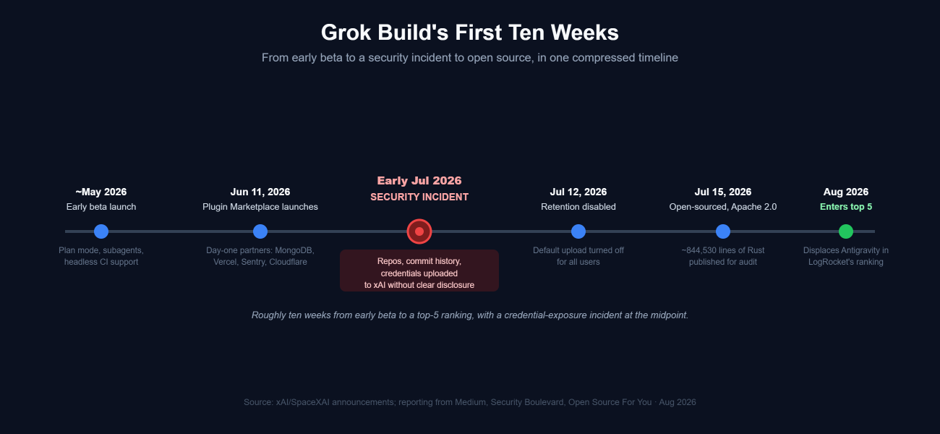
Grok Build's history since launch is unusually compressed even by 2026's AI-tool release pace. A rough timeline, compiled from CodersEra's dev-stack guide and contemporaneous coverage:
| Date | Event |
|---|---|
| Roughly May 2026 | Grok Build launches in early beta with plan mode, subagents, and headless CI support |
| June 11, 2026 | The Grok Build Plugin Marketplace launches with day-one partner plugins from MongoDB, Vercel, Sentry, Chrome DevTools, Cloudflare, and others |
| Early July 2026 | Security researcher "cereblab" publishes a wire-level analysis showing Grok Build uploading complete Git repositories, including commit histories and potentially embedded credentials, to xAI's servers |
| July 12, 2026 | xAI disables default data retention for all users |
| July 15, 2026 | xAI open-sources the entire Grok Build harness, roughly 844,530 lines of Rust, under Apache 2.0, and resets usage limits for all users |
| July 24, 2026 | Grok Build's default model is reported swapped as part of the broader stabilization following the incident |
| August 12, 2026 | Grok 4.6 ships as xAI's new flagship, with a 500K-token context window, and becomes available through Grok Build among other channels |
| August 2026 | Grok Build (referred to as "Grok CLI" in some tracker coverage) enters LogRocket's tools power ranking at #5, displacing Antigravity |
That is a product that went from early beta to a genuine security controversy to a full open-source release in about ten weeks. Whether that sequence reads as "a company that moves fast and owns its mistakes" or "a company that got caught and had to backpedal" is doing a lot of work in how anyone should evaluate the trust claims below.
The security incident, in plain terms
This is worth covering carefully because it is directly relevant to the "can it compete on trust" question this piece is asking, and because vague summaries of security incidents tend to either overstate or understate what happened.
According to reporting from Open Source For You and a detailed writeup on Medium, a security researcher using the network interception tool mitmproxy found that Grok Build CLI version 0.2.93 opened two simultaneous network channels during every session. Beyond the expected traffic to xAI's inference API, the tool was also uploading complete Git repositories, including commit history and, in some cases, credentials such as API keys, SSH keys, cloud tokens, and database passwords, to xAI's storage. xAI's response, compiled from Simon Willison's contemporaneous notes and Security Boulevard's analysis, unfolded in stages:
-
Disabled default data upload and retention for all users, starting July 12.
-
Promised to delete all previously retained coding data.
-
Open-sourced the entire agent harness under Apache 2.0 on July 15, framed by xAI as letting anyone "read the source to see exactly how it works, from context assembly to tool-call dispatch."
-
Reset usage limits for all users, a goodwill gesture alongside the technical changes.
Two caveats are worth keeping front and center, both raised by Open Source For You: the upload infrastructure itself remains present in the published source code, disabled only through a server-side configuration flag rather than removed, and xAI has not disclosed the number of affected users, provided a deletion audit, or published a formal incident report. "We turned it off" and "we removed the capability" are different claims, and only the first one has actually been made.
For anyone who ran Grok Build during the affected window, the practical guidance from security researchers, per Reptile Haus's incident writeup, is to treat every credential accessible from that working directory as compromised and rotate SSH keys, API tokens, and cloud credentials as a baseline precaution.
What "open source" actually grants here
Since this piece's whole framing is "can free and open source compete," it is worth being precise about what the Apache 2.0 release actually opens up, because "open source" is doing different work here than it does for OpenCode.
A detailed license analysis from bex.co lays out what the Apache 2.0 license genuinely grants:
- Audit rights with teeth. The privacy incident itself was uncovered through exactly this mechanism: independent researchers performing wire-level and source-level analysis of what the agent actually transmits. For a tool that reads an entire codebase and executes shell commands, that auditability is a security control, not a courtesy.
- A perpetual fork right. If xAI or SpaceXAI abandons the CLI, changes its direction, or ships something the community won't accept, the published code is legally available to maintain, modify, and redistribute, including commercially, with a patent grant attached.
- Fully local, self-hosted operation. Compile the binary, point it at a self-hosted inference server, and the agent runs without any data touching SpaceXAI's infrastructure at all.
But two things stayed closed, and both matter:
- The model itself. grok-build-0.1, the fine-tune actually powering the agent's intelligence, remains a paid, proprietary API. The harness is open. The brain behind it is not.
- The development process. Unlike a community-governed open-source project, decisions about Grok Build's direction are made entirely inside SpaceXAI, with no public roadmap input mechanism.
That is a meaningfully different kind of "open" than OpenCode's, where the project supports over 75 model providers including fully local options via Ollama and was built from the outset around a model-agnostic thesis, rather than open-sourced in response to a controversy involving its own default model's behavior.
Feature comparison: Grok Build vs Claude Code vs OpenCode
| Feature | Grok Build | Claude Code | OpenCode |
|---|---|---|---|
| License | Apache 2.0 (harness only; model stays proprietary) | Proprietary | MIT |
| Model access | Grok 4.6 (xAI/SpaceXAI models) | Claude Opus 5, Claude Sonnet 5 | 75+ providers: Claude, GPT, Gemini, DeepSeek, local via Ollama |
| Computer use | No | Yes | No |
| Offline / local-first operation | Possible via self-compiled binary + self-hosted inference | No | Yes, including true air-gapped deployment |
| Plugin marketplace | Yes, day-one partners include MongoDB, Vercel, Sentry, Chrome DevTools, Cloudflare | No dedicated marketplace | No dedicated marketplace |
| MCP server support | Yes | Yes | Yes |
| Claude Code compatibility | Reads CLAUDE.md, .claude/rules/, and Claude Code plugins/skills natively | Native | Not specifically |
| Subagents | Yes, with Git worktree isolation | Yes (Agent Teams) | Yes, background subagents |
| Skill capture (/skillify-equivalent) | Yes | Manual | Not built in |
| Headless / CI mode | Yes | Limited | Yes |
| GitHub stars (approximate) | Thousands within hours of open-sourcing (exact current count not independently confirmed) | Not open source | 172,198 (per Morphllm's tracking) |
The compatibility row is the one worth sitting with. Grok Build is not trying to build a third ecosystem alongside Claude Code's and OpenCode's. It is trying to be a drop-in alternative runtime for an ecosystem Anthropic already built, while adding its own plugin marketplace and cheaper model pricing on top.
Pricing comparison
| Grok Build | Claude Code | OpenCode | |
|---|---|---|---|
| Free tier | Yes, available on every plan including Free as of August 25, 2026 | No free tier | Yes (bring your own key) |
| Entry paid tier | SuperGrok, roughly $30/month | $20/month | $10/month (OpenCode Go) |
| API cost (coding-specific model) | grok-build-0.1 at $1.00/M input, $2.00/M output | Claude Sonnet 5 at $2/$10 per million tokens | Pass-through cost of whichever model you connect |
| Top consumer tier | SuperGrok Heavy, roughly $300/month | $200/month (Claude Max) | $200/month (OpenCode Black, reported sold out) |
Two things to flag on pricing specifically. First, xAI's own pricing guides note that plan names do not map cleanly to model versions, and tier-to-model assignment changes during staged rollouts, so a SuperGrok subscriber and a SuperGrok Heavy subscriber may not be running the same underlying model on a given day. Second, per GEO Toolbox's pricing breakdown, pricing at xAI has changed more than once in 2026 already, so any figure here should be reconfirmed against xAI's live pricing page before budgeting a team rollout.
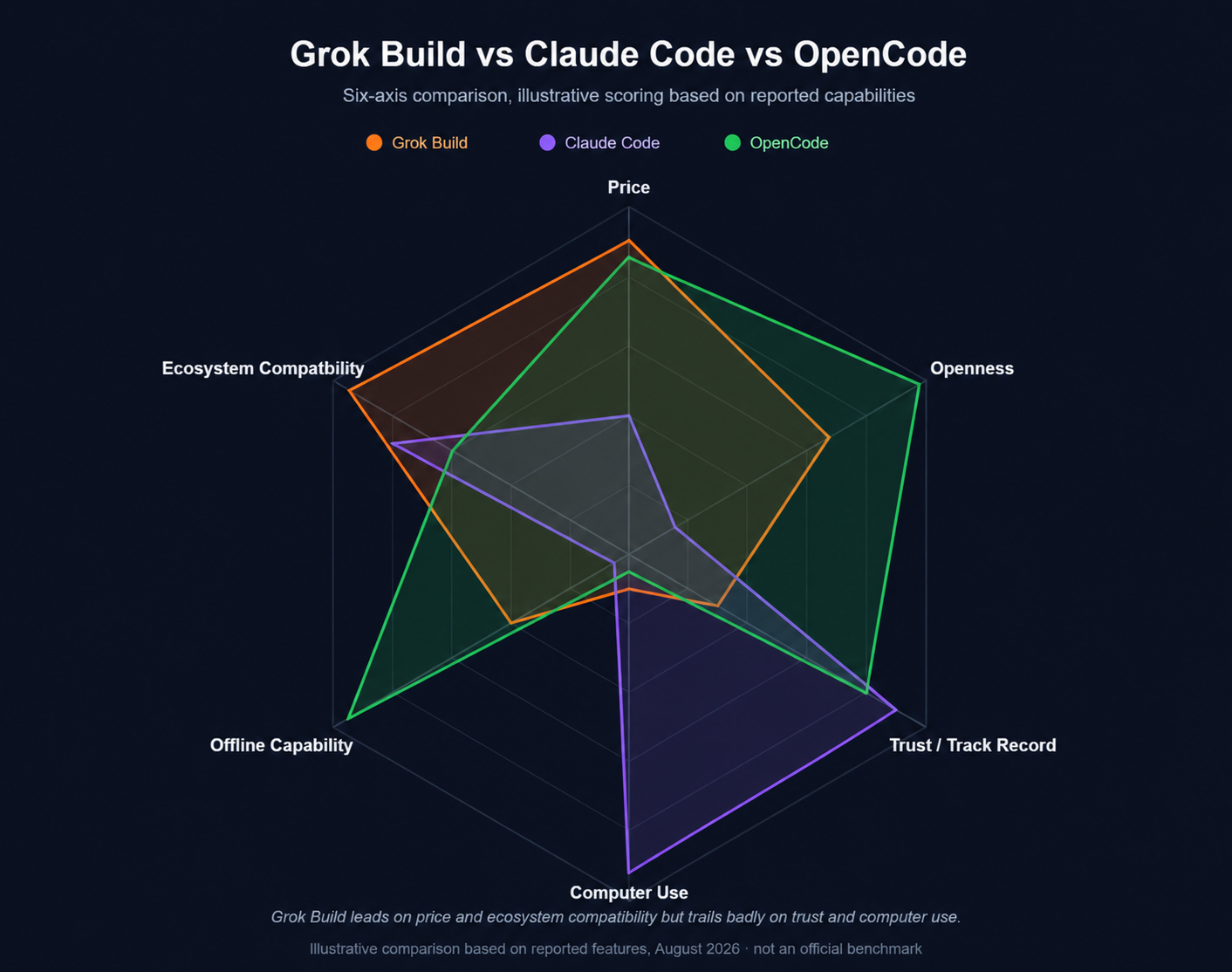
Why it displaced Antigravity specifically
Antigravity had held the #5 spot in LogRocket's tools ranking for months on the strength of being completely free during preview, offering integrated Chrome browser automation, and having the most diverse free model lineup in the category. LogRocket's own framing of the swap is that Grok Build "matches OpenCode's open positioning in a CLI," while adding the plugin marketplace, MCP integrations, and /skillify capture that Antigravity did not offer in equivalent form.
The gap that remains, per the same ranking: Grok Build currently lacks both an offline mode in its hosted form and computer use, the two capabilities that OpenCode and Claude Code, respectively, use to differentiate themselves. Antigravity's own computer-use-adjacent Chrome automation was arguably its strongest remaining edge, and Grok Build does not fully replace it.
Can it actually compete?
Breaking this down by what "compete" actually means in each dimension:
On raw feature checklist: genuinely competitive
Plan mode, subagents, worktree isolation, headless CI mode, MCP support, and now a plugin marketplace with real partners on day one. DataCamp's head-to-head testing found real feature parity with Claude Code, not just a marketing claim. This is not a thin clone.
On price: yes, clearly
A free tier available on every plan, plus a coding-specific model priced at $1/$2 per million tokens, undercuts Claude Code's lack of any free tier and Claude Sonnet 5's $2/$10 pricing. For cost-sensitive teams or individual developers, Grok Build is a genuinely cheaper on-ramp.
On trust and governance: this is the real open question
Here is where "free and open source" runs into its actual limit. OpenCode's model-agnostic, community-oriented thesis was built from day one around not depending on any single company's roadmap or ownership structure. Grok Build's open-sourcing happened as a direct response to a credential-exposure incident, and the company that owns it, SpaceXAI, is the same company whose ownership of Cursor is cited elsewhere in this same ranking cycle as a reason enterprise trust is eroding.
That is not a hypothetical concern for Grok Build specifically. It is the identical concern, applied to a different product from the same parent company, in the same month.
On ecosystem maturity: too early to call
OpenCode has had roughly two years to build its adoption base and reputation; Grok Build has had about three months, including a security incident in the middle of that window. A single month at #5 in one tracker's ranking is a genuine signal of momentum, not evidence of durable trust.
The SpaceX irony
It's worth naming plainly: the same LogRocket ranking cycle that penalized Cursor for sliding into SpaceX ownership just welcomed a different SpaceX-owned tool into its top 5. SpaceX acquired xAI in February 2026 and completed the corporate rebrand to SpaceXAI in July. The $60 billion Anysphere (Cursor) acquisition was announced in June and was expected to close in Q3 2026.
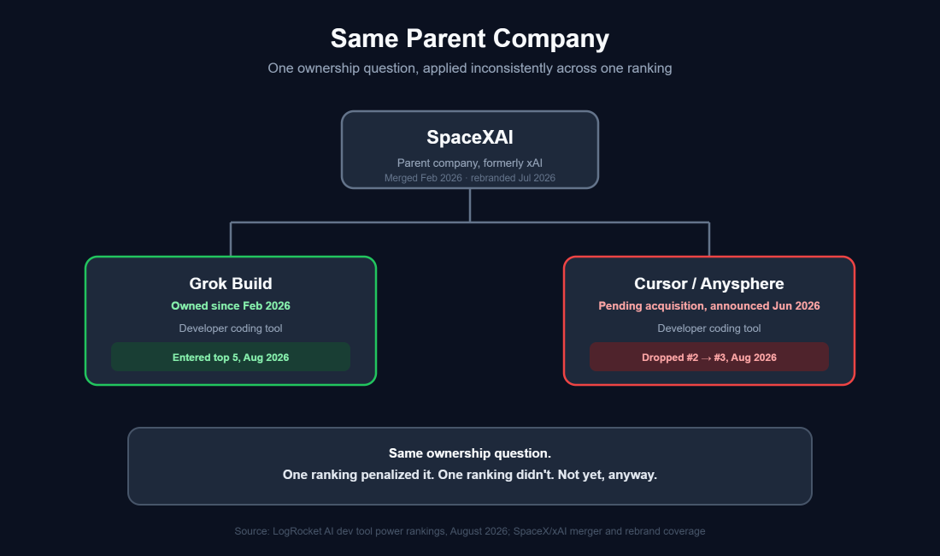
If the market's concern about Cursor is genuinely about code flowing through a SpaceX-owned pipeline, that same concern applies just as directly to Grok Build, arguably more directly, since Grok Build is not "becoming" SpaceX-owned; it already is, and has been since before this ranking cycle began. Whether that inconsistency gets addressed in next month's rankings, or whether Grok Build's open-source harness is judged to meaningfully offset the ownership question in a way Cursor's closed-source product cannot, is one of the more interesting things to watch here.
Open questions and reasons for caution
- No independent confirmation of current GitHub star count. Coverage describes "thousands of stars within hours" of the July 15 open-source release, but no source in this piece has a verified current total to compare against OpenCode's 172,198.
- No formal incident report or deletion audit has been published, despite xAI's promise to delete previously retained data. The promise exists; independent verification of its completion does not, as of this writing.
- The upload infrastructure remains in the codebase, disabled by a server-side flag rather than removed, meaning the capability could in principle be re-enabled without a client-side update.
- Pricing and plan-to-model mapping change frequently at xAI/SpaceXAI, and multiple pricing guides published within days of each other already disagree on specifics.
- This is one ranking, one methodology, one month. LogRocket's own framing prioritizes value proposition and accessibility at 45 percent combined weight, which is precisely the kind of weighting that would reward a free tier and penalize an unresolved trust question simultaneously. A methodology weighted more heavily toward raw benchmark performance might rank this differently.
What to watch next
-
Whether SpaceXAI publishes a formal incident report or deletion audit for the July data-handling issue, which would be the clearest available signal of whether the company treats trust incidents as closed once damage control ends.
-
Whether Grok Build's GitHub star count and active-developer numbers get independently tracked the way OpenCode's have been, so the comparison in this piece can eventually be made with real numbers on both sides.
-
Whether computer use or a genuine offline mode ship for Grok Build, closing the two gaps LogRocket specifically flagged against Claude Code and OpenCode respectively.
-
Whether next month's rankings apply the SpaceX-ownership discount consistently across both Cursor and Grok Build, or whether Grok Build's open-source harness is treated as sufficient mitigation in a way Cursor's closed product isn't.
Quick-reference FAQ
Is "Grok CLI" the official name? No. The product is Grok Build; the terminal command is grok. "Grok CLI" is informal shorthand used in some coverage.
Is Grok Build actually open source? The agent harness, roughly 844,530 lines of Rust, is open-sourced under Apache 2.0. The underlying model, grok-build-0.1, remains proprietary and paid. The development process is not community-governed.
What was the security incident? In early July 2026, a researcher found Grok Build uploading complete Git repositories, including commit history and potentially credentials, to xAI's servers without clear disclosure. xAI disabled default retention, promised data deletion, and open-sourced the harness in response.
Is the vulnerability fully fixed? The default behavior is disabled, but the upload code remains present in the published source, gated by a server-side flag rather than removed. No independent audit confirming full data deletion has been published.
Does Grok Build work with my existing Claude Code setup? Yes. It automatically reads Claude Code's marketplaces, plugins, skills, MCP servers, and instruction files, including CLAUDE.md and .claude/rules/, with no configuration required.
Is Grok Build cheaper than Claude Code? Yes, on both fronts. It offers a free tier on every plan as of August 25, 2026, and its coding-specific API pricing ($1/$2 per million tokens) undercuts Claude Sonnet 5's $2/$10.
Who owns Grok Build? SpaceXAI, the renamed and fully merged form of xAI following its February 2026 acquisition by SpaceX.