
Background: how we got to GLM-5.3
Z.ai, the company formerly known as Zhipu AI, has been on an unusually fast release cadence for its GLM series. A rough lineage, for context:
- GLM-4.5 and GLM-4.5 Air shipped in July 2025, the release that came with the company's international rebrand from Zhipu AI to Z.ai.
- GLM-4.5V, a 106B-parameter vision-language model, followed in August 2025.
- GLM-4.6 arrived in late September 2025, notable for running on domestic Chinese chips including hardware from Cambricon Technologies.
- GLM-4.6V and GLM-4.7 shipped in December 2025.
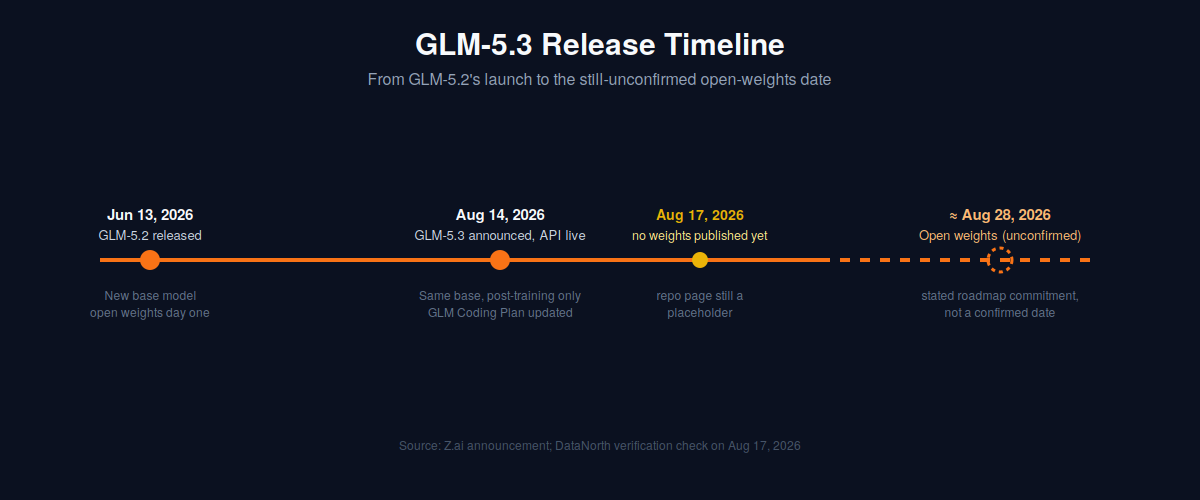
- GLM-5.2 landed June 13, 2026, a roughly 743-billion-parameter mixture-of-experts model with a 1-million-token context window and MIT-licensed open weights, and it set the open-source coding baseline that GLM-5.3 would later jump past.
- GLM-5.3 shipped 59 days later, on August 14, 2026.
That is five to six major or minor GLM releases in about thirteen months, a pace that puts real pressure on the rest of the open-weights field to keep up. It also means GLM-5.3 is not really a generational leap in the way GLM-5.2 was over GLM-4.7. It is something narrower and, in some ways, more interesting: the same generation, retrained harder.
Note on naming: Reporting during this window also referenced a possible "GLM-5.5" or "GLM-6" based on analyst forecasts and a CGTN report citing Reuters and JPMorgan. As of this writing, Z.ai has not confirmed either name, and its own documentation does not go past GLM-5.3. Treat any "GLM-5.5" claims elsewhere as unconfirmed speculation, not an official roadmap.
What GLM-5.3 actually is
| GLM-5.2 (June 13, 2026) | GLM-5.3 (August 14, 2026) | |
|---|---|---|
| Output limit | Not separately documented | 128,000 tokens |
| What changed | New base model | Post-training only: more task environments, longer-horizon training, stronger verifiers |
| License | MIT, open weights | Weights pending, same license expected |
| Access at launch | API and open weights simultaneously | API and GLM Coding Plan only; weights delayed |
Z.ai's own account, reported by MarkTechPost, is that the gains come from roughly a month of additional reinforcement learning against more executable environments and longer tasks, not a new pretraining pass. SiliconANGLE confirms the architecture is identical to GLM-5.2's mixture-of-experts design, describing GLM-5.3 as running on "an identical design" that simply "went through a more extensive post-training process."
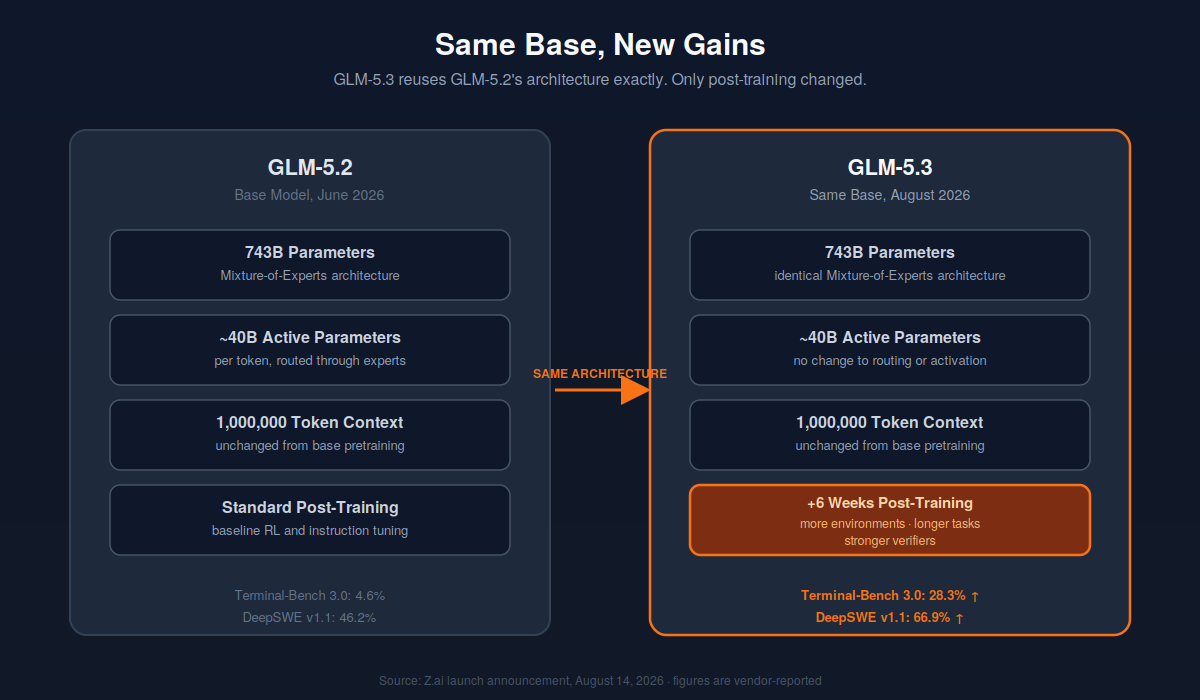
In plain terms: if you opened up GLM-5.2 and GLM-5.3 and compared their weights' underlying architecture, you would find the same skeleton. What differs is everything that happened to the model after pretraining, specifically the reinforcement learning stage where a model is trained against executable tasks, scored by verifiers, and pushed to handle progressively longer and harder problems.
The two headline gains
Z.ai's launch materials frame GLM-5.3 around exactly two capability areas, and it is worth taking each on its own terms rather than averaging them into a single "better model" headline.
1. Coding on long-horizon tasks
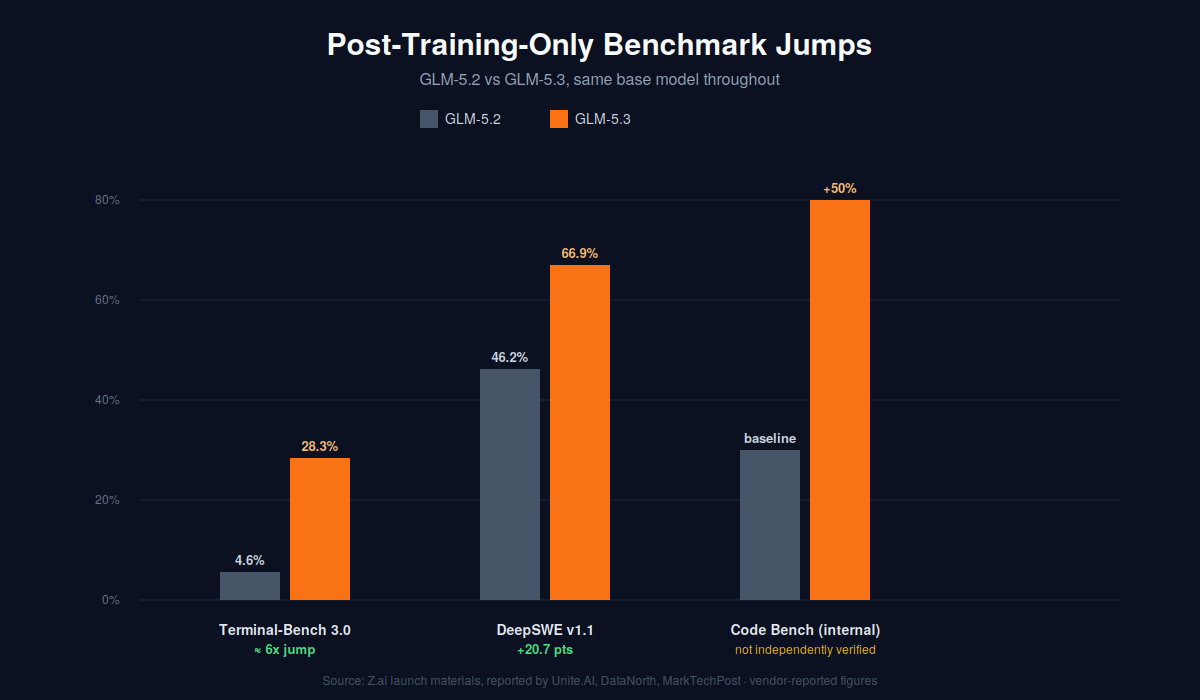
Terminal-Bench 3.0, which tests command-line and agentic coding tasks that run over extended sessions rather than single-shot prompts, moved from 4.6 percent on GLM-5.2 to 28.3 percent on GLM-5.3. That is roughly a six-fold jump, and it is reported consistently across Unite.AI, DataNorth, and Z.ai's own materials, which makes it one of the more corroborated numbers in this release even though all three sources are ultimately citing the same vendor announcement.
Some further detail worth noting:
- DeepSWE v1.1 rose from 46.2 to 66.9 percent.
- Z.ai also reports a 50 percent improvement on its in-house Code Bench, though that figure is not independently verifiable since Code Bench is not a public, third-party-run benchmark. Treat it as directional rather than exact.
- The improvement is concentrated specifically on long-horizon tasks, meaning multi-step, extended-session agentic coding work, rather than short single-function code generation. That is consistent with Z.ai's stated training focus on "longer tasks" and "stronger verifiers."
2. Cybersecurity capability that outran expectations
This is the part Z.ai frames almost as a caveat rather than a feature, and it is arguably the more newsworthy of the two gains precisely because it appears not to have been the primary goal.
- CyberGym, a benchmark for automated vulnerability discovery, reached 84.5 percent.
- On exploitation benchmarks, GLM-5.3 more than doubled GLM-5.2's scores.
- Unite.AI reports Z.ai describing the cyber capability as having grown faster than the company anticipated as training scaled.
That is a notable thing for a lab to say publicly about its own model. It implies the capability emerged as a side effect of coding-focused post-training rather than as a deliberately targeted outcome, which is exactly the kind of emergent, hard-to-predict capability jump that makes post-training-only upgrades worth watching closely across the industry, not just for this one model.
Full benchmark table
All figures below are Z.ai's own reported numbers on Z.ai's own evaluation harnesses. Nothing here has been independently replicated yet, and the gap between in-house and third-party results is exactly the open question once the weights ship.
| Benchmark | Score | What it measures |
|---|---|---|
| Terminal-Bench 3.0 | 28.3% | Long-horizon command-line and agentic coding tasks |
| DeepSWE v1.1 | 66.9% | Software engineering task completion |
| Agents' Last Exam | 28.5% | Difficult, broad agentic reasoning tasks |
| AutomationBench | 48.2% | General workflow automation capability |
| Humanity's Last Exam (with tools) | 62.5% | Broad expert-level knowledge and reasoning, tool-assisted |
| GDPval-AA v2 | 1,769 Elo | Economically valuable task performance, Elo-scored |
| CyberGym | 84.5% | Automated vulnerability discovery |
| ExploitBench | 54.4% | Exploit development capability |
| ExploitGym (2h budget) | 105 tasks solved | Exploit tasks solved within a 2-hour compute budget |
| ExploitGym (6h budget) | 130 tasks solved | Exploit tasks solved within a 6-hour compute budget |
A few things worth flagging about this table rather than just reading it at face value:
- Every number here comes from Z.ai's own harness. None of it has been reproduced by an independent lab as of publication.
- Benchmarks like CyberGym and ExploitGym are dual-use by nature: the same capability that finds vulnerabilities for defenders can be pointed at offense. That is part of why Z.ai's own framing of the cyber jump reads more cautious than celebratory.
- "Agents' Last Exam" and "AutomationBench" scores in the 28 to 48 percent range indicate these are still hard, unsolved problem categories for GLM-5.3, not areas where it is dominant. It is worth resisting the temptation to read a single flashy Terminal-Bench number as evidence the model is uniformly strong across every agentic category.
How it stacks up against the open-weights field
On the three benchmarks both companies publish, GLM-5.3 leads Moonshot's Kimi K3 on Humanity's Last Exam with tools (62.5 percent versus 56 percent) and on GDPval-AA v2 (1,769 versus 1,668 Elo), while Kimi K3 edges ahead on DeepSWE v1.1 (69 percent versus 66.9 percent), according to comparison data compiled by Qubrid AI.
| Benchmark | GLM-5.3 | Kimi K3 |
|---|---|---|
| Humanity's Last Exam (with tools) | 62.5% | 56% |
| GDPval-AA v2 | 1,769 Elo | 1,668 Elo |
| DeepSWE v1.1 | 66.9% | 69% |
Z.ai's own comparison table also places GLM-5.3 against DeepSeek's V4 Pro and OpenAI's GPT-5.6 Sol across coding, cyber, and agentic suites. Those cross-lab numbers should be read as Z.ai's framing of the field rather than neutral third-party benchmarking, since Z.ai chose which models and which benchmarks to include in its own comparison table.
Two context points make this comparison more complicated than a simple leaderboard:
- Timing. The release lands days after DeepSeek shipped its own flagship V4 Pro out of preview, setting up a near-immediate rematch between two Chinese labs now shipping flagship models within days of each other.
- Weights availability. Kimi K3 has open weights available today. GLM-5.3 does not yet, which limits how much of this comparison anyone outside Z.ai can currently verify independently. A benchmark table is only as trustworthy as the ability of outsiders to rerun it, and right now nobody outside Z.ai can rerun GLM-5.3's numbers.
Availability and pricing
GLM-5.3 is not a simultaneous weights-and-API release. As of launch:
- Available now through Z.ai's API and the GLM Coding Plan, starting at $18 per month.
- Rolled out automatically to all existing GLM Coding Plan subscribers, with requests for GLM-5.2 and GLM-5.1 auto-routed to GLM-5.3. If you were already paying for the coding plan, you were upgraded without needing to do anything.
- Runs inside Z.ai's own ZCode agent, and is also usable through Claude Code and OpenCode.
- Billing moved to a points-based quota that counts input tokens, cached input tokens, and output tokens separately, rather than a flat per-token rate.
- Off-peak pricing: requests made outside 14:00 to 18:00 UTC+8 on weekdays consume half the standard points. Since that peak window only covers weekday afternoons in China Standard Time, all weekend usage bills at the off-peak rate regardless of when during the weekend you use it.
For a US-based developer, the practical effect of the off-peak window is that most working hours fall outside Z.ai's stated peak band once you convert 14:00 to 18:00 UTC+8 into US time zones, though anyone billing at scale should check the exact conversion against their own working hours rather than assume it.
The open-weights timeline
Z.ai says weights will follow "roughly two weeks after launch," once safety evaluation and hardening are complete, which points to on or around August 28, 2026. As of the most recent check on August 17, nothing had been published, and the release page held only a placeholder where the repository link belongs, according to DataNorth.
Treat that date as a stated roadmap commitment, not a confirmed shipping date, until the repository actually goes live. Vendors slipping open-weights timelines by days or weeks is common enough in this industry that "roughly two weeks" is best read as "no earlier than two weeks."
Why the "no new base model" framing is the real story
Most flagship model releases lead with a new pretraining run and a parameter count. GLM-5.3 inverts that. Z.ai is explicitly telling the market that a 50 percent jump in coding performance and a cybersecurity capability jump big enough to surprise its own team came entirely from how the existing model was trained after pretraining, not from making the model bigger or smarter in a new base sense.
That has two implications worth sitting with.
1. Post-training headroom may be larger than assumed
If roughly six weeks of additional reinforcement learning on longer tasks and better verifiers can move Terminal-Bench 3.0 from 4.6 to 28.3 percent, base-model scaling may not be the only lever labs have left, and possibly not even the most efficient one right now. That is consistent with a broader industry pattern this year of labs squeezing more capability out of existing base models rather than always reaching for bigger pretraining runs, which are far more expensive and slower to iterate on.
2. Capability can emerge sideways
Z.ai says it did not set out to build a stronger cybersecurity model. The exploitation and vulnerability-discovery gains appear to be a byproduct of training the model to handle longer, more complex agentic coding tasks. That is a pattern worth watching as more labs report post-training-only upgrades: capabilities can show up in domains adjacent to the one being optimized for, and not always in ways that were anticipated in advance. It also raises a fair question for any lab doing this kind of training going forward: if coding-focused post-training can produce an unplanned cybersecurity jump, what else might show up unplanned in the next round?
Who should actually care about this release
Not every reader needs to track this closely. A rough breakdown:
- Developers already on the GLM Coding Plan. You were auto-upgraded. The main practical question is whether the new points-based, peak/off-peak billing changes your effective cost, especially if you do heavy usage during weekday China-afternoon hours.
- Teams evaluating open-weights coding models. Worth waiting for the actual weights release around August 28 before making any decision, since everything published so far is a vendor claim on a vendor harness.
- Security researchers and red teams. The CyberGym and ExploitGym numbers are relevant to track, both for the offensive tooling implications and because Z.ai's own framing suggests this is an area the company is still thinking through rather than one it has fully hardened for.
- Anyone comparing frontier coding models generally. GLM-5.3 is a useful data point on how much post-training alone can move benchmark scores, independent of whether you ever use the model directly.
Open questions and reasons for caution
To keep this piece honest rather than just repeating vendor claims, here is a plain list of what is not yet settled:
- No independent replication. Every benchmark number above comes from Z.ai's own evaluation harness. Third-party verification cannot happen until the weights are public.
- No published model card. Internal details such as exact training data composition, safety evaluation methodology, and any red-teaming results are not documented for GLM-5.3 specifically. What is known is inherited from the GLM-5.2 generation.
- Weights are a promise, not a shipped artifact. The stated August 28 timeline is Z.ai's own estimate, and as of the most recent check, the repository placeholder had not been filled in.
- Code Bench is not a public benchmark. The headline "50 percent coding improvement" figure comes from an internal Z.ai evaluation with no public specification, so it cannot be checked by outside parties at all, even after the weights ship.
- Cross-lab comparisons come from Z.ai's own table. The comparisons against DeepSeek V4 Pro and GPT-5.6 Sol reflect which benchmarks and framing Z.ai chose to publish, not a neutral third-party evaluation.
What to watch next
-
Whether the weights actually ship around August 28. Until they do, every benchmark in this piece is a vendor claim running on a vendor's own harness.
-
Independent replication of Terminal-Bench 3.0 and CyberGym scores once outside researchers can run the model themselves.
-
How GLM-5.3 performs against DeepSeek's V4 Pro, which shipped out of preview just days before GLM-5.3, setting up a direct rematch between two Chinese labs that are now shipping flagship models within days of each other.
-
Whether Z.ai publishes a formal model card alongside the weights, given that none exists yet and internal specifications are currently being inferred from the GLM-5.2 generation.
Quick-reference FAQ
- Is GLM-5.3 a new base model? No. Z.ai says it reuses the GLM-5.2 base exactly: no new pretraining run, no architecture change, no larger parameter count.
- How many parameters does GLM-5.3 have? 743B total in a mixture-of-experts design, with roughly 40B active per token, inherited unchanged from GLM-5.2.
- Is GLM-5.3 open source yet? Not as of publication. Weights, a model card, and license terms are all pending, with Z.ai targeting roughly two weeks after the August 14 launch, pointing to around August 28,2026
- What does GLM-5.3 cost right now? Access is through Z.ai's API and the GLM Coding Plan, which starts at $18 per month and uses a points-based quota with peak and off-peak rates.
- Is GLM-5.3 better than Kimi K3? It depends on the task. GLM-5.3 leads on Humanity's Last Exam with tools and GDPval-AA v2; Kimi K3 leads on DeepSWE v1.1. Kimi K3 also has open weights available today, which GLM-5.3 does not yet.
- Should I trust the benchmark numbers? Treat them as vendor-reported until independent evaluators can test the model directly once weights are released. That is true of the coding numbers and doubly true of the cybersecurity numbers, given how consequential dual-use capability claims are.