

Cursor just shipped the feature that quietly answers the question every AI coding tool has been circling for two years: what happens when the agent doesn't wait for you to ask? The new Automations system launches agents on its own, triggered by a Slack message, a new commit, or nothing but a timer. It landed the same season Cursor’s revenue crossed the $2 billion mark, and as SpaceX moves to complete its $60 billion acquisition of the company.
Quick Answer
- Automations, launched this week, lets Cursor start agents automatically, no human prompt required, triggered by code changes, Slack messages, or scheduled timers
- It's built on the same idea as Bugbot, Cursor's long-standing automatic bug-review feature, now generalized into a full framework
- Cursor’s annualized revenue has crossed the $2 billion mark in 2026 (with some reports putting it significantly higher by mid-year), while holding a substantial share of the generative AI coding tools market
- Current pricing runs from free (Hobby) up to $200/month (Ultra), with a new $8-equivalent regional tier launched in India
- The update lands amid genuine competitive pressure, both OpenAI and Anthropic shipped major agentic coding updates in the same stretch
What's Actually New: Automations
The core idea is simple: instead of typing a prompt every time you want an agent to do something, you set a trigger once and let it fire on its own. Cursor's engineering chief for asynchronous agents, Jonas Nelle, described the philosophy plainly: "It's not that humans are completely out of the picture." You still get looped in wherever the system decides a human should review something, you just stop being the one who has to start every task.
Three trigger types ship at launch:
- Code-based: a new addition to the codebase kicks off an agent automatically
- Slack-based: a message in a connected channel can launch a task
- Timer-based: a simple schedule runs an agent at set intervals
Cursor's own Bugbot feature, which already reviews every new code addition for bugs automatically, is the direct predecessor to this system, Automations essentially takes that one narrow behavior and opens it up to any workflow you want to build.
The $60 Billion Number Sitting Behind All of This
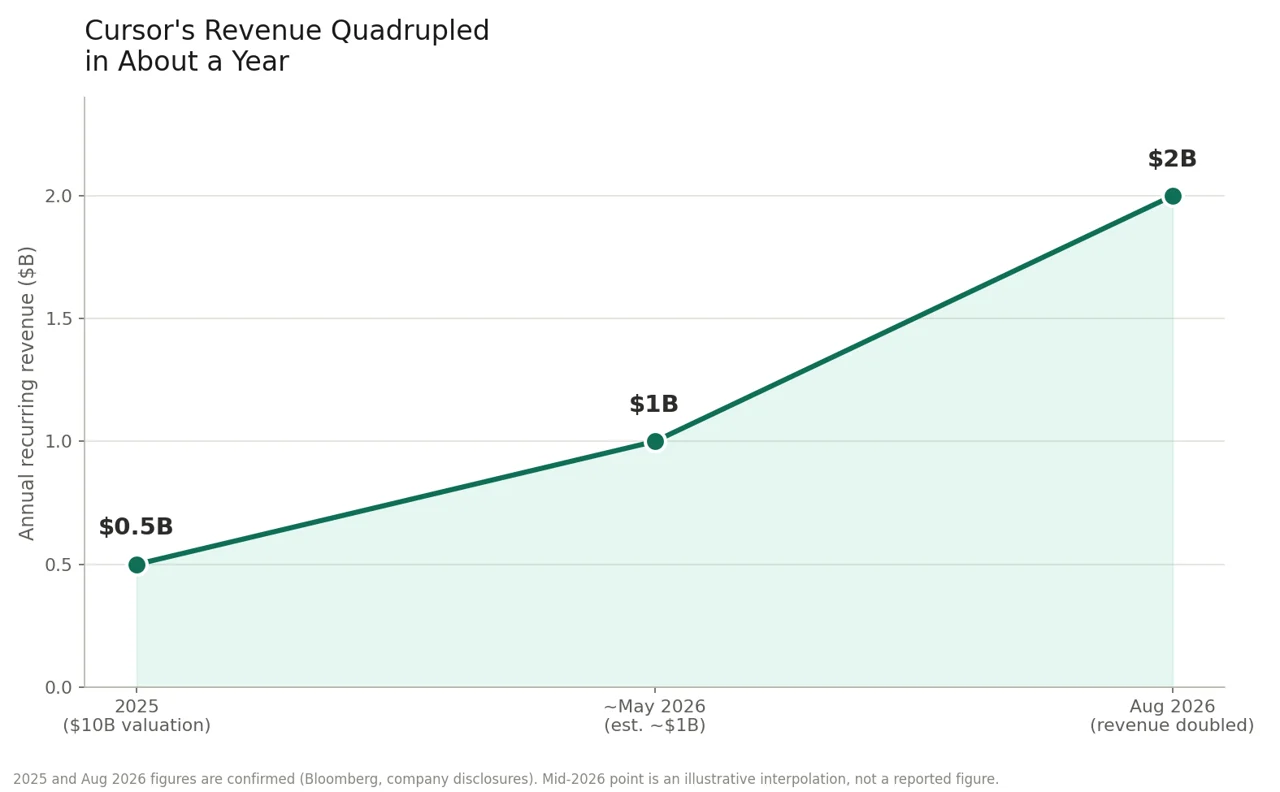
Here's the context that makes this update land differently: SpaceX announced a $60 billion all-stock acquisition of Anysphere (Cursor’s parent company). The deal is in the process of closing, folding Cursor into SpaceX’s broader AI efforts. It’s a figure that would have sounded absurd eighteen months ago, when the company had just crossed $500 million in annual recurring revenue.
The growth since then explains why: reports put Cursor’s annualized revenue above $2 billion in 2026, with some estimates significantly higher by mid-year, while the company continues to hold a substantial share of the generative AI coding tools market. That's happening despite real competitive pressure, both OpenAI and Anthropic pushed significant updates to their own agentic coding tools in the same stretch. Automations reads as Cursor's answer to staying ahead on the one axis competitors haven't fully matched yet: agents that start themselves.
Whatever happens with the acquisition, the product itself keeps shipping on its own schedule. Back to what Automations actually looks like day to day:
Two More Things That Shipped Alongside It
Automations got the headline, but two quieter updates landed in the same window and both matter for daily use:
- Cloud Agent builds: agents now prep ready-to-use development environments in the background, so a Cloud Agent starts up to 3x faster, and picks up from the last successful build instead of rebooting from scratch if something breaks mid-task
- Cursor Router: an intelligent routing layer, tested across millions of real tasks with a small group of enterprise customers, that picks the cheapest model capable of handling each request. Cursor compared what those customers actually paid against the same traffic priced entirely at flagship Opus 4.8 API rates, and the gap was the whole point of the test
What's Coming Next
Cursor hasn't published a formal roadmap, but the direction is clear from what's already in testing:
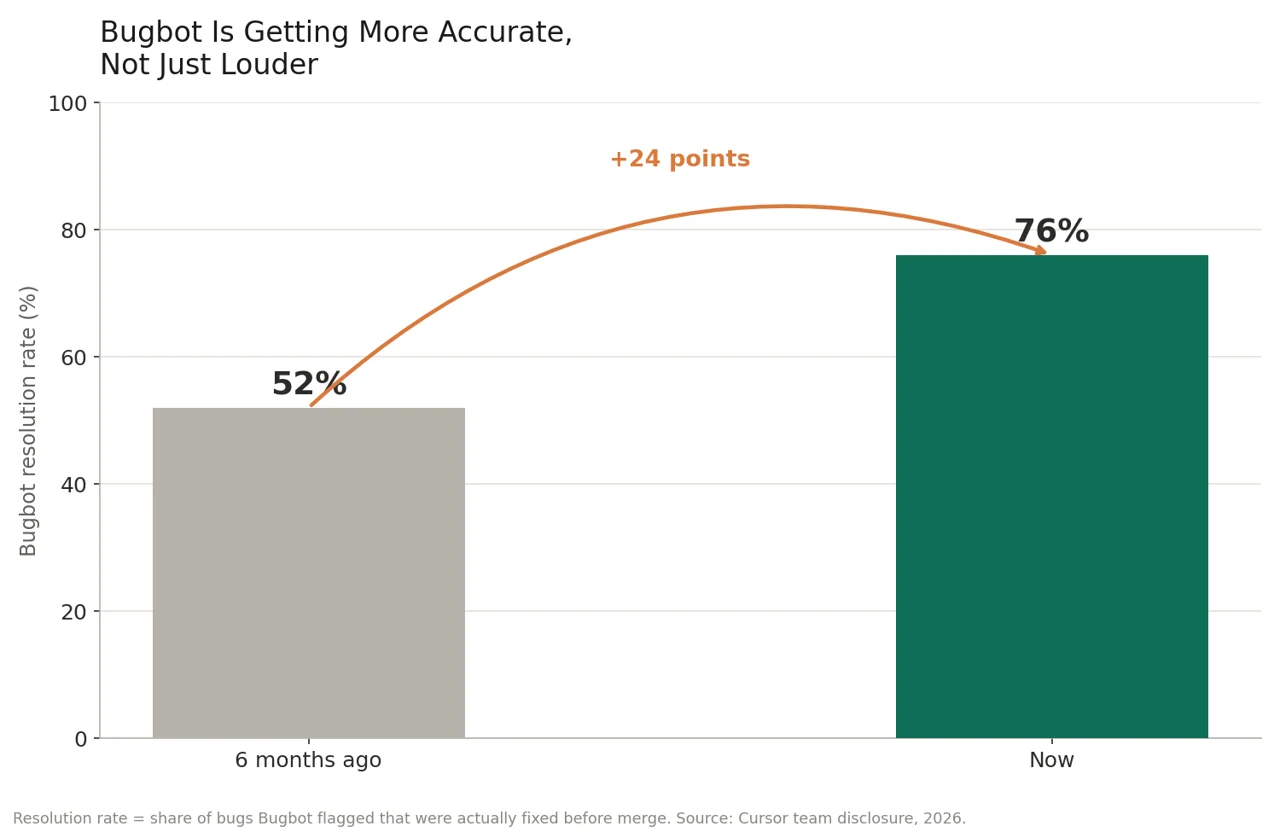
- Bugbot self-verification: the next version checks its own findings before posting them, aiming to cut false positives and enable continuous scanning instead of only reviewing on each pull request
- Custom automations beyond code review: the same event-triggered, sandboxed architecture behind Bugbot is being generalized so teams can build automations for workflows that have nothing to do with reviewing code
- Deeper JetBrains integration: the current JetBrains agent client is described internally as just "a foundation," more JetBrains-specific capability is expected
- Origin: a waitlist opened in June for Cursor's own code hosting, review, and collaboration platform, built for both human and agent contributors from the ground up
How Cursor Got Here
This didn't come out of nowhere. Cursor's biggest shift this year was Cursor 3, released April 2, 2026, which repositioned the entire product from an AI-assisted editor into what its own team calls an "agent orchestration console that also happens to be a code editor." The headline feature was Cloud Agents, AI agents that run in fully isolated virtual machines with their own complete development environment, rather than sharing your laptop's resources.
Alongside that shift came:
- Composer 2, Cursor's own frontier coding model, released March 19, 2026, built specifically for longer multi-step reasoning chains and more reliable large refactors
- Cursor for iOS, letting you launch and steer agents remotely from your phone
- Expanded MCP server support, plugins, hooks, and skills for extending Cursor across a broader workflow
The Model Lineup
Cursor doesn't build one model and stop there, it routes your work across several, and lets you choose manually if you want to:
| Model | Positioning | Pricing |
|---|---|---|
| Grok 4.5 / 4.6 | Cursor's most powerful option | Included in usage pool |
| Composer 2.5 (base) | Cursor's own, most price-efficient | $2/M input, $6/M output |
| Composer 2.5 (fast) | Speed-optimized variant | $4/M input, $18/M output |
| Claude, GPT models | Available via the same credit pool | Standard API-based rates |
Worth knowing: Cursor's own team flagged that Grok 4.5's strong score on CursorBench may be inflated, an earlier snapshot of the Cursor codebase was accidentally included in its training data. The exact impact is unclear, but it's a rare case of a company disclosing a benchmark asterisk against its own featured model rather than burying it.
What It Actually Costs Now
| Tier | Price | Notes |
|---|---|---|
| Hobby | Free | Evaluation only, limited Agent and Tab requests |
| Start (India only) | ₹649/month (~$8) | Launched July 28, 2026, generous model access |
| Pro | $20/month ($16 annual) | Unlimited Tab completions, extended Agent limits, Cloud Agents |
| Pro+ | $60/month | Same features as Pro, 3x the usage credits |
| Ultra | $200/month | Ceiling tier for heavy daily Agent use |
| Teams | From $40/user/month | Adds organizational controls, shared rules, admin tooling |
| Enterprise | Custom | Full governance and deployment controls |
Every paid tier includes a credit pool roughly equal to its subscription price. Auto mode, where Cursor picks the model for you, doesn't draw from that pool; manually selecting a specific frontier model does. Run out, and you're routed to slower models rather than cut off entirely.
Who's Actually Using It
- Over 1 million users, with adoption across more than half of the Fortune 500
- Named enterprise users include Nvidia, Uber, and Adobe
- Team-side, the same update expands Team MCPs and organization group support, giving admins more control over shared tools across larger orgs
Should You Turn This On?
- Turn it on if you have a repetitive trigger-based workflow already, code review on every commit, a recurring report, a scheduled cleanup task, this is built exactly for that
- Hold off if you're still getting comfortable with regular Agent mode, self-launching agents are a bigger trust step than agents you prompt yourself
- Either way, start with one narrow automation, not your whole workflow, the same advice that applies to every agent tool shipping in 2026
The Honest Verdict
Automations is a small feature with a big implication: the AI coding tools that win from here aren't necessarily the ones with the smartest model, they're the ones that need you the least to get started. Cursor built its whole 2026 around that bet, from Cloud Agents to iOS remote control to this. Whether that's the right direction depends on how much you trust an agent to decide when it's your turn to be looped in, and for now, that's still a decision worth making one small automation at a time.
Pricing, features, and figures reflect Cursor's public release notes and pricing page as of mid-August 2026. Usage-based pricing and included limits change frequently, confirm current details on Cursor's official pricing page before budgeting around a specific tier.