
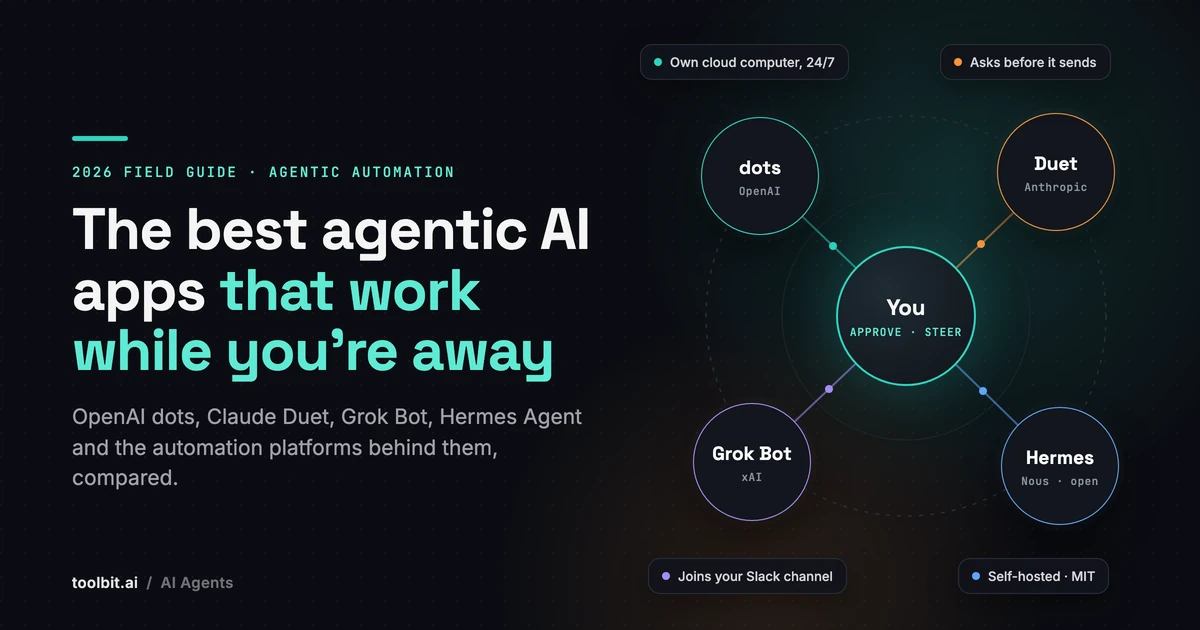
The best agentic AI apps for automation right now are OpenAI's dots if you already pay for ChatGPT Pro, Claude Duet if you want an agent that always asks before it acts, Grok Bot if your team wants shared agents inside Slack, and Hermes Agent if you would rather self-host for free. If what you need is a repeatable business workflow rather than a personal assistant, an automation platform such as n8n, Zapier Agents or Make is still the better tool. We checked every date, price and limit below against the vendors' own announcement, pricing and help pages on October 25, 2026.
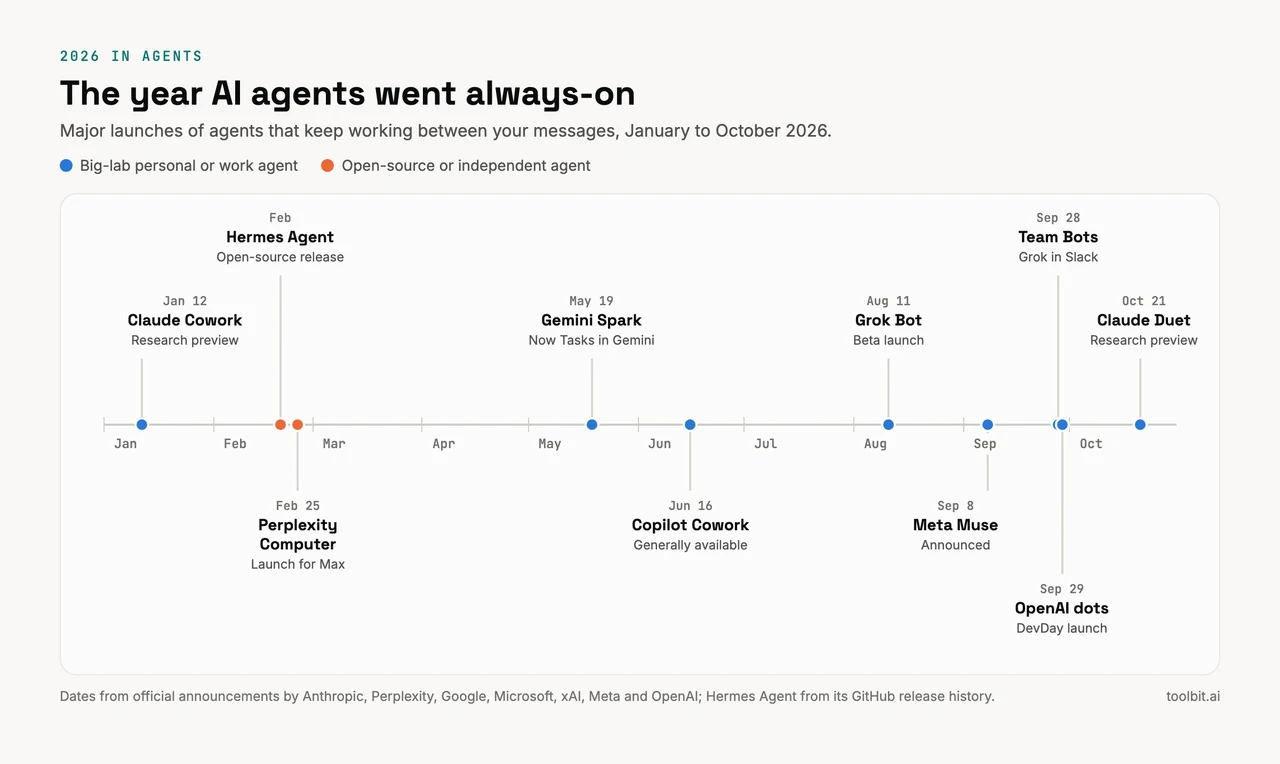
2026 is the year AI agents stopped waiting for your next message. Almost every major lab shipped an agent that works in the background and comes back with results or questions. The products sound alike, but they differ in who hosts them, what they can touch, when they stop to ask you, and what they cost.
In short:
- OpenAI dots (launched September 29) is the most capable always-on agent, with its own cloud computer, more than 4,000 apps and GPT-6 Astra, but it starts with ChatGPT Pro at $100 a month and is not available in the EEA, Switzerland or the UK on Pro.
- Claude Duet (research preview since October 21) is the most cautious: it shows the exact action and waits for your approval before it sends, pays, signs or deletes anything. It is US-only, Pro and Max, by waitlist.
- Grok Bot (beta since August 11) comes with X Premium at $30 a month, and Team Bots put one shared agent into your team's Slack channels.
- Hermes Agent from Nous Research is free, open source under the MIT license, and runs on your own server with persistent memory and self-written skills.
- For team workflows, n8n (free to self-host), Zapier Agents (9,000+ apps) and Make (from $9 a month) remain the practical choices.
What is an agentic AI app, and how is it different from a chatbot?
An agentic AI app is software that pursues a goal on its own: it plans steps, uses tools such as a browser, email or a terminal, and keeps going without a new prompt for every step. A chatbot answers when you ask. An agent acts, and the 2026 generation acts even when you are not there. If you have never set one up, our guide to building your first AI agent for free is a good place to start.
Every always-on agent in this guide runs some version of the same loop: connect to your tools, watch them, brief you, ask before risky steps, act, and remember what it learned.
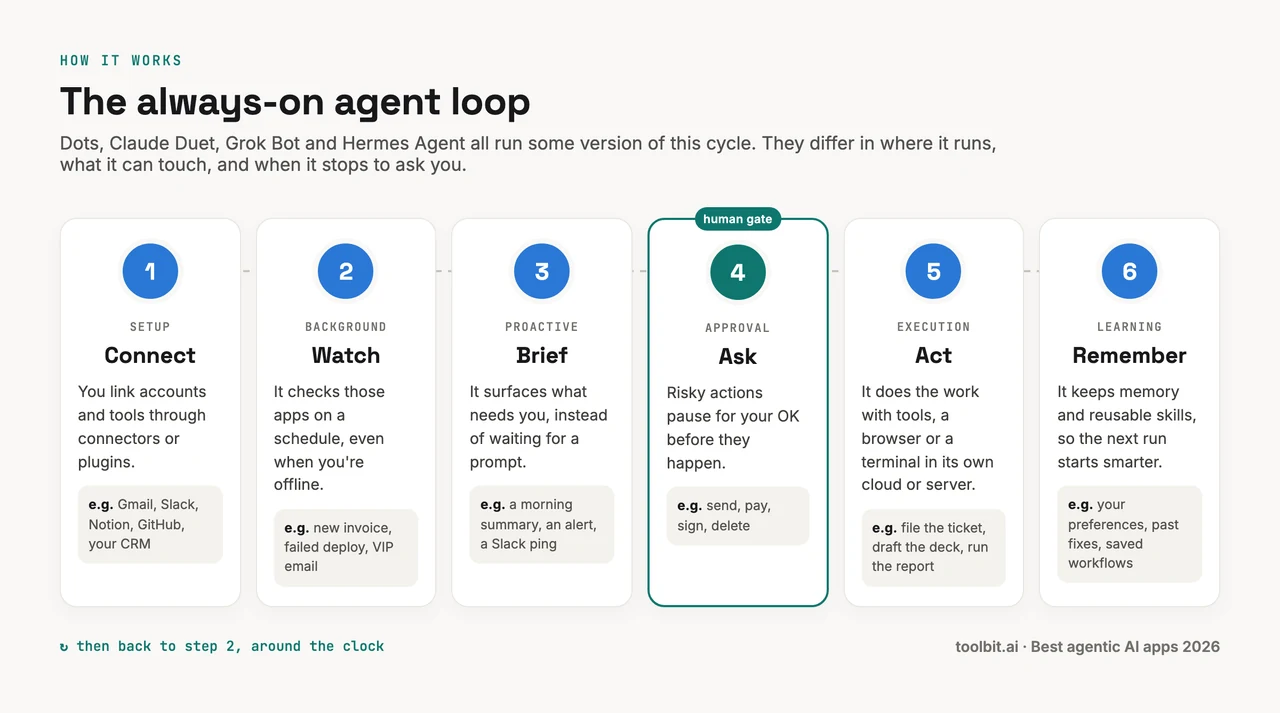
The fourth step is where the products split. Claude Duet waits for approval before any message, payment, signature or deletion. OpenAI dots lets you write Custom Rules for each kind of action, from "act without asking" to "ask first". Grok Bot can stop sensitive actions for approval and lets you set auto-review rules. Hermes Agent does whatever you configure, because you run it. That choice matters more than any benchmark: an agent with your inbox and a card can do real damage when it misreads a thread.
The best agentic AI apps of 2026 at a glance
| App | Maker | Launched | Status (Oct 2026) | Cheapest plan that includes it | Asks before risky actions | Best for |
|---|---|---|---|---|---|---|
| dots | OpenAI | Sep 29, 2026 | Staged rollout | ChatGPT Pro, $100/mo | Yes, via Custom Rules | Power users who want maximum capability |
| Claude Duet | Anthropic | Oct 21, 2026 | Research preview, US waitlist | Claude Pro, $20/mo | Always, for send, pay, sign, delete | Professionals who want control |
| Grok Bot + Team Bots | xAI | Aug 11, 2026 | Beta; Team Bots public beta | X Premium, $30/mo | Optional approvals and auto-review | Teams that work in Slack |
| Hermes Agent | Nous Research | Feb 2026 | Open source, v0.22.5 | Free (you pay for the model) | Up to your config | Developers and self-hosters |
| Muse | Meta | Sep 8, 2026 | Rolling out (US, Canada, Japan) | Free tier; Power $20/mo | Yes, plus a separate "Sentinel" check | Errands, bookings and shopping |
| Tasks in Gemini | May 19, 2026 | Experimental | Google AI Pro, $19.99/mo | Always, for sends, deletes, buys | Google account users | |
| Perplexity Computer | Perplexity | Feb 25, 2026 | Live, Automations added Sep 29 | Perplexity Pro, $20/mo | You choose which actions | Research-heavy, multi-hour jobs |
| Copilot Cowork | Microsoft | GA Jun 16, 2026 | Generally available | M365 Copilot, $30/user/mo + credits | Per-action prompts with risk levels | Microsoft 365 organizations |
OpenAI dots: the most capable always-on agent, if you pay for Pro
OpenAI introduced dots at DevDay on September 29, 2026. A dot is an always-on agent inside ChatGPT with its own cloud computer and browser. It keeps working toward your goals between conversations, runs scheduled tasks, does background research, and can be reached in ChatGPT, Slack or Microsoft Teams. It runs on GPT-6 Astra and reaches more than 4,000 apps through OpenAI's plugins. We covered the launch in our DevDay 2026 recap.
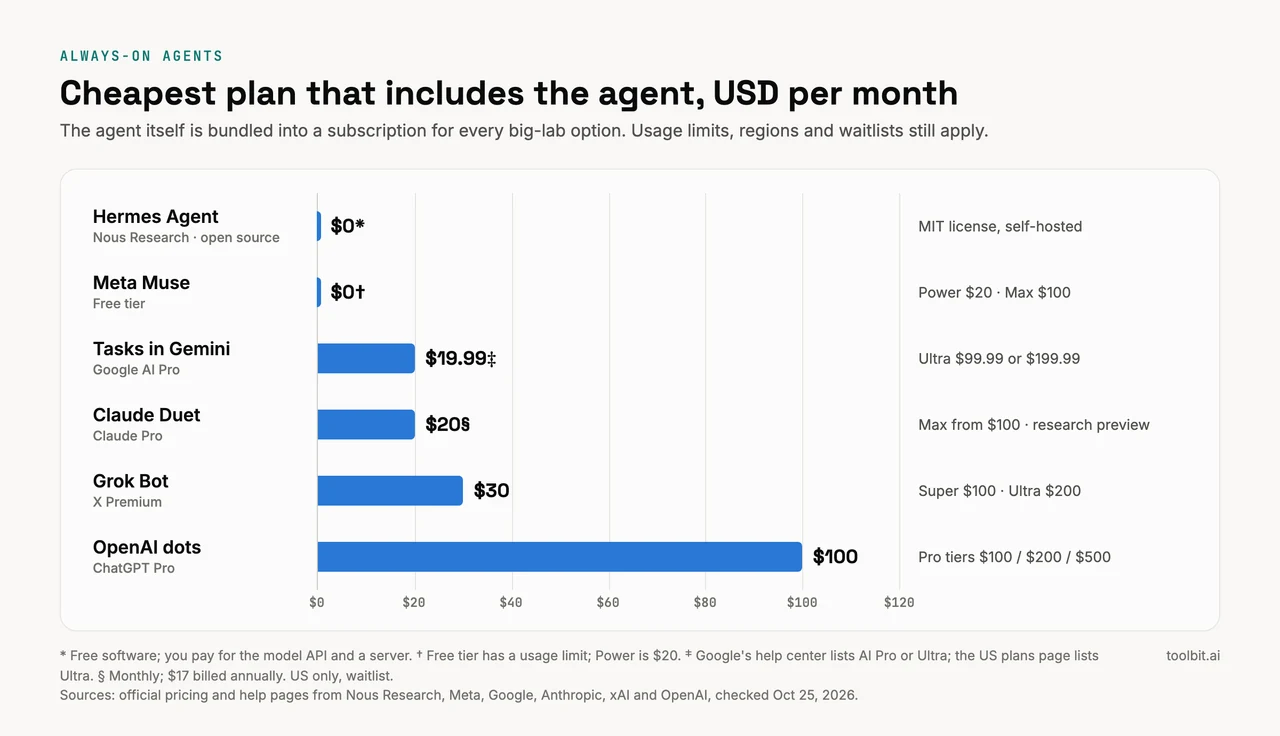
What it costs: your first dot is included with ChatGPT Pro, which now comes in $100, $200 and $500 monthly tiers, or with a Business Premium seat at $125 per user per month ($100 billed annually). Enterprise, Edu and Healthcare get an admin-enabled beta. Chatting with your dot does not count toward ChatGPT limits, but Codex and ChatGPT Work tasks it starts do, and OpenAI has not yet published usage terms beyond the first month.
Where it is strong: Custom Rules give you four settings per kind of action (act without asking, act if pre-approved, ask first, or hand it to you), background research uses read-only tools, password changes always stay with you, and access to your own computer is off by default.
Watch out for: you get one dot per user at launch, some websites block its cloud browser, and disconnecting an app does not delete what the dot already collected. To wipe its memories you have to reset it, according to OpenAI's getting-started guide.
Claude Duet: the most careful agent, still in research preview
Anthropic opened a research preview of Claude Duet on October 21, 2026. Duet is a separate app, on iOS, Android and the web, in which Claude works as a proactive agent: it sends a short brief each morning, checks your connected apps at set intervals, alerts you when something needs you, and finishes tasks you hand it while you are away. It runs on Claude Opus 5.5 and can use more than 6,000 connectors and plugins from the Claude Marketplace.
What it costs: nothing extra on Claude Pro ($20 a month, or $17 billed annually) or Max (from $100), but it uses your normal five-hour and weekly limits, and its background check-ins count toward them. Access is US-only, by waitlist, and not yet available on Team or Enterprise plans.
Where it is strong: Duet shows the exact action and waits for your approval before it sends a message, makes a payment, signs a document or deletes a file. Trading securities and moving money between accounts are blocked even if you approve, each purchase uses a one-time card, and passwords go into a separate form instead of the chat, according to Anthropic's support guide.
Watch out for: Anthropic says Duet can misread threads or misjudge what is urgent, so urgent items can arrive late. You cannot watch or take over its browser, it cannot make calls or send texts, and Microsoft 365 is not yet connected.
Grok Bot and Team Bots: shared agents that live in Slack
xAI launched Grok Bot in beta on August 11, 2026. You message named Bots like teammates; they share one always-on cloud computer with a browser, files and a terminal, run scheduled Routines, and work in group chats. The Bots' computers run in Cursor's cloud. On September 28, xAI added Team Bots, a public beta on Teams and Enterprise plans in which one shared Bot gets its own Slack app and handle and can be invited into a channel.
What it costs: since the X Subscription launch on October 12, Grok Bot is included on Premium ($30 a month), Super ($100) and Ultra ($200), with usage that resets weekly. It is not on the $8 Plus plan or the free tier. Legacy SuperGrok and paid Cursor plans also qualify, so most paying Grok users already have it.
Where it is strong: approvals are granular in Team Bots (allow once, always allow for this Bot, always allow for all Team Bots, or skip), and you take over the computer yourself for passwords, two-factor codes and CAPTCHAs.
Watch out for: all of your Bots share one computer, and xAI's own FAQ says separate Bots are not a security boundary. In Slack channels, threads share that computer and are visible to the channel, audit logs are Enterprise-only, and xAI has not named the model behind Bots or listed compliance certifications.
Hermes Agent: the best open-source agent you can self-host
Hermes Agent is an open-source agent from Nous Research, released publicly in February 2026 under the MIT license. It runs on hardware you control, from a laptop to a VPS. Nous calls it "the agent that grows with you": it writes reusable skills from its own experience and improves them as it uses them, keeps persistent memory with full-text search across past sessions, and has a built-in cron scheduler for recurring jobs.
What it costs: the software is free. You pay for whichever model you plug in, and Hermes works with almost all of them: OpenAI, Anthropic, Google Gemini, xAI, DeepSeek, OpenRouter, AWS Bedrock and more, or local models through Ollama, vLLM or LM Studio (local models need at least a 64K context window, per the provider docs).
Where it is strong: one gateway process lets you talk to the same agent from Telegram, Discord, Slack, WhatsApp, Signal, email or the command line, and it can run tools in a local shell, Docker, SSH or a cloud sandbox. It is also one of the most popular agent projects on GitHub, with almost 257,000 stars as of October 25, and version 0.22.5 shipped on October 23.
Watch out for: you are the security team. There is no vendor approval screen unless you configure one, so give it narrow credentials, keep it in a sandbox, and review the skills it writes. If you are new to how agents store context, our explainer on AI agent memory is a useful primer.
Which other agentic AI apps are worth a look?
- Meta Muse (announced September 8) runs errands from its own secure cloud machine: email, bookings, forms and purchases. It has a limited free tier, a $20 Power plan and a $100 Max plan, and a separate "Sentinel" agent must approve anything that reaches the internet. Read our Meta Muse explainer.
- Tasks in Gemini, announced as Gemini Spark at Google I/O on May 19, runs scheduled, multi-step jobs with a remote browser you can take over. Google's help page lists it for Google AI Pro and Ultra outside the EEA, Nigeria, Switzerland and the UK, with up to 15 tasks at once. See Google Gemini.
- Perplexity Computer (launched February 25) splits a goal across sub-agents for multi-hour jobs, and Automations added scheduled runs on September 29. It comes with Perplexity Pro ($20 a month) and Max ($200).
- Microsoft Copilot Cowork (generally available June 16) runs long tasks across Outlook, Teams and Office files, with per-action approvals and spending limits. It needs a Microsoft 365 Copilot license and bills usage in Copilot Credits.
- Manus 2.0 (September 28) added event-triggered Automations in beta. Manus has a free plan with 300 credits a day and Pro from $20 a month, and has run independently since September 1, after Meta's acquisition was unwound.
- OpenClaw, the open-source agent formerly called Clawdbot, is the most-starred project in this space at about 393,000 GitHub stars and is now run by the nonprofit OpenClaw Foundation. Be careful with its skill marketplace: researchers found 341 malicious skills on ClawHub in February, and the repository lists 722 published security advisories.
Watch: one day with an always-on AI agent
This 25-second explainer walks through a normal workday: a 7:00 a.m. brief, background checks during meetings, an approval request before anything is sent, and jobs that keep running overnight.
Do you need an agent app or an automation platform?
Use an always-on agent when the work is personal and changes every day: an inbox, a calendar, research, follow-ups. Use an automation platform when the same process must run the same way for a team, with logs, error handling and a predictable bill. All five platforms below now include AI agents, priced in different units.
| Platform | Agent feature | Free option | Cheapest paid plan | Integrations | Self-host |
|---|---|---|---|---|---|
| n8n | AI Agent node that picks tools at run time | Community Edition, free to self-host | Starter €20/mo billed annually (2,500 executions) | 2,000+ listed | Yes |
| Zapier Agents | AI teammates that act across Zapier apps | 400 activities/mo | Agents Pro $33.33/mo billed annually | 9,000+ apps | No |
| Make | AI Agents (beta) inside visual scenarios | 1,000 credits/mo | Make Plan $9/mo billed annually | 3,500+ apps | No |
| Lindy | An "AI employee" that works in Slack | 7-day trial with $50 in credits | Team $49.99 per active user/mo | 1,500+ | No |
| Gumloop | Model-agnostic agents for ops and GTM teams | 14-day Pro trial | Pro from $37/mo plus an 8% orchestration fee | Not stated | No (VPC on Enterprise) |
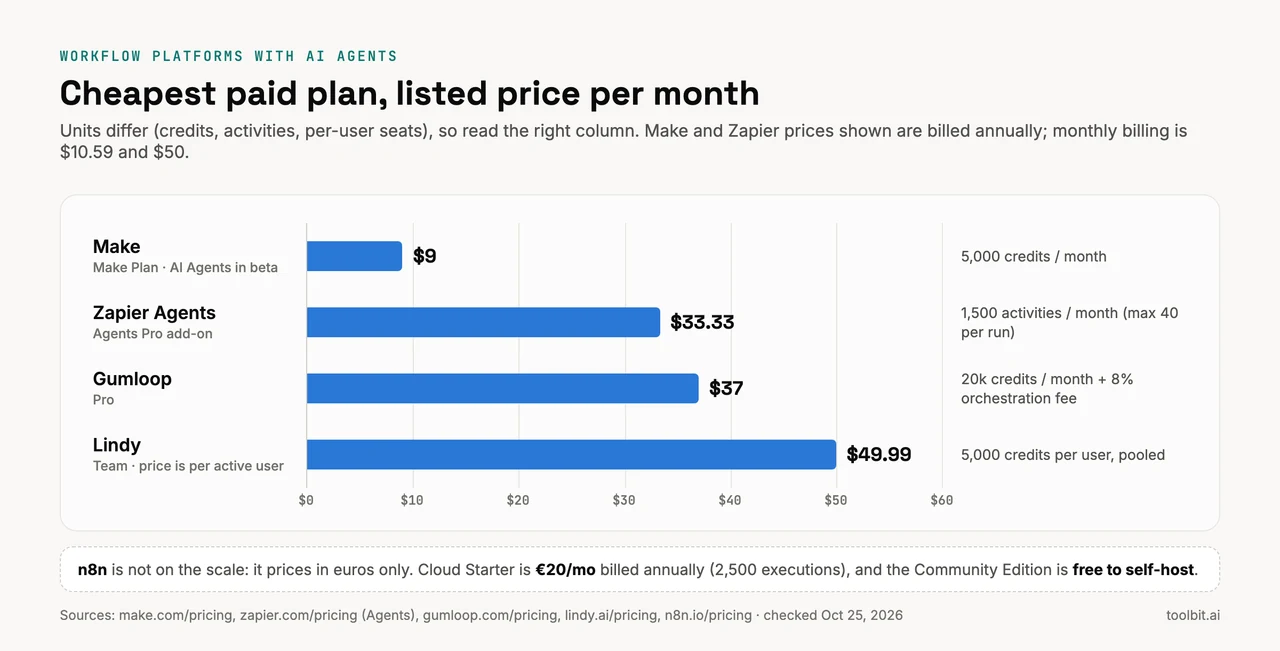
Prices come from each vendor's pricing page (n8n, Zapier, Make, Lindy, Gumloop). Two things have changed since last year: Make's pricing page now shows a single Make Plan where Core, Pro and Teams used to be, and Lindy and Gumloop now list trials instead of permanent free plans. If you are building with n8n, our guide to multi-agent workflows with n8n and Claude MCP shows a production setup.
How do you choose the right agentic AI app?
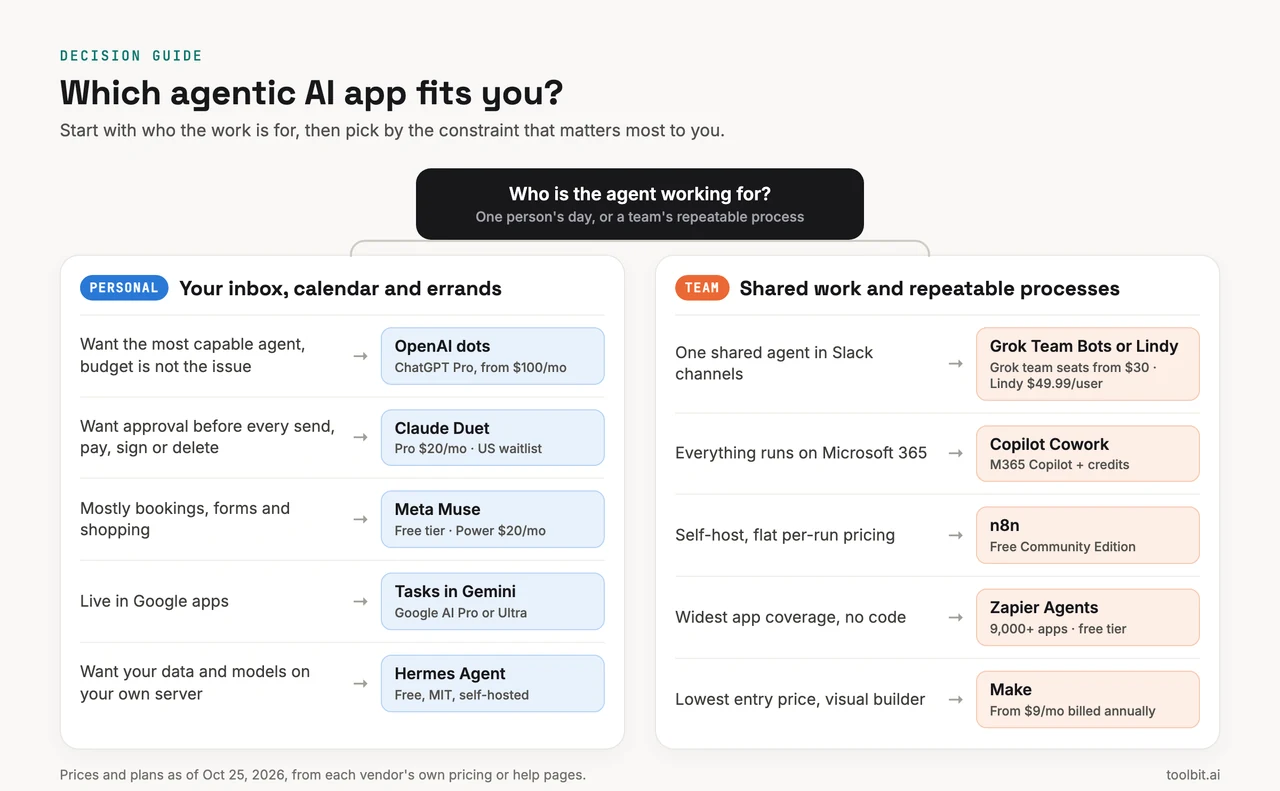
- Most capable personal agent, already on ChatGPT Pro: OpenAI dots.
- Nothing sent, paid or deleted without your OK: Claude Duet, if you are in the US and can wait for an invite.
- One shared agent in Slack: Grok Team Bots or Lindy.
- Full control over data, models and cost: Hermes Agent or self-hosted n8n.
- Life in Microsoft 365 or Google's apps: Copilot Cowork or Tasks in Gemini.
- A repeatable business process with an audit trail: n8n, Make or Zapier Agents.
What are the risks of letting an AI agent act for you?
Agents are moving from experiment to budget line. Gartner forecasts AI agent software spending will reach $206.5 billion in 2026 and $376.3 billion in 2027, up from $86.4 billion in 2025, and predicts 40% of enterprise applications will be integrated with task-specific AI agents by the end of 2026, up from less than 5% in 2025. McKinsey's 2026 State of AI survey found 40% of respondents at companies with more than $1 billion in revenue say they are scaling AI agents, up from 27% a year earlier, as reported by The Register.
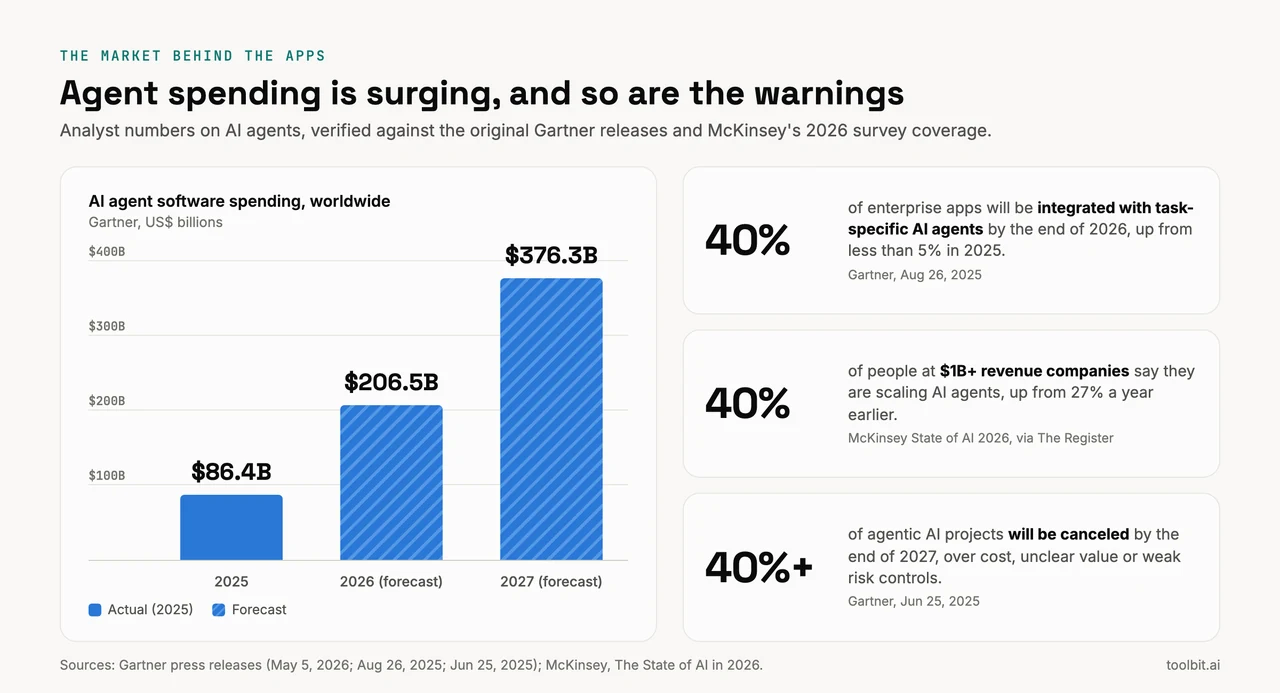
Analysts are also blunt about failure rates. Gartner predicts over 40% of agentic AI projects will be canceled by the end of 2027 because of escalating costs, unclear business value or inadequate risk controls, and estimates only about 130 of the thousands of agentic AI vendors are real. For a personal agent the risks are concrete: a misread thread, an unintended purchase, or a malicious plugin with access to your accounts.
The safest setups share three habits. Start the agent with read-only access and add write permissions one app at a time. Keep approval on for anything that sends, pays, signs or deletes, even when an "always allow" option is offered. And check what the agent remembers, because deleting an app connection does not always delete the data it already pulled. Our guides to agent guardrails and approval tools and what an AI agent really costs go deeper.
Frequently asked questions
What is the best agentic AI app in 2026?
There is no single winner. OpenAI dots is the most capable always-on agent, Claude Duet has the strictest approvals, Grok Bot is the strongest pick for shared team agents in Slack, and Hermes Agent is the best free, self-hosted choice. For business workflows, n8n, Zapier Agents and Make fit better than personal agents.
Is Claude Duet available yet?
Yes, as a research preview since October 21, 2026, for Claude Pro and Max subscribers in the US. Access is by waitlist, invitations go out in waves, and Team and Enterprise plans are not included yet.
How much does OpenAI dots cost?
The first dot is included with ChatGPT Pro ($100, $200 or $500 a month) or a Business Premium seat ($125 per user per month, or $100 billed annually). OpenAI says extra dots will come later and has not priced them.
What is Grok Bot?
Grok Bot is xAI's always-on agent. Named Bots share a cloud computer with a browser, files and a terminal, run Routines and can be shared with a team through Slack. It is included with X Premium ($30 a month), Super ($100) and Ultra ($200).
Is Hermes Agent free?
Yes. The software is free and open source under the MIT license, with no paid tier required. You pay only for the AI model you connect (or run a local model yourself) and for the server it runs on. Nous Research also offers an optional Nous Portal subscription that bundles access to many models.
Are always-on AI agents safe to use?
They are safe enough to try with guardrails, not to trust blindly. Anthropic warns that Duet can misjudge what is urgent, and xAI says separate Grok Bots are not a security boundary. Keep approvals on for sending, paying, signing and deleting, grant access one app at a time, and review the agent's memory and activity log regularly.
Last verified on October 25, 2026. Agent features, plans and regions change quickly, so check each vendor's own page before you buy.