Every team that experiments with AI agents hits the same wall around week three. The demo agent that impressed everyone in the Slack channel needs access to real systems: your Postgres database, your internal REST endpoints, the file storage where contracts actually live. And the moment you wire an LLM to production data, someone reasonably asks: what stops it from doing something dumb?
That question is why the combination of self-hosted n8n and the Model Context Protocol has become the default answer for teams building agent workflows that actually ship. n8n gives you a visual orchestration harness with credentials, versioning, and execution logs. MCP gives Claude a governed, standardized way to reach into your systems. Neither is magical on its own. Together they turn "an agent that can do anything" into "an agent that can do five specific things, one of which requires a human to click approve."
If you are still weighing automation platforms, our Zapier vs Make vs n8n comparison covers why n8n's self-hostable, fair-code model matters for exactly this use case. And if MCP itself is new to you, read the MCP protocol explainer first; this article builds on it.
The architecture: three pieces, not one platform
A governed multi-agent setup on n8n has three distinct layers, and keeping them separate is most of the discipline:
1. n8n as the orchestration harness. You self-host the Community Edition (free under n8n's Sustainable Use License for internal business use), so your workflows, credentials, and execution data stay on your infrastructure. n8n is the place where triggers fire, branches split, retries happen, and every step is inspectable after the fact. It is fair-code rather than OSI open source, which matters only if you plan to resell n8n itself; for internal automation it costs nothing.
2. Local MCP servers as the access layer. MCP, the protocol Anthropic introduced and later opened up, standardizes how an AI application discovers and calls tools. An MCP server is a small program that exposes a typed list of tools: query_orders, lookup_customer, read_contract, whatever you define. Anthropic's own framing is the USB-C analogy: one standard plug instead of a bespoke integration per system. Your MCP servers sit inside your network, talk to your Postgres instance or internal REST services, and expose only the operations you wrote into them.
3. Claude as the reasoning layer. Inside n8n, an AI Agent node powered by Claude calls those MCP tools through n8n's MCP Client Tool node. Claude decides which tool to call and with what parameters. n8n and the MCP servers jointly decide what is even possible. That split, capability versus judgment, is the entire security model in one sentence.
One direction detail matters early: n8n is fully comfortable talking to local, STDIO-based MCP servers from within your network. Anthropic's hosted MCP connector, which lets Claude's API reach remote MCP servers directly, only works with HTTP-exposed servers and only supports tool calls per Anthropic's documentation. When everything runs inside your self-hosted n8n instance, that limitation is irrelevant, which is part of the point of self-hosting.
A concrete workflow: refund triage that touches the real database
Here is a worked example small enough to build in an afternoon but realistic enough to extrapolate from: an inbound-support refund pipeline.
The setup:
- An MCP server wrapping your orders database, exposing exactly three tools:
get_order(order_id),get_customer(customer_id), andcreate_refund(order_id, amount, reason). Note the asymmetry: two reads, one write. - A second MCP server for your document store exposing
read_contract(customer_id)andlist_recent_invoices(customer_id). - A self-hosted n8n instance with an AI Agent node using Claude as the model. Two MCP Client Tool nodes feed the agent, one per server.
- A trigger: either a webhook your support widget posts to, or an email trigger.
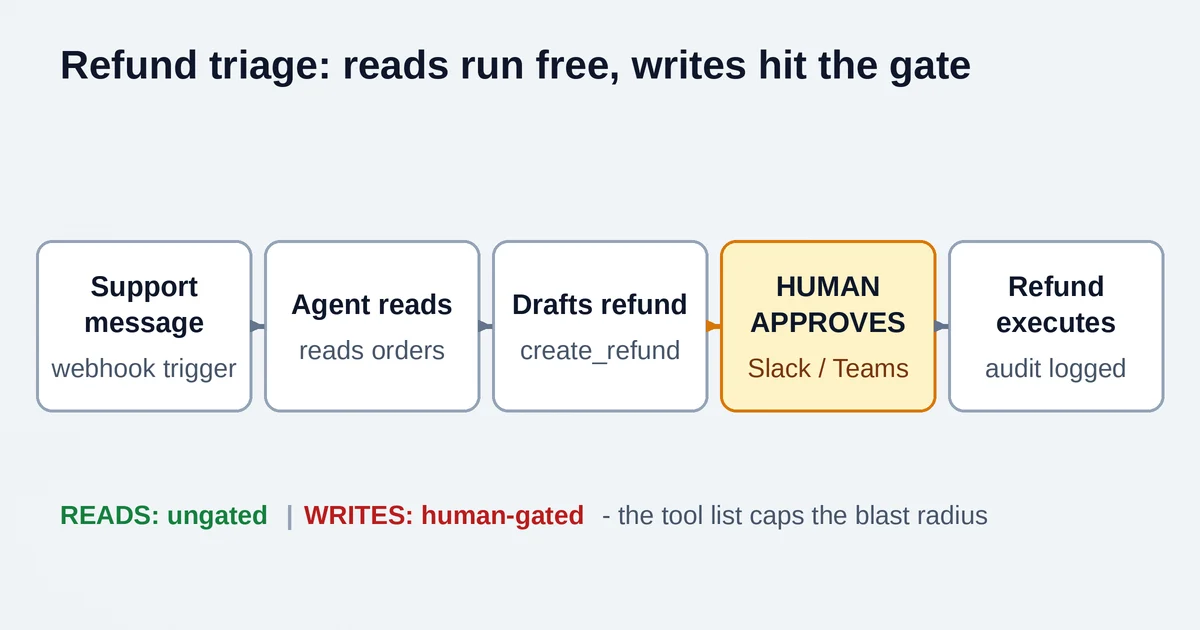
The flow in practice. A customer writes "you charged me twice for the March invoice and I want my money back." The agent calls get_order and list_recent_invoices, reads the actual records, and finds the duplicate charge. It drafts a create_refund call with the order ID, the exact amount, and a reason string.
And then it stops. Because in n8n, human-in-the-loop review is a first-class feature of the AI Agent tool system, not a hack. You mark create_refund as requiring human review. When the agent attempts the call, the workflow pauses, and an approval request lands in a channel your team already watches: Slack, Discord, Telegram, Teams, Gmail, Google Chat, Outlook, WhatsApp, or n8n's built-in chat. The reviewer sees the literal tool name and the exact parameters the agent built, not a paraphrase: create_refund(order_id=8412, amount=49.00, reason="duplicate charge"). One click approves it, the write executes, and the agent continues. A deny cancels the call and the agent is told the action was rejected, so it can adjust, say by escalating to a human agent instead of retrying.
Reads run ungated. Writes run gated. The customer gets an answer in ninety seconds; your finance team signs off on every dollar that leaves.
The governance gates, ranked by how much they save you
Human approval is the most visible gate, but it is the last line of defense. The earlier gates do more work.
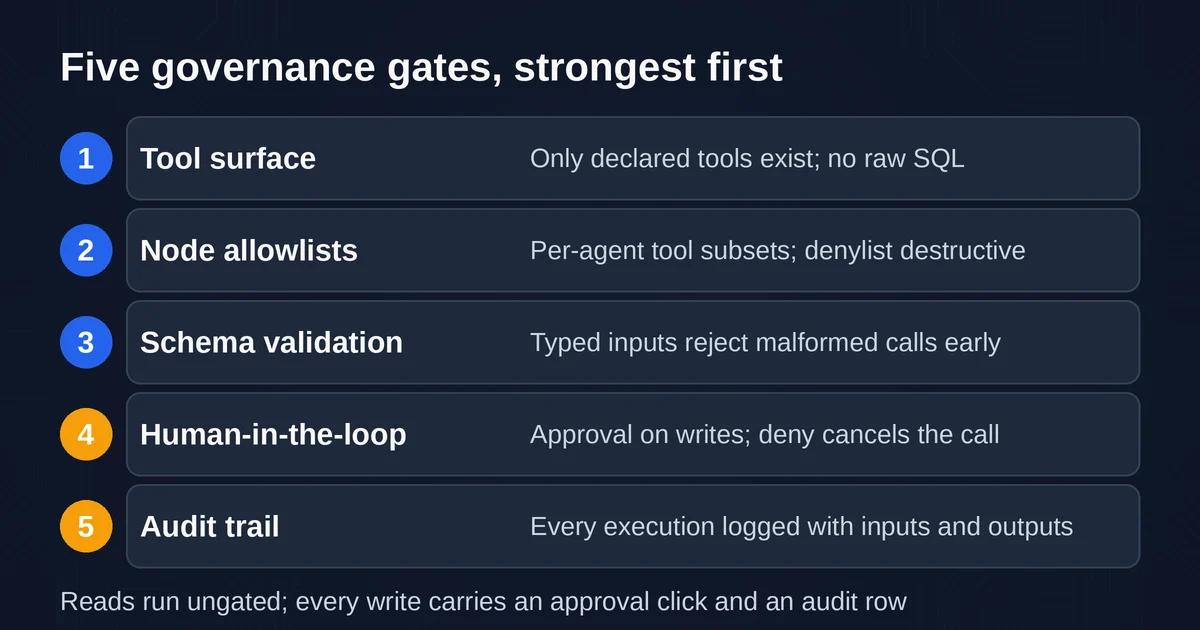
Gate 1: the tool surface itself. The strongest control in this entire stack is not a setting; it is the decision of what tools your MCP servers expose at all. create_refund exists because you wrote it. There is no drop_table. There is no raw SQL. An agent cannot call a capability that was never declared, no matter how persuasive its prompt injection attempt is. This is why prompt-injection risk deserves its own conversation but is survivable here: the blast radius is capped by the tool list.
Gate 2: allowlists and denylists at the node. n8n's MCP Client Tool node lets you expose all tools from a server, a selected subset, or all except specific ones. This is where you build the read-only agent: give the classification agent All Except write tools on the same server the refund agent uses. Anthropic's MCP connector documentation recommends the same pattern, denylisting destructive tools, when you connect Claude to servers through its hosted API. Two vendors, same principle.
Gate 3: schema validation at the boundary. MCP tools carry typed input schemas. When Claude calls create_refund, the parameters must satisfy the schema you defined, so a malformed or hallucinated call fails before it reaches the database rather than after. In n8n you can add a Code node after any MCP call to enforce invariants the schema cannot express: amount must not exceed the original order value, the order must be less than 90 days old, the reason string must be non-empty. Validation that lives in the workflow travels with the workflow.
Gate 4: human-in-the-loop, applied selectively. Apply review to the tools with irreversible, user-visible, or financial side effects: sends, refunds, account changes, deletions. Skip it for reads. n8n's review steps work inside sub-agents too, so a specialist agent buried two levels deep still hits the gate. Two practical settings from n8n's own guidance: bound the approval wait (the default is 45 minutes before the execution errors out, which you should set explicitly on production workflows so paused runs do not pile up silently), and put the review-channel note in each agent's system prompt so the model handles denials gracefully instead of thrashing.
Gate 5: the audit trail. Every execution is logged with its inputs and outputs in self-hosted n8n. When a refund goes out that should not have, you answer "who approved this, on what evidence" in minutes, not afternoons.
What breaks at scale
This stack is genuinely production-viable, which is different from being painless. Expect these failure modes:
Tool sprawl quietly degrades the agent. The single-agent-plus-fifteen-tools pattern is the classic way this architecture rots. Tool selection accuracy drops as the list grows, and debugging becomes guesswork. The fix is the multi-agent split n8n supports natively: a coordinator agent whose "tools" are entire sub-workflows, each a specialist with a small toolset, called via the Call n8n Workflow Tool node. A triage agent on a cheaper model routes; a refund specialist on a strong model executes. Route by writing honest, specific tool descriptions, because that description field is the actual routing mechanism.
Approval queues become the bottleneck. Human review is a throughput constraint. If 200 refunds a day need sign-off and your reviewer clears 40, you have built a slower manual process with extra steps. Route by risk: auto-approve amounts under a threshold, gate everything above it, and make the threshold a workflow variable you can tune without touching logic.
State passing gets ugly between agents. Conversation memory belongs on the coordinator; workers should receive a distilled task plus the context fields they need, not the full chat history. Passing everything to everyone is how context windows fill with noise and how irrelevant data leaks into specialist prompts.
The protocol moves under you. The MCP ecosystem has been consolidating on Streamable HTTP, with the older SSE transport deprecated in newer implementations. MCP servers you install today should speak the current transports, and the half-life of "current best practice" here is short enough that you should re-verify your stack's transport support before any major upgrade, not after.
You now own the plumbing. Self-hosting means you handle updates, backups, and the queue-mode setup for reliable background execution. n8n's instance-level MCP server means external AI tools, Claude included, can build and edit workflows directly on your instance, which is a delightful feature and one more attack surface to think about when you scope its access.
Verdict
For teams that need agents acting on internal systems with real consequences, n8n plus local MCP servers is the most defensible pattern available right now: capability is explicit, judgment is contained, writes are gated, and everything is auditable on hardware you control. It is not the fastest path to a demo, and the governance only works if you actually use the allowlists, the schemas, and the approval gates instead of clicking "all tools" and shipping.
Start with one MCP server, two read tools, one write tool, and a single approval channel. Get that refund flow working end to end. Then decide whether your second workflow needs a second agent, or just a second set of tools behind the same one.
FAQ
Does n8n support MCP natively, or do I need community nodes?
Natively. n8n ships an MCP Client node, an MCP Client Tool node for agents, an MCP Server Trigger node that turns any workflow into an MCP server, and an instance-level MCP server for building workflows from external AI tools. Community nodes exist for edge cases like STDIO-based servers that n8n's built-in nodes do not cover the way you need.
Can Claude connect to my self-hosted MCP servers directly, without n8n?
Not if they are local STDIO servers. Anthropic's hosted MCP connector requires HTTP-exposed remote servers and currently supports tool calls only. Local servers work fine with Claude through MCP clients like Claude Code, but for governed production workflows inside your network, routing everything through self-hosted n8n is the cleaner path.
Pricing and plan details are as published by the vendor around September 2026 and can change; confirm on the official site.