


For two years, using AI well meant a lot of copying and pasting. Open a chat, upload a file, paste some text, wait, repeat for the next task. Every tool lived in its own silo, and connecting an AI assistant to your actual systems, your database, your project tracker, your file server, meant custom code written specifically for that one integration.
Anthropic quietly ended that pattern in November 2024 with something called the Model Context Protocol, and by the time it handed the project over to neutral governance thirteen months later, it had already become a widely adopted standard for connecting AI systems to tools and data.
What MCP Actually Is
The Problem It Solves
Before MCP, connecting an AI model to N different tools meant building roughly M×N custom integrations, one for every model-tool combination. Every new data source meant new custom code. Every new AI application meant redoing that work again from scratch.
The USB-C Analogy
The comparison Synvestable's enterprise deployment guide uses is the clearest one available: MCP works like a USB-C port for AI, a universal connector that lets any AI application plug into any data source or tool without custom wiring built for that specific pairing. One protocol, not M×N custom integrations.
The Three Primitives
Underneath the analogy, MCP is built from three simple building blocks a server can expose to a model:
| Primitive | What it does | Example |
|---|---|---|
| Tools | Actions the model can call | Send a message, run a query, create a record |
| Resources | Context the model can read |
From Anthropic Project to Neutral Infrastructure
MCP didn't stay an Anthropic-only tool for long. Within a year, Anthropic's own December 2025 announcement confirms the protocol had been adopted by ChatGPT, Cursor, Gemini, Microsoft Copilot, and Visual Studio Code, alongside Claude itself.
On December 9, 2025, exactly one year and two weeks after launch, Anthropic donated MCP to the newly formed Agentic AI Foundation (AAIF), a directed fund under the Linux Foundation. That same announcement is also the primary source for MCP's headline adoption numbers, since it came directly from Anthropic rather than a third-party estimate:
- More than 10,000 active public MCP servers
- More than 97 million monthly SDK downloads
- Adoption across ChatGPT, Cursor, Gemini, Microsoft Copilot, and Visual Studio Code
The Timeline So Far
| Date | Milestone |
|---|---|
| November 2024 | Anthropic open-sources MCP |
| Throughout 2025 | OpenAI, Google, Microsoft, and AWS build in support |
| December 9, 2025 | MCP donated to the Linux Foundation's new Agentic AI Foundation |
MCP's Foundation Family
MCP didn't join the AAIF alone. The foundation launched with three founding projects together:
| Project | What it is | Contributed by |
|---|---|---|
| MCP | The connection protocol itself | Anthropic |
| goose | An open-source, local-first AI agent framework |
The AAIF itself was co-founded by Anthropic, Block, and OpenAI, with additional support from Google, Microsoft, AWS, Cloudflare, and Bloomberg, all listed as platinum members. That's a genuinely rare lineup of AI competitors agreeing to govern one piece of shared infrastructure together.
Real Companies, Real Deployments
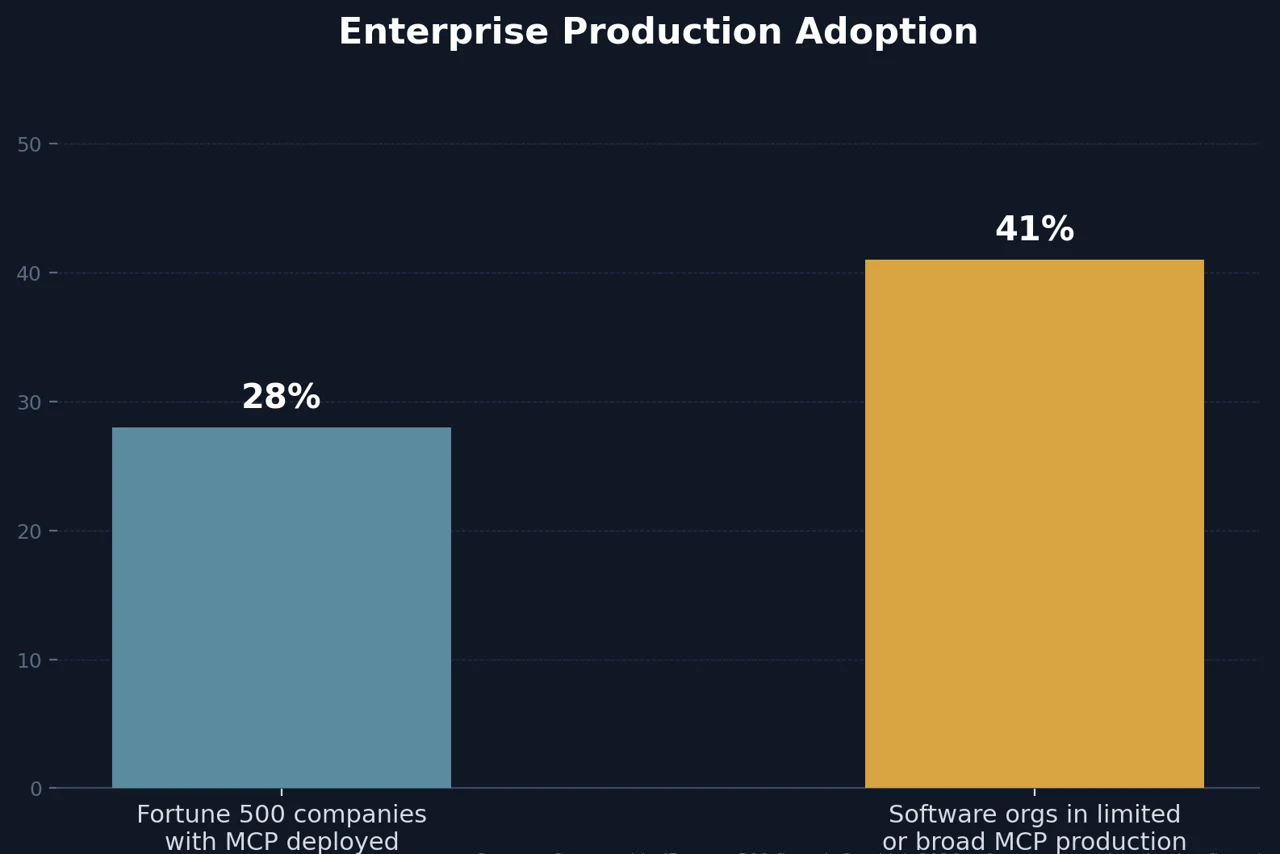
Numbers about server counts are one thing. What actually happened inside real companies is more convincing:
| Company | What they did |
|---|---|
| PayPal | Launched one of the industry's first remote MCP servers in April 2025, part of its official Agent Toolkit, letting AI agents create invoices, process payments, manage disputes, and track shipments directly |
| MongoDB | Released an official MCP Server, generally available, connecting MongoDB Atlas, Community, and Enterprise deployments to AI clients like Claude, Cursor, and VS Code for schema exploration, querying, and cluster management |
| Cisco |
How It Actually Works
MCP defines three roles that stay consistent no matter which tool or model is involved:
| Role | What it is | Example |
|---|---|---|
| Host | The AI application itself | Claude Desktop, an IDE, a custom agent |
| Client | The connector inside the host that speaks MCP |
That's the entire core of the protocol, deliberately simple enough that a new server can be built in an afternoon rather than a quarter.
MCP vs. Traditional API Integrations
| Traditional API integration | MCP | |
|---|---|---|
| Build effort per tool | Custom code for every model-tool pair | One server, usable by any MCP-compatible model |
| Adding a new AI application | Often means rebuilding existing integrations | Existing servers work immediately |
Where MCP Shows Up Right Now
The Clients Already Using It
Major MCP clients now in production include Claude Desktop, Claude Code, Cursor, Windsurf, Zed, Continue, and OpenAI's Custom GPTs, alongside the ChatGPT, Gemini, Copilot, and VS Code integrations confirmed in Anthropic's own announcement.
The Servers People Actually Install
The most-installed MCP servers aren't exotic, they're the tools most teams already run every day: Slack, GitHub, Notion, Google Drive, Postgres, local file systems, and web fetching. Knowledge management tools alone account for a large share of deployments, which tracks: the single biggest use case for MCP so far is simply letting an AI assistant read and act on information a team already has, instead of someone manually feeding it in.
The Security Question Nobody's Fully Answered
This is the part that gets less attention than the growth numbers. MCP servers can expose powerful tools and access to sensitive systems, and that access represents a meaningful attack surface that few enterprises audit systematically. Server documentation quality also varies widely, and an AI assistant working against a poorly documented server can misuse it in ways that are hard to predict in advance.
A Basic Review Checklist Before Connecting a New Server
-
Confirm who maintains the server and how actively it's updated
-
Check exactly which tools, resources, and prompts it exposes, not just what it claims to do
-
Scope its access to what the task actually needs, not everything it could technically reach
-
Review it the same way you'd review any other software with real system privileges
-
Re-check it periodically, not just once at install time
None of this is a reason to avoid MCP. It's a reason to treat a new MCP server the way a security team would treat any other piece of software with real system access.
Getting Started: How to Actually Try This
-
Pick a host you already use. Claude Desktop, Cursor, and VS Code all support MCP natively
-
Connect one well-known server first. File systems, GitHub, or Google Drive are common starting points with mature documentation
-
Grant the narrowest access that works. Expand scope later if you actually need it, not upfront
-
Watch what the model actually calls. Most hosts show which tools were used, a useful way to sanity-check behavior early on
-
Only then add a second server. One well-understood connection beats five untested ones
Common Mistakes When Adopting MCP
- Installing community MCP servers without checking who maintains them or how privileges are scoped
- Treating MCP adoption as a developer decision only, when it touches data access and governance too
- Connecting a server to everything it could technically reach, rather than the specific access a task actually needs
- Assuming MCP support means an integration is production-ready, rather than checking it against the same standards as any other software dependency
Quick FAQ
Is MCP an Anthropic product I have to pay for? No. MCP is an open specification, now governed by the Linux Foundation's Agentic AI Foundation, not a paid Anthropic product. Individual MCP servers and clients may have their own separate pricing.
Does MCP work with AI models other than Claude? Yes. It's model-agnostic by design, and is already integrated into ChatGPT, Gemini, Copilot, and other major platforms alongside Claude.
Is a higher server count better? Not necessarily. The companies getting real value tend to run fewer, well-scoped, actively maintained servers rather than the largest possible number of connections.
What This Means Going Forward
MCP solved a real, boring, expensive problem: nobody wanted to keep building the same integration over and over for every new AI tool. Now governed by a neutral foundation rather than a single company, it's no longer really "Anthropic's protocol." It's closer to plumbing, the kind of infrastructure that stops being notable exactly because it's become the default. The companies getting real value from it aren't the ones with the most servers connected. They're the ones who connected the right ones, with the right access, and reviewed them like they would any other system with real privileges.
Figures sourced from Anthropic's December 9, 2025 announcement, cross-checked against independent audits as of mid-2026.