
Quick Glossary First
A few terms this whole post leans on, translated into plain English:
- Mythos-class - Anthropic's internal tier name for its most capable models, sitting above Opus. Fable 5 is the first public release at this tier.
- Context window - how much text a model can "hold in mind" at once before it starts forgetting the beginning. Fable 5's is 1 million tokens, roughly a 750,000-word document.
- Agentic task - work where the model doesn't just answer once, but plans, uses tools, checks its own output, and keeps going across many steps without a human re-prompting it each time.
- Export control - a government order restricting who is allowed to access a piece of technology, in this case applied to an AI model rather than physical hardware.
- Prompt caching - reusing parts of a previous request so the model doesn't have to reprocess them from scratch, which cuts cost on repeated or long-context queries.
What Claude Fable 5 Actually Is
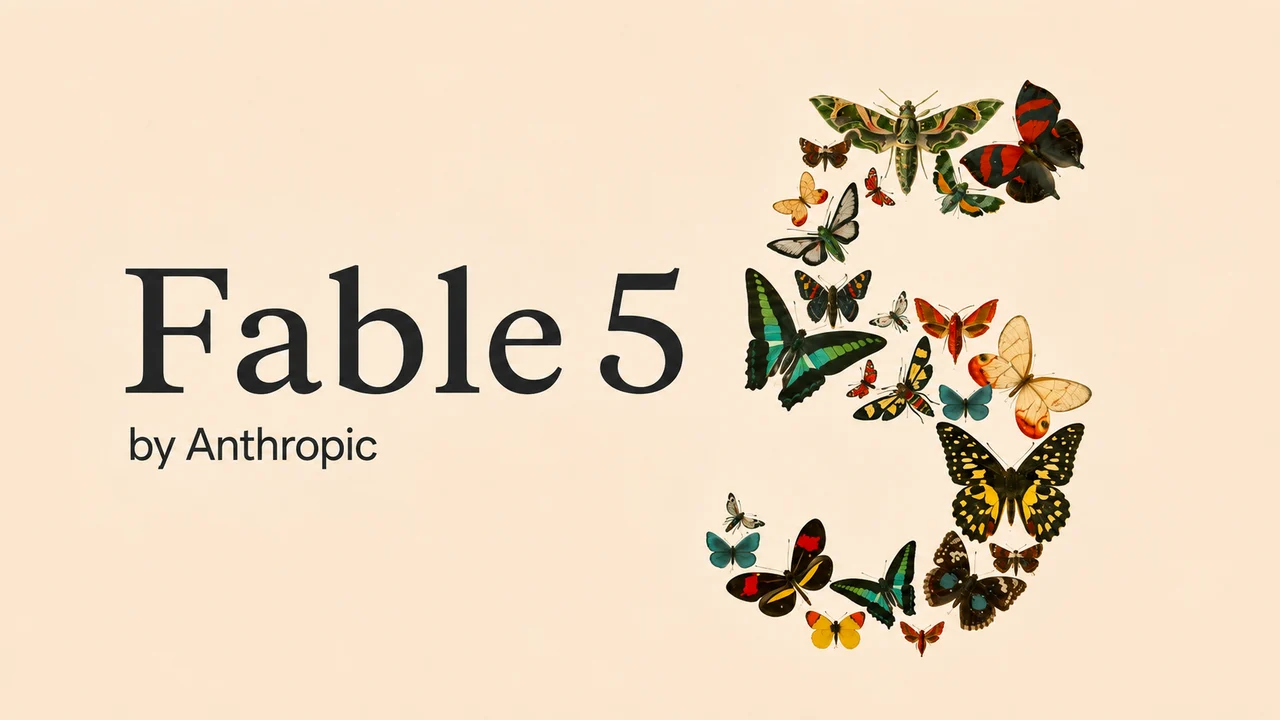
Claude Fable 5 is Anthropic's first publicly available Mythos-class model, a tier built specifically for long, autonomous knowledge work and coding rather than quick one-off answers. It shares its underlying weights with Claude Mythos 5, a more tightly restricted sibling limited to vetted government, cybersecurity, and biology-research partners under Anthropic's Project Glasswing. Fable 5 is the general-access version of the same model, with extra safeguards layered on for biology, cybersecurity, and AI-research misuse.
Anthropic's own framing is blunt about what it's for: the longer and more complex a task gets, the bigger Fable 5's lead over other models becomes. On a quick question, you probably won't notice much difference from a cheaper model. Hand it something that takes hours and dozens of steps, and the gap opens up.
Where it came from: unlike some smaller "distilled" models, Fable 5 is Anthropic's frontier release itself, not a shrunk-down copy of a bigger model. It launched already integrated into Anthropic's own agent tooling, Claude Code and Claude Managed Agents, rather than as a standalone chatbot bolted on afterward.
Key Features
- 1 million token context window, with a maximum output of 128,000 tokens per response - enough to hold an entire codebase or a long document set in one session.
- Multimodal input - accepts text, images, and files, with reasoning support built in.
- Runs inside an agent harness - through Claude Code or Claude Managed Agents, it can work for days at a time: planning across stages, delegating to sub-agents, and checking its own work before moving forward.
- Self-testing behavior - Anthropic describes it as thorough and proactive, actively verifying its own output instead of just generating text and stopping.
- 90% prompt-caching discount - cached input tokens drop to roughly $1 per million, which matters a lot given the base price.
- Vision and computer use - reads screenshots and documents directly, not as a bolted-on add-on.
Why "Built for Long, Autonomous Work" Actually Matters
This isn't just marketing language, it changes what the model is actually good for:
- Fewer check-ins. A model that can plan, delegate to sub-agents, and self-correct means less babysitting on multi-hour tasks - a real shift from re-prompting every few minutes.
- Handles scale most models choke on. Anthropic and early testers report full migrations across codebases in the tens of millions of lines, completed in roughly a day.
- Genuinely long memory. The 1M-token window means it can reason across an entire contract set or research archive in a single pass, instead of losing track halfway through.
- Still not free of oversight. None of this means "set it and forget it" - Anthropic's own guidance is to review output, not rubber-stamp it.
How to Actually Access It
Unlike a model you download and run locally, Fable 5 is entirely cloud-hosted. Here's what using it actually requires:
| Access Point | What You Need |
|---|---|
| Claude API | An Anthropic API key, billed per token |
| Claude.ai (Pro / Max / Team) | An active subscription; usage now draws on weekly limits or credits (see Pricing) |
| Claude Code / Claude Cowork | Same account access as above, used through the agent harness |
| Enterprise (seat-based) | Requires usage credits enabled; standard seats without credits do not get Fable 5 access |
| Cloud platforms | Available via Amazon Bedrock, Google Vertex, and Microsoft Foundry (BYOK-only on some, per Anthropic) |
| Internet | Required at all times there is no offline mode, this is not a downloadable model |
Use Cases: What You Can Actually Do With It
Fable 5 is built for depth, not volume. It's a strong fit for:
- Large-scale code migrations and refactors - completing changes across huge codebases with far fewer human check-ins than before.
- Long-document and contract analysis - using the full 1M-token window to reason across lengthy legal, financial, or research documents in one pass.
- Multi-day autonomous agent projects - open-ended research or engineering work run through Claude Code, where planning and self-correction matter more than raw speed.
- Client-facing content where accuracy matters - output that can't afford to be sloppy, even at a higher per-token cost.
- Finance and frontier research work - named users have reported it as their strongest-tested model for finance-first analysis and cited it reaching physics-research conclusions in 36 hours that took a competing model four days.
What it's not built for: quick, well-defined, high-volume tasks. Routing routine work through Fable 5 mostly adds cost without a noticeable quality gain - cheaper models close most of that gap on everyday jobs.
How Capable Is It, Really? Benchmark Scores
| Benchmark | Claude Fable 5 | What It Measures |
|---|---|---|
| SWE-Bench Pro | 80.3% | Solving real-world code tickets (vs. Opus 4.8: 69.2%, GPT-5.5: 58.6%, Gemini 3.1 Pro: 54.2%) |
| SWE-Bench Pro (Diamond, hardest split) | 29.3% | More than double Anthropic's previous model |
| Agentic Index (Artificial Analysis) | 80.7 | Ranked #1 of roughly 300 tracked models |
| Coding Index (Artificial Analysis) | 76.5 | Ranked #2 of roughly 160 tracked models |
| CursorBench | State of the art | Cited by both Anthropic and GitHub as best-in-class |
| Context window | 1,000,000 tokens | Larger than roughly 88% of tracked models |
A useful caveat: the exact Artificial Analysis Intelligence Index score for Fable 5 has been reported differently across sources and snapshot dates - figures between roughly 59.9 and 64.9 have all appeared, generally placing it either at or very near the top of the index depending on when the snapshot was taken and what other models had launched by that point. Treat any single number as directional rather than fixed, since new models push the index around constantly.
Claude Fable 5 vs. Claude Opus 5:
The Question Everyone's Actually Asking Now
This comparison has taken over most of the search interest around Fable 5 since late July, so it deserves its own section.
Anthropic released Claude Opus 5 on July 24, 2026 at $5 per million input tokens and $25 per million output tokens - exactly half of Fable 5's price, and the same rate as the older Opus 4.8. Anthropic positions it as coming close to Fable 5's intelligence for everyday professional work, while keeping Fable 5 as the stronger choice specifically for the longest, hardest autonomous tasks.
| Claude Fable 5 | Claude Opus 5 | |
|---|---|---|
| Price (input / output per million tokens) | $10 / $50 | $5 / $25 |
| Default on Claude Max | No (dethroned) | Yes |
| Strongest model on Claude Pro | No | Yes |
| Artificial Analysis Intelligence Index | 60–62 (varies by source/date) | 61–63, reported as marginally ahead in several independent trackers |
| Frontier-Bench v0.1 | 33.7% | 43.3% the higher score of the two |
| Cybersecurity classifier frequency | Baseline | Fires roughly 85% less often, easing legitimate security research |
| Best for | The longest, highest-risk, most autonomous jobs; cybersecurity-adjacent work | Daily coding, knowledge work, and agent tasks at a better price-to-performance ratio |
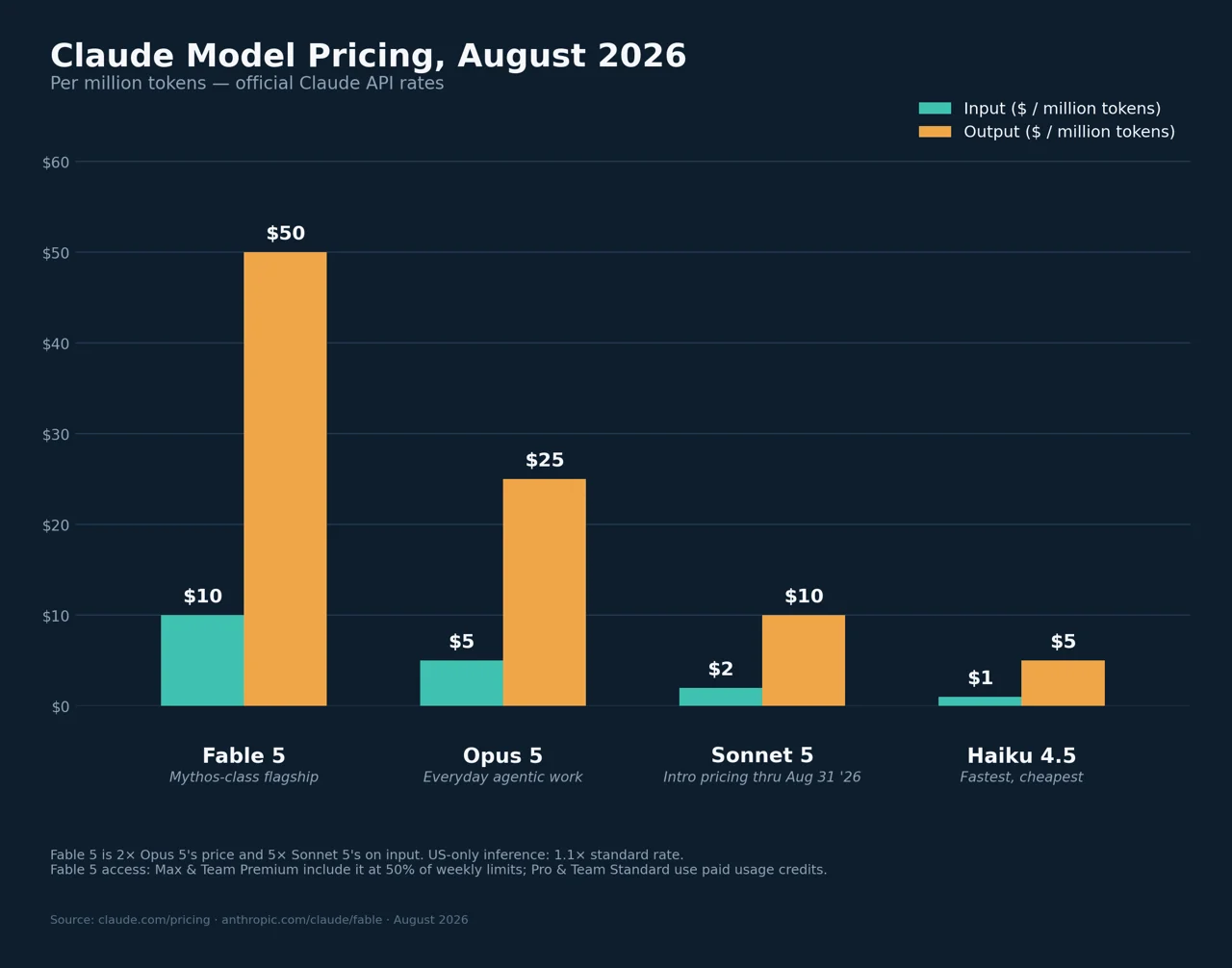
The practical shift: Opus 5 has taken over as the default model most subscribers actually use, including inside Claude Code, where it's now the recommended starting point rather than Fable 5. Fable 5 still holds a real, published edge on the longest-horizon and cybersecurity-sensitive work, but for the bulk of everyday professional tasks, Opus 5 is now the better-value pick at half the cost.
Who Should Actually Care About This
- Engineering teams doing large, messy refactors - where the multi-day agentic reliability genuinely saves hours of human oversight.
- Finance, legal, and research teams working with long documents - the 1M-token window and reported accuracy on finance-first analysis make it a strong fit.
- Teams already inside the Claude ecosystem (Claude Code, Claude Cowork) - it plugs directly into tooling they already use.
- Casual users happy with a standard chatbot - probably don't need this. The price premium and its advantage are both concentrated in long, hard tasks, not everyday questions.
- High-volume, cost-sensitive production workloads - probably better served by Opus 4.8, the newer Opus 5, or a cheaper competitor, given the per-token cost gap.
Independent Comparison:
Fable 5 vs. GPT-5.5 vs. Gemini 3.1 Pro
| Metric | Claude Fable 5 | GPT-5.5 | Gemini 3.1 Pro |
|---|---|---|---|
| SWE-Bench Pro | 80.3% | 58.6% | 54.2% |
| Input / Output price (per million tokens) | $10 / $50 | $5 / $30 | $2 / $12 |
| Context window | 1M tokens | 1M tokens | 1M tokens |
| GPQA Diamond | Not separately published by Anthropic | 94.4% | 94.3% |
| Independent hallucination rate (AA-Omniscience, lower is better) | Not directly comparable in same test round | 85.53% | Lower than GPT-5.5 in the same round |
| Strongest at | Agentic coding, long-horizon autonomous tasks | Long-context reliability, tool-augmented reasoning | Price-to-intelligence ratio, document volume |
The honest read, pulled from multiple independent write-ups: Fable 5 has the clearest lead in coding and agentic reliability, GPT-5.5 stays competitive on pure reasoning and carries a notably high hallucination rate on independent testing, and Gemini 3.1 Pro wins on cost-efficiency without falling far behind on raw capability. None of the three is a universal winner - the right pick depends on the job.
Fable 5 vs. GPT-5.5 vs. Gemini 3.1 Pro:
Which Should You Actually Pick?
| Claude Fable 5 | GPT-5.5 | Gemini 3.1 Pro | |
|---|---|---|---|
| Best at | Agentic coding, long-running autonomous work | Long-context reliability, general reasoning | Cost-efficiency, document-heavy workloads |
| Weakest at | Price most expensive of the three | Independent hallucination rate | Raw leaderboard position vs. the other two |
| Best for | Teams doing hard, multi-day engineering or research work | Teams needing dependable reasoning across long contexts | High-volume, budget-conscious production use |
Pick Fable 5 if the task is long, complex, and worth paying a premium for - big refactors, multi-day agent runs, dense analytical work.
Pick GPT-5.5 if you want strong general reasoning and are willing to double-check output more closely given its higher measured hallucination rate.
Pick Gemini 3.1 Pro if cost per token matters most and the task doesn't specifically need Fable 5's coding or agentic edge.
One honest caveat: this is a snapshot. Claude Opus 5, GPT-5.6, and other newer releases have already shifted parts of this comparison since Fable 5 launched - treat any single comparison, including this one, as directional rather than permanent.
Limitations
- Cost. At $10/$50 per million tokens, it's one of the most expensive models on the market, and hard to justify for routine or high-volume work.
- Mandatory 30-day data retention. Using Fable 5 requires data retention for safety monitoring; there's no zero-data-retention option, which may rule it out for privacy-sensitive workloads.
- Marginal gains on simple tasks. On short, well-defined work, the performance edge over cheaper models often isn't worth the cost difference.
- Already partly overtaken on everyday tasks. Anthropic's own follow-up release, Opus 5, closes much of the everyday-task gap at half the price; Fable 5's clearest remaining edge is in the longest, hardest, most autonomous work.
How to Try It Yourself
-
Get access - sign up for the Claude API, or use an existing Pro, Max, Team, or eligible Enterprise Claude.ai subscription.
-
Select the model - use claude-fable-5 via the Claude API, or select Fable 5 inside Claude.ai, Claude Code, or Claude Cowork.
-
Start with a real long-horizon task - a multi-file refactor, a long document analysis, or a multi-step research task, since that's where the model's advantage is clearest.
-
Watch usage limits - check whether your plan draws on weekly limits or usage credits before running large jobs, since pricing tiers changed after the July relaunch.
Frequently Asked Questions
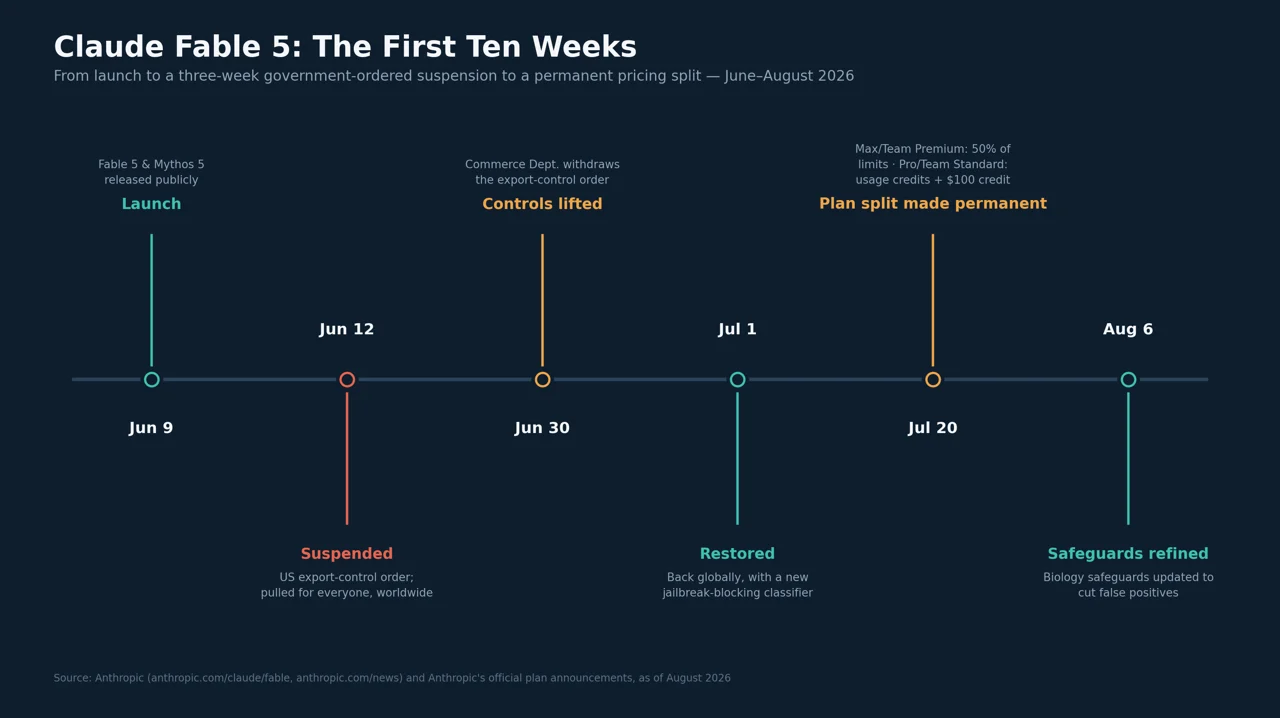
Is Claude Fable 5 free? No. It was never free on the API. On Claude.ai, it's included at no extra cost only on Max, premium Team seats, and seat-based Enterprise, up to 50% of weekly usage limits. Pro and standard Team seats have no included access it runs entirely on paid usage credits since the July 20, 2026 plan split.
Is Claude Fable 5 still down? No. It was suspended worldwide from June 12 to July 1, 2026, under a U.S. export-control order, and has been fully available since across the Claude Platform, Claude.ai, Claude Code, and Claude Cowork.
Is Claude Fable 5 better than Claude Opus 5? It depends on the task. Opus 5 is cheaper, is now the default on Claude Max, and matches or slightly beats Fable 5 on several independent benchmarks for everyday coding and knowledge work. Fable 5 keeps a real edge on the longest, most complex, autonomous tasks and cybersecurity-adjacent work.
How do I access Claude Fable 5? Through the Claude API as claude-fable-5, through Claude.ai on an eligible subscription, or through Claude Code and Claude Cowork using the same account access. It's also available on Amazon Bedrock, Google Vertex, and Microsoft Foundry.
What's the difference between Claude Fable 5 and Claude Mythos 5? They're the same underlying model. Fable 5 is the general-access version with added safeguards for biology, cybersecurity, and AI-research misuse. Mythos 5 is the same model with those specific safeguards lifted, restricted to vetted partners under Project Glasswing.
Sources & References
- Anthropic - https://platform.claude.com/docs/en/about-claude/models/introducing-claude-fable-5-and-claude-mythos-5
- Venturebeat - https://venturebeat.com/technology/anthropic-is-bringing-back-claude-fable-5-globally-after-us-lifts-export-control-order-where-can-enterprises-access-it
- Hacker News - https://thehackernews.com/2026/07/anthropic-restores-claude-fable-5-after.html
- Artificial Analysis - https://artificialanalysis.ai/models/claude-fable-5
- CNBC - https://www.cnbc.com/2026/06/30/anthropic-says-trump-admin-has-lifted-export-controls-on-claude-fable-5-and-mythos-5.html
This article is based on Anthropic's official Claude Fable 5 launch materials and system card, independent benchmark data from Artificial Analysis, and reporting from VentureBeat, CNBC, The Hacker News, and other named outlets. Pricing, access conditions, and benchmark rankings for frontier models change quickly confirm current terms on Anthropic's official pricing page before making decisions.