
While Meta and other labs race to build bigger local models, NVIDIA just took the opposite bet: smaller, faster, and built specifically to run the boring, repetitive parts of AI agents instead of the thinking part.
Quick Answer
- Nemotron 3.5 Lightning is a 30-billion-parameter open model, but only 3 billion parameters activate per request, a Mixture-of-Experts design that keeps it fast
- It's built for the execution layer of AI agents, not the planning. A bigger model decides what to do; Lightning actually does it
- 4x higher throughput and 30% faster task completion than comparable open models, and it runs on a single GPU
- It's NVIDIA's first open-source model release since CEO Jensen Huang began publicly backing open AI models in July 2026
- Free to download, use, and modify commercially, no permission required
What It Actually Is
Nemotron 3.5 Lightning has 30 billion parameters total, but only 3 billion "wake up" for any single request. That's a design called Mixture-of-Experts: instead of the whole model working on every question, it calls in just the right small team of specialists each time, like asking one expert instead of the whole office. That's what makes it fast: fewer active parts, but without losing the depth a bigger brain provides.
It's built as the next version of Nemotron 3 Nano, released just three weeks earlier. But its real knowledge comes from somewhere bigger, Nemotron 3 Ultra, NVIDIA's 550-billion-parameter flagship. Lightning was distilled from it, which is why a model this small scores 24 on the Artificial Analysis Intelligence Index, a real jump from Nano's 15, and punches well above its size.
What It's Actually Built For
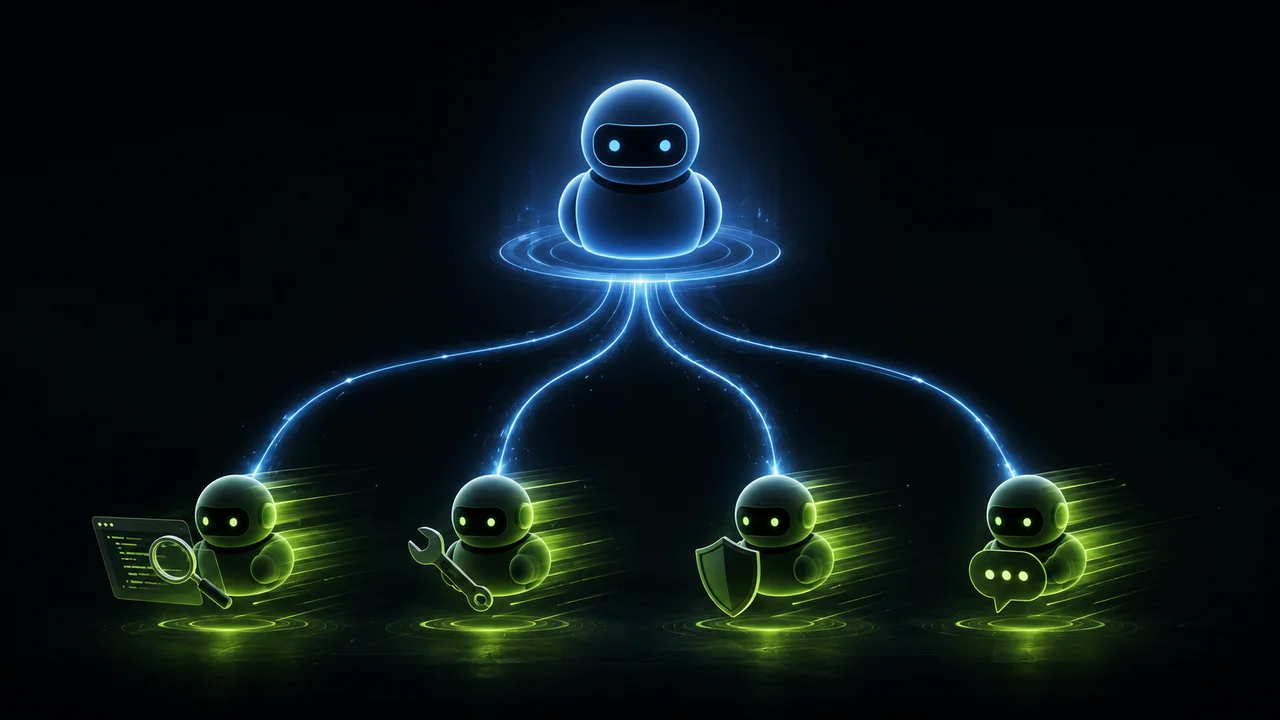
Think of a modern AI agent as a small team rather than one model doing everything. A bigger "manager" model, something like Nemotron 3 Ultra, decides what needs to happen. Lightning is the "worker" that actually does it: reviewing code, using tools, checking security alerts, answering routine billing questions.
It plugs straight into agent tools people already use:
- OpenClaw and Hermes Agent, kept secure by NVIDIA's own NemoClaw toolkit
- NeMo Switchyard, a new routing tool NVIDIA released alongside it, which automatically sends each request to whichever model actually fits the job best, open, proprietary, or NVIDIA's own
Benchmarks
| Metric | Nemotron 3.5 Lightning | Nemotron 3 Nano (predecessor) |
|---|---|---|
| Artificial Analysis Intelligence Index | 24 | 15 |
| Output speed vs. similar-sized open models | 4x faster | — |
| Total / active parameters | 30B / 3B | 30B / 3B |
Independent testing backs up the speed claim: Lightning performs similarly to gpt-oss-120b, a model with roughly four times as many total parameters, and ran 57% faster than Qwen 3.5 35B A3B on long-running agent tasks in one test (though Lightning used a single H100 GPU while Qwen needed two). The honest weak spot, echoed by several reviewers, is that it still loses to Qwen3.6 35B on harder reasoning tasks. It isn't built to win every benchmark, it's built to be fast and cheap at repeated, specialized work.
Where it genuinely shines is fine-tuning. One adopter customized it for a specific task in 3.5 minutes for under a dollar and saw real accuracy gains, and a legal-domain version more than doubled its accuracy on the CaseHOLD benchmark, from 35% to 77%. A healthcare-adapted version won 60% of blind comparisons against the plain base model.
The Comparison: Lightning vs. Muse Glimmer
Timing made this comparison unavoidable: Meta released Muse Glimmer on August 10, and NVIDIA shipped Lightning the very next day. Hacker News and reviewers are already treating them as rivals. The honest picture is a real split, not a clean win for either side:
| Nemotron 3.5 Lightning | Muse Glimmer | |
|---|---|---|
| Best at | Cheap, fast, high-volume text execution | Agentic tool-calling, safety, general local assistant use |
| Multimodal | No, text-only | Yes, reads images |
| Local deployment | Runs on a single H100 | Runs on a single 24–32GB consumer GPU |
| Tool-calling (MCP Atlas) | Trails by 20+ points | Leads decisively |
The honest read, echoed across reviews, is that Muse Glimmer is the better single, general-purpose local assistant, while Lightning is the better narrow specialist for repetitive execution work sitting behind a router. They're not really competing for the same job.
Why NVIDIA Is Doing This Now
This isn't a random release. In July 2026, CEO Jensen Huang publicly started backing open AI models, arguing that open models still need hardware to run on, and cheaper AI usually drives more usage overall, not less, which means more chips sold either way. Lightning is NVIDIA's first real open-model release since that shift, and reports suggest a much bigger trillion-parameter Nemotron 4 is already planned, aimed squarely at the current open-source leaders.
Use Cases
For everyday use, think personal agents that manage email, calendar, projects, and bookings, running locally so the agent has full context without sending everything to the cloud. For businesses, the fit is even tighter:
- Enterprise execution tasks: code review, tool use, security alert monitoring, answering routine billing questions, the repeated, specialized work that makes up most of an agent's actual workload
- Domain-specific fine-tuning: adapted versions for legal document analysis and healthcare Q&A both showed real, measurable gains over the base model, at a fraction of the cost of training a model from scratch
Who Should Actually Care
- Developers building agent systems — a genuinely cheap, fast worker model to slot behind a smarter orchestrator
- Businesses with repetitive AI workloads — billing questions, security monitoring, code review, exactly the high-volume tasks that waste money on a flagship model
- Casual chatbot users — probably not the right pick, Muse Glimmer or a similar general assistant fits better
Pricing
| Option | Cost | Notes |
|---|---|---|
| Self-hosted | Free | OpenMDW-1.1 license, download and run on your own hardware, no per-token cost |
| Hosted API (DeepInfra, OpenRouter) | $0.05 / $0.20 per million tokens | Input / output pricing |
| Hosted API (other launch-day providers) | ~$0.10 / $0.25 per million tokens | Input / output pricing, varies by provider |
| Context window | Up to 1M tokens | Some providers cap it lower, around 262,144 tokens, worth checking before you build around a specific limit |
Limitations
- Text-only, no image or audio input, unlike some competing local models
- Still a 30B-class model to store, even though only 3B parameters activate per request, the disk and memory footprint doesn't shrink just because the compute does
- Optimized around NVIDIA's own stack, performance elsewhere may vary
- Loses to larger models like Qwen3.6 35B on genuinely hard reasoning tasks, this is a specialist execution model, not a general-purpose flagship
How to Try It
The weights are live now on Hugging Face, with NVFP4 and BF16 versions for different hardware setups, and it's already on Ollama too, a single command downloads and runs it if you have Ollama installed. No sign-up or approval needed either way.
The Honest Verdict
Lightning isn't trying to be the smartest model out there, and NVIDIA says so plainly. It's a bet that most of what an AI agent actually does day to day is fast, repeated work, not deep thinking, and that a smaller, cheaper specialist beats an expensive flagship for that specific job. Paired with NeMo Switchyard's routing, this is less a standalone product and more a piece of NVIDIA's real strategy: sell the hardware that every AI model, open or closed, still has to run on.