
Two weeks ago, Qwen3.8 was a name with no confirmed specs, pricing, or benchmarks, just a preview endpoint and a promise. On August 3, 2026, that changed. Alibaba took Qwen3.8-Max fully generally available, attaching real numbers to the claims for the first time.
The Size, and What It Actually Means
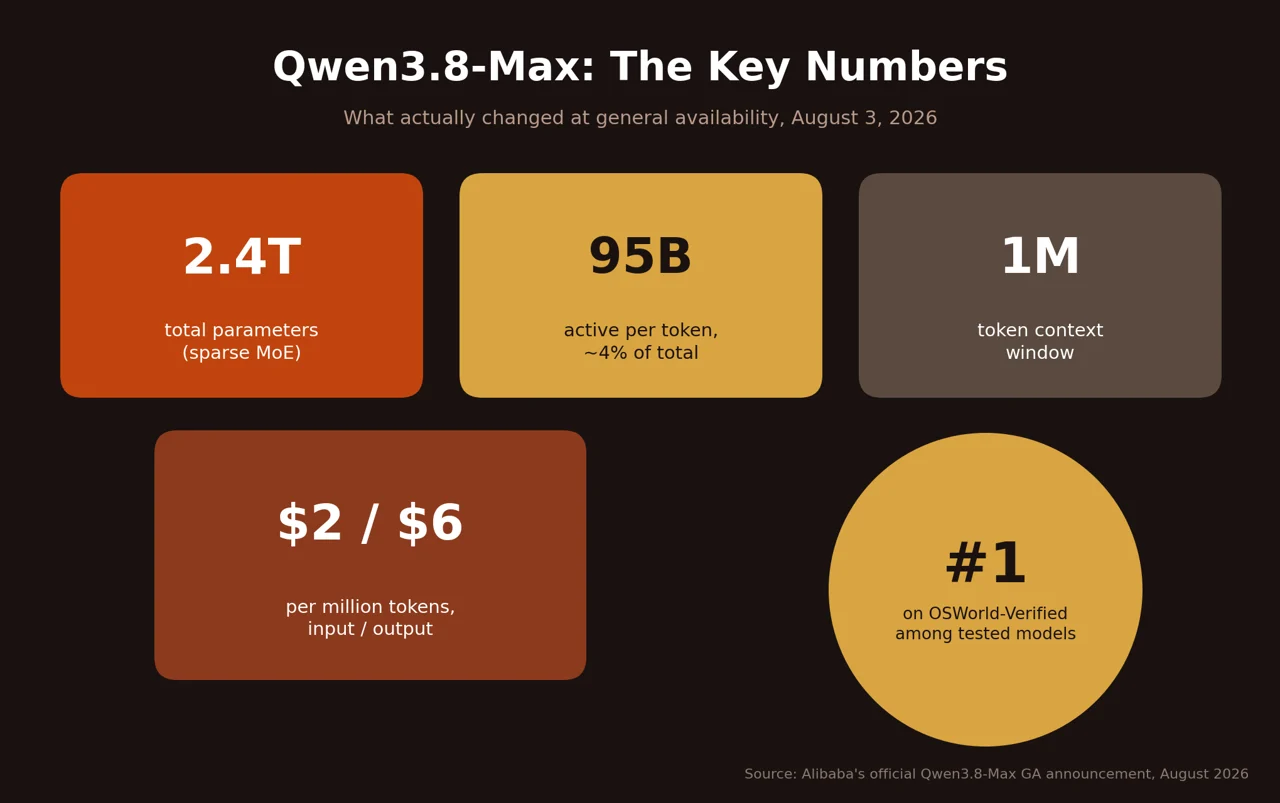
- 2.4 trillion total parameters, but that headline figure alone is misleading
- Built as a sparse Mixture-of-Experts (MoE) architecture
- Only 95 billion parameters activate per token, about 4% of the total
- Active count, not total, is what drives serving cost and speed
- Puts Qwen3.8-Max in a lighter serving class than the headline number suggests
From Preview to Production: The Real Timeline
| Date | What happened |
|---|---|
| July 19, 2026 | Previewed at the World AI Conference in Shanghai, as qwen3.8-max-preview |
| Late July 2026 | Preview access opens via Token Plan and tools like Qoder |
| August 3, 2026 | Goes generally available: pricing, benchmark table, and API ID qwen3.8-max published |
| Week of August 10, 2026 | Open weights promised for Qwen3.8-Max and Qwen3.8-27B, not yet confirmed live as of this writing |
For roughly two weeks, the preview had no official benchmarks, no disclosed license, and no confirmed active-parameter count. All of that arrived at GA.
What's Actually New at General Availability
- A published benchmark table, replacing an unverified claim
- The 95B active-parameter disclosure
- Standard per-token pricing, replacing the harder-to-forecast Token Plan credits
- Multimodal input: text and image, with one source additionally citing video
- A 1 million token context window, 131,072 token maximum output
The Benchmarks: Strong, But Read the Fine Print
Alibaba's table shows Qwen3.8-Max leading on agentic computer-use tasks (OSWorld-Verified) and trailing behind Claude Fable 5 on software engineering (SWE-bench Pro, FrontierSWE). Two caveats before treating any of this as settled:
-
These are vendor-reported figures. No independent evaluator like Artificial Analysis or LMArena had published its own reproduction as of this writing.
-
The multimodal comparison uses a weaker baseline. Alibaba benchmarks against Qwen3.7-Plus, not Qwen3.7-Max, its actual predecessor, flattering the generational delta.
One easy-to-miss technical detail: Alibaba's own reinforcement learning scaling curve peaks around 4,000 training environments, then declines at higher counts, a rare bit of self-reported nuance suggesting training returns weren't purely linear.
The FullBenchmarkTable
The three headline benchmarks above are only part of what Alibaba published. Here's the complete set of scores disclosed at GA:
| Benchmark | What it measures | Qwen3.8-Max score |
|---|---|---|
| Terminal-Bench 2.1 | Command-line and terminal task completion | 86.6 |
| SWE-bench Pro | Real-world software engineering | 67.7 |
| FrontierSWE | Advanced software engineering | 73.5 |
| OSWorld-Verified | Agentic desktop/computer use | 86.1 |
| PaperBench | Reproducing research papers | 93.0 (leads) |
| IFBench | Instruction following | 82.8 (leads) |
| GPQA Diamond | Graduate-level science reasoning | 92.6 |
| Parametric CAD Bench | Spatial and CAD-style reasoning | 91.5 |
| OmniDocBench 1.5 | Document understanding | 92.1 |
The Generational Leap From Qwen3.7-Max
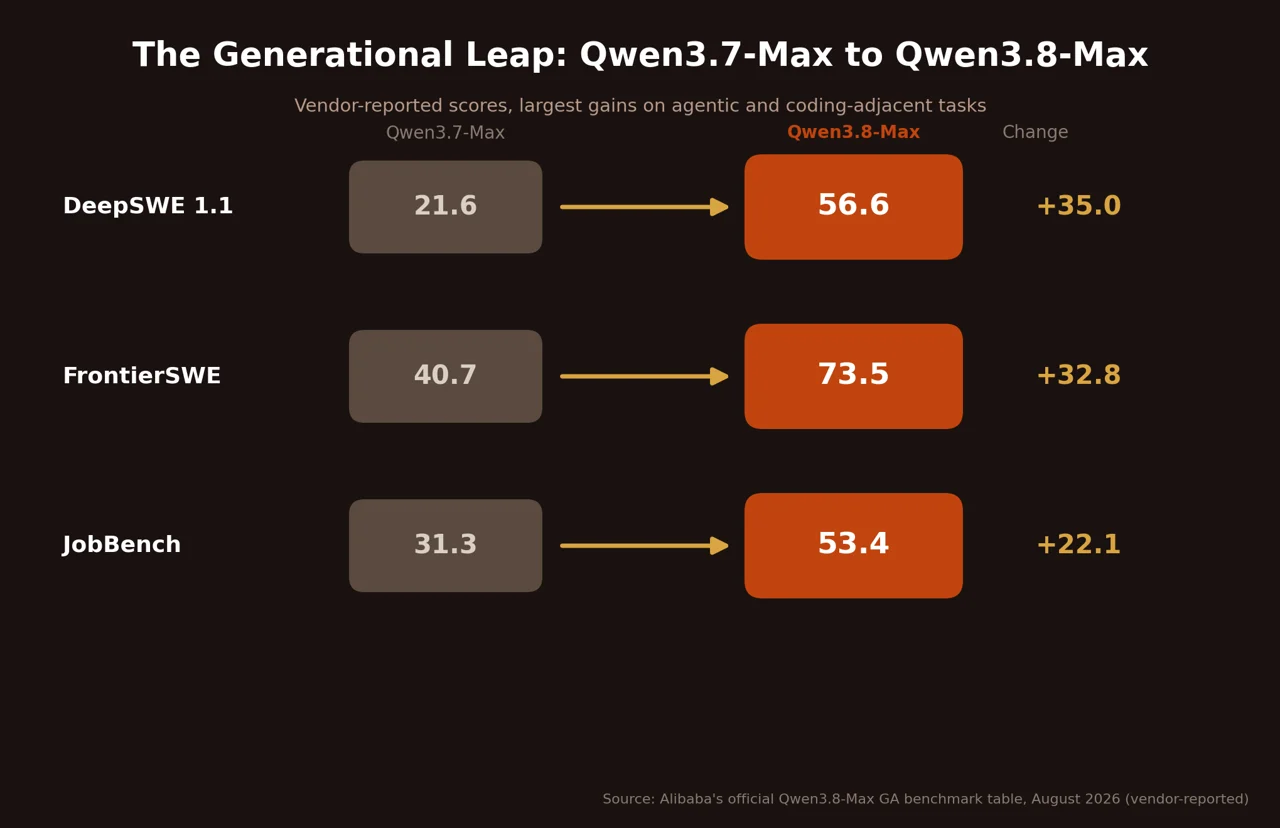
The clearest way to judge this release isn't against competitors, it's against Alibaba's own prior flagship:
| Benchmark | Qwen3.7-Max | Qwen3.8-Max | Change |
|---|---|---|---|
| DeepSWE 1.1 | 21.6 | 56.6 | +35.0 |
| FrontierSWE | 40.7 | 73.5 | +32.8 |
| JobBench | 31.3 | 53.4 | +22.1 |
| GPQA Diamond | 92.4 | 92.6 | +0.2 |
The pattern is consistent: the jump is largest on agentic and coding-adjacent tasks, and marginal on general science reasoning, which was already near its ceiling in the previous generation.
Pricing: The Most Aggressive Number in This Release
| Item | Price |
|---|---|
| Input | $2 per million tokens |
| Output | $6 per million tokens |
| Implicit cached input | $0.25 per million tokens (~8x discount vs. fresh input) |
| Explicit cache creation | $2.50 per million tokens |
| Explicit cache reads | $0.17 per million tokens |
| Rate limits | 2M tokens/minute, 15,000 requests/minute |
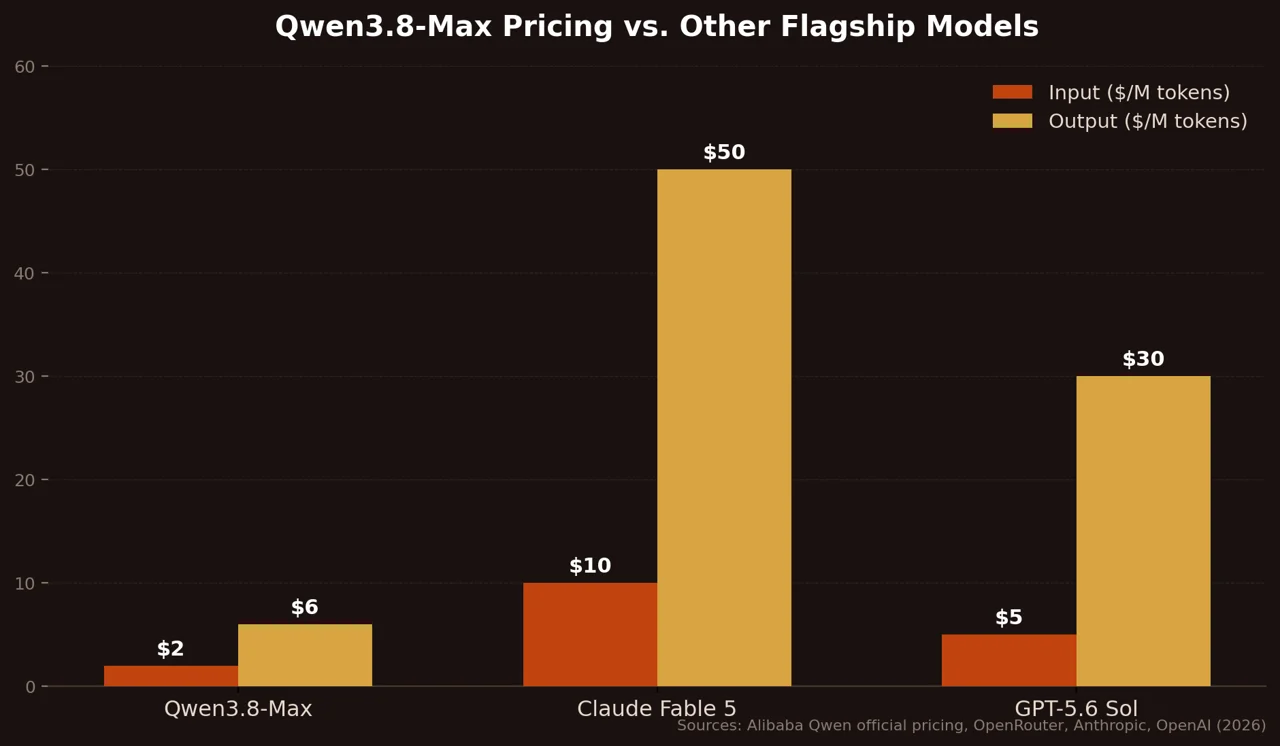
A fraction of Claude Fable 5's per-token cost, and meaningfully below GPT-5.6 Sol's. The strategic logic: Alibaba Cloud has idle GPU capacity, low prices drive early adoption, and switching costs create retention once teams build around a model.
The Open-Weight Commitment
The most structurally significant part of this release. Alibaba has never open-sourced a Max-tier model, smaller Qwen models have been open-weight, but the flagship stayed API-only. Weights are promised roughly a week after GA for both Qwen3.8-Max and Qwen3.8-27B.
Still unconfirmed as of this writing:
- No license disclosed yet. Apache 2.0 or a more restrictive custom license, unknown.
- Weights weren't live at GA announcement time. The realistic near-term self-hosting path is likely the smaller 27B checkpoint, not the full 2.4T flagship.
Where It Actually Wins
The clearest, least disputed strength: agentic computer use. On OSWorld-Verified, which measures how well an AI agent operates a real desktop environment, Qwen3.8-Max leads every model Alibaba tested it against, including GPT-5.6 Sol and Claude Fable 5. Strong results also show on document understanding (OmniDocBench) and CAD-style spatial tasks (Parametric CAD Bench), areas that get less attention than coding benchmarks but matter for real enterprise automation.
A Composite Example
Scenario: An operations team wants an AI agent to handle a recurring task, pulling data from an internal desktop application that has no API, reformatting it, and filing it into a shared document.
Why the model choice matters here: This is exactly an OSWorld-style task, operating a real desktop environment rather than calling clean APIs, which is Qwen3.8-Max's strongest documented benchmark category.
Why cost matters too: At $2/$6 per million tokens, a recurring desktop-automation agent run many times a day costs a fraction of running the same workload on a $10/$50 model, without necessarily sacrificing the specific capability the task needs.
The caveat: For the same team's contract review or code refactor work, the benchmark data suggests Fable 5 is the better-performing option despite the higher cost per token, since Qwen3.8-Max's documented gap is largest on exactly that kind of software engineering task.
Why This Release Matters Beyond the Numbers
Qwen3.8-Max isn't an isolated release, it's part of a broader shift in where AI usage is actually happening. By May 2026, Chinese open-weight models, DeepSeek, Alibaba's Qwen family, Moonshot's Kimi, and others, accounted for roughly 61% of all tokens used on OpenRouter, with four of the five most-used open models on that platform coming from Chinese labs. A Qwen flagship finally committing to open weights at the Max tier, not just smaller checkpoints, is a direct continuation of that trend rather than a one-off product launch.
How to Access It
- API: production endpoint qwen3.8-max, available now through Alibaba Cloud
- Qwen Studio: hosted interface for testing without API setup
- Token Plan: subscription option for individual use
- Regions: five-region hosted access at launch
- Open weights: not yet live, check Hugging Face and ModelScope once released
Common Mistakes to Avoid
- Treating vendor-reported benchmarks as independently verified fact
- Assuming the 2.4T parameter count reflects real serving cost, only the 95B active count does
- Planning full-scale self-hosting before a license is even confirmed
- Comparing Qwen3.8-Max's multimodal gains directly to Qwen3.7-Max, when Alibaba's own table used Qwen3.7-Plus instead
Limitations and Honest Caveats
- No independent benchmark verification yet. Every number here traces back to Alibaba's own table.
- Trails on software engineering specifically. Real gap behind Claude Fable 5 on SWE-bench Pro and FrontierSWE.
- Multimodal gains measured against a weaker predecessor, not the most direct comparison.
- No confirmed open-weight license yet, so the open-source story isn't fully resolved.
- Full-scale self-hosting isn't realistic for most teams at 2.4 trillion total parameters.
How It Compares
| Qwen3.8-Max | Claude Fable 5 | GPT-5.6 Sol | |
|---|---|---|---|
| Input price (per million tokens) | $2 | $10 | $5 |
| Output price (per million tokens) | $6 | $50 | $30 |
| Context window | 1M tokens | 1M tokens | Not directly comparable |
| Strongest area | Agentic computer use | Software engineering | General flagship reasoning |
| Open weights | Promised, not yet live | No | No |
| Independent verification | Not yet available | Partial, mixed across sources | Established |
Alibaba's own positioning: Qwen3.8-Max trails only Claude Fable 5 overall among current frontier models, a vendor claim, not an independently confirmed ranking, but a notably specific one.
Quick FAQ
Is Qwen3.8-Max open source? Not yet. Open weights are promised, but no license or live download exists as of this writing.
Why is it so much cheaper than Fable 5 or GPT-5.6 Sol? Partly real efficiency from its MoE architecture, partly a deliberate market-penetration strategy from Alibaba Cloud.
Can I self-host it? Not practically at full scale. The smaller Qwen3.8-27B, once released, is the realistic on-premise option.
Who Should Actually Care About This
- Cost-sensitive teams with high-volume workloads, where the pricing gap compounds fast
- Anyone building agentic desktop or computer-use tools, its most credible strength
- Teams waiting for independent verification before committing production workloads to a single vendor's benchmark table
- Not yet a fit for full-scale on-premise deployment, until the 27B checkpoint and license actually ship
Figures are drawn from Alibaba's official Qwen3.8-Max GA announcement and Alibaba Cloud's model documentation, current as of the August 3, 2026 release, cross-checked against independent technology press coverage. Benchmark scores are vendor-reported and had not been independently reproduced as of this writing. Confirm current pricing, licensing, and weight availability directly with Alibaba's official Qwen documentation before making deployment decisions.