Every machine translation comparison on the internet asks the same question: which one sounds better? That is the wrong question for business translation. Nobody's procurement team ever rejected a proposal because the sentences lacked sparkle. What gets companies into trouble is when "Scale Plan" becomes "Tarif Skala" in one paragraph and "Skalierungsplan" in the next, or when a legal phrase in the footer of your customer email quietly mutates between the English and the German version.
Business translation is a consistency job, not a creativity job. The product name, the plan name, the exact legal wording you cleared with counsel: those have to survive the trip into another language unchanged, every time, in every document, forever. And that requirement is exactly where the three tools people actually consider in 2026, DeepL, ChatGPT, and Gemini, behave very differently.
So instead of another beauty contest, this is a consistency test. One customer email. Five frozen terms. Run through each tool. The results say more about which one belongs in a business workflow than any fluency score ever will.
The test: one email, five terms that cannot change
Here is the setup. A fictional SaaS company, Northwind Cloud, replies to a German customer who asked about upgrading and about data processing. The email is ordinary business prose, maybe 150 words, the kind of thing a support lead sends a dozen times a day.
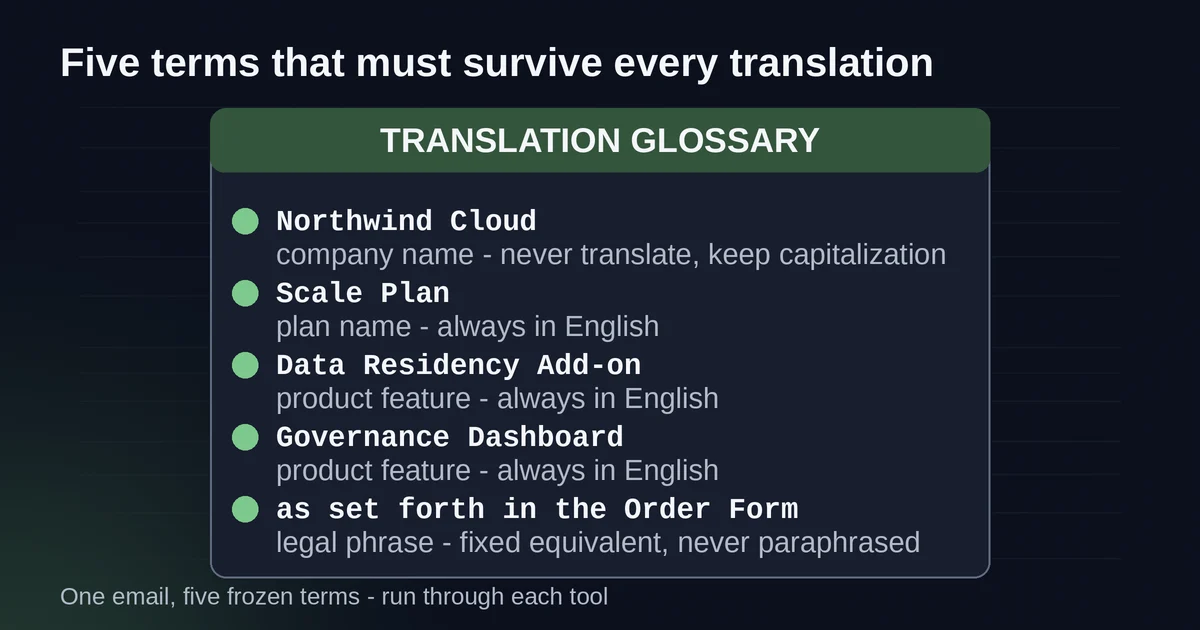
Five terms must come out of the translation exactly as specified, no matter how awkward that is for the sentence around them. This is the glossary, and it is deliberately small: five entries, fifteen words in total.
| Frozen term | Rule |
|---|---|
| Northwind Cloud | Never translate, never localize, keep exact capitalization |
| Scale Plan | Plan name, always in English |
| Data Residency Add-on | Product feature, always in English |
| Governance Dashboard | Product feature, always in English |
| as set forth in the Order Form | One fixed legal equivalent, chosen once, never paraphrased |
That last entry is the killer. Legal phrases in German have to sound like actual legal German, and the whole point of a glossary entry is that you choose the rendering once, with someone who knows, and then never let a machine improvise it again.
Now the three tools get the same email and the same glossary, and we check two things. First, does each frozen term come out exactly right? Second, does it come out the same way if you run the same email again tomorrow, in a new chat, from a different colleague's account? The second question is the one most comparisons never ask, and it is the one that matters for a company.
DeepL: the glossary is the product
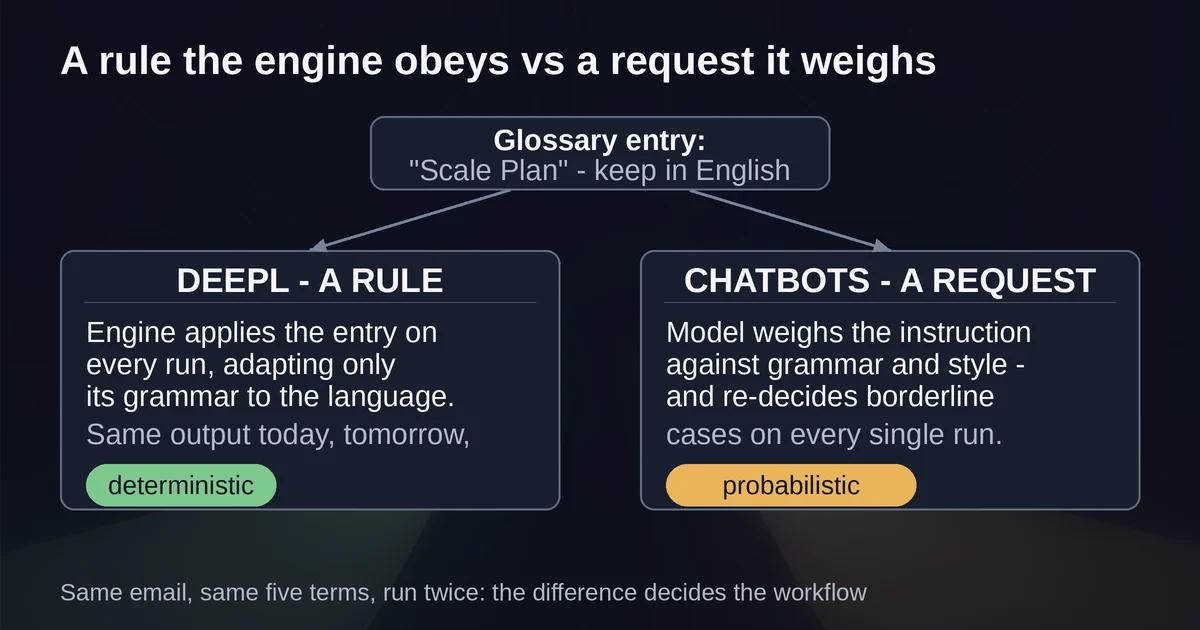
DeepL's answer to the frozen-terms problem is a built-in glossary feature. You enter your terms once, the engine applies them on every translation, and the mechanics matter: per DeepL's own documentation, entries are adapted to the grammar of the target language rather than pasted in with find-and-replace. A plan name gets the right case ending when the German sentence needs one. A glossary entry for a legal phrase produces the same German rendering whether the sentence around it is a question or a clause.
That is a deterministic enforcement mechanism. The glossary is not a suggestion the model weighs against its sense of style, it is a rule the engine applies. For the five terms in our test, that means Northwind Cloud stays Northwind Cloud in all five occurrences, Scale Plan never becomes a German compound, and the legal phrase lands in exactly one form, because there is exactly one form in the list.
It scales, too. DeepL ships a glossary generator that can build entries out of your previously translated documents, plus pre-made sample glossaries for fields like legal, finance, IT, and marketing, and the glossary follows you across the web app, desktop and mobile apps, browser extensions, Microsoft 365 add-ins, and the API. Translation memory arrives at the Business tier, which catches repeated sentences the way the glossary catches repeated terms. Together those two features are most of what a lightweight terminology practice looks like, without buying a full translation management system.
The honest limits: DeepL's raw fluency ceiling is lower than a good chatbot's. Give it marketing copy that needs to charm, or an email that needs a complete tonal rewrite rather than a translation, and it will be accurate and a little flat. Its text and voice translation covers around 30 languages, though document translation extends past 100. And its own quality numbers deserve the asterisk they carry: the March 2026 blind tests behind DeepL's "94% win rate" across 16 language pairs against GPT-5.2, Gemini 3.1 Pro, Claude Opus 4.6, Google Translate, and Microsoft Translator were commissioned by DeepL, with 48,000 evaluations from professional linguists. Independent testing keeps landing on the same direction, DeepL ahead on core European pairs, with narrower margins. The consistency argument does not depend on the beauty-contest numbers at all, which is exactly why it is the sturdier one.
ChatGPT: the best sentences, the wobbliest terms
ChatGPT is the tool most teams reach for first, and it earns it. The prose is excellent, the tone control is unmatched, and OpenAI now ships a dedicated ChatGPT Translate page, a free, no-login translation surface that keeps meaning, tone, and intent intact, with style shortcuts that hand the text over to the main chat for polishing. Under the hood, the default GPT-5.5 Instant model is one OpenAI explicitly built out for translation. For understanding an inbound email in another language, or drafting a reply that needs to sound human, it is superb.
But run our five-term test and the weakness shows immediately. ChatGPT has no glossary mechanism. There is no place to enter frozen terms that the engine is contractually obliged to respect. Your only option is to put the glossary in the prompt: "Never translate these five terms" is a natural-language request, and a request is not a rule. What actually happens in practice:
- Both terms usually survive. In a single short email, a well-prompted GPT-5.5 keeps all five frozen terms intact the large majority of the time. The failure rate on a clean, short email is low.
- The failures cluster where sentences need restructuring. When the German sentence wants the plan name to take a case ending or the legal phrase wants to move, the model faces a choice between your rule and grammar, and it does not always pick your rule. A Data Residency Add-on becomes a Data-Residency-Add-on, then an Add-on für Datenresidenz, in the same email.
- Nothing is stable across sessions. Re-run the identical email in a new chat tomorrow and the legal phrase may come out differently, because nothing persists. Every colleague has to paste the glossary every time, and the model re-decides the borderline cases each run. For a company, that is the real disqualifier: not that ChatGPT fails often, but that it fails unpredictably.
The mitigation exists and it works reasonably well: a saved glossary block in Custom Instructions or a Project, plus explicit "these are trademarks, keep them verbatim" framing. If you already use ChatGPT this way, prompting it deliberately for constrained output buys you most of the way. But you are still shipping a policy in a message and hoping. DeepL ships a policy in a mechanism.
Gemini: widest reach, same chatbot weakness
Gemini's translation story in 2026 runs through Google Translate, which rebuilt its text translation on top of Gemini and now handles idioms, slang, and local expressions contextually instead of word-for-word. Google's live-translation beta does speech-to-speech while preserving the speaker's tone and cadence, and Translate's coverage of roughly 250 languages is far beyond anything DeepL offers. If your business needs Estonian, Tagalog, or Zulu, Google is realistically the only option of the three.
For the glossary test, Gemini behaves like ChatGPT's close cousin. In the Gemini app you can paste the same instruction block, get the same mostly-obedient output, and hit the same wall: no persistent termbase, no enforced entries, no guarantee that the fifth email of the week matches the first. The recent contextual upgrades, alternative renderings with usage tips, make it a better interpreter of meaning, and a meaning-interpreter is exactly what you do not want deciding how to render "as set forth in the Order Form" this time around.
That gives you the cleanest possible summary of the 2026 field: DeepL is a translation engine with consistency features bolted in as a first-class mechanism. ChatGPT and Gemini are brilliant general models with consistency as a politely requested afterthought. Google, to its credit, documented the Gemini rebuild openly, and the improvement is real; it just lives on the fluency axis, not the consistency axis.
| DeepL | ChatGPT | Gemini / Google Translate | |
|---|---|---|---|
| Enforced glossary | Yes, native, grammatically adapted | No, prompt-only | No, prompt-only |
| Persistence across sessions | Yes, account-level | Manual (Custom Instructions/Projects) | Manual |
| Translation memory | Business tier | No | No |
| Fluency ceiling | Good, occasionally flat | Excellent | Very good, best idiom handling |
| Language breadth | 30+ text, 100+ documents | 40+ via Translate page | ~250 languages |
| Data guarantees for Pro | No training on your text, deleted after processing | Enterprise agreements required | Enterprise agreements required |
| Failure mode | Predictable, mechanical | Unpredictable, probabilistic | Unpredictable, probabilistic |
What you should never auto-translate
None of this is a license to point any of these tools at everything. Some document classes should not go through machine translation at all, regardless of which engine wins the glossary test:
- Contracts, NDAs, terms of service, anything with legal effect. No vendor claims their tool is certified for legal translation, and you should not either. A mistranslated indemnification clause is not a typo, it is a liability. Machine translation is a legitimate first-pass aid for a qualified human translator, and it is not a substitute for one on a document anyone signs.
- Regulated medical and safety content, official filings, immigration paperwork. Same logic, higher stakes.
- Anything you could not defend in the target language. The practical test: if a native speaker read this line aloud in a meeting, and you had only the machine output, could you stand behind it?
What remains after you carve those out is still most of a company's translation volume: support replies, internal announcements, understanding inbound customer email, first drafts of marketing and documentation that a human reviews, meeting notes. That is the safe operating zone for all three tools, and within it the glossary test is the deciding factor.
For choosing between the chatbots on general office work, the differences run deeper than translation, and the broader Claude vs ChatGPT comparison covers ground this test does not.
FAQ
Is ChatGPT better than DeepL for business translation? For fluency and tone, often yes. For terminology consistency, no. DeepL's glossary is an enforced mechanism while a chatbot's glossary is a prompt request, and a prompt request is obeyed most of the time rather than all of the time. If your documents contain terms that must never vary, that difference decides the answer.
Can I translate a contract with any of these tools? Not without a qualified human translator in the loop. None of the three is certified for legal translation, and DeepL's own positioning for legal content is about terminology consistency, not legal sufficiency. Use them to understand a contract or to prepare a first pass, never as the final word on a binding document.
The decision rule, then, is simple. Repeated business documents, product communications, anything with terms that must not drift: DeepL, with a glossary you actually maintain, which starts at the Individual tier (EUR 7.49/month, one glossary) and gets serious at Team (EUR 24.99 per user, five shared glossaries) and Business (EUR 49.99 per user, unlimited glossaries plus translation memory). One-off correspondence, creative rewriting, understanding a foreign-language email: ChatGPT or Gemini, whichever you already pay for. Rare languages: Google Translate, with human review. And before anything with legal effect reaches a customer: a person whose job it is to know. Pricing and plan details are as published by the vendor around September 2026 and can change, confirm on the official site.