The Pitch Ends at Launch. The Cost Doesn't.
Every AI automation demo ends the same way: task automated, hours saved, cost worked out. What that math almost never includes is what happens six months later. That's when the model's answers slowly start getting worse, or the app it connects to changes something, or the price goes up after you've already built three workflows around it.
Back in 2015, Google researchers gave this problem a name that's stuck ever since. D. Sculley and colleagues described machine learning systems as carrying "hidden technical debt."
Their warning was simple: it's easy to build an AI system fast and pile up real, expensive maintenance work that never shows up on a budget sheet. That paper is over ten years old now. The warning matters even more today, because AI agents touch more systems, run with less supervision, and change faster than the systems Sculley wrote about.
Why AI Costs More to Maintain Than Regular Software
Normal technical debt comes from one clear source: code that was written as a shortcut and never cleaned up. It just sits there until someone touches it again.
AI debt is different, and that's what makes it expensive:
- The system can change on its own. A workflow that worked perfectly on day one can quietly get worse just because the real-world data flowing through it has changed, even if nobody touched the code
- Problems hide behind answers that look fine. A normal bug usually breaks something visibly. A drifting AI model keeps giving confident, reasonable-sounding answers that are quietly wrong, so it's harder to catch, and more costly by the time someone notices
- Every connected app is a new way things can break. An automation linked to five different apps has five separate places something can quietly stop working the next time any one of those apps changes
Model Drift Is the Cost Nobody Plans For
Model drift is what happens when the patterns an AI system learned stop matching the real world it's working in now. Customer habits shift, a market changes, a company you pull data from changes its format. The output usually doesn't fail loudly. It just gets slightly less accurate, then a little more, until someone finally notices the automation has been making worse calls for weeks.
One industry piece on AI governance put it well: this kind of problem "can hide behind plausible model outputs, quietly building risk at the data and decision layer," instead of announcing itself the way a crashed program would. The fix isn't a one-time patch. It takes ongoing checking and regular retraining, and both of those cost real money that rarely gets planned for at the start.
A real example of how bad this gets: researchers studying production machine learning systems at a major cloud provider, published at MLSys 2022, found that even with frequent retraining already in place, real deployed models still experienced accuracy drops of up to 40 percent from data drift, along with a real, measurable rise in operational cost. The point isn't that retraining doesn't work. It's that even teams already retraining regularly still got caught off guard by how much drift can cost before anyone gets it fully under control.
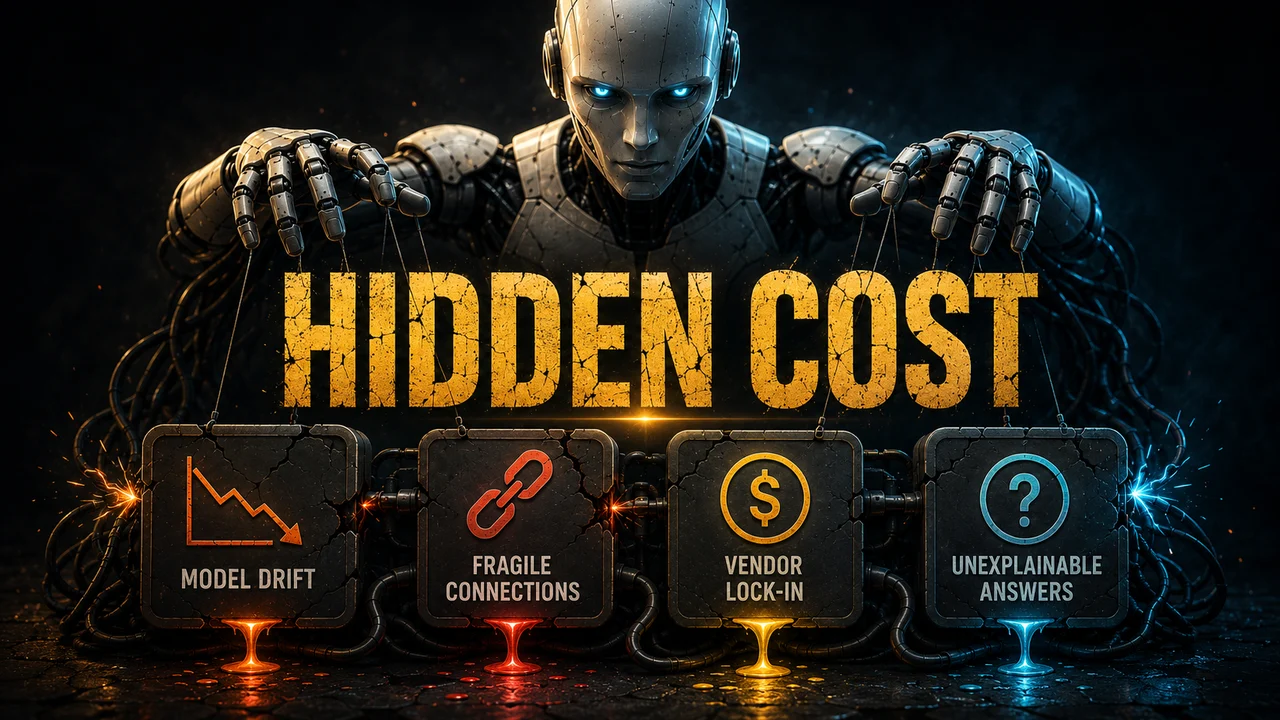
Three More Costs That Sneak Up on You
- Fragile connections. An automation built on five connected apps has five separate points of failure. When any one of them changes its API, the whole chain can break without warning
- Getting stuck with one vendor. Building workflows deeply around one platform's specific features makes it expensive to switch later, even if a better or cheaper option shows up
- Answers you can't fully explain. Some AI-driven decisions are genuinely hard to trace back to a clear cause, since the reasoning isn't written out in code a person can just read. That makes fixing a bad answer slower than fixing a normal bug
None of this means you shouldn't automate. It just means the "hours saved" math from a launch-week demo is never the full story.
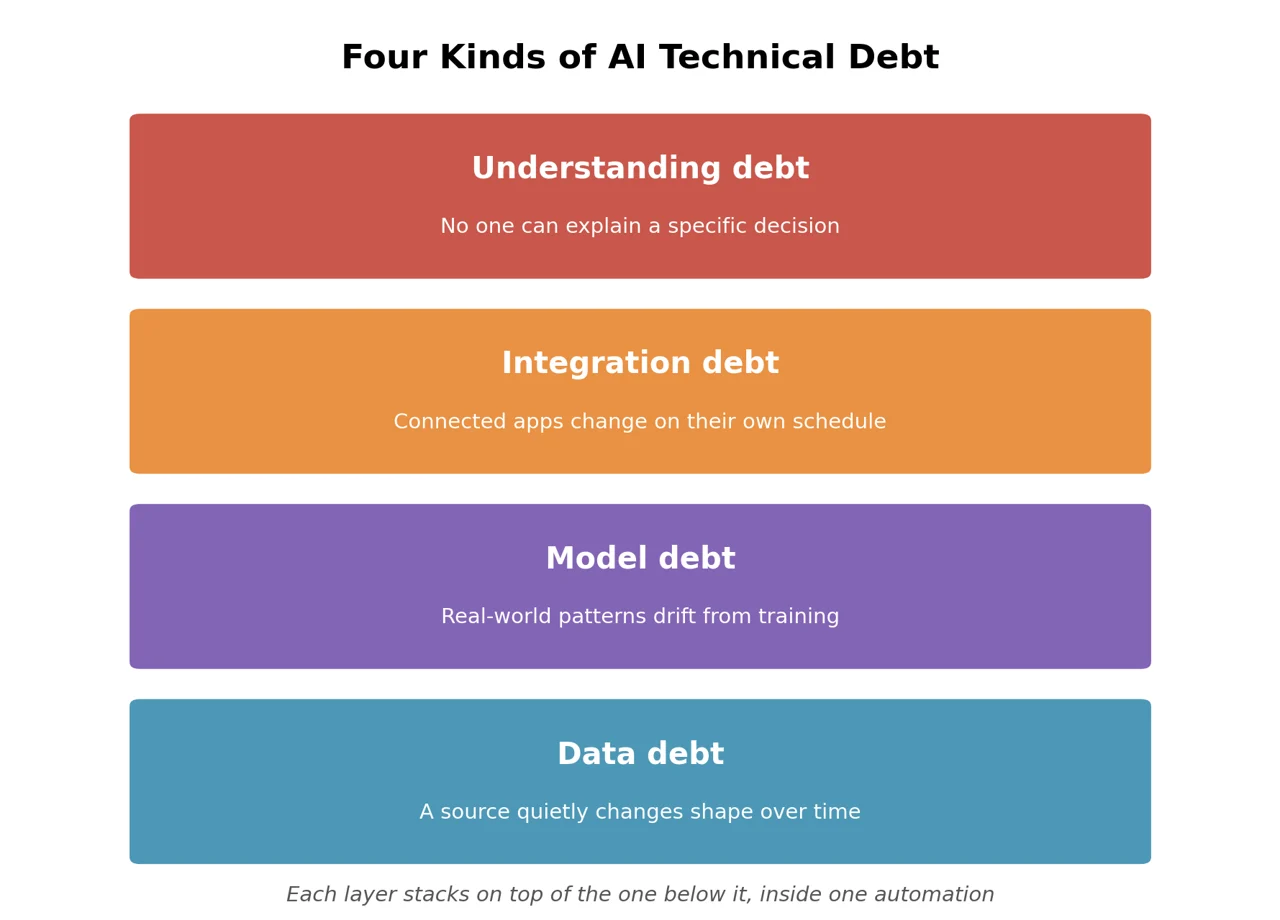
The Four Kinds of Debt Hiding Inside One Automation
"AI technical debt" isn't one single thing. It's a stack of different problems that build up at the same time:
| Type | What it actually is | Why it's easy to miss |
|---|---|---|
| Data debt | The automation depends on a data source or format that quietly changes shape over time | Nothing crashes, the system just starts working with slightly wrong information |
| Model debt | The model itself drifts as real-world patterns move away from what it was trained on | Output still sounds fluent and confident, so it doesn't feel "broken" |
| Integration debt | Every connected app or platform is something that can change on its own schedule, not yours | You don't control when a vendor updates their system, only how fast you notice it broke something |
| Understanding debt | Nobody on the team can fully explain why the system made a specific decision | Everything passes testing and the demo works, and the gap only shows up once something goes wrong for real and needs a clear cause |
That last one has a real name in AI research: opacity. One kind means you can see the result but can't trace the reasoning behind it. The tougher kind means your tests pass, but the system still fails once it's live, because the test conditions didn't match reality closely enough. Both make fixing an AI-driven automation slower than fixing a normal script, where you can usually just read the code and see what's wrong.
Why This Builds Up Faster Than Old-Fashioned Tech Debt
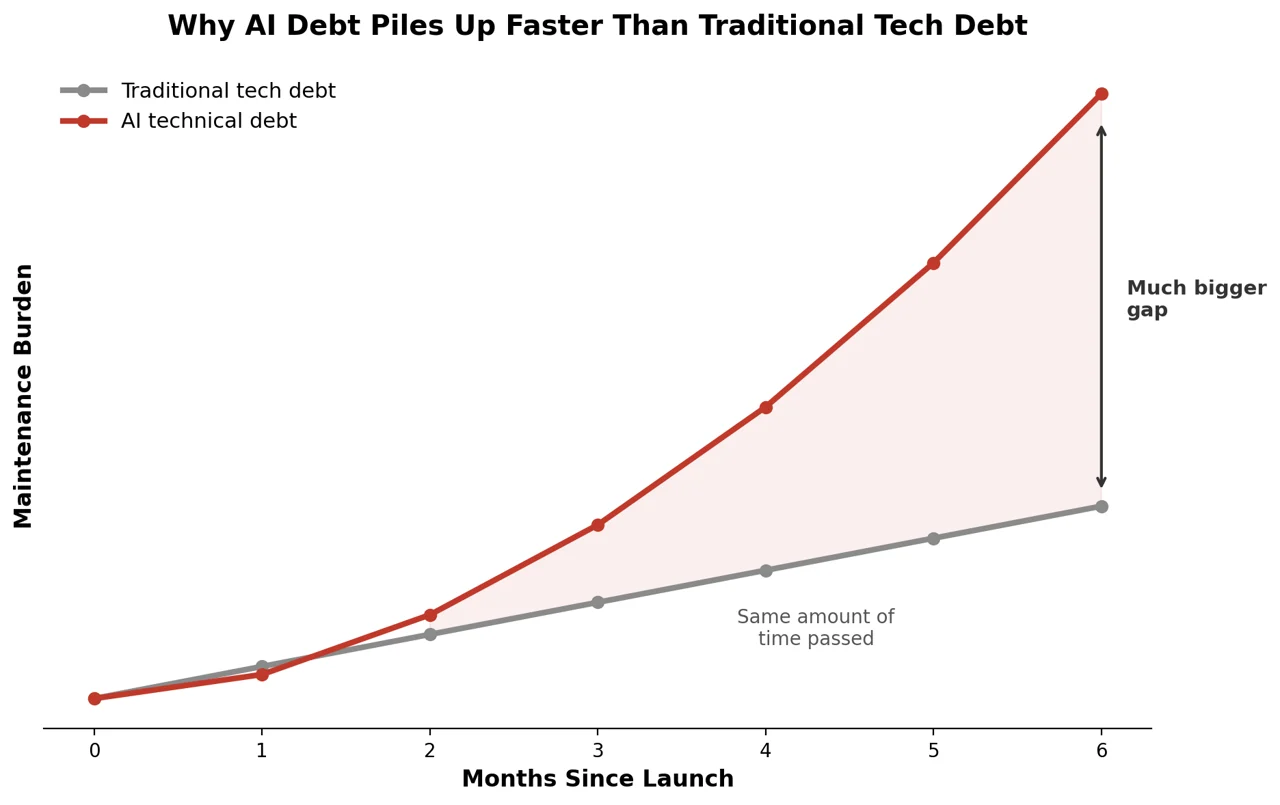
Normal technical debt grows about as fast as your team writes code. AI automation breaks that pattern in two specific ways:
- Volume. An AI agent can make far more automated decisions in a day than a team of people ever could by hand. That means any small, systemic mistake gets repeated at a much bigger scale before anyone catches it
- No memory between runs. Many AI agents effectively start fresh each time, quietly re-deciding formatting or logic instead of sticking to what worked before. Over time, a workflow can slowly stop agreeing with itself, even if nobody changed anything on purpose
Neither of these means the technology is bad. It just means the debt builds up faster than most budgets are set up to catch.
Warning Signs Worth Watching For
- Output that "feels" slightly worse than it used to, without one clear error to point to
- A growing pile of manual fixes or overrides that nobody's actually tracking as a group
- An automation that already broke once because a connected app changed something, with no plan in place to catch the next time
- Nobody on the team can explain, in plain words, why the system made a specific recent decision
- The same workflow acting differently depending on which day, or which run, it happened on
How to Estimate the Real Cost Before You Build
Most automation budgets only account for the obvious line item: the subscription or API cost. A more honest estimate adds four more:
-
Setup cost - what it actually takes to build and connect the workflow, including the trial and error
-
Monitoring time - someone, even part-time, needs to periodically check that outputs still look right
-
Retraining or re-tuning cadence - how often the model or prompt will realistically need adjusting as the real world shifts underneath it
-
Integration upkeep - a rough estimate of how often a connected app changes something and forces a fix on your end
-
Replacement cost - what it would take to migrate away from this specific tool or vendor if you had to
None of these need to be precise to be useful. Even a rough guess against each one turns "this automation costs $200 a month" into a number that's actually close to true, instead of one that only holds up until the first thing breaks.
Which Automations Carry the Most Risk
Not every automation carries the same risk. Watch these ones most closely:
- Anything customer-facing. A drifting recommendation tool or support bot hurts the customer experience directly, often before anyone inside the company notices
- Anything touching money, legal, or compliance decisions. The cost of one wrong decision here can outweigh months of savings from the automation
- Long-running workflows nobody checks often. A scheduled automation running quietly in the background is far less likely to get caught drifting than one someone actually looks at every day
What Actually Keeps the Cost Down
- Watch the quality of the output, not just whether it's running. A workflow can be technically "working" while quietly giving worse answers than it did a month ago
- Plan for retraining and review from day one, instead of treating it as a surprise cost later
- Use standard, shared connections instead of custom one-off ones where you can. A standard like MCP means a broken connector is a common, known problem with existing fixes, not something only your team can solve
- Give simple automation the routine work, and save full AI agents for tasks that actually need judgment. Every bit of added autonomy is also added maintenance
- Write down why, not just what. A short note on why an automation handles a tricky case a certain way saves hours later, especially after the person who built it has moved on
- Set a check-in schedule before launch, not after something breaks. Even a quarterly review catches problems far earlier than waiting for a complaint
The Bottom Line
The companies getting hurt by AI automation usually aren't the ones who automated too much. They're the ones who planned for the launch and never planned for what comes after. Maintenance was never optional for software. AI just made it a lot easier to ignore, until the bill shows up.
The one change worth making today: before you approve the next AI automation, ask who's checking its output next month, not just who built it this week. If there's no answer to that question, that's the real cost estimate you're missing, not a rounding error.
Based on Google's research on hidden technical debt in machine learning systems, plus recent industry writing on AI-specific technical debt and model drift. Maintenance cost figures vary by source, treat any single percentage elsewhere as an estimate, not a rule.