
A Deadline That Didn't Land the Way Everyone Expected
What Was Supposed to Happen This Month
For over a year, compliance teams across Europe and beyond had a single date circled on the calendar: August 2, 2026. That's when the EU AI Act's obligations for "high-risk" AI systems, the category covering most AI agents used in hiring, credit decisions, and other consequential business processes, were set to become legally binding.

What Actually Happened Instead
That deadline just moved. In May 2026, EU lawmakers reached a political agreement on a package known as the Digital Omnibus on AI, and that agreement has since been finalized into law. The result: high-risk AI system obligations for the most common category of agents, listed in what's called Annex III, are now delayed from August 2026 to December 2, 2027, a 16-month postponement.
This isn't a rumor or an early proposal anymore. It's the operative timeline companies now need to plan around.
By the Numbers
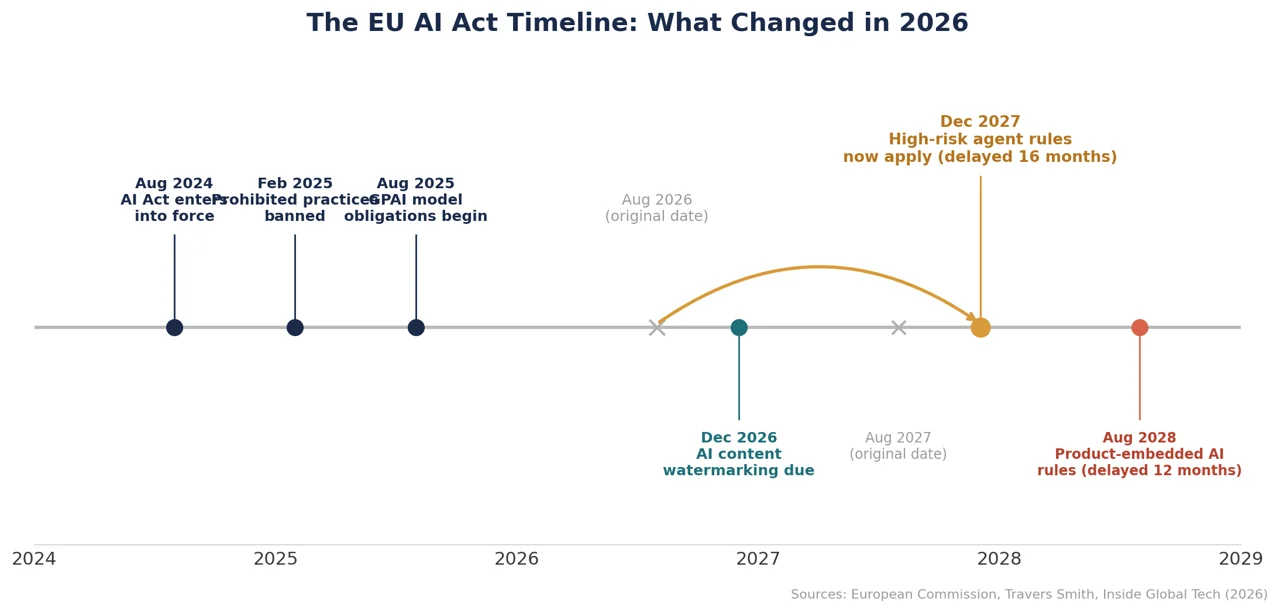
Key Dates at a Glance
| Milestone | Status |
|---|---|
| AI Act enters into force | Already in effect since August 2024 |
| Prohibited AI practices banned | Already in effect since February 2025 |
| General-purpose AI model obligations | Already in effect since August 2025 |
| High-risk AI system obligations (most agents) | Delayed from August 2026 to December 2027 |
| Product-embedded AI system obligations | Delayed from August 2027 to August 2028 |
| AI-generated content transparency rules | Still due December 2026, barely delayed at all |
What the Penalties Still Look Like
Even with the delay, the eventual fines haven't gotten any smaller:
- Prohibited practices: up to 35 million euros or 7% of global turnover
- High-risk system non-compliance: up to 15 million euros or 3% of global turnover
- Supplying incorrect information to regulators: up to 7.5 million euros or 1% of global turnover
- Smaller companies and startups get proportionate, lower caps
Why the EU Hit Pause
The Readiness Gap
The delay wasn't a policy reversal so much as an admission that the infrastructure behind the law wasn't ready. National regulators in several member states hadn't yet been designated, and the harmonized technical standards companies need in order to actually complete a conformity assessment were still incomplete.

What's Driving the 16-Month Delay
Regulators effectively concluded that forcing an August 2026 deadline without finished standards and functioning national oversight bodies would have meant enforcing a law that companies had no reliable way to fully comply with yet. The new date gives both sides more room: regulators to finish the technical groundwork, and companies to actually build toward it.
What Still Applies Right Now, Delay or Not
Already in Force
It's worth being precise about what didn't change. These parts of the AI Act are already active law, delay or no delay:
- Outright bans on prohibited AI practices, like social scoring by public authorities
- Obligations on providers of general-purpose AI models, active since August 2025
- The Act's extraterritorial reach: it applies to any provider placing an AI system on the EU market or putting it into service there, regardless of where the company is headquartered
Coming Regardless of the Delay
One deadline barely moved at all. Transparency requirements for AI-generated content, like labeling or watermarking, only had their compliance window shortened from six months to three, and are still due by December 2, 2026. Not every part of the Act got breathing room.
What This Means for Companies Running AI Agents
The Temptation to Relax
It's tempting to read "delayed to December 2027" as "we have well over a year to ignore this." That's the wrong takeaway, for three reasons.
Why That's the Wrong Read
- Conformity assessments, technical documentation, and quality management systems take real time to build. Sixteen months sounds long until an audit is actually underway.
- The delay covers new or substantially modified high-risk systems specifically. Companies already running qualifying systems before the postponed date may still face different transitional rules.
- Regulatory timelines have already moved once. Treating December 2027 as a hard floor, rather than a reason to wait, is the safer read of a regulation that has already shown it can shift.

A Composite Example: Where This Actually Bites
Scenario:
A mid-sized European insurer's AI agent handles initial claims triage, deciding which claims get fast-tracked and which get flagged for human review.
Why it matters:
Claims-decision systems of this kind sit squarely in the kind of use case the AI Act's high-risk category was built for.
What changed for them:
The December 2027 deadline buys the team real time, but their compliance roadmap, data governance documentation, human oversight design, and monitoring, didn't get any smaller. They're using the extra runway to actually finish it properly instead of rushing a version that barely passes.
Where Companies Get This Wrong
Common Failure Points
- Treating a delayed deadline as a canceled one
- Assuming a system that "just optimizes performance" is automatically exempt, when the Act's safety-component definitions are specific and narrower than most teams assume
- Waiting for final harmonized standards before starting any internal documentation work at all
- Forgetting that some deadlines, like AI-content transparency, barely moved and are still close
The Pattern Behind the Failures
Every case above comes down to the same mistake: reading one delayed date as a green light to stop paying attention to the whole regulation.
Quick Checklist: Is Your Agent Stack Actually EU-Ready?
The Checklist
- You know which of your AI agents plausibly fall under a high-risk Annex III use case
- You're already documenting data governance and human oversight design, not waiting for the new deadline
- You've confirmed whether your AI-generated content already needs labeling ahead of the December 2026 deadline
- You've assigned clear ownership for EU AI Act compliance internally, not left it as "someone's eventual problem"
- You're tracking regulatory updates directly, since this timeline has already shifted once
If Most of These Are Unchecked
The extra sixteen months is only useful if a team spends it building. Used as an excuse to wait, it disappears just as fast as the original deadline would have.
What's Next
Two Things Worth Watching
- Whether the harmonized technical standards regulators promised actually arrive well before December 2027, or whether this timeline shifts again
- Whether other jurisdictions modeling their own AI regulation on the EU AI Act adjust their own timelines in response
The Real Takeaway
The EU AI Act didn't get weaker. It got a longer runway, aimed at making sure both regulators and companies can actually meet it when it lands. Companies that treat this as extra preparation time, rather than a reprieve, are the ones that won't be scrambling in late 2027.
Sources & References
- Cloud Security Alliance Labs: EU AI Act high-risk deadline and enterprise readiness gap: labs.cloudsecurityalliance.org
- Holland & Knight: on the possible August 2026 compliance deadline for U.S. companies: hklaw.com
- Travers Smith: on the EU's agreement to delay key AI Act compliance deadlines: traverssmith.com
- DLA Piper GENIE: on the Digital Omnibus's proposed deferral of high-risk obligations: knowledge.dlapiper.com
- Inside Global Tech: on the finalized timeline relief and new prohibitions: insideglobaltech.com
- Pinsent Masons: on the finalized law delaying the EU's high-risk AI rules: pinsentmasons.com
- Legiscope: EU AI Act deadlines and penalty calendar for 2026 to 2027: legiscope.com
Figures and dates reflect research and reporting current as of early August 2026. EU regulatory timelines have already shifted once in 2026 and may shift again as harmonized standards and national enforcement bodies are finalized. Confirm the latest status directly with the cited sources, or with legal counsel, before making compliance decisions based on this piece.