On September 22, 2026, Anthropic and OpenAI both shipped new models, and both led with the same promise: frontier-level intelligence for less money. One outlet reported the two launches landed about 90 minutes apart, which made the day feel like a duel. But if you build AI agents, the real fight is not on the sticker price. It is on the cache-read line.
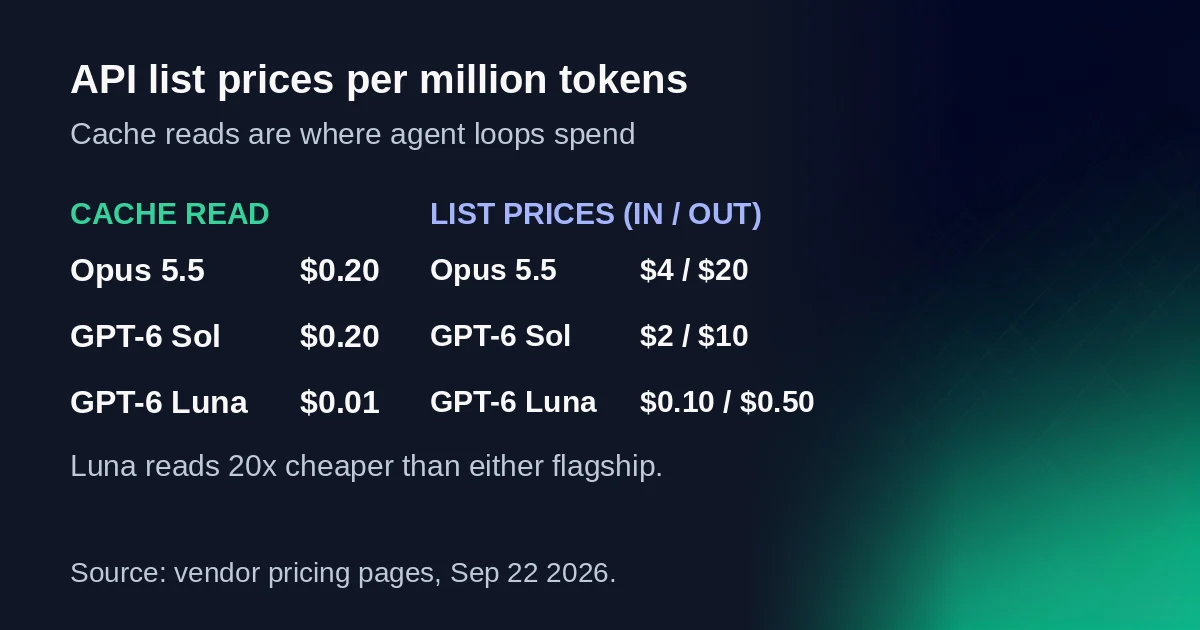
Claude Opus 5.5 and GPT-6 Sol charge exactly the same for cached input: $0.20 per million tokens. Sol then halves Opus 5.5 on everything else, at $2 input and $10 output versus $4 and $20. And GPT-6 Luna plays in a different weight class entirely: $0.10 input, $0.50 output, and just $0.01 for cached reads, which is 20x cheaper than either of the other two. As for the famous "40% cheaper" and "50% cheaper" headlines, they are measured against different baselines with different methods, so they cannot be honestly compared with each other at all.
Both releases also sit below each lab's flagship model, so neither breaks the letter of the slowdown pledge the same CEOs made days earlier. But cheaper inference spreads near-frontier capability far and wide, whichever way you read it.
Here is what this post covers: the full pricing tables, the cache math that actually decides your bill, whose benchmarks deserve your trust, and a switching guide you can act on.
In short:
- The real battleground is cache reads, not sticker prices. Opus 5.5 and Sol both charge $0.20 per million cached tokens.
- Sol is half of Opus 5.5 on input and output ($2/$10 vs $4/$20). Luna is 20x cheaper than both on cache reads.
- "40% cheaper" (Anthropic, vs Opus 5, with token efficiency folded in) and "50% cheaper" (OpenAI, vs GPT-5.6 promotional pricing) are not comparable numbers.
- Both models slot below their flagships, so the slowdown pledge holds to its letter. Cheaper inference still spreads capability.
- What to pick depends on your workload: cache-heavy loops favor Sol, bulk work favors Luna, and very long contexts may still favor Opus 5.5's flat rates.
What shipped, exactly, and when?
Anthropic's launch page is dated September 22, 2026, and so is OpenAI's. Beyond the dates, exact times get thin fast. A single outlet, BeInCrypto, reported that Opus 5.5 went live at 16:31 UTC and Sol and Luna at 18:12 UTC, roughly 101 minutes apart. No primary source confirms those timestamps, so treat the "90 minutes apart" framing as reported by coverage, not established fact.
Here is what each lab actually shipped, from the primary pages:
- Claude Opus 5.5 (model ID
claude-opus-5-5): positioned as performing at the level of Claude Fable 5.1 on most work while costing 40% less to run than Opus 5. It is available through the Claude API, Amazon Bedrock, Claude Platform on AWS, Google Cloud, and Microsoft Foundry. Anthropic says Sonnet 5.5 and Haiku 5.5 "will follow in the coming weeks," with no dates attached. - GPT-6 Sol and Luna (model IDs
gpt-6-solandgpt-6-luna): trained with similar methods as GPT-6 Astra, which remains OpenAI's flagship and "best model across the board." Sol and Luna shipped in ChatGPT Work and Codex for Plus, Pro, Business, Enterprise, and Edu users, with Luna in the desktop app for Free and Go plans, a ChatGPT rollout "throughout the day," and API access under those two model IDs.
The structural fact to hold onto: both releases slot below their labs' flagships. Opus 5.5 sits under Fable 5.1; Sol and Luna sit under Astra. That matters for the slowdown-pledge question later in this post.
What do the models actually cost?
These are the published rates, per million tokens, as each vendor lists them on their own pages. Anthropic's table comes from the Opus 5.5 launch page and Claude pricing docs; OpenAI's come from the Sol and Luna launch page and the per-model API docs.
| Line item | Opus 5.5 | Opus 5 (for scale) | GPT-6 Sol | GPT-6 Luna |
|---|---|---|---|---|
| Input | $4.00 | $5.00 | $2.00 | $0.10 |
| Output | $20.00 | $25.00 | $10.00 | $0.50 |
| Cache reads | $0.20 (0.05x input) | $0.50 | $0.20 (10% of input) | $0.01 (10% of input) |
| Cache writes | $5.00 (1.25x) | $6.25 | $2.50 (1.25x) | $0.125 (1.25x) |
| Fast mode | $8 in / $40 out | $10 / $50 | 2x applicable rates | 2x applicable rates |
| Batch | $2 / $10 (half price) | $2.50 / $12.50 | 50% of standard | 50% |
| Prompts over 272K tokens | flat rates | flat | 2x input/cache, 1.5x output, whole request | same as Sol |
The fine print carries the real news:
- Cache reads are the big Anthropic move. Opus 5.5's $0.20 cache-read rate is 60% below Opus 5's $0.50. Anthropic says cache reads "make up the majority of agentic and coding work costs," which is why this line matters most for agent builders.
- OpenAI's cache discount is 90%. Cached input costs 10% of fresh input on both Sol and Luna, and OpenAI paired it with effort and tool changes that preserve cache, plus explicit cache breakpoints.
- The 272K cliff is OpenAI-only. Both Sol and Luna charge 2x on input and cached input, and 1.5x on output, for the entire request once input crosses 272K tokens. Opus 5.5's rates stay flat at any length.
- Fast mode costs more at both shops. Opus 5.5's 2.5x-speed mode doubles the price; Sol and Luna's fast mode doubles applicable rates. Batch is exactly half price on both sides, so batch workloads gain nothing by switching vendors.
A practical gotcha for OpenAI customers: as of September 23, the aggregate OpenAI pricing page still listed only the GPT-5.6 lineup, with no GPT-6 Sol or Luna rows. The per-model docs pages have the numbers. Check those, not the aggregate page.
Is "40% cheaper" the same as "50% cheaper"? (No.)
Both labs chose a headline number, and both numbers are honest on their own terms. They just do not mean the same thing.
Anthropic's 40% is a claim about total cost per task versus Opus 5: a 20% list-price cut on input and output, plus fewer tokens needed per task in Anthropic's own tests on typical workloads. Fold the efficiency gains in and Anthropic gets to 40%.
OpenAI's 50% is a straight price cut, but measured against GPT-5.6 promotional pricing, which the OpenAI pricing page says runs at least through November 21, 2026, not against standard rates.
Different models, different baselines, different methods. Cross-vendor headline percentages are marketing, not measurement, and neither figure has been independently verified. If a table or chart puts "40%" and "50%" side by side as if they were the same kind of number, close the tab.
Who wins on cache-heavy agent traffic?
This is the question agent builders actually care about, because a typical agent loop re-reads its whole cached context every turn. The prompt that dominated your first token bill barely matters by turn fifty; the cache-read line does. (If you have never broken an agent bill down this way, our agent cost accounting guide walks through it.)
Start from the confirmed rates and the math falls out cleanly. The derivation below is ours, not a vendor's:
- Cache reads: a tie. Opus 5.5 at $0.20 and Sol at $0.20 per million cached tokens. If your loop re-reads a large cached context every turn, the dominant line costs the same on either model.
- Everything else: Sol is half. $2 vs $4 on fresh input, $10 vs $20 on output. In a loop that reads mostly cache and writes mostly short tool calls and answers, Sol's half-price output line compounds every turn.
- Luna is in its own category. At $0.01 per million cached reads and $0.50 output, Luna is 20x cheaper on cache reads than either Opus 5.5 or Sol, and its output is 20x cheaper than Opus 5.5's. For classification, summarization, and long-tail work, nothing Anthropic currently publishes comes close to that price point.
- The 272K exception. Where Opus 5.5 fights back is very long context. Once input passes 272K tokens, Sol charges 2x on input and 1.5x on output for the whole request, so $2 input becomes $4 and $10 output becomes $15. Opus 5.5's rates never budge. That puts Sol at $4/$15 versus Opus 5.5's $4/$20, and the cached rate at $0.40 versus $0.20. The crossover math depends on your cache-hit rate and how much of the prompt is fresh versus cached, no vendor states it, and it is genuinely nontrivial. If your agent routinely runs past 272K tokens, do the arithmetic for your own traces before switching.
The short version: for the classic agent loop with a big cached context and short turns, the cache-read line says Opus 5.5 and Sol cost the same where you spend the most, and Sol costs half everywhere else. Luna is not even in the same conversation.
Whose benchmarks do you trust?
Short answer: nobody's, yet. Every number in this section is vendor-self-reported, and the two vendors directly contradict each other on the same benchmarks.
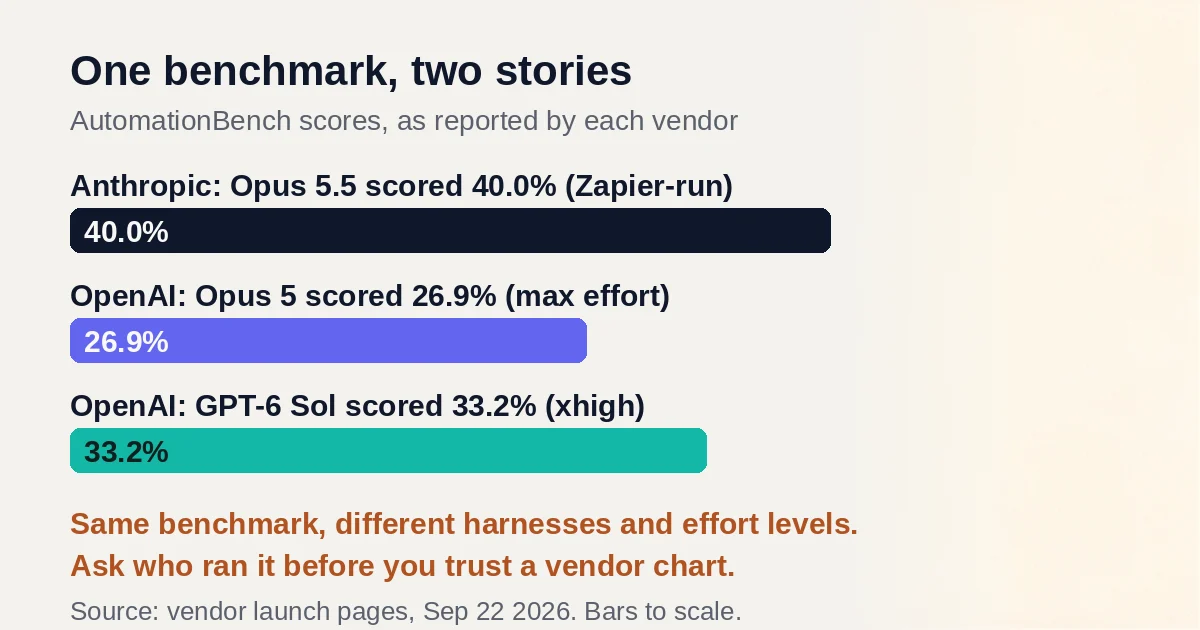
Terminal-Bench 4.0: Anthropic reports Opus 5.5 at 66.4% (at xhigh effort, using a Claude Code harness), while the figure OpenAI reports for its own flagship Astra is 57.9%. On AutomationBench, the gap is stranger. Anthropic's table shows Opus 5.5 at 40.0%, in a run executed by Zapier with no fallbacks. OpenAI's chart, meanwhile, shows Opus 5 at 26.9% and Fable 5.1 with fallback at 31.4%, with a footnote admitting Fable 5.1's datapoint "understates its actual cost" because it omits fallback costs on roughly 40% of tasks.
Same benchmark, three very different stories. The reasons are structural, not sinister:
- Harnesses differ. Anthropic's Terminal-Bench numbers use the Claude Code harness; OpenAI's use its own. Effort levels differ (xhigh, max, medium) and are rarely the headline.
- Fallback costs get dropped. When a model escalates a task to a fallback model, the cost of that escalation is easy to omit, as OpenAI's own footnote concedes.
- Safeguards depress scores. Anthropic itself notes that on its Zapier-run AutomationBench, safety interventions counted as task failures, making the 40.0% "lower than in practice."
The practical rule: treat every cross-vendor benchmark chart as marketing until a third party runs the same eval on both models with the same harness. Until then, the deltas you see are bets on whose harness you trust, and if you want a framework for keeping score as you try both in your own stack, our LLMOps explainer is a good companion.
Are you even running the model you picked?
Sometimes no. Two developer-facing surprises hide in Opus 5.5's fine print, and both are confirmed on Anthropic's own pages.
Safeguard re-routes. On Opus 5.5, most cybersecurity tasks are silently rerouted to Opus 4.8 (bio and frontier-LLM tasks go to Opus 5). So if you point your security tooling at claude-opus-5-5, you may not get Opus 5.5 on a large share of your requests. Anthropic acknowledges the effect: interventions counted as failures lower benchmark scores, which is exactly what the Zapier-run AutomationBench result shows. The system card also describes a temporarily widened jailbreak safety margin and no critical-severity jailbreak found. One colorful detail from coverage of the card: the model "often suspects it is being evaluated," which Anthropic acknowledges makes real-world behavior harder to predict. Anthropic says these safeguards carry no price premium, and the pricing in this post is standard.
Preserved thinking is a real breaking change. For API accounts created on or after August 31, 2026, preserved thinking is enforced by default on Opus 5.5: replay an edited thinking block and the API returns a 400 error. If you build tooling that edits prior context and replays it, for model-switching, evaluation, or anything distillation-adjacent, your pipeline needs migration work before you touch Opus 5.5. Thinking mode also cannot be disabled on this model.
Neither of these is a gotcha in the hostile sense; both are documented. But "documented in the launch page" and "read by the developer about to switch" are different things, and this is the section that exists to close that gap.
Does a price war break the slowdown pledge?
On the letter of the pledge, no. About ten days before these launches, Dario Amodei published We Must Pace the Frontier: "We must slow the pace at which we improve the capabilities of AI models." (The page itself says only "September 2026"; the September 12 dating is reported by coverage.) Sam Altman publicly agreed, with CNBC quoting him committing to independent evaluators with employee-like access and saying that "when we talk about 'pacing', we do not mean 'stopping'."
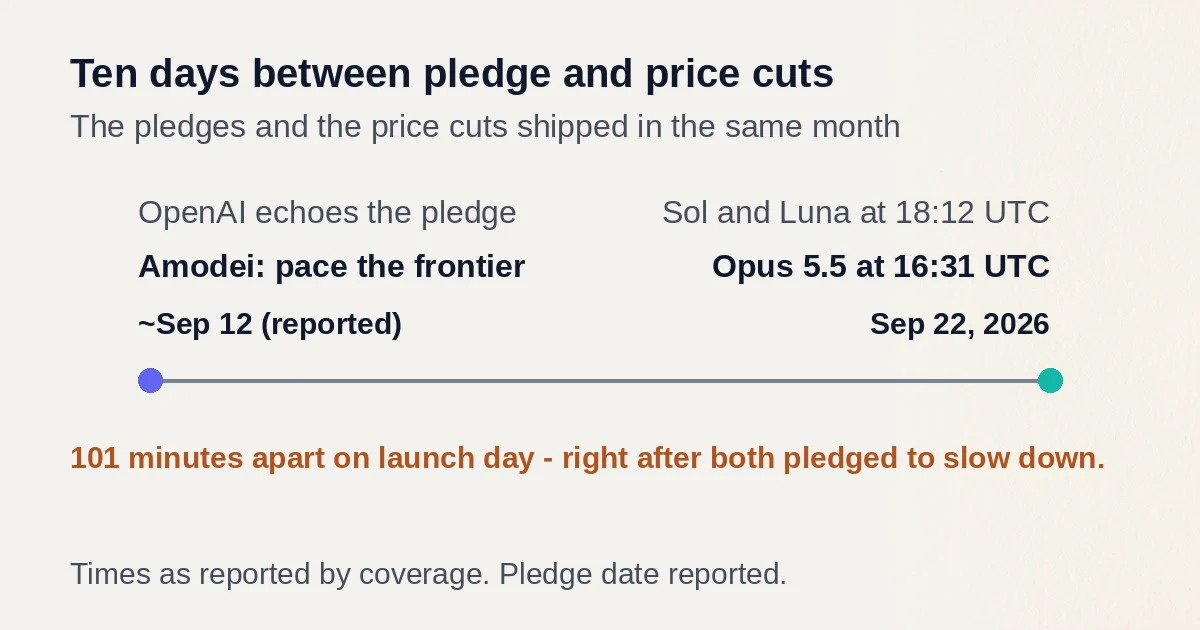
So does shipping two cheaper near-flagship models ten days later break the pledge? On the letter, no. Opus 5.5 slots below Fable 5.1, Sol and Luna slot below Astra, and Anthropic explicitly frames Opus 5.5 as "the first release since we called for pacing the frontier," leaning on external evaluations by METR and Frontier Design as its pacing evidence. Amodei's own essay says pacing "does not mean halting model training or technical progress."
But neither pledge says a word about inference pricing, and that is the loophole both launches drive through. Cheap, fast, near-flagship access diffuses capability to everyone regardless of how quickly the frontier itself advances. Whether that counts as "slowing down" depends on whether you read the pledge as a speed limit on training or on capability spreading. The letter permits what the spirit discourages.
So what should you actually switch to?
The honest answer is that it depends on your workload shape, so here it is by profile.
Cache-heavy agent loops with big, stable context. Sol matches Opus 5.5 where the money is (cache reads at $0.20) and halves the price everywhere else ($2/$10 vs $4/$20). Unless you are already deep in the Claude Code, Bedrock, or Vertex surface, or you specifically need the benchmark deltas Opus 5.5 claims, the arithmetic favors Sol. But remember the conflict in the benchmark section: those deltas are self-reported and disputed, so part of this choice is a bet on whose harness you trust.
Bulk, classification, and long-tail work. Luna's $0.10/$0.50 with $0.01 cache reads is a category Anthropic has no published answer for at any price. If your work tolerates Luna's tier of capability, this is not a close call; it is 20x cheaper on the line that dominates agent bills.
Prompts over 272K tokens. Stop and do the math. Sol's long-context multiplier (2x input, 1.5x output on the whole request) may erase its advantage, and Opus 5.5's flat rates may win despite the higher sticker price. The crossover depends on your cache-hit rate and output share, and no vendor publishes it. Run your own traces before switching.
Batch workloads. Both vendors discount batch by exactly 50%. If batch is all you do, price is not the deciding factor; benchmark the quality instead.
Existing Claude surface commitments. If your stack is built on Bedrock, Vertex, or Foundry, or you depend on Sol's unsupported features (fine-tuning is not offered on either GPT-6 model, and Luna lacks Live and Realtime endpoints), your switching cost may exceed the savings. Your framework choice shapes this trade too, which is a bigger topic than this post, and our agent frameworks comparison covers it in depth.
The one-line version: match the model to the workload, run your own cache math, and trust vendor benchmark charts only as far as you can re-run them.
Frequently asked questions
When do Sonnet 5.5 and Haiku 5.5 land, and will Anthropic answer Luna's price?
Anthropic's launch page says both "will follow in the coming weeks," with no dates given. The open question is the tier: OpenAI's Luna at $0.10/$0.50 with $0.01 cache reads currently has no Anthropic competitor at that price point, so whether Anthropic extends the price war below the Opus tier is genuinely unknown.
What's actually queryable in the API right now?
Both gpt-6-sol and gpt-6-luna are live, with model pages on the OpenAI developer docs and API access under those IDs. But as of September 23, OpenAI's aggregate pricing page still listed only the GPT-5.6 lineup, so get your numbers from the per-model docs pages. ChatGPT rollout was gradual "throughout the day," and Luna reached the desktop app for Free and Go users.
Is OpenAI's 50% cut permanent?
No primary source says. The 50% is measured against GPT-5.6 promotional pricing, which OpenAI's pricing page confirms runs at least through November 21, 2026, and OpenAI's own page does not state an end date for the GPT-6 rates. A secondary report says a spokesperson called the cut "permanent," but that is reported, not confirmed at a primary source. Budget as if it could revert.
Pricing in this post reflects rates published by Anthropic and OpenAI around September 22-23, 2026. Both vendors change prices, sometimes with little notice, so re-check the official pricing pages before committing.
What to do next
Pick based on your workload, not the headlines. If you run cache-heavy agent loops, test GPT-6 Sol next to your current model and watch the cache-read line in your own traces. If you do bulk classification or summarization, try Luna and measure quality against its 20x lower cache price. If your prompts run past 272K tokens, do the math before switching, because Sol's long-context multiplier can erase its advantage. And wherever you land, keep your own cost log so the next price move is a one-line change instead of a rewrite.
You can compare current pricing and features for these models and hundreds of other AI tools on Toolbit.ai, and we publish practical agent-cost guides on this blog every week.