On September 20, 2026, Alibaba's Qwen team released Qwen-Image-2.1, a fully open-weight image model that handles both text-to-image generation and image editing in a single checkpoint. The weights are on Hugging Face, plus ModelScope, GitHub, and a hosted demo, and there is no API-only tier hiding the model behind a paywall. It generates native 2K images, produces real transparent RGBA output, and accepts up to 10 reference images for edits and compositions. The official announcement calls it compact and unified, and for once the marketing words mostly match the shipped thing.
In short:
- Released on September 20, 2026, and fully open-weight - no API-only tier.
- One checkpoint does generation and editing. You do not pick between two models.
- Native transparent RGBA output, including subject cut-outs from regular photos.
- Up to 10 reference images per edit or composition.
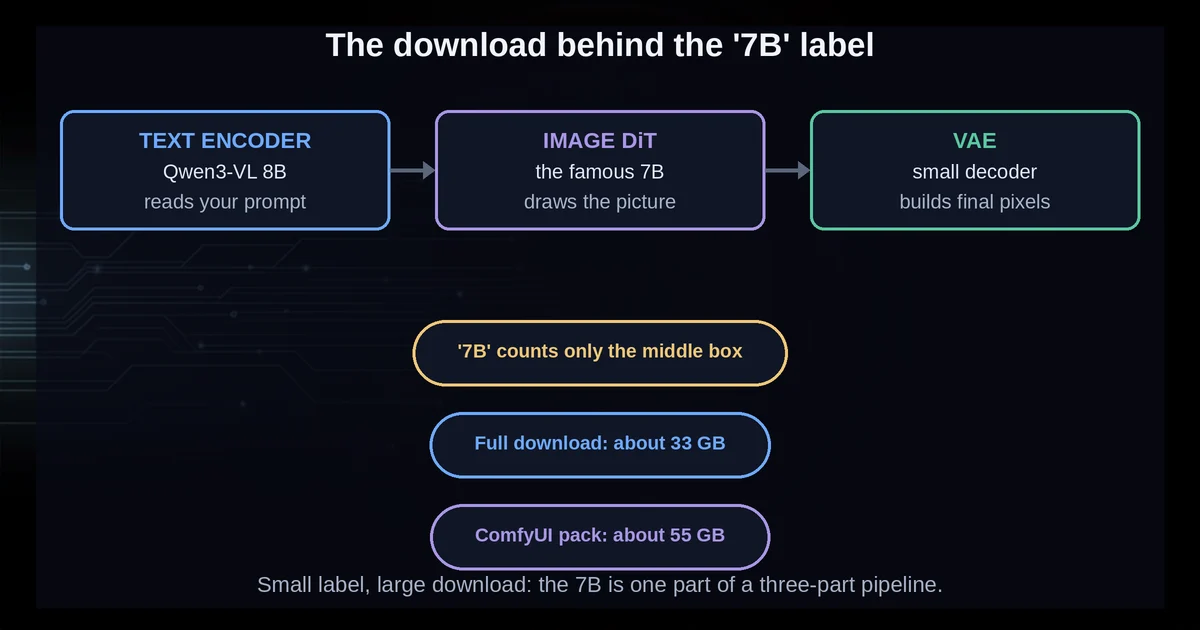
- "7B" is only the image transformer. The full download is about 33 GB.
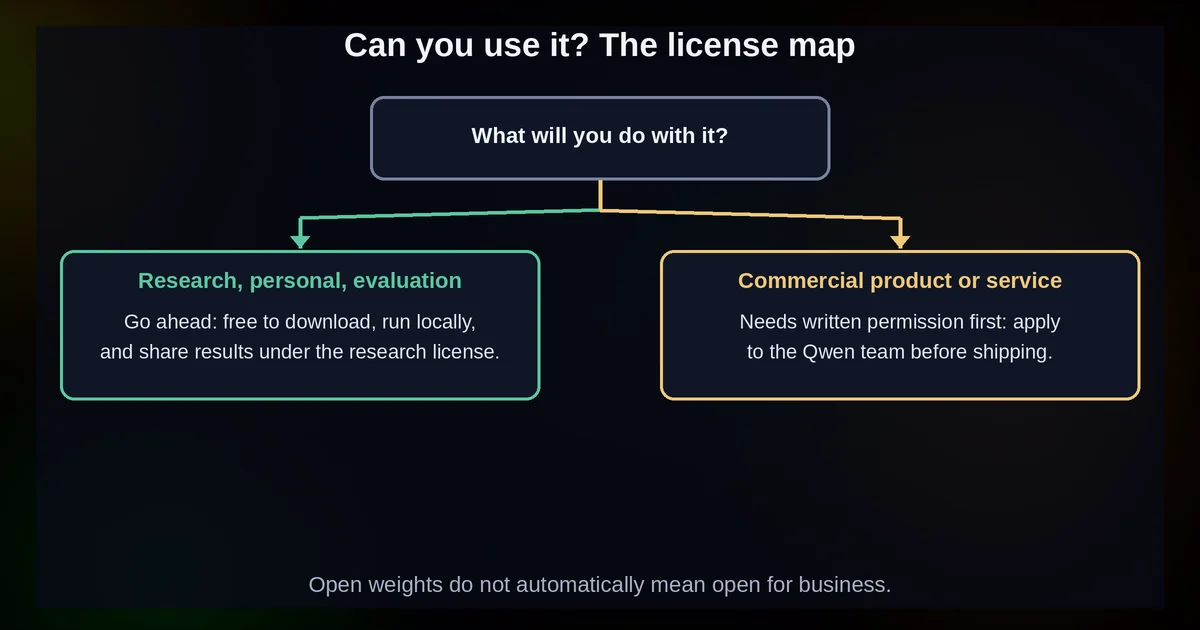
- The Qwen Research License is non-commercial; business use needs an application.
What exactly shipped, and how open is it?
Three primary sources tell the same story: a blog post dated September 20, a GitHub repo with the full LICENSE text, and weights listed as fully open on Hugging Face. What shipped is a complete set of weights for a single image model, plus a choice of repos and frameworks: run it in ComfyUI, Diffusers, or vLLM, each with day-one recipes. When you download it, there is no API-only tier and no hidden quantization you must pay to unlock.
What can one checkpoint actually do?
One download covers three jobs that used to need separate models: generating images from text, editing existing images from plain-language instructions, and pulling clean subject cut-outs with transparent backgrounds straight from regular photos. Concretely, the model handles: the major text-to-image workflows, instruction-based edits that keep the rest of the picture intact, mask-guided local edits that change just the marked region, and the new unified capability Qwen calls generation and editing in one pass.
Specifically, the model supports:
- Native 2K output across multiple aspect ratios.
- Transparent RGBA generation - images with real alpha channels, not fake transparency via post-processing.
- Up to 10 reference images for multi-subject composition: group portraits, virtual try-ons, room redesigns.
- KV-cache-driven speedups for faster generation.
Why does "7B" undersell - and oversell - the download?
The famous "7B" is the image transformer only. One download actually contains three parts:
| Part | What it does | Size |
|---|---|---|
| Text encoder (Qwen3-VL 8B) | Reads and understands your prompt | a few GB |
| Image transformer (the famous 7B, 32 layers) | Actually draws the picture | the bulk of the download |
| VAE (small decoder) | Turns hidden representations into final pixels | the smallest part |
Two honest readings of that table. It undersells the model: "7B" sounds small, and the image transformer genuinely is compact and fast for what it does. It oversells the download: you are not pulling a 14 GB file, you are committing a large chunk of a drive, and the popular ComfyUI repackage adds about two-thirds more by bundling quantized variants alongside the originals.
Is it really open? The license catch
The verdict on "open": the weights are open, the license is not. The Qwen Research License covers research and evaluation use only. The LICENSE file spells out: research or evaluation purposes only. Commercial use requires a written application to the Qwen team first.
What's genuinely new vs Qwen's own earlier models - and what's just claimed?
The benchmark claim is Qwen's, and only Qwen's. The blog shows Qwen-Image-2.1 beating most closed models on Qwen-Image-Bench. But that result appears as a chart image on Qwen's own blog, with no numbers you can read out and no independent verification anywhere yet. The Hugging Face model card carries no benchmark table at all, and press coverage notes that independent benchmarks are still pending. Treat "beats closed models" as the maker's claim until someone else measures it. If you are weighing closed options anyway, our AI image generator guide covers the current field, and ChatGPT's image editing tools show how far hosted editors have come.
What is genuinely new: folding RGBA generation, editing, and cut-out extraction into the same compact checkpoint as regular generation, and doing it at 2K natively. What is quietly not new: transparency itself, which Qwen's own December 2025 model already had. What is genuinely uncertain: every quality comparison against closed rivals.
How to try it this weekend
Open ComfyUI, and the model arrives as a roughly 55 GB package with quantized variants you can swap in for smaller cards. The steps are:
- Update ComfyUI to the latest version.
- Install via the built-in manager or download the ComfyUI package from the official blog post.
- Drop in your prompt, then start with generation before trying edits and cut-outs.
A word on hardware: press coverage mentions an RTX 3090-class card as a comfortable baseline, but that figure comes from one outlet's testing notes, not Qwen's own docs. Treat it as a useful signal, not a promise.
Frequently asked questions
Can I use Qwen-Image-2.1 commercially?
No. The Qwen Research License allows research and evaluation use only. You can freely download, run, and share results for experiments and personal work, but any commercial product or service needs written permission from the Qwen team first - apply before you ship, not after.
How is it different from Qwen-Image-Layered?
Qwen-Image-Layered (December 2025) is a 20B specialist for multi-layer transparent image generation under Apache 2.0. Qwen-Image-2.1 is a 7B all-in-one - generation, editing, and subject cut-out in one checkpoint - but under the research-only license. One is a layering specialist with permissive terms; the other is the all-in-one model with a stricter license.
One last note: license terms are as published by the Qwen team around September 2026 and can change - confirm on the official site before you rely on them for a commercial decision.