What Vibe Coding Actually Means
From a Meme to a Development Style
The term was coined by Andrej Karpathy in early 2025 to describe a specific workflow: a developer describes what they want, an AI assistant generates the code, and the developer moves on without deeply reading or reviewing what came out. It caught on so fast that it was named Collins Dictionary's Word of the Year for 2025, after search interest for the term spiked by roughly 6,700% in a single spring.
Why It Spread So Fast
The appeal is obvious. Development timelines that used to take months can now take days, and people without deep technical backgrounds can build working software for the first time. By most projections, the large majority of professional developers now use AI coding tools daily, and a large share of all new code being written globally is AI-generated rather than hand-typed.
Why the Debt Piles Up So Quietly
Duplication, Not Innovation
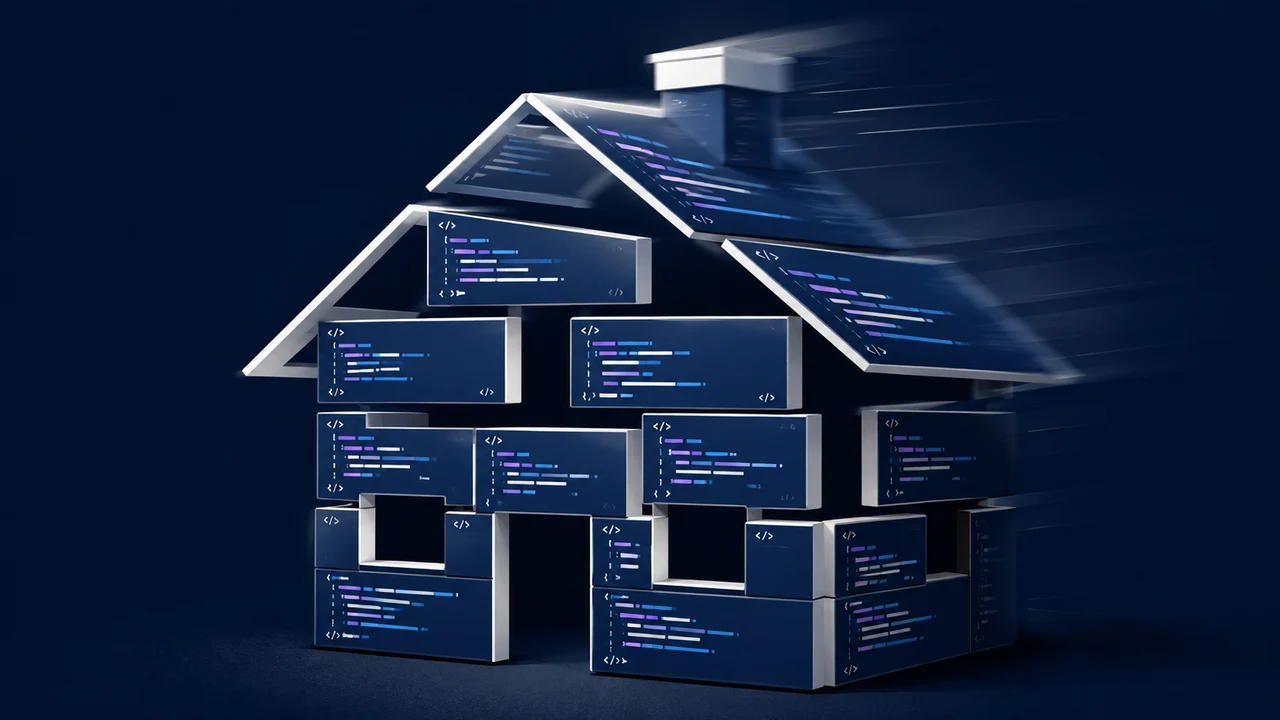
AI tools are very good at solving the exact prompt in front of them, and not very good at noticing that a similar function already exists somewhere else in the codebase. The measurable result:
- Code duplication increased by roughly 48% following widespread AI tool adoption
- One analysis found duplication running at four times the rate seen in hand-written codebases
- Refactoring activity, the work that cleans duplication back up, dropped by around 60% over the same period
The Bug Rate Nobody Priced In
The productivity story gets more complicated once bugs enter the picture:
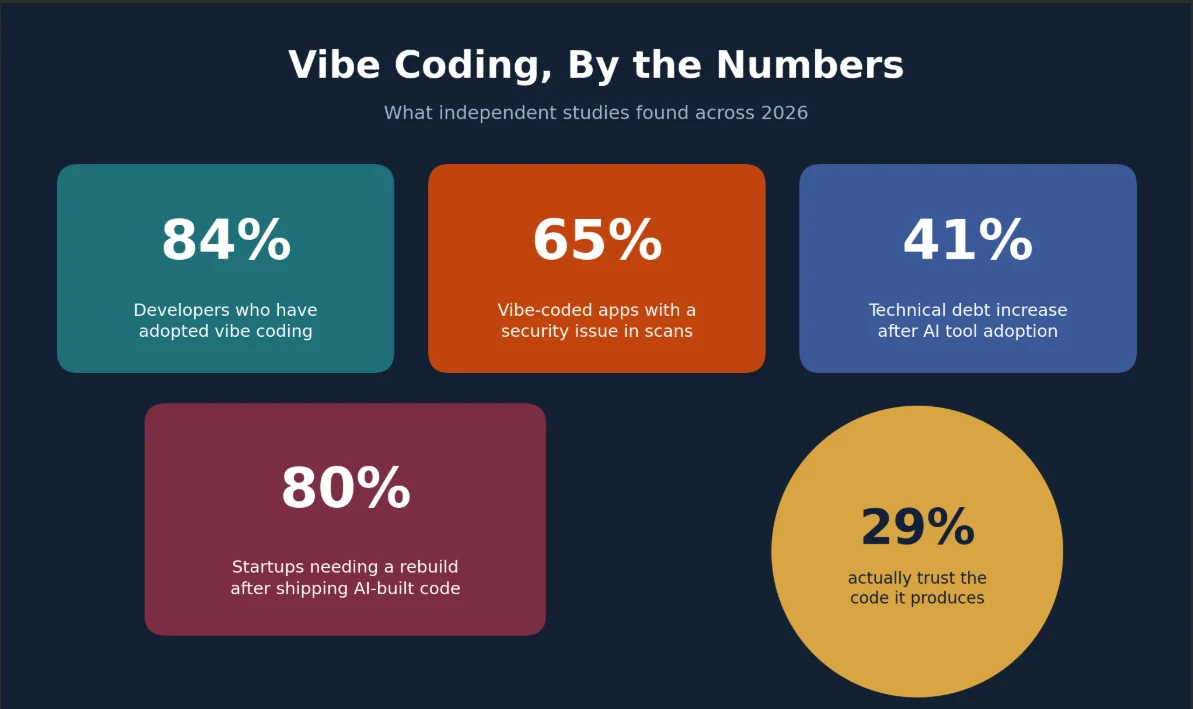
- A study of roughly 800 developers found that initial speed gains from AI coding tools were neutralized by a 41% increase in bug rates
- A review of 470 open-source pull requests found AI-coauthored code carried 1.7 times more major issues than human-written code, with logic flaws up 75% and readability problems roughly tripling
- Across a broader analysis of 8.1 million pull requests, measured technical debt rose 30 to 41% after AI tool adoption took hold
The Hidden Security Proble
What Independent Scans Found
Security researchers who went looking for problems in production vibe-coded software didn't have to look hard:
- A scan of more than 1,400 vibe-coded production applications found 65% had security issues, with 58% containing at least one critical vulnerability
- Roughly 45% of AI-generated code fails even basic, automated security checks, not advanced penetration testing
Real Numbers From Real Products
- An audit of 50 vibe-coded applications found 88% had a core database security setting entirely disabled, not misconfigured, simply switched off, meaning the database would return any record to any query with no enforcement at all
- Of 1,645 publicly showcased apps built on one popular AI app-building platform, 170 had critical security failures visible from the outside, on live products with real users
The Rebuild Wave Already Underway
8,000 Startups, One Common Story
By the end of 2025, roughly 10,000 startups had used AI coding tools to ship production applications. By mid-2026, more than 8,000 of them needed either a partial rebuild or dedicated rescue engineering just to keep operating.
What Rescue Engineering Actually Costs
That work isn't cheap or quick:
- Rescue engineering costs typically run between $50,000 and $500,000 per project, depending on how far the app had grown on top of its original shaky foundation
- Industry-wide cleanup costs are estimated somewhere between $400 million and $4 billion
- "Rescue engineering" and "vibe-coded debt" have become real terms inside job descriptions, something that didn't exist as a category two years ago
A Composite Example
Scenario: A small startup built its entire booking platform using an AI app-building tool over six weeks, shipped to real customers, and grew to several thousand users within its first quarter.
What went unnoticed: The database's row-level security had never been enabled, meaning any user could technically query any other user's booking records through the public API.
What it took to fix: A rescue engineering team spent five weeks re-architecting the data layer and adding proper access controls, at roughly a third of the platform's original development cost, before new investors would sign off on the product.
The lesson: Speed to launch and speed to a secure, maintainable product turned out to be two very different timelines.
Where Teams Get This Wrong
Common Failure Points
- Treating a passing test suite as proof the code is safe, when test coverage on AI-heavy projects often runs far below industry norms
- Merging AI-generated utility functions without checking whether an equivalent already exists elsewhere in the codebase
- Assuming a working demo means production-ready security, especially around database access rules
- Cutting junior hiring without a plan for who builds the debugging expertise those juniors would have developed
The Pattern Behind the Failures
Every one of these comes from the same root cause: treating AI-generated code as a finished answer instead of a first draft that still needs a human to actually read it.
What's Next
Two Things Worth Watching
- Whether "rescue engineering" becomes a standard, permanent specialty inside development shops, the way security auditing did a decade earlier
- Whether the junior hiring slowdown starts showing up as a measurable skills gap once today's AI-generated debt needs experienced hands to untangle it
The Real Takeaway
Vibe coding didn't fail as a technique. It succeeded exactly as designed: it made writing code fast. The debt crisis of 2026 is what happens when speed outruns the review process that was supposed to keep up with it.
Sources & References
- RockB: on the vibe coding technical debt crisis and maintenance cost data: baeseokjae.github.io
- Keyhole Software: 2026 vibe coding adoption, productivity, and code quality data: keyholesoftware.com
- The Vibelog: on the 90-day technical debt reckoning and junior hiring data: thevibelog.dev
- daily.dev: vibe coding explained, adoption figures, and industry commentary: daily.dev
- Kingy AI: on the state of vibe coding and the term's origin: kingy.ai
- Creatr: on the 8,000-startup rebuild wave and rescue engineering costs: getcreatr.com
- Pixelmojo: on the 84% adoption, 45% vulnerability data, and the hollowed-out career ladder: pixelmojo.io
- IP With Ease: on Anthropic's 2026 Agentic Coding Trends Report and session-length data: ipwithease.com
Figures and statistics reflect research and reporting current as of mid-2026. Studies on this topic vary in methodology and sample size, so treat exact percentages as directional rather than universal. Confirm the latest data directly with the cited sources before republishing.