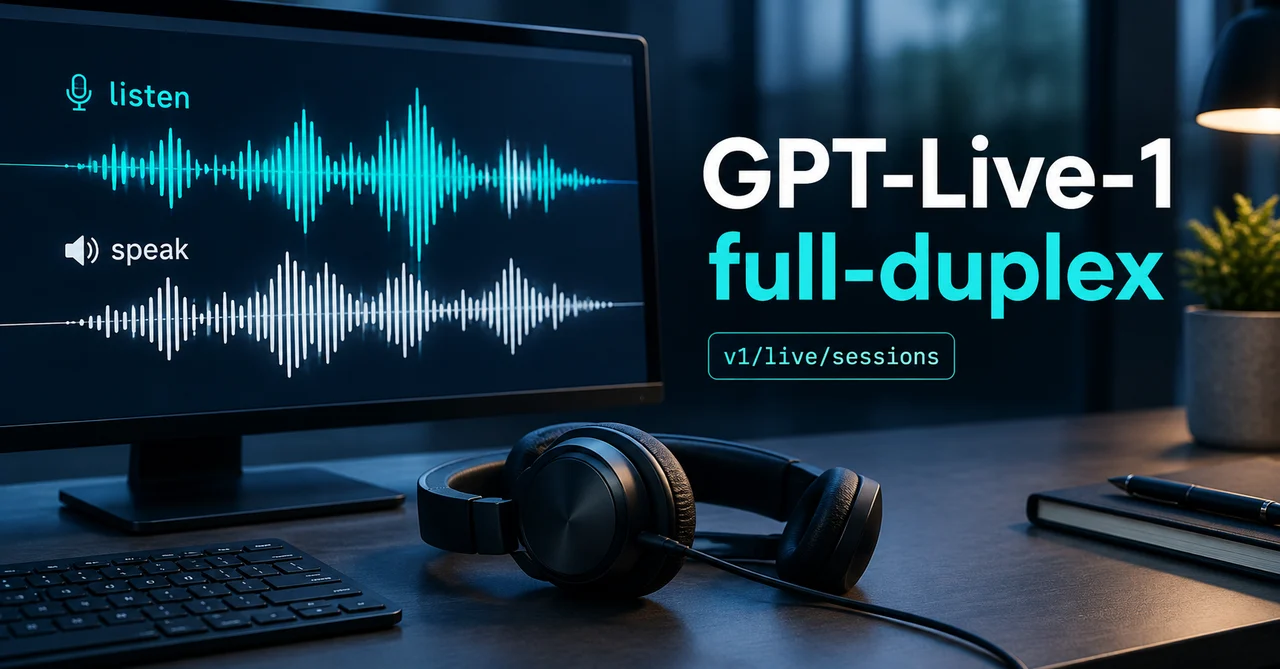
OpenAI put GPT-Live-1 in the API on September 10, 2026 - a full-duplex voice model that listens and speaks at the same time over v1/live/sessions. Price the voice front-end at $0.05 per minute (billed per second). Backend models and tools bill separately. The free API tier is unsupported. This is a developer voice layer for agents and phone workflows - not Agents API sandboxes, ChatGPT Work, or consumer voice mode.
In short
- Shipped in the API Sep 10, 2026; model ID
gpt-live-1(OpenAI launch post) - Full-duplex voice front-end vs cascaded STT-LLM-TTS
- Backend delegation via Responses (hosted) or your client agent (for example Astra-class depth)
- $0.05/min covers the voice session only; backend, tools, and Presence are separate
- Telephony, broader voices, native transcripts, keyword biasing, turn detection
- OpenAI reports +30 percentage points on Full Duplex Bench vs GPT-Realtime-2.1
- Keep cascade, Vapi, or LiveKit when orchestration or media still wins
What is GPT-Live-1 in the API?
GPT-Live-1 brings ChatGPT-class natural voice to apps as an API model. Users can talk over the agent, correct mid-sentence, or add a detail without waiting for a hard turn boundary. You steer tone, pace, and style through the system prompt.
Session creation uses the Live endpoint only:
- WebRTC:
POST /v1/live/sessions - WebSocket:
wss://api.openai.com/v1/live/sessions
Modalities are audio and text in and out. Image and video are not supported on the model card. The published knowledge cutoff is July 31, 2025. Full model details live on the GPT-Live-1 model page.
If you already ship phone or mic agents, think of Live-1 as the speaking-and-listening layer - not a full product stack by itself. You still choose media transport, telephony glue, tool permissions, and how hard the backend thinks on each turn.
OpenAI also expanded voice options (accents, dialects, languages) with more coming later. Verify the live catalog before you promise a market. Enterprise teams can look at Presence, which sits on top of GPT-Live-1 for realtime agents that use company systems and escalate to people - eligibility and pricing are sales-led, with no public sticker on the launch post.
How does full-duplex change voice-agent architecture?
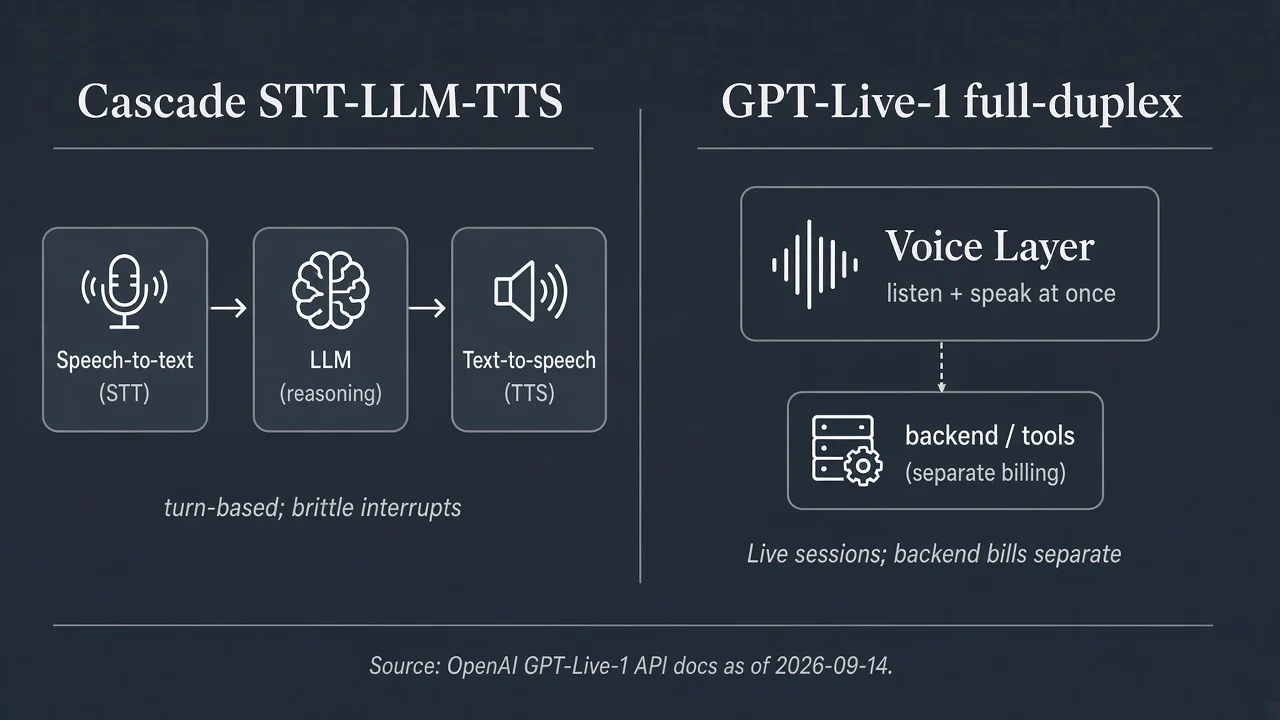
Most production voice agents still look like a cascade:
- STT turns speech into text.
- An LLM decides the next reply (and maybe which tools to call).
- TTS speaks the answer.
Every handoff adds latency. Interruptions become state-machine work: cancel TTS, flush buffers, restart STT, decide whether the half-spoken sentence still counts. That glue is where voice products get brittle.
GPT-Live-1 collapses the voice front-end into one model that listens and speaks together. Conversation can keep flowing while deeper work runs on a backend. That is the architectural break: the voice layer stops being three services that only see partial context, and starts being one duplex channel you can steer with a system prompt.
OpenAI also ships native ASR transcripts plus response text, keyword biasing for domain terms, and turn-detection hooks for logging, UI state, or compliance - even though the model is not turn-based by nature. If your product still needs discrete "user finished speaking" events for analytics or compliance, you can keep those hooks without rebuilding a walkie-talkie turn protocol.
A practical mental model:
| Layer | Job | Typical cost driver |
|---|---|---|
| GPT-Live-1 (front-end) | Natural duplex conversation, interruptions, spoken delivery | $0.05 per minute (voice layer) |
| Backend model / harness | Reasoning, tools, business logic, retrieval | Separate model pricing + your infra |
| Media / telephony / ops | WebRTC, SIP, routing, queues, analytics | Your stack or a platform |
How do you pair GPT-Live-1 with a backend model?
Live-1 is not forced to do all the thinking. OpenAI's live migration guide describes two common patterns:
| Mode | Who runs the brain | When it fits |
|---|---|---|
| Responses delegation | Hosted backend model + tools via Responses | You want OpenAI to run the reasoning path with less custom glue |
| Client delegation | Your orchestrator / existing agent harness | You already own tools, permissions, and durable state |
Match depth to the turn. Launch examples (OpenAI's framing): Luna-class models for high-volume tasks like scheduling updates; Astra-class models when the call needs deeper reasoning. Third-party backends are allowed too.
Your app still owns permissions, confirmations, and durable state. Split prompts cleanly: session instructions for spoken style and turn behavior; backend instructions for tools and business logic. Do not paste one mega-prompt into both places.
Customer quotes on the launch page (names and titles only) point the same way - simpler duplex stacks, better turn-taking on phone flows, and fewer interruptions during thinking pauses. Treat those as vendor-shared stories, then measure your own calls.
A simple cost-tuning habit: use a lighter backend for "confirm my reservation time," and a heavier backend for "diagnose this account issue and call three tools." Duplex keeps the phone line feeling alive either way; the backend bill is where depth shows up.
What does $0.05/min include - and what does it leave out?
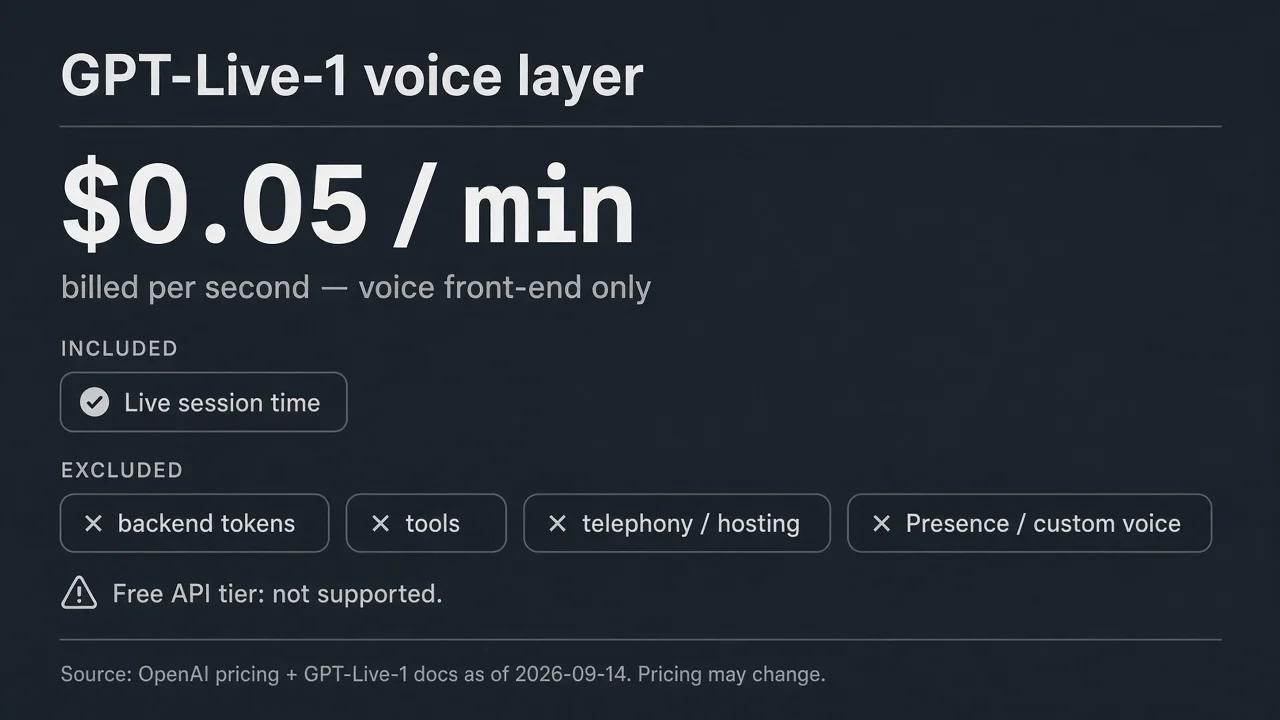
OpenAI prices GPT-Live sessions for gpt-live-1 at $0.05 per minute. Billing is per second, without rounding up to a whole minute. See the model page and API pricing.
| Included in $0.05/min | Not included |
|---|---|
| Front-end voice session time | Backend model tokens |
| Duplex listen + speak audio path | Tool calls (search and others) |
| Per-second billing (no whole-minute round-up) | Your telephony, hosting, and platform fees |
| Presence / custom voice (sales-led; no public sticker on the launch post) |
WebRTC caveat from the voice WebRTC guide: creating a session bills 15 seconds of voice duration up front, then credits that against the running session. It is not an extra forever charge - still plan for it in unit tests.
Rate limits are measured in concurrent sessions, not tokens. Free tier: Not supported. Paid tiers scale from Tier 1 at 25 concurrent sessions up to Tier 5 at 500 (check the live model table before you size a call center).
Pricing and limits can change - re-check OpenAI before you lock unit economics.
What do the reported evals actually say?
Keep product claims and eval numbers in separate buckets.
OpenAI-reported: On Full Duplex Bench, GPT-Live-1 improves by 30 percentage points over GPT-Realtime-2.1, with gains framed around turn-taking latency and interactive behavior. OpenAI also describes pairing Live-1 with GPT-6 Astra (medium) as #1 on Tau3 for frontier voice-agent end-to-end tasks. Useful directionally - not a substitute for your own recordings.
Speak-reported (early evaluations): Andrew Hsu (Co-founder & CTO, Speak) is quoted that Live-1 cut interruptions during thinking pauses by almost 80% versus previous turn-based systems. Promising for tutoring and any flow where users need space to think. Still a customer + OpenAI shared result.
Do not invent Full Duplex Bench row tables from secondary blogs. For shipping decisions, measure interruption rate, time-to-first-audio, tool success on hesitant speech, and hang-up rate on telephony.
When should you still use cascaded STT-LLM-TTS, Vapi, or LiveKit?
Live-1 is a strong default for natural duplex conversation. It is not always the whole answer.
| Approach | Keep it when... | Watch-outs |
|---|---|---|
| Cascaded STT-LLM-TTS | You need best-of-breed STT/TTS, strict turn protocols, or you already paid for a stable pipeline | Interrupt state machines stay brittle |
| Vapi-style platforms | You need orchestration, multi-vendor routing, and phone-ops glue | Live-1 is a model underneath, not the ops layer |
| LiveKit-style stacks | You need WebRTC rooms, media transport, and custom clients | Live-1 is the voice layer, not a full app stack |
| GPT-Live-1 | Interruptions, mid-sentence corrections, and phone-feel matter most | Backend + concurrency limits still yours to size |
Migrate from Realtime only when the conversational gain justifies a prompt split and event rewiring. The migration guide is the checklist - not a wholesale paste.
Quick rule of thumb: if your pain is robotic interruptions and mid-sentence corrections, evaluate Live-1 first. If your pain is multi-vendor routing, queueing, or custom WebRTC rooms, keep the platform or media layer and swap the speech model underneath when ready.
FAQ
Does $0.05/min include the reasoning model and tools?
No. The $0.05 per minute covers the front-end voice session only. Backend model tokens, tool usage, your telephony or hosting, and Presence or custom voice (sales-led) bill separately. Session time is billed per second with no whole-minute round-up.
Can I call gpt-live-1 from Chat Completions or the Realtime endpoint?
No for session creation. GPT-Live-1 sessions are created on Live v1/live/sessions (WebRTC or WebSocket). Use Chat Completions or Realtime for other models and stacks - not as the host for a Live-1 duplex session.
Does GPT-Live-1 support phone / telephony agents?
Yes. OpenAI lists telephony among the API release strengths for full-duplex voice agents on phone calls (reservations, support, and similar flows). You still bring SIP or PSTN glue, carrier minutes, and compliance yourself.
Is GPT-Live-1 the same as ChatGPT voice, Work, or Agents API sandboxes?
No. GPT-Live-1 is the developer voice model on /v1/live/sessions. ChatGPT voice is a consumer surface. Work is agent mode for finished docs and Sites. Agents API sandboxes are cloud code environments on /v1/agents/sessions - a different product story (hosted sandboxes guide).
Are the Full Duplex Bench +30pp numbers independent third-party results?
No. The +30 percentage point Full Duplex Bench gain versus GPT-Realtime-2.1 is OpenAI-reported. Speak's almost-80% fewer interruptions figure is an early customer evaluation shared via the launch. Run your own scripts before you bet a call center on either number.
What to do next
- Spin up a Live session with
gpt-live-1and a short system prompt. - Decide cascade vs Live-1 for your interruption-heavy flows.
- Pick backend depth (Responses delegation or your client agent) and keep permissions in your app.
- Measure concurrent-session limits against peak call volume.
- Keep Vapi or LiveKit where orchestration or media transport still pays for itself.
Pricing, rate limits, and voice catalogs can change - confirm on OpenAI's live docs before you ship.