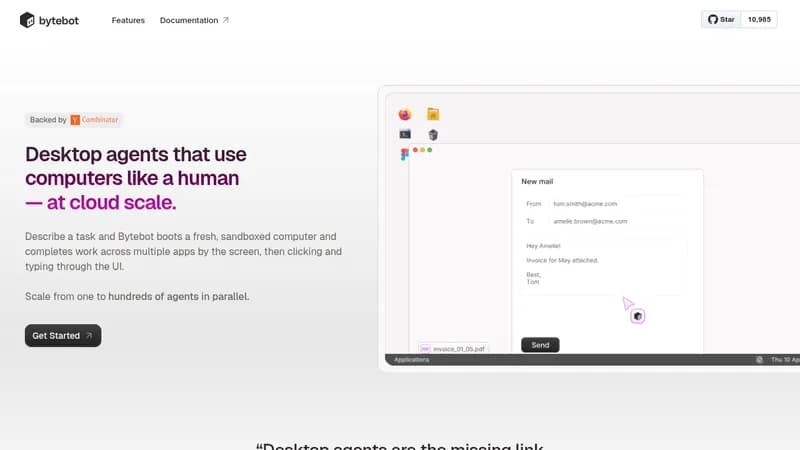
Bytebot is an open-source AI desktop agent that operates a containerized Linux desktop environment to automate complex, multi-application workflows. By interpreting natural language instructions, Bytebot interacts with graphical interfaces using a virtual trackpad, keyboard, and screen—enabling it to click, type, scroll, and navigate any application exactly like a human user.
Key Features
- Complete Virtual Computer: Each instance comes with a browser, file system, terminal, code editor, and password manager. Additional applications can be installed as needed.
- Precise GUI Automation: Bytebot controls the desktop at the pixel level, executing clicks, keystrokes, and scrolls with pinpoint accuracy.
- Guided Recovery & Human-in-the-Loop: Tasks run autonomously but pause when assistance is required, allowing users to take over, complete a step, and resume the agent.
- Audit Logs: Every action is captured with before-and-after screenshots for transparency and debugging.
- Self-Hosted & Portable: Runs via Docker on local machines, Railway, or cloud platforms (AWS/GCP/Azure), with no external dependencies—your data remains on your infrastructure.
Use Cases
- Secure Logins with 2FA: Bytebot can use Bitwarden or 1Password to autofill credentials and handle two-factor authentication steps.
- Development Workflows: It can scaffold projects, install dependencies, edit code in VS Code, and verify changes in a browser—all from a single command.
- Technical Research: Bytebot researches online, downloads PDFs, and extracts structured summaries from complex documents.
AI Provider Support
Bytebot integrates with Anthropic Claude, OpenAI GPT models, Google Gemini, and any LiteLLM proxy. Users provide their own API keys.
Key Benefits
- Open source and self-hosted for full data control
- Natural language commands with no coding required
- Handles secure logins and 2FA via password managers
- Fine-grained screen control with human-like interaction