You have probably read some version of this sentence: "75% of resumes are rejected by applicant tracking software before a human ever sees them." It shows up in career blogs, in AI resume tool marketing, and, ironically, in the answers chatbots give when you ask how to get hired. It is terrifying, it is memorable, and it is not backed by any study. People who tried to trace the number landed on a 2012 sales pitch from Preptel, a resume-optimization company that folded the following year and never published a methodology.
The myth survives because it sells things: ATS checkers, "beats the bot" resume templates, keyword-stuffing guides. And it distorts what tailoring actually is. If a robot is rejecting three quarters of applicants, then the obvious move is to game the robot, white text and keyword spam and all. But that is not how hiring works, and the past few years of recruiter research say so clearly. The robots mostly rank and sort. Humans still decide.
So this is the plan: separate what an ATS actually does from what the fear economy claims, then walk through real tailoring with tools you already have, Teal as the tracker and match engine, a chatbot as the drafting assistant, and one non-negotiable invention check that catches the fake metrics before a recruiter does.
What an ATS actually does (and the myths to drop)
An applicant tracking system is a database with a workflow attached. It collects applications, parses your resume into structured fields like titles, employers, dates, and skills, and lets recruiters search and sort the pile. Jobscan's ATS usage report, which audits Fortune 500 career sites, detected an ATS at 97.8% of them. So yes, software almost always touches your resume first at a large employer. That part of the fear is real.
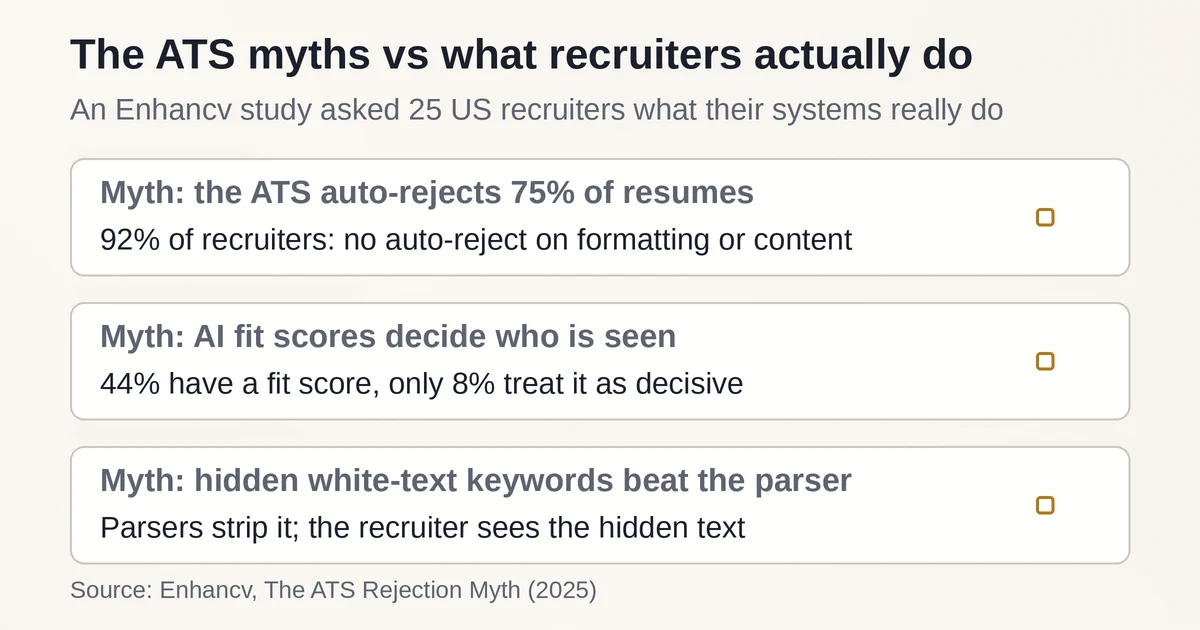
The rejection part is not. When Enhancv interviewed 25 US recruiters across more than ten ATS platforms (Workday, iCIMS, Greenhouse, Bullhorn, BambooHR, SuccessFactors, and others) for its study The ATS Rejection Myth, 92% said their system does not automatically reject resumes based on formatting, content, or design. Only two recruiters, both handling high-volume entry-level roles, had content-based auto-rejection switched on at all, and even theirs was a crude floor for wildly mismatched applicants, not a connoisseur of bullet points. Meanwhile 44% had an AI "fit score" available, but only 8% treated it as a decisive filter. Most ignored it entirely.
That leaves one genuine auto-filter, and it is not the parsing engine. It is the knockout questions on the application form: "Are you legally authorized to work in the US?", "Do you hold a current RN license?", "Are you willing to relocate?" Every recruiter in the study used them. Answer one wrong and you can be filtered instantly, resume quality irrelevant. If you have ever been rejected five minutes after applying, that is usually what happened, and it had nothing to do with your font choice.
Here is the myths list, updated for 2026:
| The myth | What actually happens |
|---|---|
| The ATS auto-rejects 75% of resumes | Traceable to a defunct vendor's 2012 marketing. Systems rank and store; humans reject. |
| You need a 90%+ score from an ATS checker | Third-party scanner scores are the vendor's own metric, not the employer's. Even Jobscan calls 75%+ a good match. |
| White text with job keywords fools the parser | Parsers strip formatting. The hidden text shows up in the recruiter's view. Candidates get rejected for it. |
| PDFs get rejected | Text-based PDFs parse fine on modern systems. Only image-based or scanned PDFs fail. |
| Keyword stuffing guarantees interviews | Stuffing reads as spam to the human who opens the file, and the file does get opened. |
The real mechanism is quieter and, in a way, harsher: functional invisibility. A recruiter facing 250 applications runs a keyword search, opens the top 20 or 30, and never scrolls to yours. You were not rejected. You were never retrieved. The Harvard Business School and Accenture Hidden Workers report found 88% of executives agreed that qualified candidates get filtered out by rigid exact-match criteria, often just because their resume described the same work with different words.
That is why tailoring works, and it is also why honest tailoring beats gaming. In Jobscan's State of the Job Search analysis of over 2.5 million applications, resumes that included the job's exact title were 10.6 times more likely to get an interview. The mechanism is retrieval: the posting says "program manager," so recruiters search "program manager," and your resume that says "project coordinator" simply does not come back. You are matching vocabulary, not defeating an algorithm.
What real tailoring means: evidence per requirement
Tailoring is not rewriting your resume in the job post's image. It is building a case that you meet the stated requirements, with evidence, in the employer's vocabulary.
Strip any job post down and you get two kinds of claims. Hard requirements: "5+ years managing paid social, experience with GA4, comfortable presenting to executives." And responsibilities that describe the actual job: "own the Q4 campaign calendar, report on channel performance weekly." Real tailoring is an evidence audit against those lines:
- For each hard requirement, is there a bullet on your resume that shows you doing that thing? Not the keyword, the thing.
- For each responsibility, is there an accomplishment that proves you can carry it?
- Where you honestly lack something, does the rest of the resume compensate clearly enough that a recruiter does not have to guess?
Notice what is missing from that list: tricks. No white text, no keyword dumps, no rebranding yourself as something you are not. If the posting asks for Salesforce and you have never touched Salesforce, the correct move is to not mention Salesforce. Teal's own tailoring guide says this almost verbatim: a 75% match with real content beats a 95% match with fluff. It is genuinely refreshing advice from a company that sells a match score.
There is a subtlety in vocabulary matching that keeps it honest. Renaming your headline from "Marketing Specialist" to "Demand Generation Manager" because that is the job you do and the title you are targeting is a clarification, and it is one of the highest-impact edits you can make given that title match alone carried a 10x interview difference in the Jobscan data. Claiming you "led a team of 12" when you led 4 is fabrication, and it will surface in the interview or the reference check. The line between tailoring and lying is whether the underlying facts survive scrutiny.
The workflow: Teal as the tracker, the chatbot as the drafter
Here is the system, end to end. It assumes one master resume that holds everything you have ever done, and a lightweight derived version per application. That structure, a big truthful master and small tailored slices, is what makes this fast instead of miserable.
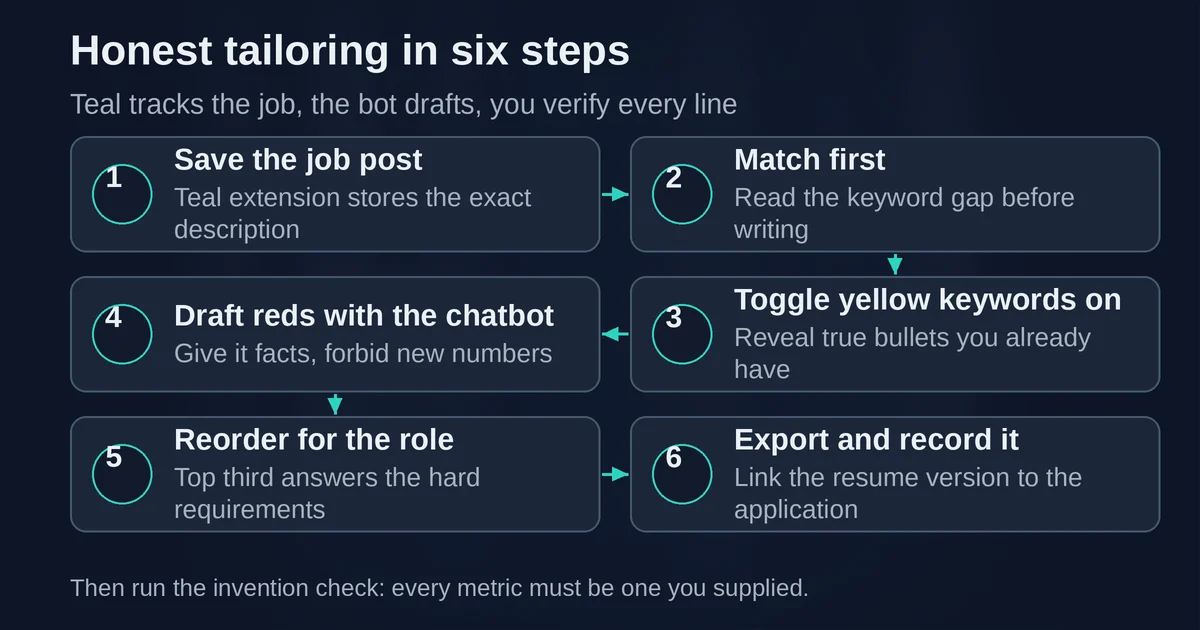
1. Save the job before it disappears. Use the Teal Chrome extension (or paste the posting manually) into the Job Tracker. The description is stored permanently, which matters because postings get pulled down and you will want the exact text later, both for interview prep and to remember what you claimed. Teal's tracker is free and unlimited on every plan, which is why it earns the command-center role here even if you draft elsewhere. It slots neatly into a wider AI toolkit for job hunting if you are also handling LinkedIn rewrites and interview practice.
2. Match before you write. Attach the saved job to your resume and look at Teal's keyword breakdown. On the free plan you get the top 5 keyword insights; Teal+ ($13 a week, $29 a month, or $79 a quarter, an unusual short-cycle ladder the vendor prices by the day) unlocks the full keyword list and a numeric Match Score. Green keywords are already on this resume version. Yellow ones exist in your master resume but are toggled off. Red ones appear nowhere in your material.
3. Toggle yellows on before typing anything. This is the highest value-per-minute step in the whole workflow, and it is the reason a master resume pays for itself. Most of your "tailoring" is just revealing work you already did: the posting wants "email lifecycle marketing," you have a bullet about onboarding drip campaigns, toggle it on. Zero new writing, honest content, match score up.
4. Draft reds and rewrites with the chatbot, not from the chatbot. For genuine gaps, skills you have but never wrote down, you need new bullets. Give the model raw material and a constraint: "Here is the job description. Here are three facts about my work: I ran a weekly performance report for 6 channels, I cut our cost per lead by moving budget out of display in Q2, and I presented monthly to the VP. Draft one bullet per fact using the job post's terminology. Do not add any numbers I did not give you." That last sentence is the entire trick, and we will come back to it. If you are new to steering models this deliberately, the same prompting fundamentals that work everywhere else apply here: specific input, specific constraint, specific format.
5. Reorder for the specific role. The top third of the page gets read; everything else gets skimmed. Move the bullets that answer this post's hard requirements into the top two or three positions of each role. Re-run the match check. Read it once as a recruiter would: can I tell in ten seconds why this person fits this job?
6. Export, name it properly, and record it. Teal exports a text-based PDF, and the tracker lets you link the exact resume version to the application, which permanently answers "wait, which version did I send them?" Name the file something like YourName_CompanyName_Resume.pdf and move on to the next one.
One honest caveat about Match Scores: they are Teal's estimate, not a window into the employer's system. Every third-party score, Jobscan's included, is a simulation. Treat it as a proofreading light for vocabulary coverage, not a verdict. A 68% with truthful content is a better application than a 94% stretched with fluff, because the score is not what interviews you. The recruiter is.
The invented-metrics trap: the invention check
Here is where AI-assisted tailoring goes wrong, and it goes wrong quietly.
Chatbots are trained to produce impressive text. Ask one to "improve this resume bullet" and it will usually hand back something stronger, because it will hand back something with numbers in it, and it has no idea what the real numbers are. This is the same hallucination problem that shows up wherever models fill gaps in their knowledge, just dressed in business casual. "Optimized email campaigns" becomes "optimized email campaigns, boosting open rates by 47% and driving $230K in incremental revenue." That bullet looks great. It is also fiction, and fiction has three ways to catch you: the recruiter asks how you measured the 47%, the interview panel drills into the $230K and you go quiet, or your LinkedIn and resume stop matching, which in 2026 is one of the most-watched red flags in screening. None of these outcomes is worth a prettier bullet.
The evidence says the assist itself is fine when it stays an assist. A randomized field experiment by MIT Sloan researchers on nearly half a million jobseekers (480,948 of them) found that people who got algorithmic help with resume writing, spelling, grammar, phrasing, tone applied to their real content, were 8% more likely to be hired, pulled 7.8% more job offers, and earned higher wages, with no sign employers valued them less. The mechanism, in the authors' framing, is clarity: better writing does not fake ability, it helps the employer see the ability that is already there. The experiment worked because the AI edited what the candidates actually did. It never invented what they did.
So run the invention check on every AI-drafted line before it enters your resume:
- The provenance question: can I point to where this happened? A project, a quarter, a dashboard, a person who would confirm it. If not, the line does not ship.
- The number question: did I supply this number, or did the model? Every metric in the final resume must be one you gave the model or verified from your own records. The prompt from step 4 exists to make this easy to police.
- The interview question: could I talk about this for five minutes with a follow-up question from a skeptical interviewer? Tailored means defensible.
- The plausibility scan: does the sentence sound like something a person who did the work would say, or like the 50th polished bullet a recruiter has seen this week? Uniform rhythm, buzzword stacks ("leveraged cross-functional synergies"), and metrics that escalate beyond your seniority are the tells hiring managers are now trained, by sheer volume, to spot.
A worked example of the difference. Say your master resume holds: "Ran weekly performance reporting for paid channels." The posting asks for "experience reporting on channel performance to senior stakeholders." An honest tailoring pass with the chatbot might produce: "Ran weekly performance reporting across 6 paid channels and presented monthly summaries to the VP of Marketing, highlighting budget shifts that cut blended cost per lead." Specific, true, uses the post's vocabulary, and every element survives the provenance question. The rejected version: "Ran weekly performance reporting across 6 paid channels, improving ROAS by 38% QoQ." More impressive, one hundred percent invented. If you cannot say where 38% came from, it does not matter that the sentence scans beautifully. Cut it.
The same discipline applies to the summary. The model can help you compress your real positioning into two sharp lines, but it does not know what kind of colleague you are, what you want next, or which of your achievements you would defend in a room. You do. Keep authorship where the facts live.
The verdict
The fear version of job hunting says a robot is rejecting you, so you should trick the robot. The evidence says the software mostly files and ranks, and a busy human either retrieves you or does not. That changes what tailoring is for: it is not camouflage, it is translation. You are making sure the true record of what you have done shows up in the exact words the employer is searching for, with evidence attached to every requirement.
Used that way, the tools compound nicely. Teal keeps the pipeline organized, makes the vocabulary gap visible, and stores the ground truth for every application. The chatbot compresses drafting time and, per the best causal evidence we have, clarity in resume writing genuinely increases hires. The invention check keeps the whole thing worth something, because a tailored resume is only an asset while it is credible, and credibility is the one ranking advantage you cannot regenerate.
Tailor honestly, on the roles you actually fit, and let the match score be a proofreading tool rather than a target. The robots were never the gatekeepers. They were just the filing system, and the filing system rewards exactly one thing: a truthful resume, written in the employer's language, that a tired human can verify in ten seconds flat.
FAQ
Do ATS checkers' scores reflect what the employer sees?
No. Scores from tools like Teal, Jobscan, or Resume Worded are each vendor's own simulation of keyword matching, not a readout of the employer's ATS. They are useful for spotting vocabulary you forgot to include, and even Jobscan frames 75%+ as a good match rather than demanding perfection.
Is it cheating to use a chatbot on my resume?
Using AI to edit, restructure, and clarify your real experience is mainstream and defensible, and a randomized experiment with nearly half a million jobseekers found AI writing assistance increased hires with no penalty in employer satisfaction. Fabricating experience, metrics, or titles is not a gray area; it is the line, and it fails the moment anyone asks a follow-up question.
Pricing and plan details are as published by the vendor around September 2026 and can change - confirm on the official site.